ONE of the attractions of life at the Cheyenne Indian agency, is the reserved seat ticket to the regular slaughter-house matinee. The agency butchers kill at the rate of ten bullocks per hour while at work, and so great was the rush to the slaughter-pens for the internal economy of the slaughtered animals, that Major Love found it necessary to erect a box-office and gate, where none but those holding tickets could enter and provide themselves with these delicacies.
This is not a sensation, it is the plain truth, and we desire to call the attention of those who love and admire the Indian at a distance of 2,000 miles, and to the aesthetic love for the beautiful which prompts the crooked-fanged and dusky bride of old Fly-up-the-Creek to rob the soap-grease man and the glue factory, that she may make a Cheyenne holiday. As a matter of fact, common decency will not permit us to enter into a discussion of this matter. Firstly, it would not be fit for the high order of readers who are now paying their money for The Boomerang; and secondly, the Indian maiden at the present moment stands on a lofty crag of the Rocky mountains, beautiful in her wild simplicity, wearing the fringed garments of her tribe. To the sentimentalist she appears outlined against the glorious sky of the new west, wearing a coronet of eagle's feathers, and a health-corset trimmed with fantastic bead-work and wonderful and impossible designs in savage art.
Shall we then rush in and with ruthless hand shatter this beautiful picture? Shall we portray her as she appears on her return from the great slaughter-house benefit and moral aggregation of digestive mementoes? Shall we draw a picture of her clothed in a horse-blanket, with a necklace of the false teeth of the pale face, and her coarse unkempt hair hanging over her smoky features and clinging to her warty, bony neck? No, no. Far be it from us to destroy the lovely vision of copper-colored grace and smoke-tanned beauty, which the freckled student of the effete east has erected in the rose-hued chambers of fancy. Let her dwell there as the plump-limbed princess of a brave people. Let her adorn the hat-rack of his imagination—proud, beautiful, grand, gloomy and peculiar—while as a matter of fact she is at that moment leaving the vestibule of the slaughter-house, conveying in the soiled lap-robe—which is her sole adornment—the mangled lungs of a Texas steer.
No man shall ever say that we have busted the beautiful Cigar Sign Vision that he has erected in his memory. Let the graceful Indian queen that has lived on in his heart ever since he studied history and saw the graphic picture of the landing of Columbus, in which Columbus is just unsheathing his bread knife, and the stage Indians are fleeing to the tall brush; let her, we say, still live on. The ruthless hand that writes nothing but everlasting truth, and the stub pencil that yanks the cloak of the false and artificial from cold and perhaps unpalatable fact, null spare this little imaginary Indian maiden with a back-comb and gold garters. Let her withstand the onward march of centuries while the true Indian maiden eats the fricasseed locust of the plains and wears the cavalry pants of progress. We may be rough and thoughtless many times, but we cannot come forward and ruthlessly shatter the red goddess at whose shrine the far-away student of Black-hawk and other fourth-reader warriors, worship.
As we said, we decline to pull the cloak from the true Indian maiden of to-day and show her as she is. That cloak may be all she has on, and no gentleman will be rude even to the daughter of Old Bob-Tail-Flush, the Cheyenne brave.
A JUDICIAL WARBLER
JACOB BEESON BLAIR, who has been recently renominated as associate justice of the Supreme Court of Wyoming, and judge of the second judicial district, with his headquarters at this place, is one of the most able and consistent officials that Wyoming ever had. I might go further and say that he stands at the head of them all. A year ago, as an evidence of his popularity, I will say that he was unanimously nominated to represent the Territory in Congress, which nomination he gracefully declined. He has put his spare capital into mines, and shown that he is a resident of Wyoming, and not of the classic halls of Washington, or the sea-beat shores of "Maryland, my Maryland."
Two years ago I had the pleasure of making a trip to the mines on Douglas creek, or, as it was then called, Last Chance, in company with Judge Blair and Delegate Downey, owners of the Keystone gold mine in that district. The party also included Governor Hoyt, Assayer Murphy, Postmaster Hayford, and several other prominent men. Judge Brown and Sheriff Boswell were also in the party at the mine. Judge Blair is, by natural choice, a Methodist, and renewed our spiritual strength throughout the trip in a way that was indeed pleasant and profitable. The Judge sings in a soft, subdued kind of a way that makes the walls of the firmament crack, and the heavens roll together like a scroll. When he sings—=
```How tedious and tasteless the hours
````When Jesus no longer I see,=
the coyotes and jack-rabbits within a radius of seventy-five miles, hunt their respective holes, and remain there till the danger has passed.
Looking at the Judge as he sits on the bench singeing the road agent for ten years in solitary confinement, one would not think he could warble so when he gets into the mountains. But he can. He is a regular prima donna, so to speak.
When he starts to sing, the sound is like an Æolian harp, sighing through the pine forests and dying away upon the silent air. Gradually it swells into the wild melody of the hotel gong.
A FIRE AT A BALL.
DOWN at Gunnison last week a large, select ball was given in a hall, one end of which was partitioned off for sleeping rooms. A young man who slept in one of these rooms, and who felt grieved because he had not been invited, and had to roll around and suffer while the glad throng tripped the light bombastic toe, at last discovered a knot-hole in the partition through which he could watch the giddy multitude. While peeping through the knot-hole, he discovered that one of the dancers, who had an aperture in the heel of his shoe and another in his sock to correspond, was standing by the wall with the ventilated foot near the knot-hole. It was but the work of a moment to hold a candle against this exposed heel until the thick epidermis had been heated red hot. Then there was a wail that rent the battlements above and drowned the blasts of the music. There was a wild scared cry of "fire": a frightened throng rushing hither and thither, and then, where mirth and music and rum had gladdened the eye and reddened the cheek a moment ago, all was still save the low convulsive titter of a scantily clad man, as he lay on the floor of his donjon tower and dug his nails in the floor.
A LITTLE PUFF.
SOME time ago the Cheyenne Sun noticed that Judge Crosby, known to Colorado and Wyoming people quite well, was making strenuous efforts, with some show of success, to obtain the appointment of Associate Justice of the Supreme Court of Wyoming. Since that, I have noticed with great sorrow that the President, in his youthful thoughtlessness and juvenile independence, has appointed another man for the position.
I speak of this because so many Colorado and Wyoming people knew Mr. Crosby and had an interest in him, as I might say. Some of us only knew him fifty cents worth, while others knew him for various amounts up to $5 and $10. He was an earnest, unflagging and industrious borrower. When times were dull he used to borrow of me. Then I would throw up my hands and let him go through me. It was not a hazardous act at all on my part.
The Judge knew everybody, and everybody knew him, and seemed nervous when they saw him, for fear that the regular assessment was about to be made. Every few days he wanted "to buy a pair of socks," but he never bought them. Forty or fifty of us got together and compared notes the other day. We ascertained that not less than $100 had been contributed to the Crosby Sock Fund during his stay here, and yet the old man wore the same socks to Washington that he had worn in the San Juan country. A like amount was also contributed to the Wash Bill Fund, and still he never had any washing done. We often wondered why so much money was squandered on laundry expenses, and yet, that he should have the general perspective and spicy fragrance of a Mormon emigrant train. He used to come into my office and be sociable with me because he was a journalist. It surprised me at first to meet a journalist who never changed his shirt. I thought that journalists, as a rule, wore diamond studs and had to be looked at through smoked glass.
He liked me. He told me so one day when we were alone, and after I had promised to tell no one. Then he asked me for a quarter. I told him I had nothing less than a fifty-cent piece. He said he would go and get it changed. I said it would be a shame for an old man, and lame at that, to go out and get it changed; so I said I would go. I went out and played thirteen of my eternal revolving games of billiards, and about dusk went back to the office whistling a merry roundelay, knowing that he had starved out and gone away. I found him at my desk, where he had written to every Senator and Representative in Congress, and every man who had ever been a Senator or Representative in Congress; likewise every man, woman and child who ever expected to be a Senator or a Representative in Congress; also, to every superintendent and passenger agent of every known line of railway, for a pass to every known point of the civilized world, and this correspondence he had used my letter heads, and envelopes and stamps, and he wasn't done either. He was just getting animated and warming up to his work, and perspiring so that I had to open the hall door and burn some old gum overshoes and other disinfectants before I could breathe.
A large society is being formed here and in Cheyenne, called the "Crosby Sufferer Aid Association." It is for the purpose of furnishing speedy relief to the sufferers from the Crosby outbreak. We desire the cooperation and assistance of Colorado philanthropists, and will, so far as possible, furnish relief to Colorado sufferers from the great scourge.
Later.—Henry Rothschild Crosby, Esq., passed through here a few evenings since, on his way to Evanston, Wyoming, where he takes charge of his office as receiver of public moneys for the western land office.
Henry seems to feel as though I had not stood by him through his political struggle at Washington. At least I learn from other parties that he does not seem to hunger and thirst after my genial society, and thinks that what little influence I may have had, has not been used in his interest.
That is where Henry hit the nail on the head, with that far-sighted statesmanship and clear, unerring logic for which he is so remarkable.
I do not blame those who were instrumental in securing his appointment, remember. Not at all. No doubt I would have done the same thing if I had been in Washington all winter, and Henry had hovered around me for breakfast, and for lunch, and for dinner, and for supper, and for between meals, and for picnics, and had borrowed my money, and my overcoat, and my meal ticket, and my bath ticket, and my pool checks, and my socks, and my robs de nuit, and my tooth brush, and my gas and writing materials and stationery; but it should be born in mind that I am a resident of Wyoming. I have property here and it behooves me to do and say what I can for the interests of our people. I may have to borrow some things myself some day and I don't want to find, then, that they have all been borrowed.
Let Hank stand back a little while and give the other boys a chance.
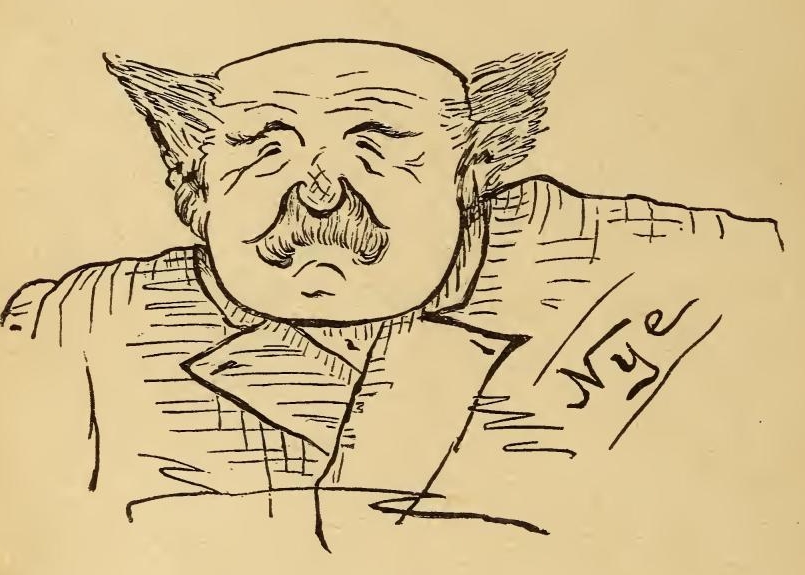
[Note.—In order to give the gentle reader an idea of Mr. Crosby's personal appearance, I have consented to draw a picture of him myself. It isn't very pretty, but it is horribly accurate. It is so life-like, that it seems as though I could almost detect his maroon-colored breath.—B. N]