Carolyn May’s heart was filled with trouble. She had, ere this, proved herself to be a deeply thoughtful child, and the grown people about her did not suspect how much she was disturbed by a new subject of thought.
This was the result of her first talk with the old sailor. Not from him, nor from anybody else, did Carolyn May get any direct information that the sailor had been aboard the Dunraven on her fatal voyage. But his story awoke in the child’s breast doubts and longings, uncertainties and desires that had lain dormant for many weeks.
“I do wish, Princey,” she told her mongrel friend, her single really close confidant, “that my papa and mamma were like the folks buried there behind the church,” and she sighed.
“I’d know just where they were, then. That part of ’em that’s dead, I mean. But now we don’t know much about it, do we?
“Being lost at sea is such a dreadful unsatisfactory way of having your folks dead.”
Uncle Joe and Aunty Rose loved her and were 189 kind to her. But that feeling of “emptiness” that had at first so troubled Carolyn May was returning. Kind as her new friends here at The Corners and at Sunrise Cove were, there was something lacking in the little girl’s life.
Nothing could make up to her for the jolly companionship of her father. Even while his health was declining, he had made all about him happier by his own cheerful spirit. And the little girl longed, more and more, for her mother. She had followed her father’s axiom to “look up” and had benefited by it; but, at last, her loneliness and homesickness had become, it seemed, too great to endure.
She began to droop. Keen-eyed Aunty Rose discovered this physical change very quickly.
“She’s just like a droopy chicken,” declared the good woman, “and, goodness knows, I have seen enough of them.”
So, as a stimulant and a preventive of “droopiness,” Aunty Rose prescribed boneset tea, “plenty of it.” Now, she loved Carolyn May very much, even if she could not bring herself to the point of showing her affection before others; but boneset tea is an awful dose!
Carolyn May took the prescribed quantity and shook all over. She could not bear the taste of bitter things, and this boneset, or thoroughwort, had the very bitterest taste she had ever encountered.
“Do—do you think it’s good for me, Aunty Rose?” she asked quaveringly. 190
“It certainly is, Carolyn May.”
“Well—but,” returned the little girl, “wouldn’t something else do me good—only, maybe, slower—that wasn’t so awfully bitter? I—I’m afraid I’ll never learn to like this boneset tea—not really, Aunty Rose.”
“We are not supposed to like medicine,” declared Aunty Rose, being a confirmed allopath.
“Oh, aren’t we?” the little girl cried. “I ’member being sick once—at home, with my mamma and papa—and a doctor came. A real nice doctor, with eyeglasses. And he gave me cunning little pills of different colours. I didn’t mind taking them; they were like candy.”
Aunty Rose shook her head decidedly and negatively.
“I do not believe in such remedies,” she said. “Medicine is like punishment—unless it hurts, of what use is it?”
Therefore three times a day Carolyn May was dosed with boneset tea. How long the child’s stomach would have endured under this treatment will never be known. Carolyn May got no better, that was sure; but one day something happened.
Winter had moved on in its usual frosty and snowy way. Carolyn May had kept up all her interests—after a fashion. She went to school, and she visited Miss Amanda, and her sailor man held her attention. But they were just surface interests. “Inside” she was all sick, and sorry, and prone to tears; and it 191 was not altogether the boneset tea that made her feel so unsettled, either.
Benjamin Hardy had gone to Adams’ camp to work. It seemed he could use a peavy, or canthook, pretty well, having done something besides sailing in his day. Tim, the hackman, worked at logging in the winter months, too. He usually went past the Stagg place with a team four times each day.
There was something Carolyn May wished to ask Benjamin Hardy, but she did not want anybody else to know what it was—not even Uncle Joe or Aunty Rose. Miss Amanda had gone across town to stay with a lady who was ill, so the little girl could not take her into her confidence, had she so wished.
Anyway, it was the seaman Carolyn May wished to talk with, and she laid her plans accordingly. Once in the fall and before the snow came she had ridden as far as Adams’ camp with Mr. Parlow. He had gone there for some hickory wood.
But, now, to ride on the empty sled going in and on top of the load of logs coming out of the forest, Carolyn May felt sure, would be much more exciting. She mentioned her desire to Uncle Joe on a Friday evening.
“Well, now, if it’s pleasant, I don’t see anything to forbid. Do you, Aunty Rose?” Mr. Stagg returned.
“I presume Tim will take the best of care of her,” the woman said. “Maybe getting out more in the air will make her look less peaked, Joseph Stagg.” 192
The hardware dealer stared at his little niece with knitted brow.
“Does she look peaked, Aunty Rose?” he asked anxiously.
“She doesn’t look as robust as I could wish.”
“Say! she isn’t sick, is she? You don’t feel bad, do you, Car’lyn May?”
“Oh, no, Uncle Joe,” the child hastened to say, remembering vividly the boneset tea. “I’m quite sure I’m not ill.”
The excitement of preparing to go to the camp the next morning brought the roses into Carolyn May’s cheeks and made her eyes sparkle. When Tim, the hackman, went into town with his first load he was forewarned by Aunty Rose that he would have company going back.
“Pitcher of George Washington!” exclaimed Tim. “The boys will near ’bout take a holiday. You tell her to put on her red hood and a blue hair-ribbon, and she’ll be as purty as a posy to go a-visiting.”
“Never mind what she wears, Timothy,” said Aunty Rose sternly. “You see that she gets back here safely.”
“Surest thing you know, Miz Kennedy,” agreed the man.
Carolyn May—and, of course, Prince—were ready when Tim came back with the empty sled, or “jumper,” as he called it. He had thrown a number of sacks upon it, on which she might sit, and they 193 started off briskly. The bells on the horses’ collars jingled a merry tune.
Prince bounded about the sled in wild delight, barking madly. Such an adventure as this was quite to his liking.
“I vow!” croaked Timothy, “I’ve often thought I’d like to be a dog—some men’s dog, I mean. They ain’t got nothin’ to trouble ’em—’nless it’s a few fleas. And maybe they ain’t such a heavy cross and burden. They give the dog good healthy exercise a-scratchin’ of ’em.
“Now, look at that Prince critter, will you? He’s all of a broad grin—happy as a clam at high water. He don’t hafter worry about rent, or clo’es, or how to meet the next payment on the pianner. He sure is in an easy state of mind.”
“Yes,” Carolyn May agreed, “I think Prince is a very cheerful dog. Why, he almost laughs sometimes!”
“I reckon he does,” agreed Tim. “Only, dumb critters don’t never really laff.”
“Oh, yes, they do!” cried Carolyn May, eager to give information when she could. “Anyhow, some animals do.”
“Pitcher of George Washington!” ejaculated the man. “What animals, I’d be proud ter know?”
“Why, there were some of them at the Zoo. That’s ’way up in the Bronx, you know.”
“What’s the Brow-n-x?” interrupted Tim as they jounced along. 194
“Why—why, it’s a park. Bigger’n Central Park, you know—oh! ever so much bigger. And they have lots of animals—wild animals.”
“Not loose?” cried her listener.
“Oh, no. That is, not all of them. Some are in big fields, or yards; but there are fences up.”
“Yep, I sh’d hope so,” returned Tim. “And, if I was goin’ to visit ’em, I sh’d want them fences to be horse high, hog tight, and bull strong. I sure would!”
“Well, but the laughing hyenas are in cages,” explained Carolyn May.
“Do tell! An’ do they laff? They must be good-natured critters, after all, them—what d’ye call ’em—laffin’ hannahs?”
“Hy-e-nas,” repeated Carolyn May carefully. “They look something like dogs—only they aren’t. And they look something like zebras—only they aren’t. And when they do laugh, Mr. Tim, it just makes the cold chills run up and down your back. Oh, they are dreadful ugly beasts! So laughing don’t always make things good-natured, does it?”
“Pitcher of George Washington!” murmured Tim, the hackman, staring at her wide-eyed. “What a ’magination that young one’s got!”
But the little girl did not hear this comment, else she would have been unhappy.
They jogged along very comfortably, reaching the camp a little before noon. Adams’ camp was the largest lumber camp near Sunrise Cove; but it 195 was a raw-looking place—nothing but a clump of sheet-iron sheds and log huts.
The snow on the roofs, and the fact that the drifts hid many unsightly things, made the place seem less crude than it really was. Still, Carolyn May was doubtful as to whether or not she would like to live there.
There was but one woman in the camp, Judy Mason. She lived in one of the log huts with her husband. He was a sawyer, and Judy did the men’s washing.
Benjamin Hardy was pleased, indeed, to see his little friend again. She sought him out as soon as the engineer blew the whistle for the noon rest, and they went into the bunk-house together, where more than forty men gathered around the long table for dinner.
There was no tablecloth, and the food was served in basins, and they ate off tin pie plates, and drank out of tin mugs. But the men were a jolly crowd, and the dinner hour was enlivened by jokes and good-natured foolery.
Carolyn May appreciated their attempts to amuse her, but she clung close to Benjamin, for she had a question in her mind that only he, she thought, could answer.
“You come with me, please,” she whispered to the old seaman after dinner. “You can smoke. You haven’t got to go back to work yet, and Tim is only just loading his sled. So we can talk.” 196
“Aye, aye, little miss. What’ll we talk about?” queried Benjamin cautiously, for he remembered that he was to be very circumspect in his conversation with her.
“I want you to tell me something, Benjamin,” she said.
“Sail ahead, matey,” he responded with apparent heartiness, filling his pipe meanwhile.
“Why, Benjamin—you must know, you know, for you’ve been to sea so much—Benjamin, I want to know if it hurts much to be drownd-ed?”
“Hurts much?” gasped the old seaman.
“Yes, sir. Do people that get drownd-ed feel much pain? Is it a sufferin’ way to die? I want to know, Benjamin, ’cause my papa and mamma died that way,” continued the child, choking a little. “It does seem as though I’d just got to know.”
“Aye, aye,” muttered the man. “I see. An’ I kin tell ye, Car’lyn May, as clos’t as anybody kin. I’ve been so near drownin’ myself that they thought I was dead when I was hauled inboard.
“That was when I sailed in the old Paducah, a cotton boat, from N’Orleans to Liverpool. That was long ’fore I got to runnin’ on the Cross and Crescent Line boats, ’cause steamships is easier to work on than sailin’ vessels.
“Well, now, listen. We used to carry almighty cargoes—yes’m. Decks loaded till we could scarce handle sail. She was down to the mark, and then some. An’ if it come on to blow, we was all in danger of our lives. Owners cared more for freight money than they did for the lives of her crew.”
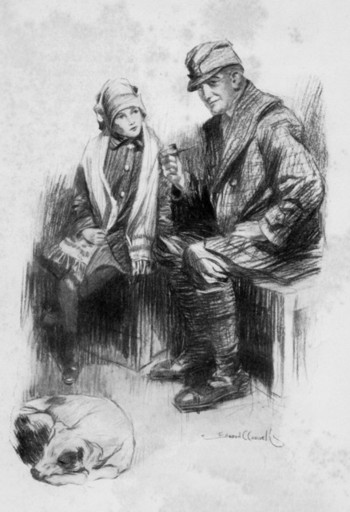
“Do people that get drownd-ed feel much pain?”
“Oh! How very wicked!” exclaimed Carolyn May, her mind led somewhat away from the gruesome question she had propounded to Benjamin.
“’Twas that, indeed,” agreed the sailor, puffing on his pipe. “The old Paducah sometimes rolled through the wash like she was top-heavy. And if the swell got too strong for her we had to jettison the top tiers of cotton bales—pitch ’em overboard, you see.”
“Oh!”
“An’ one day, when the old craft was rollin’ till her yards nigh touched the sea, I was loosin’ the upper tier of bales and slidin’ ’em overboard, when over I went with one of ’em.”
“Oh, Benjamin! Never!”
“Aye, aye, matey. That’s what I done,” said the old man, sucking away on his pipe. “There was me in the sea, hangin’ on to a balehook that was stuck in the cotton. The old Paducah rushed by me, it seemed, like an express train past a cripple.”
“But you weren’t drownd-ed!” exclaimed Carolyn May.
“No-o. But I was near it—mighty near it. They seen me go, an’ I heard the cry, ‘Man overboard!’ when I come up after my first plunge. I knowed they’d wear ship and send a boat after me. So, first off, I thought I’d hang to the balehook and be all right. 198
“But I got ’nough o’ that soon—yes’m! The waves was monster tall. One seized me and the bale o’ cotton, an’ we shot right up to the crest of it. Then I found myself fallin’ down on ’tother side, an’ that cotton bale tumblin’ after me. I had to get out o’ the way of that bale in a hurry, or it might have swiped me a blow that I’d never come up from. An’ I wasn’t much of a swimmer.”
The little girl’s eyes were round with interest and her lips were parted. She drank in every word the old sailor uttered.
“Well, there I was, little miss,” he said, still puffing on his pipe. “There was sev’ral of them cotton bales had been slid overboard about the same time, an’ I found myself a-dodgin’ of ’em. Fust one, then another, come after me—it seemed as if they was determined to git me.
“When I warn’t lookin’ for it, the end of one bale clumped me right in the back. I went down that time, I thought, for keeps.
“Down and down I went, till all I could see above me was green water streaked with white. I couldn’t git my breath; but otherwise, mind ye, I wasn’t in much trouble. I jest floated there, and I didn’t much care to come up. I didn’t care for anything.
“Lots o’ things I’d done, good an’ bad, chased through my head,” went on Benjamin. “I remembered folks I hadn’t thought of for years. My mother and father come to me—jest as plain! An’ them dead for a long time.” 199
“Oh! did you see ghosts?” Carolyn May exclaimed.
“Not to frighten me,” the sailor assured her. “It was jest as though I was sittin’ in a rockin’-chair, half asleep, an’ these dreams come to me. I warn’t in any pain. It was a lot worse when the boys reached me in the boat an’ hauled me inboard.
“Then,” said the old man with vigour, “it cost me something. Comin’ back from drowning is a whole lot worse than bein’ drowned. You take it from me.”
“Well,” sighed Carolyn May, “I’m glad to know that. It’s bothered me a good deal. If my mamma and papa had to be dead, maybe that was the nicest way for them to go.
“Only—only,” confessed the little girl, “I’d feel so much better if they’d been brought back and we could have buried them behind the church, like Aunty Rose’s babies and her spouse. And—and I’d feel better yet if they weren’t dead at all!”