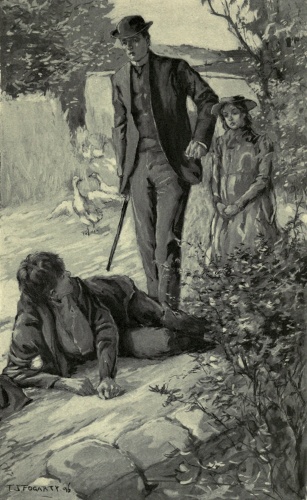
The young minister put out his hand to Vara and the two walked quietly back to where Boy Hugh was kneeling on the grass, and baby Gavin was sitting grasping a dandelion with one hand and looking with wide deep-set eyes of philosophic calm upon the world.
"Tell me all about it," said her champion. And Vara told the tale with her heart again beginning to beat with terror. "But how is it that you are here?" said he. And Vara explained as much as she could.
"To look for your father in Liverpool?" he said. "It is a long, sad way—a terrible journey." He mused.
He had a passion for setting things right, this young fellow, and it occurred to him that it would be a good thing if he could get these children into a home of some kind, and then communicate with the police on the subject of their father.
But as soon as the young man began to speak in his low, persuasive tones of a home where they could be safe and quiet, Vara stood up.
[208]
"O no, sir, I thank you, but we can not bide. Somebody might come and find us."
At the mere thought she began to tremble and hastily to put her scattered belongings together. The young minister made no further objection. He walked with them a little along the way, and before he parted from them he put another shilling into Vara's hand. Then he leaped over the stone dyke on his way to a farmhouse where there was a sick man waiting for him. From the other side of the fence he told Vara shyly to remember that she had another Father to care for her, who could always be found. But he was shy about saying so much, this remarkable young man. However, he had a high sense of duty, and he felt that the circumstances justified the observation.
"Thank ye," said Vara; "I'll no forget."
This, their second day, had become one of brooding heat, and Vara was glad to have enough to buy a good meal for them all at the next little town they passed through. They were fortunate also in the afternoon, for at a little house by the wayside, a cottage with red creepers growing all along the wall, the mistress took them all in and gave them a cup of tea and some of the fresh white scones she was baking. There was milk too for little Gavin. And as they went away a thought seemed to strike the woman. She bade them wait a little while. She climbed up into the attic, and presently returned with a shawl, which she wrapped about Vara, and settled the baby into the nook of it with her own hands.
"But this is a good shawl. We must not take it from you," said Vara.
"Nonsense," said the good woman; "it is a fair exchange. Leave me the auld ane; it will make very decent floor-clouts."
 "Out with it!" said the minister.
[209]
So it was on the whole a good day for them. And it was not till late in the evening that misfortune again befell them. Vara's hands were usually so full of Gavin that she had little thought for anything else. But at one resting place she put her hand into her pocket and her heart stood still because she failed to find the slim coins upon which she had put her trust. She felt the pennies, but not the shilling or the sixpence. She laid Gavin down on the grass and turned the pocket inside out. There was nothing whatever there. But Vara found instead a little slit in the lining, and the thought of her great loss, together with what it meant to them all, turned her faint and sick.
"The man might just as well have had them, after all," she said.
Night fell with them still upon the road. They had found no friendly shelter, and they seemed to be alone on the wide moor, through which the road ran unfenced, like a tangle of string which has been loosely thrown down. Hugh Boy cried bitterly to be allowed to lie down. Vara looked about her anxiously and long. But she could see nothing but the wild moorish hilltops girdling the horizon, too like one another to give her any idea of the direction in which a habited house might lie. She only saw the slow twilight of midsummer in the north creeping down over the brown moors, and in the moist hollows of the bogs shallow pools of mist gathering.
For the distance, the sound of a voice was borne in the still air.
"Hurley, hurley, hie away hame!" it said. And Vara went to the top of a heathery knowe and called loudly. But only the moorbirds, making ready for bed, answered her. They flew round, circling and complaining, especially [210]the peewits, which, being reassured by the small size of the three, came almost offensively near.
Boy Hugh filled his pockets with stones to drive them away. He also got out his whip. He had heard of the Babes in the Wood, and, being a sensible boy, he did not want any Robin Redbreast nonsense. It was not that he so much objected to die, but he felt the humiliation of being covered with leaves by the whaups. He complained bitterly to Vara, who was preoccupied with Gavin, that the Drabble had stolen from him the iron barrel of the pistol which Cleg Kelly had given him. Had it not been for that felony, they would not now have found themselves defenceless in that wild place.
"Boy Hugh thinks there's sure to be lions an' teegers here!" he said.
It was not long before Vara decided that they must spend another night out of doors, and looked about for a suitable spot where they could get water and shelter.
At last she settled upon the lee of a large boulder, and began to give Gavin what remained of his milk. Boy Hugh thought this was his opportunity to make sure that they were well defended against their enemies. The moon was rising, and he remembered that Cleg Kelly had told him how lions and tigers always hunted by moonlight. That widely-read journal, "The Bully Boys of New York," was Cleg's authority for this statement.
There was certainly an appalling silence on the face of the moorland. Boy Hugh could see, indeed, the rock behind which Vara and Gavin were. But he tried to forget it. He wanted the sensation of perfect loneliness. Then the devil entered into Boy Hugh, and he wanted to explore. The moon came out from behind a cloud, and everything became bleached and flat, melting away into vague immensities and nerve-shaking mysteries which [211]vanished as you approached. Of course that was not the way Boy Hugh put it to himself. It only made him want to run away. But suddenly a vague fear struck him to the heart, and he started to run back (as he thought) towards Vara and Gavin. He imagined that he could hear the sound of some animal trampling about the moss in search of wandering little boys. And it occurred to him that he had no means of defence except the whip, and even that served him not so well now, for the lash was broken. So this was the reason why Boy Hugh ran away.
Though, indeed, his progress could hardly be called running. For at every few steps he tripped in some intricate twist of heather, tough as wire, and, falling forward, he instinctively bent his body into a half-hoop, like a young hedgehog. Thus he rolled down the brae, often coming upon his feet at the bottom and continuing his flight with energy unabated and without pausing a single moment even to ascertain damages.
And so soon as she missed him Vara stood up, with Gavin in her arms, and cried, "Come back, Boy Hugh!" But Boy Hugh continued his wild flight, driven by the unreasoning terror of the vast and uncomprehended which had seized him suddenly and without warning.
At last Boy Hugh paused, not so much because he wished it as because he had fallen into a moss-hole up to the neck, and so could run no further. He sustained himself by grasping a bush of blaeberry plants, and he dug his toes into the soft black peat.
Then Boy Hugh, who had not gone to Hunker Court for nothing, bethought him that, since there was nothing else that he could do, it was time to say his prayers. "O Lord!" he prayed—"O Lord, forgive us our sins, and remember not our trans-somethings against us! Look [212]down from heaven and help"—(so far his supplications had run in the accustomed groove in which Samson Langpenny conducted the "opening exercises" of Hunker Court, but at this point Boy Hugh diverged into originality, as Samson did sometimes when he stuck in the middle of the Lord's prayer)—"Look down from heaven and help—a—wee laddie in a moss-hole. Keep him frae teegers and lions, and bogles and black horses that come oot o' lochs and eat ye up, and frae the green monkeys that hing on to trees and claw ye as ye gang by. And gie me something to eat, and Vara and Gavin after me. For I'm near dead o' hunger, and I want nae mair yesterday's bread, and help me to find my whup-lash. And make me grow up into a man fast, for I want to do as I like—and then, my certes, but I'll warm the Drabble for stealin' my pistol. And bless Vara and Gavin, my faither and Cleg Kelly, and a' inquirin' freends. Amen."
And if anybody knows a more comprehensive prayer, let him instantly declare it, or, as the charge runs, be for ever silent.