While the General was explaining all these things, he was at the same time deftly handling the gridiron upon which he was cooking the four red herrings which he had laid out. These, with bread and the aforesaid best specially imported Danish butter, dug out of the keg with a scoop, furnished their simple meal. General Theophilus made tea in a black kettle, by the simple process of putting in a soup ladle filled with tea and allowing the water in the kettle to come to the boil.
"The tea is of the best quality," he said, "though I am somewhat prodigal of it, as you see. But a man must have some luxuries."
Yet all the time, while Cleg was partaking of the herrings, cutting the bread, and drinking the tea, he was oppressed by the dark overwhelming bulk of the house [319]behind him, through which he had been led. He instinctively felt it to be full of secrets, of unknown echoing passages, doors that clicked and sprung, and of all untold and unutterable mysteries.
All through their dinner time the General was most courteously polite, handing the salt and helping the herrings with infinite address. And when Cleg in his ignorance or his awkwardness committed a solecism, the General only in the slightest degree emphasised the correctness of his own demeanour, so that Cleg, if he chose, might benefit by the lesson in deportment. Not that Cleg needed many, for had he not often taken tea with Miss Celie Tennant, which in itself was a charmingly liberal education?
When the meal was finished, Theophilus Ruff took Cleg into a little room adjoining. Here there was a fixed wash-tub and a tiny boiler.
"I do my own washing, you see. Cleanliness is most important!" the General explained. "I learned the art while campaigning in Afghanistan. For the present, therefore, I shall continue to do the washing, though I shall be glad of your assistance in the matter of drying and ironing!"
Cleg could hardly credit his ears—a General and the owner of all this wealth, talking freely of doing his own washing. Cleg looked at the beautiful linen sheets on the bed and marvelled still more. Then he remembered what Theophilus had said about the presence of women.
"This is your bedroom," said the General, opening a still smaller room, which contained nothing but a wash-stand and a small "scissors" camp-bed. Upon a nail behind the doors hung a couple of suits of clothes.
"These are yours," explained the General; "this room is also yours. I shall not again enter it. I beg of you, [320]therefore, that when you have been visiting your friend the widow you will wear one of these suits, either as it pleases you. But when you come into the rooms which I share with you, or undertake any of the duties connected with your position, you will take the trouble to change into the other."
Cleg touched the nearer suit of clothes gently with his hand. It was of fine texture, though of a fashion somewhat antique, with wide lapels to the coat and the vest very long. The General opened a drawer.
"Here," he said, "you will find collars, shirts, and stockings which, though a little large for you, are such as you will rapidly grow into. Consider them as your own. Assure yourself completely that the owner of these has no further need for them."
Cleg thanked his benefactor frankly, but without subservience or profusion.
"Now," said the General, turning rapidly upon Cleg, "I should like to come to financial terms with you. I am willing to give you one pound sterling or twenty shillings a week and your food. At the present rate of the rupee in India, from which much of my income is derived, I am not desirous of making it more. But in the event of any decided appreciation in the price of silver, I should be willing to consider your claims to a supplement."
"It's far ower muckle as it is," cried honest Cleg. "Man, I wad be glad o' the half o't!"
The General waved his hand.
"My dear sir," he said, "you are as yet unaware of the intensely peculiar services which your position here will require of you. You may have to see strange things sometimes, and to learn to say nothing. I desire, therefore, to remunerate you suitably in advance. What I shall reveal to you is perfectly harmless, as I shall show you. [321]But still I am aware that there is a not unnatural prejudice against such experiences, especially among the young. We will call it, therefore, for the present a pound a week."
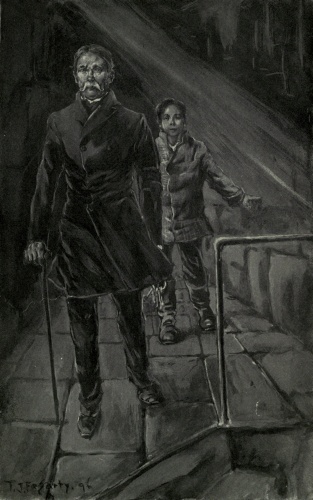 Along gloomy passages.
Cleg nodded. He was willing to sleep in a vault amongst skulls and crossbones, with a reliable up-to-time ghost thrown in, for a pound a week.
"I will now show you my own bedroom," he said.
The General opened the locks of the doors leading into the house with the same precise caution, and with some additional secrecy as well. But even in this the General behaved with a gentlemanly reticence.
"You will observe," he said, "that I do not for the present make you free of the passwords of the fortress. That in time will doubtless come; but in the meantime you will consider me as the governor of the castle, with discipline to maintain and my own secrets to keep.
"Your nerves are strong, I trust?" he added, as they passed along gloomy passages through which the winds blew gustily as in some cave of the winds.
"I'm no feared, gin that's what ye mean. I dinna ken aught aboot nerves," said Cleg.
The General led him sideways down a flight of steps like one that goes stealthily into a cellar.
They stopped before a door of massive iron painted red as a ship is before she is launched, and with the boltheads neatly picked out in white.
"You observe," said the General, "this door is entirely of my own construction—aided, that is, by the most skilled smiths and mechanicians. You notice that the rock upon which the house is built is above our heads, and also that the door is really excavated in the stone itself. The iron frame upon which the door closes is mortised so deeply and completely into the solid rock all round, that to all intents and purposes it is practically one piece with it."
[322]
The General pointed upwards to where a pale yellow gleam on the wall showed through a range of open and glassless but triply barred windows.
"That," he said, "is Cheiranthus Cheiri, the common, yellow, or wild wallflower—of a different species from that of the garden and, in my opinion, a much finer plant. It is growing up there on the natural rock. So that I sleep, as sayeth the Scripture, 'within the living stone'!"
Cleg looked at the General. His eyes seemed to grow darker, his figure became more erect. He continued every few minutes to refer to his watch.
"This lock," he said, patting the keyhole, "is a highly ingenious union of a time-lock and the commoner letter combination lock. This morning I set the wards to open at two in the afternoon. So that it is now almost the time when we shall be able by the application of the key-word to open the door."
He waited till the hands of the watch were opposite the hour.
"Now!" he said, and stepped forward with some show of eagerness.
The son of the burglar looked on with an interest which was almost painful.
The General twirled the lock till he had brought five letters into line upon the dial. Then he inserted a little key which hung at his watch-chain. The massive red iron door, with its white-studded nails, swung back softly of its own accord.
"A simple application of the principle of the water balance," he said, "thus—I open the lock, the water runs out and the door opens. In another five minutes the small cistern will fill of its own accord, and its weight will automatically close the door."
Cleg hung back. He was not afraid, as he had said. [323]But it seemed an uncanny place to be shut up in with only a madman for company. For Cleg had no doubt whatever that the General was out of his mind.
General Theophilus Ruff noticed his hesitancy.
"Do not be afraid. I have the combinations all in the inside of my watch scales, so that even if I were suddenly to die here, you would still be able to make your way out."
The two stepped within, Cleg being ashamed to show any further feelings of reluctance to trust his benefactor.
The General touched a match to a large lamp which stood on a pedestal. The whole room, which had been pitchy dark a moment before, seemed now fairly bursting with light.
"My bedroom!" said the General, circling the place with his hand, with the air of one who makes an important introduction.
The walls were of red-painted iron throughout, the red of farm carts in the district, and the bolts were again picked out with white. But the furniture was the strange thing. There was nothing whatever in the room save three coffins, each arranged squarely upon its own table.
The lids of the two at either side were hinged and closed. The centre one stood open. The coffins were not large or fine ones, but, on the contrary, common and covered with black cloth. The lid of the centre one was off, and stood leaning against the wall at the coffin head. Cleg could easily read the inscription, which was in white letters upon a black painted plate:—
MAJOR-GENERAL THEOPHILUS RUFF,
E.I.C. BENGAL ARMY.
BORN JULY 21st, 18—.
DECEIVED JULY 21st, 18—.
UNDECEIVED JULY 21st, 18—.
DIED JULY 21st, 18—.
[324]
"It is not long now," he said, pointing to the latter date. "I have not added the year, you observe. But it was revealed that all my days of fate should culminate on the 21st of July. And so hitherto they have. I do not think I shall see more than other four."
Then a new thought seemed to strike him. He turned to Cleg Kelly sharply.
"Note the lettering on the coffins," he said; "I did it all with an ordinary sharpened knitting needle. I bought a plain black tin plate from the carpenter of the village, and he showed me how the paint scrapes off. It is quite easy. But I have done it much more neatly than could the carpenter himself. I have since attended quite a number of male funerals in order to observe the quality of the lettering upon the coffin. I do assure you it is, in general, disgracefully slipshod. The man does not appear to take the least pains to improve. I have even thought of offering to do the job for him."
Cleg was continuing to look about him, when a sudden noise behind him caused him to leap to the side. The great red iron door had swung to with a little well-oiled click.
The General smiled indulgently and reassuringly.
"It is only the water balance I told you of. It is now full; the little wet-bob rises to the top, and the door swings to of its own accord."
Cleg continued to look about him. The room was about thirty feet square and half as high. But there was no bedstead or any other furniture to be seen.
The General noticed his perplexity.
"I observe," he said, smiling, "that you are looking for my bed. Here it is," laying his hand on the central coffin. "Oblige me with your hand. I usually depend upon a stick, but your shoulder is better."
[325]
The General balanced himself for a moment upon the edge of the coffin, and let his head drop back upon the little white pad. Then he arranged his shoulders into the fiddle-shaped swell, and deftly drew in his feet after him.
"Now," he said, "damp the herbs in that pipe. Light a ribbon of the prepared paper at the lamp, and put it in the bowl to smoulder."
Cleg hastened to obey. It was a large-headed East Indian pipe with a flexible handle, and mouthpiece of fine pale amber.
"You observe," said the General, as he calmly and carefully adjusted his pipe-stem over the edge of the coffin, "I do not use ordinary tobacco, but a mixture of Indian hemp and Datura stramonium, or thornapple, a common dunghill plant. With ordinary people the smoking of these would produce madness; but in my case they produce only a peculiar exaltation, and then a kind of ethereal coma, without at all being followed by the evil effects of opium."
He beckoned Cleg to come nearer. Cleg did so, and took up his position at the foot of the coffin with some reluctance.
"Now," he said, "I am about to take my siesta. Do you set the time arrangement by carefully turning the hands of the small clock to seven—the lower dial, if you please. Thank you. Now bring the letters of the word FALSE to the face of the lock attachment, and you will be able to open it by the use of this duplicate key. The same word will (for this day only) enable you to open the outer door—from the inside, that is, not again from the outside. The pass-word is changed every day. I always write it on a paper inside my watch every morning."
As Cleg was leaving the room the face and neck of the General were suddenly jerked up, so that he rose almost [326]to a sitting position. Cleg's muscles twitched, and with a sharp cry he leaped into the air.
The General waved the hand which was not employed in managing the pipe-stem, upon which his eyes were steadily fixed.
"I beg your pardon most heartily," he said, "I should have warned you of this. The fact is, I have an automatic attachment, which I have applied beneath the pillow, by which at certain intervals my head is raised. For, though so remarkably spare of person, I have several times in the East been threatened with apoplexy; and, indeed, I suffer constantly from asthma, for which I find the Datura stramonium most useful."
And as Cleg whirled the combination circles in imitation of the General, he prayed that he might never again have to enter that ghastly chamber. Yet it was his fortune to abide with the General four years as his body servant, and to enter the strong-room of Barnbogle nearly every day.