Fate produced a man who had chickens to sell
ith June the Pride and the Hope came home from school. The brook, the barn, Old Beek, and Mis' Cow all had their uses then—also a tent in the yard, a swing, hammock and whatnot. When God made the country He made it especially for children. Burning suns, a weedy garden and potato blight may dismay the old, but such things do not fret the young mind. As long as the brook is cool and the fields are sweet and there is fresh milk and[Pg 215] succotash on the table, happy childhood is indifferent to care.
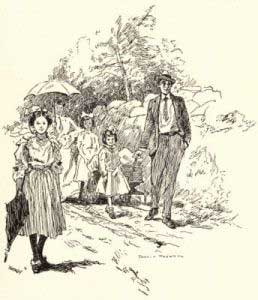
We were given to picnics. Often we packed some food things into a basket and went into the woods and spread them in a shady place. Lena, the Finn, sometimes accompanied these excursions and went quite mad with the delight of them, racing about and digging up flowers and shrubs to plant in the door-yard, fairly whooping it up in joyful Finnish and such English words as[Pg 216] she had acquired. I believe the aspect of our woods reminded her of Finland.
Lena was a good soul, that is certain, and measurably instructive. We learned from her how priceless is the gift of good nature, which was the chief thing that kept her with us; also, to eat a number of dishes quite new to us, and that an apple-tree—or perhaps it was an apple, baked or in dumpling—was, in her speech, an "ominy poo." She was not strong on desserts, but she could always fall back on the ominy poo—meaning in a general way the big sweet-apple tree that grew by the barn and was loaded to the breaking-point with delicious fruit. Any baked apple is good, but a big, cold, baked sweet-apple—"punkin sweets," Westbury called them—with cold cream, plenty of it, and a sprinkle of sugar, is about the most blithesome thing in the world. Hurrah for the ominy poo! whether it be the tree, or the fruit, baked or in dumplings. When the strawberry passed and was not, the ominy poo reigned gloriously. I don't know what Lena called certain other dishes that from time to time[Pg 217] she tried to substitute—some other kind of poo, maybe—I know we gradually persuaded her away from them into a better way of life.
Sometimes we joined our picnics with the Westburys'—loaded our baskets into a little hand-express wagon, or into the surrey behind Lord Beaconsfield—and these were quite elaborate affairs that required a good deal of preparation and meant a general holiday. More than once we spread long tables on the green of Westbury's shaded lawn that sloped down to the river and the mill, and was a picture-place, if ever there was one. Other days we went over the hills for huckleberries—and came home with pails of the best fruit that grows for pies, bar none. Happy days—days of peace—a true golden age, as it seems now. Will the world, I wonder, ever be so happy and golden again?
We had no intention of embarking in chickens when we settled in Brook Ridge. Neither of us had any love for chickens on foot, and we had no illusions about the[Pg 218] fortunes that, according to certain books, could be made from a setting of eggs and a tin hen—an incubator, I mean. Also, our experiment with pigs had cooled us in the matter of live stock for profit.
Still, we did love chickens in their proper place—that is to say, with dumplings or dressing and some of the nice jellies and things which Elizabeth had made during those autumn months of our arrival. It seemed extravagant to have them often; chickens had become chickens since our long-ago early acquaintance with them, when "two bits" had been a fancy price for broilers and old hens. Elizabeth finally conceded that perhaps a few chickens—a very few, kept in a neat inclosure away from the garden—might be desirable. It would be so handy to have one when we wanted it. She even hinted that the sound of a satisfied and reflective hen singing about the barn would add a rural note to our pastoral harmony. Then, of course, there would be the eggs.
Fate produced a man, just at that moment, who had chickens to sell. He had[Pg 219] been called away, and would let his flock go cheap—he had about a dozen, he thought, assorted as to age and condition. We could have them for fifty cents each. It seemed an opportunity. William Deegan was instructed to prepare the neat inclosure, which he did with enthusiasm, William being enamoured of anything that was alive.
The man who had been called away had made a poor count of his flock. He arrived with nearly twice as many as he said, but we were in the mood by that time, and took over the bunch. They were not a very inspiring lot. They were of no special breed, but just chickens—a long-legged, roostery set, with a mixture of frazzled hens of years and experience. We said, however, that food and care would improve them. Remember what it had done for Mis' Cow.
"Ye'll be after eatin' thim roosters, prisently," William commented, as we looked at them through the inclosing wire, "before they be gettin' much older. Ye'll be wantin' eggs from the hins."
William's remark seemed wise. We were[Pg 220] wanting the eggs, all right, and those ten or twelve speedy-looking roosters ought to go to the platter without much delay. We would feed liberally and begin on the best ones, forthwith.
Still, we did not have chicken that day, nor the next. There is nothing so perverse as the human appetite. Those were not really bad chickens, and in a few days they were much better. If any one of those middle-aged roosters had been brought to us by the butcher we would have paid the usual dollar for it, and, baked and browned and served with fixings, it would have gone well enough, even though a trifle muscular and somewhat resilient.
But somehow this was a different proposition. I don't believe I can explain just why. There was something about the aggregation as a whole that was discouraging. I suspect William's remark that they must be eaten "prisently" had something to do with it. Eating those chickens was not to be an entertainment, a pastime, but a job—a job that increased, for the "old hins" did not lay, or very sparingly—an[Pg 221] egg a day being about the average. William brought it in solemnly. We had got to devour that entire flock of chickens, and the thought became daily less attractive. Even our tribe of precious ones, who had always been chicken-hungry before, suddenly became indifferent to the idea of chicken fried, baked, or in fricassee. I said, at last, we would have to have a series of picnics. Anything would taste good at a picnic.
I don't remember how many we used up in that way, but I know the business of getting rid of those chickens seemed interminable. We tried working them off on William and Lena, but even they balked before the end was reached. I have heard it stated that no one can eat thirty quails in thirty days. I don't know about that, but I know that when we tried to put over a dozen chickens on Lena and William in six weeks it was a failure. At last we were reduced to one old hen, who by general consent was made immune. Also free. The garden was too far advanced for her to damage it. The door of the neat wire[Pg 222] inclosure was left open for her to go and come at will. There was danger of foxes at night, but we did not shut it. The foxes, however, did not come. Even foxes have to draw the line somewhere. That venerable old lady wandered about the place, pecking and contentedly singing, and in that part we really became fond of her. I think she died at last of old age.