"Flora, my love, has anything occurred to distress you?" said the baronet, as he entered the breakfast room one morning in his embroidered dressing-gown and slippers, with the newspaper in his hand.
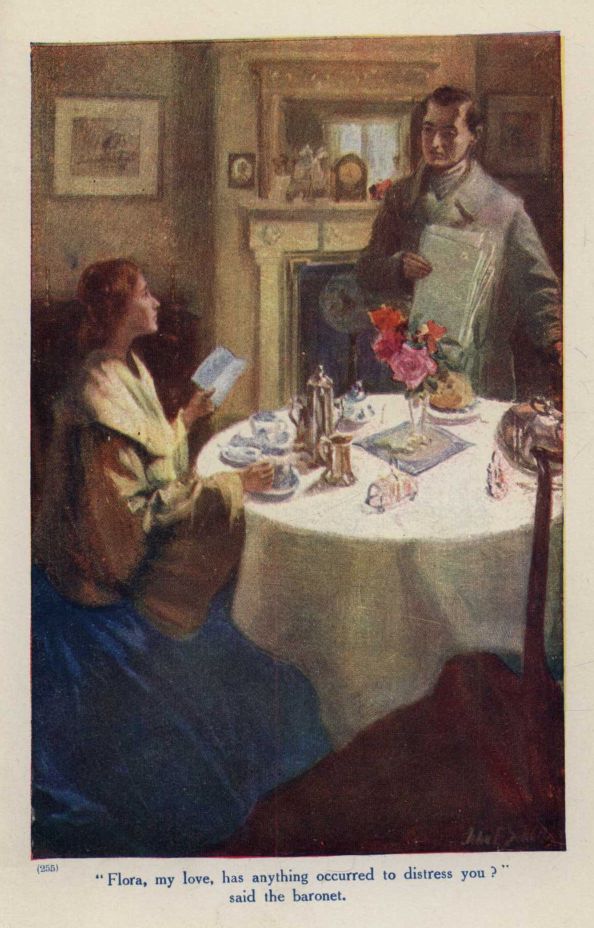 "Flora, my love, has anything occurred to distress you?" said the baronet.
Flora looked anxious and unhappy, her eye rested upon an open letter which she had received by the early post.
"I have heard from Mr. Ward, dearest," she replied; "he gives me tidings which have made me very uneasy. Scarlet fever, of a malignant kind, has been raging lately in Wingsdale, and I grieve to say that two of my brother's children are ill with it now, and it is feared that the baby is sickening."
The baronet coughed slightly, stirred the fire, and sat down to sip his chocolate.
"My poor mother!" faltered Flora; "Mr. Ward writes that she is far from strong; the nursing will be so heavy upon her."
"Have not the children a mother?" said Sir Amery, abruptly.
"Emma has taken such alarm at the idea of infection, that she has actually hurried away, and engaged a room at a hotel in a town about ten miles distant from Wingsdale!"
The baronet elevated his handsome brows with an expression of contempt.
"I fear," continued Flora, with emotion, "that the anxiety and fatigue will quite break down the health of my mother. She will watch the children day and night, as she watched me in my fever." The voice of the daughter trembled as she added, "Oh, Amery! she needs me to help her; dearest, will you not spare me to her now?
"You!" exclaimed her husband in a loud tone of surprise, pushing back his chair from the table; "what could have put such an insane thought into your mind? Do you think that I would suffer you to go into the midst of infection--to take the place of an unfeeling woman--to act as nurse to a set of mulattoes--to risk your precious life for those whom their own mother has deserted?"
"My mother will never desert them," said Flora; "it is to assist her--"
"We will send a nurse down from London to assist her; let that set your mind at rest," replied Sir Amery. Then he added, as his stern features relaxed into a smile, "It is easier to find an efficient substitute for you, Flora, in the sick-room at Laurel Bank, than at Lady Montague's soirée to-night."
"The ball!--oh!" exclaimed Flora, leaning back on her chair, "I have not the heart to go to it!"
"No heart is required," said the baronet, laughing; "we do not look for such commodities at balls."
Flora was ever submissive and obedient to her husband. She saw that it was his will that she should accompany him to the party, and she went, though with a joyless spirit. Decked out in jewels and costly array, and leaning on the arm of him who attracted every eye, the fair young wife might have appeared an object of envy to the proudest dame in the glittering throng. But there was a fount of sadness in her bosom, which mingled with and imbittered every pleasure. The music had to her a mournful tone; the gay dancers flitted before her like images in a dream; she felt it hard to wear a smile on the lips when the heart was depressed with care. Flora was glad to choose a quiet corner for herself, where it would be unnecessary to enter into conversation, where she might remain unnoticed and unknown.
She was seated beside some ladies who were strangers to her, and Sir Amery conversing with friends of his own in another apartment, Flora felt herself alone in a crowd, solitary in the midst of society. Her thoughts wandered back to her mother's home--she was treading, in fancy, well-known paths, seeing long absent faces, listening to the sound of the church bells which had once made sweet music to her ear; and, absorbed in her own recollections, had been at first inattentive to the conversation of the ladies beside her, till her ear was caught by the sound of the name which was to her dear beyond all others.
"And that is Sir Amery!" exclaimed one, leaning forward to catch a glimpse of him through the open folding-doors; "what a princely form! what a noble countenance! He looks like the statue of an old Greek demigod warmed into life!"
The wife felt a glow of pleasure at the words, and turned with interest towards the speaker.
"Did you not say that he was married?" said the companion of the lady who had spoken.
"Oh, yes; he married some time ago; made quite a mistake, if report be true--the usual fate of geniuses; he threw himself away on some insipid little rustic, who had nothing but a pretty face to recommend her!"
Flora had heard enough; she rose and left her seat, and made her way with difficulty through the crowd to another part of the ball-room.
But even here she was destined again to find her gifted husband the topic of conversation. An elderly gentleman was talking with a young man, who appeared to be eagerly arguing some point with him.
"But you must allow that he has very great power--"
"Just as I allow that the boa-constrictor has very great power," replied the senior, laughing. "This man envelops truth in the mighty folds of his genius, and squeezes the very life and shape out of it. I believe that writers like Sir Amery do a world of mischief, especially amongst young men. I, for one, will not join this worship of an author whose great merit seems to be, that he can mix up poison so skilfully that the victims take it for a wholesome medicine."
Flora, trembling, made her way into the adjoining room, and again was at the side of her husband, bearing in her bosom a sting which lay and rankled there for many a day.
The next morning brought another letter from Mr. Ward--Mrs. Vernon not writing herself, lest her epistles should convey contagion. Flora learned that the youngest child had taken the fever, and that Johnny was not expected to live. Mrs. Vernon had sat up with him the whole of the preceding night, and had never quitted the sick-room. Flora's only comfort was in the thought that the experienced nurse, whom without delay she had procured from an hospital, would relieve her mother to a certain degree; and she wrote a long tender letter to Mrs. Vernon, secretly wishing that she herself could take the place of her epistle.
Then followed two days of silence, weary, anxious days to Flora, whose absence of mind and restless longing for news called forth an impatient remark from Sir Amery. Submissive and fearful of displeasing, Flora sat quietly listening to his comments on a new work, even when she at last heard the double rap at the door; and she held the unopened letter in her hand, though it bore the postmark of Wingsdale, till her husband had concluded the brilliant review, of which his auditor had not comprehended one sentence.
"Thank Heaven!" exclaimed Flora, as she glanced at the first lines, "all the children are likely to recover!"
"Did you feel any apprehensions on their account?" said the baronet drily; "empty casks always float, the full ones are those that are in danger of sinking."
"But, oh! how shocking!" exclaimed Flora as she read on further: "'Your sister-in-law had scarcely reached the place of her retreat when she was seized with the terrible malady, all alone as she was, without a friend near her. Your dear mother could not quit the sick children; but she sent the London nurse on to Manton directly. From her account of the state in which she found her patient, serious apprehensions are entertained for the poor lady's life.'"
"Oh, she'll recover too," said the baronet philosophically.
But the unhappy Emma did not recover. She had had her last warning--had thrown away her last opportunity of returning to that God whom she from childhood had neglected and forgotten. Her harvest was over, her summer was ended, and she was not saved. She was not one who could be charged with any gross violation of the commandments of the Lord; but they had never had a place in her heart. The seed of the Word had not perished on the cold ice of unbelief, or the burning lava of passion, but on the track beaten and trodden down by selfishness--the highway of folly, on which the soft breath of counsel, or the keen blast of trial, had stirred nothing but the light dust of vanity.