BY BOWMAN TILLER.
CHAPTER V.
Ben Brailsford lost not a moment in raising the insensible Frank in his arms, and was about to quit the ground, when he caught sight of the prostrate lieutenant, who now began to recover something like consciousness. He hesitated to depart, and that hesitation was fatal to their freedom, for the enemy had rallied, and receiving a strong reinforcement, became in turn the assailants. The allies were beaten back, and in a few minutes Ben and his young charge were prisoners of war under the guard of the very soldier who had so shortly before been defeated by the seaman. In their progress to the rear they stopped at a dilapidated house near Alcoule, which was occupied as an hospital, and Frank's wound, which was not very serious, was dressed by a surgeon, and the youth recovered.
In the same apartment were several wounded officers, amongst whom were General O'Hara and the man who subsequently ruled the destinies of France—Napoleon Buonaparte. But the young midshipman and his gallant protector were not suffered to remain; they were placed with a number of other prisoners under an escort, and proceeded on towards Paris. At Louviers they were joined by another detachment from Toulon, and amongst them was their old acquaintance Sambo. But the negro was not a prisoner: with the cunning of his race, he had no sooner been captured than he declared himself the servant of Monsieur Polverel, and that being forced into the English service, he was endeavouring to escape. His story was not at first credited; but being recognised by the younger Robespierre (then acting as the chief of the commissariat before Toulon), who had seen him in Paris, he was released. A plausible tale deceived the Frenchman, and Sambo was sent round to join his master.
Ben hailed the black with great glee, and Frank addressed him, expressing regret at his capture; but the wary negro pretended not to know them, though when they halted for the night, he found means to supply them with provisions, and clean straw to sleep upon.
At length they entered Paris, and were met by a revolutionary mob which had just been witnessing the feeding of the guillotine with victims from their own body. The appearance of the prisoners was hailed with loud shouts, and numbers of both sexes rushed forward to wreak their still unsatiated vengeance. Sambo had stood aloof; but when he saw the extreme danger which his old friends were in, he joined them, fully determined to afford all the protection in his power. The sight of a black seemed to awaken a still greater degree of excitement amongst the rabble, especially as the negro by his position manifested opposition to their designs. Yells and shouts arose. "A bas les noirs!" "à la lanterne!" "à la place de Grève!" "let us see what colour his blood is!" "an experiment! an experiment!" "away with him to the guillotine!" "we have had no negro yet! an experiment! an experiment!" A desperate rush was made upon them, and both Sambo and the young midshipman were separated from the rest and borne away by the mob.
[113]
It was perhaps well for Frank that he had been plundered of his uniform soon after his capture; for such was the demoniac hatred of the English, that, as an officer, he probably might have been torn to pieces. The negro addressed them in their own language, announcing himself a native of San Domingo, employed by Monsieur Polverel, but his voice was drowned in the universal outcry, and then he joined in their shouts of "Vive la Nation!" sung snatches of revolutionary songs, danced as they danced, and tried by every means to appease their fury. But the wretches wanted to see a black man die; it promised a new sensation.
The mob approached the Hôtel de Ville, when their progress was arrested by a tall man who was supported on a post that elevated him so as to be distinctly conspicuous to all. His dress was shabby in the extreme, and on his head he wore the revolutionary cap, but both Frank and the negro instantly recognised Monsieur Polverel. He spoke to the rabble, and in a vehement address that drew down loud applause he approved of their excesses, whilst the mob, to show that they had fresh victims to immolate, thrust forward the negro and the youth, so that he might see them. Polverel instantly descended, and, rushing amongst the throng, clasped the negro in his arms.
"What do you?" exclaimed he; "in your just fury the eye of reason is dimmed—is he not a man and a brother?" and again he embraced him, to the great surprise of the black. "Cease, my friends," continued Polverel; "know ye not that deputies have arrived from San Domingo to sit in the great council of the nation? This is one of them; I am a member of the Society of 'Les Amis des Noirs,' and know him well." He turned to Sambo, "Pardon, citizen deputy, the zeal of the people." He took the arm of the astonished negro, and pinching it most unmercifully, shouted "Vive le peuple, vive la nation;" the impressive hint was not lost, for Sambo's voice rose high in chorus.
In an instant the scene was changed, the merciless wretches were diverted from their purpose, and the negro whom they would have murdered in pastime but for this fortunate intervention was raised upon the shoulders of two stout men and greeted with cheers of welcome; they bore him along to the Hôtel de Ville. In his joy for deliverance Sambo forgot his young master, but it was only for the moment; and in turning to look for him, he saw that Monsieur Polverel had taken him under his protection, and was leading him away from the throng; for the Frenchman had not forgotten the obligation he was under to Frank for saving him from the fury of an English mob; he withdrew him cautiously from the dangerous company he was in, and placing the youth under the charge of a friend, followed the rabble in order to perfect the rescue of his servant.
The person to whose care Frank was entrusted was an elderly man apparently verging upon sixty years of age, but there was a keenness in his eye and a vivacity in his manner that manifested an active and intelligent mind; his dress was slovenly, but he wore a handsome tri-color sash round his loins, and carried a red cap in his hand. At first he spoke to Frank in French, but something occurring to displease him, he broke out into broad English, and muttered his anathemas against the cause.
[114]
"You are an Englishman, then," said Frank, with symptoms of disgust which did not escape the other's notice.
"Thou art right," returned the man; "I am an Englishman by birth, but a citizen of the world—a friend to the whole human race on the principles of universal liberty. Expatriated and driven from my country, this noble and enlightened nation has adopted me; and here in brotherly affection I can carry out into practice my theory of the rights of man. What is life, my young friend, without the blessings of freedom!"
At this moment a municipal officer, attended by three or four subordinates, stepped up to Frank's companion, and, grasping him by the arm, uttered "Citizen Paine, you are our prisoner."
"By whose authority?" demanded the Englishman, his face assuming a deadly paleness.
"The authority is here," returned the officer, showing a paper with the signature of Robespierre attached to it, and, a fiacre immediately stopping by their side, citizen Paine was hurried into it and driven off to the Luxembourg, where, in the chamber which had been occupied by many a victim to the revolutionary mania, he contemplated the paternal regard of the nation that had adopted him, and sighed for the blessing of that freedom of which he had so vainly boasted. He had sat in judgment on the mock trial of the unfortunate Louis, but had given his vote against the monarch's death. This had rendered the ambitious dictator his enemy, and an opportunity was soon sought to take his life. The egotistical boasting of Thomas Paine afforded a pretext for arresting him; he was sent to prison, and would have been sacrificed by "his friends" but for an accident which saved him.
Frank, hungry and thirsty, destitute of money, and but with few rags to cover him, now stood alone in one of the by-streets of Paris. As evening came on, he crept into the cellar-way of an uninhabited house. At daylight he emerged from his concealment, and proceeded in the same direction in which he had been going when parted from his guide. It was yet early when, on turning a corner, he beheld a well-looking young man, accompanied by a stout Amazonian female, who were hurrying forward, but, on seeing the youth, suddenly stopped, and Frank felt his arm grasped by the woman, whilst a chuckle of delight escaped from the young man, who uttered in a whisper—
"Yah no for peak-a me, Massa Frank, hearee? Dere him, massa, for me behind—tan lilly bit become for you."
Frank stared with astonishment—the voice was that of Sambo, but the skin was fair. "How—what is this?" demanded he.
"Oh, it's all ship-shape enough, Master Frank," said the woman in a masculine tone, and hitching up her petticoats in true nautical style. "I'm bless'd, young gentleman, but you do shake a cloth or two in the wind—but there, what's the odds so as you're happy? Mountseer Pulthebell is coming up astarn, and a precious cruise they've had arter you."
"Yah no for tand palaver here, Missy Ben," muttered Sambo, with a grin of mirth. "Golly me black deputy now, and dem debbil take off white head at 'em gullemtine, no sabby de citizen nigger," and he pushed forward with his companion.
[115]
In spite of all his mishaps Frank could not refrain from laughing at the awkwardness of the pretended female, who straddled along with swinging arms, the petticoats evidently embarrassing the wearer. In a few minutes the youth was joined by Monsieur Polverel, who cautioned him to preserve silence and follow his movements. Shortly afterwards he stopped before the entrance of a mean-looking building, and knocking at the door, was immediately admitted. Frank followed, and was ushered into an apartment poorly furnished, where he found Sambo and the seaman, and learned that Polverel, by means of his influence and some little intrigue, had procured Ben's release, and disguised in woman's clothes, under the guidance of Sambo, whose face was concealed beneath a mask, had got him clear away from present danger.
Refreshment was ordered, and Polverel led Frank through the house to some back premises, where the apartments were fitted up in the most elegant style, everything displaying an air of luxury which strongly contrasted with the appearance of the front building, which served as a blind to the populace, who had declared a lasting enmity to all things beyond their own sphere of enjoyment, though themselves were the principal sufferers through the want of demand for their manufactures and the consequent stoppage of industrious labour.
Here Frank and Ben remained, and Polverel renewed his attempts to undermine the youth's loyalty; he took him with him to the clubs; offers of lucrative appointments were made, powerful inducements were held out, but all were firmly rejected. He loved his country too well to swerve from his allegiance; his heart yearned to see his mother once again; but had there not been these incentives, the horrible atrocities he had witnessed were too deeply impressed upon his mind to permit a willing companionship with the wretches who perpetrated and sanctioned them.
In his evening excursions Frank had frequently encountered a tall man whose features were familiar to him, and more than once or twice he had observed him enter the house of Monsieur Polverel. An indefinable curiosity induced him to watch this man, and being on one occasion in a remote part of the room, when he and the deputy came in, he remained perfectly still and undiscovered, and was not long in ascertaining by their conversation that the stranger was an Englishman in the pay of the Jacobins, and had brought over some important intelligence relative to the designs of the English government, which he was now in a traitorous manner betraying to the enemy.
Frank scarcely suppressed an indignant exclamation, but fortunately he did suppress it, and rose to quit the room. This was the first intimation they had of his presence, and as he passed the spy the youth looked boldly in his face. In an instant the man's countenance underwent a change; there was the peculiar rolling of the eye which Frank had never forgotten, and lawyer Brady was revealed before him.
The young midshipman now resolved to attempt an escape, and Polverel finding that all his endeavours to detain him were useless, at last furnished him with the means. Stores were about to be forwarded to the Army of the North, and it was proposed that the seaman and his young officer should accompany them; the former habited as a Dutchwoman,[116] the latter as a volunteer, taking their chance to slip away wherever and whenever they could; but the very night these arrangements were completed, Polverel was seized by order of his friend, Robespierre, a sham trial was hurried over, and the next day he was consigned to the guillotine.
Frank did not delay another instant (for he was aware that the property of the deputy would be plundered by the populace), and being provided with the papers furnished by Polverel, set out on his journey, accompanied by Ben in short petticoats, wooden shoes, and a large hat; his whiskers were shaved off, but he would not part with his tail, and it was therefore braided up round his head, and a fine buxom vrow he made. Sambo had no inducement to remain behind; so securing what money he could find, and taking his fiddle, he joined his young master, and all three proceeded on their way. The stores for the army were not ready, and they, therefore, resolved to travel as "independent" characters.
In the evening they stopped at a small village, about thirty miles from Paris, and entering the kitchen of a cabaret, they ordered supper; but finding they were objects of notice, Frank directed Sambo to tune his violin, and he chanted forth a chansonette with much taste and feeling, to the great gratification of several young demoiselles, who honoured the performance with applause, and pronounced it "bien bon!"
Sambo next struck up a lively tune, and footing it first to one and then to another, the company caught up the humour, and to dancing they went with great glee. Frank, selecting a pretty little girl for a partner, joined in the sport; and Ben, in short, quilted, red petticoats, nearly up to his knees—his stout sustainers covered with blue worsted stockings and heavy sabots—with a tight-fitting woman's jacket and red neckerchief as a body-dress, and his pipe raised in the air, footed it merrily enough to Sambo and his violin. Frank, in a jacket with silver lace on the collar and cuffs, and diminutive worsted epaulettes on the shoulders—striped gingham trousers, and a tri-color sash round his loins, wheeled with grace and agility through the mazy figures with his beautiful little partner. She was tastefully arrayed in a white frock, embroidered with flowers, (for it was the festival of her tutelar saint,) and her hair was wreathed with vine-leaves, jasmine, and roses. Several young females, who had come to visit her on the occasion, were clad in their best attire, and, as a matter of course, the youths of the neighbourhood had joined them after their day's labour; and now they were all in motion, till dark night put an end to the revelry; and the trio, accommodated in a barn, soon forgot their cares and their pleasures in sweet, refreshing sleep.
The next morning the three quitted the cabaret—at the door they were accosted by a gendarme; but the youth told his ready tale, showed his papers, and they received no further molestation. Numerous were their adventures as they progressed—sometimes in extreme danger of detection—at others, enjoying themselves in perfect confidence. Two days they passed in the woods without food, journeying only by night.
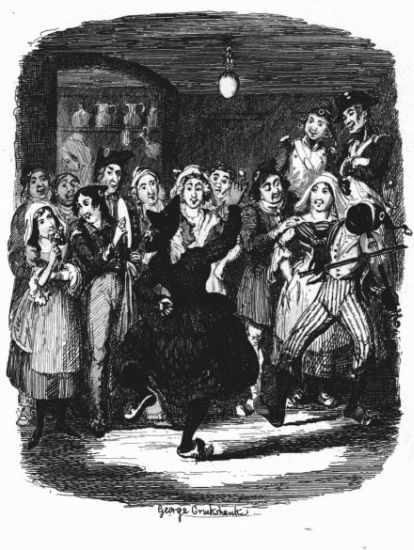
Frank, Ben, and Sambo, amusing the Natives.
London, Tilt & Bogue, 86 Fleet Street.
At length they abandoned the direct road, and kept away to the left for the coast; hoping to reach some place in the neighbourhood of Blankenberg, a fishing village on the sea-shore. This they accomplished, and arrived about midnight on the beach, which they crept along, at some[117] distance from the vessels, lest they should be detected. Not a boat to suit their purpose could they find at liberty—all were fast secured by chains, and their oars removed, as if some such visitation as the present had been feared. In this dilemma they cautiously returned to the village, and searched amongst the cottages; but here they were again doomed to disappointment, and were about to retreat to some place of concealment till the following night, when the sound of voices was heard in a small cabin, and Frank, stealthily approaching to listen, at length got near enough to a chink in the window to see the interior, and ascertained that an Englishman, with two females, was endeavouring, by the offer of a considerable sum, to bribe three or four fishermen to convey them either to Holland or to England. The men at first seemed disinclined to listen to any proposals that might bring upon them the vengeance of the police, and they talked of surrendering them to the authorities.
"That will at once seal my doom!" exclaimed the Englishman, in agony. "Have not the wretches denounced me, because of the money they owed me, and their base designs upon my child? Oh, God! do thou appear for me in this trying moment!"
The fishermen consulted together in whispers, whilst the females clung to the Englishman; and Frank ascertained by their discourse that the elder lady was the wife, and the younger the daughter, of the man. Again the latter earnestly urged his appeal to their generosity, their humanity, and every better principle of human nature—the ladies, too, joined their entreaties. Frank was half-tempted to the hazardous experiment of bringing up his companions and forcing them into compliance.
At length the fishermen consented to embark them for Holland, or any place occupied by the Allies, on condition that they gave up all the money and every valuable in their possession previously to their departure, and insured a still further sum on reaching a place of safety. Elated at the prospect of escape, the terms were immediately complied with; and now Frank became aware of the extreme danger he should have incurred had he attempted to attack them, for whilst the Englishman and the females were divesting themselves of their cash and every valuable they had, three other athletic men came from an inner apartment—making seven in all—to claim their share of the spoil.
As soon as the division had taken place, they departed to launch their boat, commanding the Englishman and the ladies to remain quietly in the cottage till they were sent for. Frank concealed himself in an adjacent shed, occupied by his companions, till they were gone.
"It's all plain enough, young gen'l'man," whispered Ben; "they will get the great vessel afloat—come ashore in the punt for the passengers—we must seize on her, shove off, and capture the big craft—then take the ladies on board, and make sail for the North Foreland—though the wind is dead again us; but what's the odds—"
"That," interrupted Frank, "could only be effected by leaving our countryman and the ladies behind; an idea I will not for one moment entertain. Remain here—if I want you, I will whistle—then come without delay."
The youth returned to the cottage, and addressing the gentleman in French, he acknowledged that he had overheard their scheme, and earnestly[118] implored him to permit himself, a female servant, and a negro, to embark in the same vessel, provided they could gain the consent of the crew. The gentleman steadfastly refused—"he would not endanger his own safety by acceding to it."
Rather mortified at being thus harshly treated—especially as he knew that he might ensure his own safety by leaving them behind—Frank would have answered indignantly, but he preferred remonstrance, avowed himself a royalist desirous of joining the Allies, and assured him that no danger could occur by giving his consent. The man continued inflexible, till the ladies, won by the youth's earnestness, interceded, and an unwilling assent was obtained.
The light of coming day had become visible when one of the fishermen returned, and great was his apparent vexation to find other suppliants for a passage in the vessel. However, he offered but slight objection, and in a few minutes they were all down on the beach. Here a difficulty arose as to their embarkation. The punt would carry no more than two passengers beside the men that pulled, and the gentleman was unwilling to leave either his wife or his daughter behind, nor would the females consent to go without him.
"Do not fear," said one of the fishermen. "Time is precious with us—we ought to be all on board now; and rely upon it we are not such fools as to leave any one behind to betray our movements."
The latter argument was the most conclusive, and the gentleman embarked with his wife, leaving his daughter to the care of Frank, who spoke soothingly to her, and tried to allay her alarm; he took off his jacket and wrapped it round her shoulders, as a protection from the cold air, and in her fear she clung to his arm whilst he supported her.
The punt was not long away—all were soon aboard—the anchor was weighed, and they hauled off from the shore. The father with the females took up his station abaft, whilst Frank and his party occupied the midships, and the seaman and the negro were soon fast asleep; but the young midshipman's thoughts were too pleasantly occupied by his escape, and the prospects of an interview with his mother, to compose himself to slumber. Another object too now presented itself; it was the fair young creature who had so confidingly clung to him on the beach. However, to prevent observation, and the better to indulge in meditation, he closed his eyes, and pretended to be oblivious to all that passed. Whilst thus reclining, he overheard a sort of muttered conversation between two of the fishermen which, though he could only catch disjointed sentences, apprised him that treachery was at work; and he now readily understood the reason that greater obstruction had not been offered to the embarkation. The crew doubted the promise to receive further recompense, and expecting to be rewarded for delivering them up as prisoners, had come to the determination of making for a French port. Frank's ears tingled whilst listening to this avowal of abominable treachery, but he cautiously abstained from exciting any suspicion that he was aware of their designs. He determined to watch them narrowly, and when opportunity offered, he got close to Ben, who, on making a tack to windward, had roused up, and without mentioning particulars, told him "they were betrayed unless they could master the crew, and directed him to be ready for an attack at[119] a moment's warning." He then briefly conveyed a similar communication to Sambo, and vainly tried to catch the eye of the gentleman abaft for the purpose of inciting him to wariness.
The breeze was to the northward, with a lee tide running, so that, though apparently working to windward between the sands and the shore, they were rapidly drifting down towards Ostend, which was then in the hands of the French. Ben comprehended the whole of this in an instant, and saw, what the others, from their want of nautical knowledge, did not observe, that the helmsman frequently edged off from the wind, so as to facilitate their approach to Ostend, which was soon upon their lee-bow, and the boat standing for the harbour.
The gentleman, wholly insensible to the danger which threatened them, sat between his wife and daughter, and was speaking words of cheering import, relative to their being rescued from the enemy, and the prospect of soon enjoying the comforts of their native land. Everything was perfectly tranquil in the vessel, which was lightly dancing over the smooth waters and breaking the sun-light upon its surface. He also remarked upon the quietude of their fellow-passengers, and even ventured a joke upon the apparently solid countenance of the Dutchwoman, when suddenly—in an instant, as if madness ruled the moment, they saw her spring to her feet, and, grasping the pump-brake in her hand, she flourished it right and left, laying a fisherman prostrate at every blow. Sambo also grappled an opponent, whom he lifted over the gunwale, hurled into the sea and then attacked another, whilst Frank rushed aft to the steersman, shouting to the gentleman, "We are Englishmen, it is a French port under our lee, and we are betrayed; for the sake of those you love—hurrah!—do not remain inactive."
Nothing could exceed the amazement of the gentleman at this wholly unexpected occurrence, and his astonishment was still more increased when the supposed Dutchwoman, came bounding aft, flourishing her weapon, and shouting in the nautical language of his native land, as he hurled the steersman from his place,—"Ware hause, you lubber—what's the odds, so as you're happy?" and taking the tiller, he put the vessel right before the wind. "Bear a hand, Master Frank," continued Ben, "and keep her as she goes: and I'm saying, ould gentleman, jist you show yourself smart, and let 'em know as you've a little English blood in your veins. Hurrah!—what's the odds?"—and again he rushed forward to assist Sambo, who was stoutly contesting it with his foes.
British prowess triumphed—the struggle, though severe, did not last long—the Blankenbergers were conquered; the punt was cast adrift for those who were swimming—the remainder were bound hand and foot; the sails were trimmed to stand off from the land; and great indeed was the gratitude of the husband and the father, and still more delightful were the acknowledgments of the ladies, when they ascertained the great service that had been rendered to them. Mutual explanations ensued—hearty congratulations were given; and in the afternoon they fell in with an English brig which received them all on board. The fishermen, after a sound rope's-ending for their treachery, had their vessel restored; and the rescued party were the next morning gratified by entering the river Thames.
[120]