BY BOWMAN TILLER.
CHAPTER VI.
The agitation and distress of Mrs. Heartwell at finding that Frank did not return on the day of the ship-launch may readily be conceived—he was the only stay and hope of her heart. Suspecting the cause of his absence, she set out for the tender at the Tower; but as it was dark night, the sentries would neither allow her to come on board nor render any information, so that she was forced to return unsatisfied. But on the following morning she was again alongside, and learned the fate of her son and the negro, who were then at some distance down the river. This, though it removed her fears for his safety, did not diminish her anxiety for his welfare, nor was it till she received the letter announcing his being placed on the quarter-deck of the Thunderbolt, seventy-four, that she felt relieved from the sickening apprehensions that had almost overwhelmed her.
It was about this time that Richard Brothers, the supposed prophet, became extremely popular; and as he had declared that he was commanded by divine authority to proclaim the destruction of the city of London by earthquake and fire, many of his believers who resided within the doomed precincts quitted their habitations, and found temporary abodes outside the proscribed districts: amongst these was a Mr. Baurie, a tradesman of the Strand, who, terrified at the denunciation, at a very considerable sacrifice of business and property, left his house and occupied Mrs. Heartwell's apartments. Brothers resided in Paddington-street, where he was almost worshipped as the Prince of the Hebrews, and the Deliverer and King of the Jews, who was to restore them to New Jerusalem, and become their ruler; and as there had been some remarkable coincidences connected with his prophecies, thousands of all ranks—even bishops and clergy—visited him, and not a few gave full credence to his absurdities. He frequently called upon Baurie, and, being a lieutenant in the navy, Mrs. Heartwell had more than once or twice conversed with him about her husband. His answers were invariably the same—"Though he be dead, yet shall he live again—though he is lost, yet shall he be found." Ambiguous as this reply may be considered, it encouraged the cherished hope that her husband would be restored to her. Strong as her mind usually was, the mild and gentlemanly manners of the prophet, combined with his upright conduct and undeviating integrity, won upon her feelings; and though she pitied the weakness of his believers, there were times when his observations made a deeper impression upon herself than she liked to acknowledge.
Meetings were held in Baurie's apartment, which were attended by numbers of the select—the principal of whom were Brassey Allhead, an intelligent oriental scholar, who had resided many years in India, and now sat as member of Parliament for ——, William Bryan, George Turner, and others, who pretended to see visions, claimed the gift of prophecy, and bore testimony to the authenticity of Brothers's mission—that he was the[145] descendant of King David—the rod that was to come out of the stem of Jesse, &c., &c.: in fact, there only wanted the "unknown tongues," which has since been discovered by the disciples of fanaticism, to render the whole farce perfect in all its parts.
The twilight of a summer evening was gradually deepening its shade, when a hackney-coach stopped at Mrs. Heartwell's door, and the servant announced that a strange-looking woman who came in it had endeavoured to force her way into the house, and still remained clamorous to be admitted. Without a moment's hesitation, Mrs. Heartwell went to the hall—the door was re-opened, but the lady could not help retiring back with amazement, when she beheld a stout female, in short Dutch petticoats, wooden shoes, and a peaked-crown hat, who, in spite of the resistance of the servant, immediately and hurriedly advanced towards her.
"Who, and what are you?" demanded Mrs. Heartwell. "Keep the woman back, Mary!"
The girl caught hold of the intruder's petticoats, but, observing a thick club queue hanging down the female's back, she shouted, "Oh, my! ma'am, she's got a pig-tail!" and let them go again.
"What is all this?—who do you want?" demanded the lady, retreating. "Why don't you stop her, Mary?"
"Lor', ma'am, I carnt," replied the girl, again catching hold of the petticoats, whilst a well-remembered voice laughingly exclaimed,—
"Bless you, my lady—why, dont you know me? Howsomever I hope I arnt frightened you; but what's the odds so as you're happy?"
"Can it indeed be Ben!" said Mrs. Heartwell, in surprise. "But why are you dressed thus?"
"Oh, it's a long story, my lady!" replied the seaman; "and I've kept the duds on to circumwent the pressgangs. But I am so happy to see you again."
Mrs. Heartwell extended her hand to the worthy tar, and as her child was the first object of her thoughts, she eagerly inquired whether he "had seen or heard anything of Frank." From the answers she elicited, she very soon came to the conclusion that Frank was not far off. "He is here, Ben—I am sure of it. Open the door, Mary—the coach is still waiting—my son!—my son! Merciful Father, I thank thee!" The next minute the youth was in her arms; and Sambo, full of joy at his return, sprang in and caught the servant-girl round the neck, so as to excite something like jealousy in the mind of Ben, who however, in the fulness of delight, cut a few capers of the college hornpipe, exclaiming, "What's the odds, so as you're happy!" and making the hall echo again to the sounds of his wooden shoes.
There was pleasure that night at Mrs. Heartwell's, both in the parlour and in the kitchen. In the former Mr. Baurie and family and Mr. Unity Peach, who had called in, witnessed the gratification and anxiety of the mother as Frank recounted his adventures from first to last, not omitting his interview with Brady in the character of a traitorous spy, and stating that the merchant, with his wife and daughter, who had escaped in their company, had gone to an hotel in the neighbourhood.
Sambo and Ben in the kitchen enjoyed themselves to their heart's[146] content—the grog was abroach—the pipes sent forth their wreaths of curling smoke—the servants were delighted, and the hour was late before they all departed to their rest.
The next morning Frank and his two humble companions were supplied with suitable apparel, and Mrs. Heartwell looked with pride upon the handsome appearance of her son in his uniform, though a sigh would now and then escape as she contemplated the strong resemblance which he bore to his father, and when she thought how soon they must part again.
The young midshipman, accompanied by the seaman and the negro, went to the Admiralty and reported their escape to the secretary, who questioned Frank pretty closely relative to what he had witnessed in Paris. During the inquiry a tall, upright, stately gentleman entered the room, and not only remained to listen to the conversation, but put several questions to the youth, and seemed satisfied with the ready and pleasing manner in which they were answered. He was then directed to call the next day, and instructions would be given to him for their future proceedings.
Frank was quitting the Admiralty gates, when a government messenger tapped him on the shoulder and an officer took him into custody. Ben and the black would have resisted; but the youth desired them to desist, and, conscious of innocence of any crime, cheerfully accompanied the messenger, followed at a little distance by Sambo and the seaman. The whole had been done so quietly that no bustle was excited, and they were soon in the Home-office at Downing Street, and Frank was summoned into the presence of Mr. Dundas, the Secretary of State, and questioned relative to his having seen lawyer Brady at the house of Polverel, and what transpired there.
The youth explicitly answered every interrogatory, and was requested to accompany Mr. Dundas to the Privy Council, which was then about to sit. The carriage was waiting; and when Ben saw the smiling face of his young master as he nodded at him on ascending the steps of the vehicle, he became assured that nothing was wrong, though he determined to watch where he went to; and both the seaman and the black had a smart run for it till they saw the equipage enter the archway of a prison-like building, and Ben became fearful that the young officer was "going to be clapped in limbo." He went up to the sentry and, offering him a bite of pigtail, inquired "What place that was," His mind became more appeased, though his wonder was not lessened, on being told that it was "the King's Palace."
The Privy Council had met, and lawyer Brady was a prisoner before them on a charge of treasonable practices. Several witnesses were examined, who gave evidence against him; but as nothing very conclusive could be drawn from it, he remained cool and firm till Frank was introduced, when that peculiar rolling of the eye for which he was remarkable under sudden excitement plainly indicated strong internal emotion.
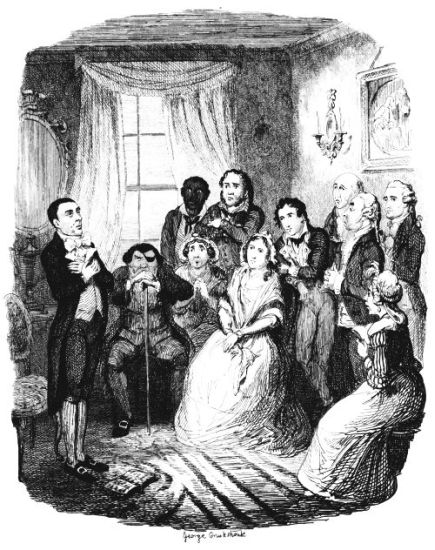
Richard Brothers the Prophet at Mrs. Heartwells.
London: Tilt & Bogue. 86. Fleet Street.
Frank was at first somewhat confused, but he was encouraged by the tall gentleman he had seen at the Admiralty, and who was, in fact, the Earl of Chatham, at that time the head of the navy. The youth narrated every particular that had transpired in connexion with Brady at Paris,[147] and at the close of his examination he was requested to withdraw. He was shown into a room where the other witnesses were assembled, and here Frank learned that Brady had been engaged by the government as a spy amongst certain of the higher classes of society, whom he first betrayed, and then, having obtained all the intelligence he could of national affairs, it was supposed had secretly gone over to communicate his information to the enemy. This last supposition Frank had confirmed; and the lawyer was committed to prison on a charge of high treason.
On the following day Frank had another interview with the secretary of the Admiralty, and was desired to leave his address and remain at home till further orders, and the seaman and the negro had leave of absence extended to them.
Mrs. Heartwell was much pleased at retaining her son with her for some time, especially as she received another handsome donation from her unknown friend, which enabled her to procure him a complete outfit. Mr. Wendover, the merchant, had called, and behaved with great kindness and attention to both the mother and son, and the latter was invited to pass a few days at a handsome mansion which had just been purchased near Finchley common, and which gave a right to the owner as lord of the manor. Frank was delighted—he had never ceased to treasure the most pleasing remembrances of the interesting girl who had clung to him for protection on the beach at Blankenburg, and she, with all the tenderness and devotion of youthful affection, secretly cherished a warm regard for the young midshipman, and she most earnestly longed to see him again.
On the evening previous to the intended visit, Brothers, the prophet, held a "meeting" in the drawing-room of Mr. Baurie's lodgings, and as on these occasions—which were looked upon in the light of devotional exercises—none were excluded, Mrs. Heartwell, Frank, Mr. Unity Peach, Ben and Sambo, and two or three of his leading disciples, as well as the servants, were present. There was nothing in the illusionist's general manner that could be construed into aberration of intellect. He was perfectly intelligible and sane when his monomania was not called into operation. He was a strong-limbed man; his hair was cropped close—his full eyes bent upon a book that he held in his right hand, and from which he commenced his address by reading passages from the prophecies of Daniel. His dress was remarkably plain, approaching to that usually worn by the Society of Friends, and his cravat was tied in the most exact manner, so that the bow in front resembled the cross of St. John of Jerusalem. At first, his voice was mild and gentle; but as he proceeded and became warmed with his subject, his countenance assumed an expression of wild energy, his utterance became deep and sepulchral, till at length, throwing down the book, he stood erect, with his arms crossed upon his breast, as the spirit of prophecy seemed to come upon him.
"Woe unto ye of the earth who seeing will not believe; who hear and yet despise. I am he of whom it is said, that a man will be revealed to the Hebrews as their prince, and to all nations as their governor, according to the covenant entered into with king David. Haste then and flee from the wrath to come, for have I not prophesied, and it hath[148] come to pass?—Have I not foretold, and the fulfilment is at hand? Did I not predict the downfal of monarchy in France? and lo! it hath fallen. Did I not foretel the death of Louis? and he is no more. Did I not say the king of Sweden was given over to destruction? The great Gustavus is laid in the tomb by the hand of an assassin. Have I not declared that England would be deserted by her allies? many of them are already gone, and the others will quickly follow.—The king of Prussia will acknowledge the republic of France;—the government of Poland will be changed, and the monarch driven from his throne;—the stadtholdership of Holland shall be cut off close to the ground! Hear and understand, ye men who are in authority! The prisons are crowded with captives charged with high treason, but the powers shall not prevail against them;—yet a little while and the prison doors shall be opened and the whole shall walk forth free. Hearken, oh! ye Hebrews, and listen, oh! ye people—London, with its Armageddon[9], shall be utterly destroyed.—Lo! I saw in a vision, and Satan clothed in white and scarlet, and breathing desecration and fire, was entering the condemned city, and suddenly there was strife and confusion among the citizens, and every man's hand was armed against his brother, till a river ran through London of the colour of blood, and there was a voice of fury and the noise of an earthquake, and there were groans of woe—woe—woe! And I prayed and wrestled with the spirit that the city might be spared, and He, the Mighty One, was angered, and his wrath frightened away the angel from my side, and all became dark and oblivious; yet I saw in my vision that London had sunk into the bowels of the ground, and between the Downs and Windsor there was but one vast sheet of water, so that no trace of the city could be found. Why will ye die, oh! house of Israel?—hear and believe! And a storm shall arise—there will be consternation amongst our rulers—the English Admiralty shall be shaken as a man would shake bread in a basket." (Frank looked at Ben, and his countenance evinced displeasure.) "The prop and stay of the nation shall be knocked away—her armies will be destroyed, and her navy will be annihilated—the carcases of her soldiers shall strew the earth—the bodies of her seamen in an ocean-grave lie buried—for the enemy shall prevail, and the proud ships shall be sunk or grace the triumph of the foe."
Here the prophet was interrupted by Ben, who, rising up and biting through his quid, as he hitched up his trowsers, ejaculated with vehemence the word "Gammon," seemingly to the great delight of Mr. Unity Peach, who screwed his face into all manner of shapes to conceal his mirth, and uttered, "Sit down, man—saucy sailor—go to sea." The prophet prepared to renew his subject; but Frank, seconding Ben's motion by rising also, boldly said, that "being a British naval officer he could not sit to hear the service he loved denounced—it would be treason to his country. The English ensign had been victorious on the seas, and its gallant defenders would never allow it to be dishonoured."
"Hurrah, Master Frank," shouted Ben, "who cares for a bit of a[149] breeze! Nillyhate our navy indeed!—bury all hands in the ocean!—strike to the enemy too!—Gammon, all gammon; but there, what's the odds so as you're happy."
"Neber see de day, boy," chimed in Sambo, as he imitated the example of his master, "Golly-make me tink ob em gullemtine."
The three withdrew, and Mr. Unity Peach soon afterwards left the party, "in order," as he said, "to scold the unmanly interruption given to Mr. Brothers," but in reality to vent his spleen against everybody; and the prophet very speedily took his departure.
The stately and elegant mansion purchased by Mr. Wendover was indeed delightfully situated, and the grounds had been laid out with considerable taste and skill. Joyous were the hours that Frank passed there in the society of friends, who esteemed him as their deliverer from death, and particularly with Helen, who not only admired the handsome young officer's improved appearance, but also very naturally evinced gratitude towards him for saving the life of her father.
Never were pair more truly happy; the present was to them all bright, and clear, and shining; they had no thought of the coming future; not a cloud intervened to cast a gloom upon their innocent enjoyments; and no pain was experienced till the time of separation approached, and then they felt how truly estimable and dear they were to each other. Frank was on the verge of his seventeenth birth-day; Helen had just passed her fifteenth; and both were experiencing those delightful sensations of affection, which in early life are so exquisitely delicious, because they are untainted by unhallowed thoughts or worldly desires.
On the estate was a beautiful little rural cottage, over which the vine grew in rich luxuriance, and its garden shone bright with the varied hues of many flowers. Often when passing it Frank had wished it was the home of his mother, whose health had become impaired by lodging-house keeping, and she earnestly desired to retire from it. The place had been unoccupied for several years, and Helen, without saying anything to Frank, had urged the suit with her parents to offer it to Mrs. Heartwell as a residence. Mrs. Wendover and Helen called upon that lady; and the former was so much gratified with the deportment and conversation of Mrs. Heartwell, that she at once made the proposition and invited her down to visit the place.
The invitation was accepted, but before the day arrived Frank was accosted in the street by Shipkins, who had acted as Brady's assistant, and he delivered a message from his employer, earnestly entreating that the youth would come to him, as he had affairs of importance to communicate. Shipkins also added his own persuasions to go immediately; but Frank peremptorily declined, until he had consulted with his mother, who, on his return home, not only advised the interview, but also resolved to accompany him as vague thoughts rose in her mind that possibly she might learn something respecting her husband. On the succeeding forenoon they went to the prison, and were informed that Brady had contrived to make his escape during the night, and the officers were then out in search of him.
Protected from impressment by leave from the admiralty, both Ben[150] and the negro could go where they pleased; and as the merchant had presented them with a liberal sum, they did not fail to avail themselves of the enjoyment of freedom. The Royal Circus (as the Surrey Theatre was then called) was a place of great celebrity for its melo-dramatic performances, and the "unrivalled" feats of horsemanship, enlivened as they always were by the quaint humour of a clever clown. Ben and Sambo had gone to visit a relation of the former somewhere in the neighbourhood of Walworth, and Frank had engaged to meet them at the notorious tea-gardens known by the sign of the Dog and Duck, in St. George's Fields, to accompany them to the Circus. The morning and evening promenades at the Dog and Duck were frequented by all the dashing bucks of the time, with their ladies; and amongst the company might often be seen gentlemen riders, whose modesty on the highway induced them to put crape over their faces as they uttered "Stand, and deliver"—in short, the place became the assemblage of the worst characters of society. Frank, habited in plain clothes (as his uniform would not have corresponded with the dress of his companions), was crossing the open fields to the place of appointment, when Shipkins again addressed him, and by assurances that he could inform him of the fate of his father, induced the young man to enter a respectable-looking house in the neighbourhood; but no sooner had they advanced into a room at the back of the premises, than Frank was seized by two stout men, a wet cloth bound over his mouth, and he was conveyed to a sort of dungeon in the rear of the building, where his clothes were stripped off, and a canvas shirt and trousers substituted in their stead; an iron band was then clasped round his body, and he found himself chained to the floor.
The intentions of Shipkins were now evident; and Frank conjectured that his death was determined upon. Thinking more of his mother than himself, the young man suffered great distress, which was not relieved by a confused noise that suddenly commenced; and by placing his ear against the ground, he thought he could distinguish the strife of many human voices. What it meant he could not tell, but he was not long kept in ignorance, for in another half hour the door of his dungeon was thrown open, and Ben and Sambo, with a crowd of people, entered to his rescue.
"He is not here," said the seaman mournfully, and not knowing the youth in his change of attire; "but this is another victim, anyhow—the man-trapping vagabones!"
The black, however, with keener eye, had recognised his master, and he exclaimed, "Golly, you blind, Misser Ben, for no see me young massa," and he bounded forward to release him; but the chain and band defied his strength—the key was not to be found; but the enraged populace applied crow-bars to the stone in which the staple was fixed, and, after much exertion, it was forced away, and Frank was carried to the open air, where other unfortunate captives had been previously conveyed.
It appeared that Ben and the black were passing the house, which was notoriously known as one of the numerous crimping establishments of the neighbourhood, when their progress was arrested by a crowd that had gathered in front of it, and two or three declared that they had seen a young gentleman decoyed into it, and so many crimes had been perpetrated there,[151] that they were determined to put a stop to them. Ben required a description of the young gentleman, which was given, and suspicion crossed his mind that induced him to join the assailants; in fact, he became their leader—the doors were beat in—the windows smashed, and a forcible entrance made by the mob, whose numbers increased every minute. Several poor creatures were discovered almost in a state of exhaustion, but the principals of the establishment had escaped. In one room Ben found a part of Frank's dress, and the sight almost maddened him. The search was continued, and resulted as has already been told; and now a wild but characteristic scene of lawless justice ensued. The mob dragged the furniture out into the fields, and piling it up fire was applied, and the whole was soon in a blaze. They next proceeded to demolish the building itself, nor did they cease till the whole was razed to the ground. But Frank did not wait to witness the termination—a locksmith had succeeded in forcing the clasp of the band, and releasing him from the encumbrance, which Sambo carried home with him as a trophy. Mrs. Heartwell was informed of what had taken place, and a probability was suggested that her husband might have been carried off in a similar way.
The visit to Finchley was made, and Mrs. Heartwell was persuaded by Frank to accept the tenancy of the cottage, hoping that Fortune would favour him with prize-money to render her life independent and comfortable. He had now twelve months' pay due, which, with what she would receive by disposing of part of her furniture, would serve for present exigencies; and a distant relation had bequeathed her an annuity of thirty pounds a year—so that prospects brightened before her.
Brady could not be found, and Frank was ordered down to join his ship, that was then refitting at Portsmouth, and to take Sambo with him, whilst Ben was directed to accompany them and procure a passage round to Plymouth to the Windsor Castle.
Frank received a letter to his captain from the secretary, and set out for Portsmouth, where he delivered his letter, and ascertained that it contained a strong recommendation of himself to the captain. Being somewhat of a favourite with the first lieutenant, the young midshipman earnestly solicited him to use his influence in getting Ben transferred to the same ship with him. The request prevailed; and Ben, by the admiral's directions, was entered on the books of the "Thunderbolt" seventy-four. Nor was he disappointed in his expectations of prize-money, for in the course of a few months several valuable captures were made, and the young midshipman enjoyed the satisfaction of knowing that his mother was comfortably settled at the cottage with a competence, and that Helen when at Finchley visited her daily.