BY BOWMAN TILLER.
CHAPTER VIII.
The attempt to break into Mrs. Heartwell's cottage, and the important discovery that succeeded, were, as far as possible, kept secret; and Mr. Wendover's steward, in expectation of another visit from the nocturnal intruder, set a watch upon the premises. No one, however, appeared to disturb the tranquillity of the place; but still the lady could not suppress her fears, and a constant dread weighed heavily upon her spirits.
Frank had gone down to the Nore to join the prize-crew on board the Sandwich, but during his absence they had been sent round by sea to Plymouth, and as no other vessel was expected to go down the Channel for some time, he obtained permission to travel thither by land, hoping, as there had been a long run of strong westerly winds, to reach that port as soon as his men did. Accordingly he started for London to visit his mother, and finding her much alarmed, and averse to remaining at the cottage, he removed her to ready-furnished lodgings at Marylebone; when, after an interview with Mr. Unity Peach (who promised to use his best endeavours to promote the comfort of Mrs. Heartwell), the young officer set out in the mail for Plymouth, where, on his arrival, he at once reported himself on board the Admiral, and ascertained that the vessel with the seamen had not yet got round. As his own hammock and chest were in her, permission was granted for his remaining on shore till she came into the Sound. Of his ship nothing accurate was known, but it was believed she had gone up the Mediterranean, to join the fleet under Earl St. Vincent.
Frank's ardent attachment to Helen had always exercised a powerful control over his actions. Before her departure from Finchley he had cherished the most sanguine hopes that his affection was returned; nothing, in fact, had ever occurred to raise the slightest doubt in his mind upon the subject; for the course of his love, though unavowed, had experienced no obstruction, nor was it till their separation that he awakened to a painful conviction of the vast difference which existed in their pecuniary circumstances. This raised apprehensions that he might have been deceiving himself, by mistaking the operations of a grateful spirit for feelings of personal regard towards himself.
The mansion of Mr. Wendover was situated on the right bank of the[211] river Fowey, close to the pretty and romantic harbour of the same name. The distance from Plymouth could not exceed twenty miles—the Falmouth coach passed within a short walk of the neighbourhood—a strong westerly breeze was blowing—what, then, prevented him from trying to obtain an interview with the fair girl, and to learn from her own lips the real sentiments which she entertained for him?
Thus argued Frank. The temptation was too powerful to be subdued—his mind was tortured by suspense, and yielding to the quick impulse of his nature, in little more than three hours he was on the borders of the domain of the wealthy merchant—and a lovely place it was. The gradual development of spring was evidenced in the bright tints of the spreading foliage; the young grass was springing in rich luxuriance; art and nature were combined to heighten the beauty of the scenery; and slumbering on the surface of the stream that ran in front of the building, laid a superb little cutter-yacht, rigged with peculiar neatness, and her ensign blowing out freely in the wind. Frank's eyes glistened with the peculiar pleasure that a seaman always experiences when beholding a well-finished piece of work connected with his profession; but that was not all—the young midshipman rightly conjectured that the yacht belonged to Mr. Wendover; Helen had most likely sailed in it; and what would he not have given to have been with her, to display his knowledge of seamanship in managing the vessel.
The little punt, with two men in it, put off from the cutter to the shore; Frank hurried to meet them when they landed; it was a precious opportunity by which he might gain information relative to the family. Flatter a sailor's vanity in reference to his craft, and you at once possess a key to his heart. The young officer praised the beautiful vessel, and having expressed a wish to inspect her closely, he was invited to go on board. This was precisely what he wanted; the men were communicative, and he was not long in ascertaining that Mr. Wendover had been summoned to London on urgent business—that Mrs. Wendover was confined to the house by indisposition—and that Miss Helen was often to be seen taking her lonely walks about the grounds.
The deck of the yacht commanded a full view of the house and lawn, and Frank, whilst learning these particulars, watched eagerly, in hope that Helen would make her appearance; nor was he disappointed, for, after a short interval, a female was observed descending the steps of the mansion, and the spy-glass at once announced to him who it was. He had already taken a hasty survey of the vessel, and having presented a donation to the crew, he requested to be put on shore.
Helen had never ceased to cherish a strong feeling of real affection for Frank Heartwell, but she had never adequately known its power and extent, till the period of their separation; and though her father had not openly declared the occasion of her removal from Finchley, yet love is quick-witted in discovering causes; and knowing his determined character, she saw at once that he had opposed a barrier to her heart's dearest wishes. His conversations relative to her future prospects of aggrandisement opened to her conviction that he expected rigid obedience to his commands. But Helen could not—in fact, she did not try, to conquer the esteem for[212] the young sailor, which had strengthened with her years—he had been the means of rescuing herself and her parents from threatened destruction—gratitude had ripened into love, and had become the sweetest contemplation of her life. Yet Frank had never made any avowal, and doubts similar to his own would at times cross her mind. Mr. Wendover could not but be sensible, by the change in his daughter's health and gaiety, that the disappointment had caused the most acute distress; still, however, he hoped that time would deaden the affliction, and she would forget the young officer. It was in vain, however, that he strove to raise her sunken spirits by excursions of pleasure abroad, and amusing pastimes at home. The bloom was leaving her cheeks, and her beautiful form began to waste away, for there was a sickness at her heart.
When Helen left the house that morning, her thoughts were dwelling upon Frank with all the tenderness of woman's gentle nature; she loved to stroll through the avenues alone, for no one there could disturb her meditations. She was turning the angle of one of the alleys, when Frank stood before her, and, the ardour of her feelings overcoming the coldness of formality, the next instant she was encircled in his arms, whilst unrepressed tears of surprise and delight came gushing from her eyes.
When the first burst of joy at meeting had subsided, they conversed more calmly, and Frank, whose doubts had been at once dispersed through the undisguised manifestations of attachment which his reception had evinced, now unequivocally declared, that "the happiness of his future existence depended upon Helen. He was not insensible to the hostility he must expect to meet with from her father; but he hoped by strenuous exertions in his profession to overcome even that, provided he might rely with confidence on her undeviating regard."
Their interview was not of long duration, but it was decisive to the peace of both. Helen candidly admitted her love for Frank, and though with the acknowledgment came apprehensions of her father's displeasure, yet he tried to soothe her alarm, by assurances that his prospects would brighten—prosperity had already smiled upon him—and could he once attain the rank of captain, he should consider himself eligible to propose to Mr. Wendover for his daughter's hand. At all events, he determined to persevere with unremitting ardour and hope, and enterprise gave promise of success.
Harmonious to the ear and grateful to the heart is the persuasive voice of one beloved. Helen placed perfect reliance on all Frank said, and there, in the sight of Heaven, they mutually pledged their vows of faith and constancy. The young officer returned to Plymouth more assured, nay, comparatively happy, and, the vessel arriving with his people, he solicited to be put in active service. A number of ships were fitting out to join Earl St. Vincent, and strengthen the force in the Mediterranean. Frank and his men were sent on board a frigate, which soon afterwards went out from Hamoaze into Cawsand Bay, but, as a matter of course, the boats were still employed in bringing off stores.
It was about three weeks after his interview with Helen, that Frank had charge of a pinnace to convey a rather heavy freight from the Dockyard, and though blowing hard from the north-west, he had strict orders[213] to use his best endeavours to get out to the ship. The gale, however, increased, and the broken sea came tumbling in against a strong tide, so that he was driven to leeward. A dark night closed in upon them—the boat was half full of water—and, to add to their calamities, they struck upon the Shagstone rocks, and narrowly escaped with their lives. The pinnace was in a sinking state, when Frank deemed it advisable to lighten the boat, and to bear up for Yealur river; but the atmosphere was too dense to allow of their distinguishing objects on the land, and the sea was breaking fearfully high wherever they approached the shore, so that it threatened certain death should an attempt be made to run the boat in. All night they toiled, but towards daylight they were so close to the rocks, and drifted in so fast, that their fate seemed inevitable. The pinnace struck and was dashed to pieces; but Frank, being an excellent swimmer, after some buffeting amongst the breakers, succeeded in getting sure footing; and now that he was himself in safety, his anxious care was turned to his boat's crew. This is a trying moment to an officer, whose first thoughts are generally devoted to the brave fellows who have shared his perils, and Frank felt it. Two or three he knew were saved, for they were with him, but the fate of the rest could be but conjecture. Happily, however, though separated when wrecked, daylight brought them again round their officer, and the reckless humour of the tar soon prevailed over all sense of the dangers they had escaped. A few fishermen's huts afforded them shelter, and as these men occasionally ran across to Guernsey and Jersey, there was no lack of brandy, though at first it was produced with great caution.
The pinnace was irrecoverably gone—not a single trace of her was to be seen, and, consequently, after a plentiful repast, and a short rest, Frank prepared to set out with his men on foot for Mount Batten, where he expected to obtain boats to carry them over to Plymouth. The gallant fellows had mustered in what they called "good sailing trim," and were just on the point of departure when a cutter was seen urging her wild and headlong course towards the rocks, and from the manner of her approach, a nautical eye could easily detect that either her rudder was gone, or had sustained so much injury as to defy all control from the helm—her sails were blown to ribands—her topmast and bowsprit were carried away—and it was evident to all that she was hurrying to destruction.
Sometimes taking the seas clean over her broadside; at others almost buried beneath the waves that broke over as she rushed stem on, the deck of the cutter was now distinctly visible, as the crew, in wild despair, were clinging to the rigging; but what was Frank's agony when, by the aid of a glass he recognized the vessel to be the pretty little yacht that he had inspected, as she laid at anchor before Mr. Wendover's house, at Fowey; and as he could distinguish the white dresses of females, he made no doubt that Helen and her mother were on board. The young officer immediately assumed a command—his own men were prompt in obedience, and the fishermen were not less so through humanity. They tried to launch a boat, but the thing was impracticable; the sea drove her instantly back again, a perfect wreck.
Onwards came the cutter, till she struck on the rocks, at no great distance[214] from the shore; the boat was launched from her deck, and a temporary lull enabled most of those on board to jump into her; but another sea came rolling in, and the boat was separated from the vessel. What anxious agonizing moments were those to Frank! he could not see who had left the cutter; but amidst the foaming of the breakers, it was evident that more than one swimmer in his strong agony was struggling with death. The small boat rose buoyant on the summits of the waves; the men pulled steadily; the people on shore waved them to the safest place for landing, and thither they sped; but before they could reach the shore they were caught by the recoil of the sea, as a raging breaker came curling its monstrous head astern, the boat was overset by its violence, and then dashed up upon the strand. In a moment Frank threw off his coat and waistcoat, and with his hardy band, rushed forward and grasped at all within their reach; the young midshipman was guided to a female, by her clothes appearing for an instant floating on the surface of the troubled waters. She was sinking, but he dived and brought her up again, just as the swell washed them within the range of further help from the shore, and the female was carried forward to a place of safety; it was Helen's mother. But where was the daughter? Frank would have again plunged into the waves; but on passing through a group, near where the boat had been thrown up, he heard the voice of Mr. Wendover, in earnest entreaty for them "to save his child." He seemed to be almost bereft of reason, as he wildly clutched his hair in agony, and pointed to the cutter, where a female was discerned clinging to the taffrail.
"Launch the boat again!" he loudly shouted, "I will go myself if no one will accompany me;" and then with imploring cries he offered the most lavish rewards to any one who should save his child from such imminent danger.
To satisfy him, the men endeavoured to launch the boat—but Frank saw the impossibility of accomplishing it, and instantly nerved himself for the occasion, with coolness and intrepidity. He watched for a moment the set of the tide and the drift of the sea; then hurrying to a projecting rock to take advantage of both, he bound a handkerchief tight round his loins, as he looked undauntedly upon his task, breathed a short prayer to Heaven for its aid, and then exclaiming "Helen, Helen, I will save you or we will die together!" he plunged into the foaming billows just as the boat washed back again upon the beach showed the utter impracticability of affording help from that quarter.
All eyes were now directed towards the swimmer, who boldly breasted the surge, dashing aside the white spray, as the raging element yielded to the energy of his sinewy arms: sometimes lost to sight in the hollow between the waves, then rising on the coom of the sea, he became a conspicuous object as he fearlessly cleaved his way, and bursts of admiration, as well as fervent petitions for his success, arose from the throng assembled on the shore.
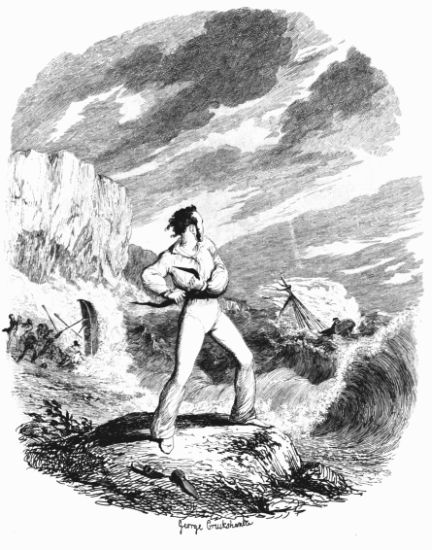
The Wreck.
London: Tilt & Bogue, Fleet Street.
The fainting Helen beheld his approach, but she knew not who it was that was thus risking his existence to try and preserve hers—the never-dying principles of hope revived her faculties; though at times when the head of the swimmer was obscured by intervening billows, her heart[215] sickened with alarm as she feared he had sunk to rise no more. Then again when surmounting the crest of the wave, she saw him fearlessly lessening the distance between them, a re-action took place in her bosom, and fervently she prayed to the Omnipotent to stretch forth his hand and save. The pleasures of past enjoyments never seem so precious and valuable as when the extreme of peril threatens dissolution. Home, friends, and those beloved cling round the very soul as if to bind it more firmly to existence, and to render more arduous the struggle of separation from the body. Helen experienced this as the seas came breaking over the cutter, and she beheld her relatives upon the shore. But her principal remembrances were devoted to Frank; and as the swimmer approached, and his features became more distinct, she fancied she could trace a resemblance to him of whom she was thinking; the bare conjecture caused a sudden thrill through every vein; but when she heard the voice of her lover as he ascended to the deck and gained the taffrail, even the appalling danger was almost forgotten in the sudden delight of her heart at his noble and generous conduct. His presence re-assured her; his soothing language allayed her fears; and though the sea at intervals broke over them, yet there was now a confidence in her bosom, for Frank was with her.
But no time was to be lost; the young midshipman feared that his own strength would not bear him out to carry her to the shore; the wreck of the main-boom was floating alongside, and he resolved to lash Helen to the spar. At first she shrunk from the hazard, but Frank clasped her in his arms, pressed her to his heart, and fervently imploring the blessing of Omnipotence upon his efforts, at once proceeded to his perilous undertaking; he succeeded in lashing Helen to the boom, impressed upon her mind the absolute necessity of clinging fast to her support, and then with his knife was cutting away the jaw-rope, as the body of a female floated up the space that had been covered by the skylight—she was dead.
Helen did not see her, and Frank, without delay, separated the boom from the wreck. Then springing into the sea, he directed the course of its drift for the shore, where the agonized father and the anxious seamen beheld what was passing, and waited in excited expectation for the result. The raft bore up its burthen well, and Frank swimming close to her cheered the terrified girl as they neared the land, and the waves dashed over them with resistless fury. The spectators calculating the precise spot where they would take the ground, hastened thither, and more than one brave fellow rushed through the surf to lend his officer a hand.
They were in the breakers; the boiling and bubbling foam was raging around them—the noise of the waters was hissing and howling in their ears, when Frank cut away the lashing that sustained Helen, and disengaged her from the spar, lest she should be injured by the concussion as it struck the rocks: supporting her by one arm, he manfully plied the other; two of the seamen kept near him; a heavy sea rolled them over, but Frank, though almost exhausted, still maintained his hold; the next minute they were washed up upon the shore, and, raised on the shoulders of the people, were carried to dry land.
Extreme, indeed, was the joy of Mr. Wendover as he clasped his child,[216] and implored blessings on her deliverer, whom in his wet condition, with his hair hanging about his face, the merchant did not recognize, but to whom he promised payment of the large reward which he had offered, supposing that alone to have been the motive for going to the rescue of Helen. Frank made no reply, for ignorant of Mr. Wendover's forgetfulness, he imagined that he must be known, and he felt indignant at money being offered for saving one who was far more precious to him than his own life. Helen was carried to the hut where her mother had already been kindly cared for, and the merchant never left his child, who, at first, sank into insensibility through terror and fatigue, and on her recovery gazed wildly round, and called upon Frank as her rescuer from death. Mr. Wendover at first considered it the ravings of a disordered imagination; but when grown more calm his daughter assured him of the fact, the merchant exclaimed, "The hand of Providence is in this; he above all others is the man I wish to see, nor will I any longer oppose your affection; he has a second time saved my child, and he is worthy of her."
Wishing to atone for his neglect, he went himself in search of Frank, but young Heartwell, after seeing Helen in security, had quitted the place with his people, and was some distance on his way to Plymouth. One of the seamen of the cutter accompanied them, and from him the young officer learned that they were on their way round to the Thames when the gale caught them. At the time the yacht struck the rocks and the boat was launched, a favourite servant of Miss Wendover's was in the cabin; Helen had generously hastened down with the captain to fetch her up. Whilst thus engaged, the rope that held the boat parted—the cabin was nearly filled—Helen was forced by the captain to the deck and lashed to the taffrail—he himself was washed overboard; and Frank rightly conjectured that the body he had seen floating was that of the drowned servant.
Mr. Wendover would have sent messengers after young Heartwell, but, as he purposed removing his family as soon as conveyances could be procured, he thought the delay of a day or two could not be of much consequence; but when the time arrived, and Helen was all delight at the prospect which was opening before her, they ascertained that the frigate had sailed only a few hours before for the Mediterranean.