BY BOWMAN TILLER.
CHAPTER IX.
When lawyer Brady was first taken into custody he seemed to treat the matter very lightly, for he relied greatly on his own sagacity in keeping his schemes from the knowledge of all except immediate confidants, who would, he trusted, render him every assistance for the purpose of dragging him through the difficulties in which he found himself involved. Amongst the most prominent of these was Mr. Acteon Shaft, to whom he promptly communicated his situation; but as no one was allowed to have a private interview with the prisoner, previously to his examination, Mr. Shaft forbore visiting him till after his committal for trial to Cold Bath Fields prison—at that time called the Bastille by the disaffected. He found Brady utterly subdued by the weight of evidence which had[247] been brought against him, and wholly at a loss to account for the accuracy by which it had been got up. The cunning of the lawyer had been completely foiled, and Frank's inauspicious appearance and testimony had almost overwhelmed him, whilst the dependence he had placed on old associates met with the disappointment which generally follows the unseemly combinations of disreputable characters,—he found himself abandoned by nearly all his former parasites and admirers, with the additional mortification of suspecting that some amongst them had been the medium through which his proceedings had been betrayed. In this frame of mind it cannot be expected that he was very communicative—in fact, he knew not on whom to fix; Shaft himself might be the individual who had given the information, and therefore he felt that it behoved him to exercise caution: their interview, consequently, was of short duration, and terminated abruptly, both apparently weary of the other.
To the clear view of the lawyer there seemed to be but one chance for his life, and that was escape from prison. Shipkins still adhered to his master, and was the supposed channel of correspondence between the latter and an eminent barrister, who, it was alleged, had undertaken Brady's cause, but for the present remained in the background. It is true that the clerk was suspected, and a watch was set upon them when together; but their conversation was generally carried on in too low a tone to be distinctly overheard or understood, though not unfrequently their gestures manifested warm disputes, if not downright quarrels, and muttered threats and menaces were exchanged, which usually terminated in earnest appeals from the master, and the seeming acquiescence of the clerk.
The apartment[17] occupied by Brady was one of those appropriated to state prisoners—and the lawyer was well acquainted with its locality, having frequently visited this particular part, to hold consultations with his clients, who were confined for political offences. Its dimensions were about twelve feet by eight; but one corner was occupied by the fire-place so as to face the opposite angle of the room, and as many indulgences were allowed by the authorities, and others were procured by the aid and connivance of turnkeys, there was an air of comfort about it which was rendered more striking by comparison with other parts of the building. There were two strongly-grated windows facing the north, and as the room was thirty feet from the ground it commanded a distant view of Highgate and the neighbouring upland, whilst the adjacent grounds—now nearly covered with houses—were at that time open fields.
In his visits Shipkins had contrived to furnish Brady with extremely sharp files, and the latter occupied himself, during several nights, in cutting through the bars of one of the windows, which after nearly a fortnight's labour he successfully effected, and from his general demeanour during the day no suspicion was excited. On the night which he had fixed for his escape, he was locked up at the usual hour, and anxiously did he await the time he had appointed with Shipkins to make the trial. Brady was not deficient in courage; but when he heard the deep sonorous[248] and lengthened tones of St. Paul's clock, as they came swelling on the breeze, a sickening sensation crept over him. Watt had recently been executed at Edinburgh for treason, under somewhat similar charges as those brought against Brady, but not of so aggravated a nature. The lawyer was aware of this, and being a clever man in his profession, he knew his case to be so glaring, that he could expect nothing but conviction, without a shadow of mercy. His present attempt, therefore, was for the preservation of his existence, and every stroke of the cathedral clock was to him as a death-knell, to warn him of his future fate, should his endeavours fail.
The sounds proclaiming the midnight hour had ceased—the wind from the south came in fitful gusts through the long passages and up the winding staircase, and its moaning noise resembled the wail of lamentation from those who were suffering the punishment for crime. Brady listened for a moment, and then his energies reviving, he wrenched away the bars from their slight hold, and cautiously placed them in the room. A coil of sash-line doubled and knotted was drawn forth from beneath his bed—one end was thrown over the projecting frieze of the side wall, which flanked his window, the other he held in his hand; but hardened as the man was, and thus peculiarly situated, he breathed forth a prayer to Heaven for deliverance. His descent was easy, but just as he had gained the ground, a lurid light was suddenly spread around him—and in the impulse of the moment, the villain, who but a minute or two before had been petitioning the Omnipotent to save him, now drew forth a sharp-pointed stiletto, determined to perpetrate murder should there be only one to oppose him. The light, however, disappeared, and he felt disposed to ridicule his own alarm, as he called to recollection that it emanated from a rocket which had been sent up from that noted and much-frequented place of amusement, Bagnigge Wells. Without further delay, he proceeded to the outer wall, about fifty yards distant, and here, at a particular spot, he found that a rope-ladder, with a stone attached to the end, had been thrown over, which satisfied him that his confederate Shipkins had not deserted him. In a few minutes he was on the summit of the wall, and could perceive a dark moving mass below; he looked over the dim expanse, and gloomy as it was in the dreariness of night, it reminded him of freedom. In a short time the rope was secured, by working it in between the coping stones, so that a knot could not be drawn through, and after trying his weight he descended totally unobserved, and found his ally awaiting him. The Fleet river, which flowed by the western wall, was passed, a hackney-coach was at hand in the road, and they drove off in the direction of Islington.
A few days subsequently Brady got down upon the coast, and obtained a passage across to France, where he remained a spectator of, and often an actor in, the revolutionary atrocities that marked this eventful era. Reports, however, were prevalent that he had returned to England—the police were directed to be on the alert; but though it was repeatedly averred that he had been seen in London and its precincts, he contrived to escape the vigilance of all.
[249]
CHAPTER X.
When Frank Heartwell visited the estate of Mr. Wendover, near Fowey, and had an interview with Helen, the merchant had journeyed to the metropolis to examine the property that had been so strangely discovered in the cottage at Finchley, and which had been deposited for security in his mansion; for his steward had discovered amongst the papers, deeds involving a vast amount, together with several thousand pounds in bank-notes, the whole belonging, he had every reason to believe, to a person then in existence. Mr. Wendover went down to Finchley, and ascertained by a registry of names and documentary evidence, that an extensive conspiracy, connected with the revolutionary societies of the day, had been in fearful progress, and that one of the principal leaders and agents had formerly been in possession of the cottage, where arms and ammunition had been collected to carry out their traitorous designs; but the promptitude of the government had arrested some of the chiefs in the intended insurrection, and the voice of the nation had so unequivocally declared against revolution, that the plan had been abandoned, and the arms remained in concealment. On examining the deeds, he was much struck by reading in numerous places the name of Heartwell; and even the parcels of bank-notes which were found in a tin-box had similar superscriptions on the envelopes which inclosed them; with only this difference, that the christened name in the former was Thomas, and on the latter Frank.
Mr. Wendover was well acquainted with Mrs. Heartwell's affecting history, and he could not help connecting the discovery of the wealth with the great loss she had sustained, especially as frequent mention was made of Calcutta, where a valuable property was situated; still there was nothing of a definite nature to prove the fact. The merchant, though fond of money, was also an honourable man: he might have appropriated the treasure to his own use, but he determined to institute a rigid investigation, and then act with integrity. He accordingly waited on Mrs. Heartwell, and minutely inquired into every circumstance of her melancholy story; from thence he repaired to the agent and banker, through whose hands the documents had passed; and here at once his doubts were set at rest, for most of the papers were identified by the clerk (now a partner in the firm), who had delivered them up in Brady's office, and produced the acknowledgment of their being received, in which the whole were distinctly noted and set forth, so as accurately to correspond with those which were found; and on referring to the books, the very numbers of the bank-notes were ascertained.
All was thus far perfectly satisfactory, and Mr. Wendover lost no time in communicating the intelligence to Mrs. Heartwell, to whom the acquisition of riches was only acceptable, as tending to promote the welfare of her son. Everything was put in proper train to secure her right, and she now experienced a melancholy satisfaction in returning to the cottage, as she cherished a fervent hope that there the mystery which hung over the fate of her husband would be solved. At no time had she yielded to utter despondency; but the merchant strongly suspected that[250] the lieutenant had been decoyed or forced to the cottage, murdered, and his remains deposited in some of the vaults underground, which (under pretence of requiring repairs, so as not to wound Mrs. Heartwell's feelings) were immediately ordered to be cleared, and every part strictly examined. This was faithfully executed, but nothing whatever was discovered to elucidate the affair, beyond the fact, that the former occupants were men of daring and desperate character, whose names were unknown in the neighbourhood.
Mr. Wendover returned to Cornwall for the purpose of removing his family to the metropolis; he promised Mrs. Heartwell to inform her son of the events which had transpired, and if possible to put into Plymouth and perform it personally. After some delay the anxious mother wrote all the particulars to the young officer, and the letter reached Plymouth on the very day that Frank sailed for the Mediterranean, so that he departed wholly ignorant of his good fortune.
Young Heartwell's breast glowed with warm and joyous feelings, when the thoughts of his having rescued Helen from death dwelt upon his mind:—and when did he forget it? He had shown her proud father that he was not undeserving of friendship and patronage, and he had again proved to Helen the devotedness of his regard. The Mediterranean offered a fair field for promotion to those who were determined to merit it; for Nelson was there, and his name carried with it a conviction that daring achievements and good conduct would not be suffered to sink into oblivion.
The frigate made a quick passage to Gibraltar, where she was suffered to remain only a few hours, and was then directed to pursue her way with despatches for Sir Horatio Nelson. It was known that the French fleet was out from Toulon, and the gallant admiral in pursuit, but his exact situation rested on conjecture. With a fine breeze the captain steered for Sicily, and found the fleet at Syracuse, preparing to get under weigh; the despatches were delivered, the supernumeraries of the frigate were transferred to the flag-ship—the Vanguard; and thus Frank and his two humble friends, Ben and Sambo, had the honour of being within the same heart-of-oak with the gallant hero whose fame has been immortalised throughout the world, and whose name is sanctified by a nation's gratitude. Nelson was ever kind and considerate to young officers,—he looked upon them as under his immediate protection and care, and Frank's appearance and manners very soon attracted his notice; he inquired relative to his future prospects—learned the story of his life—had been acquainted with his father, and he now promised to befriend the son, should the young man prove deserving of his patronage. As a pledge of his future intentions, he promoted a meritorious midshipman to the rank of lieutenant, and gave Frank the vacant rating, "in order," as the admiral said, "to give him a stronger claim upon the Admiralty when they had captured or destroyed the fleet of the enemy," for he entertained no doubt of the result could he but fall in with them.
The Battle of the Nile is a matter recorded in the pages of history, and no Englishman can be ignorant of its details—therefore description will be unnecessary here. Ben was in his glory, and though his gun was twice nearly cleared of men, and himself severely wounded, he continued[251] nobly performing his duty, taking a steady aim in the darkness by the fire of their opponents, the Spartiate and Aquilon—exclaiming as he applied the match to the priming, "Hurrah! there it goes, my boys! What's the odds so as you're happy?"
Frank was on the quarter-deck near the undaunted chief when he fell wounded into the arms of Captain Berry, and Nelson's face was instantly covered with blood that deprived his remaining eye of sight—a piece of langridge having struck him across the forehead and cut away a portion of skin, that hung down like a flap. Frank assisted in carrying the brave admiral to the cockpit, and was witness to his magnanimity, when he refused to have his own wounds dressed until those who had precedence of him were attended to. He recognised the midshipman by his voice—pressed his hand—requested Captain Berry not to forget his interests, and bade the young man "farewell," for Nelson believed that he was dying. Happily for his country, the hero lived—the enemy was beaten, and Frank, with strong certificates and recommendation, was sent home in one of the captured ships that he might be enabled to pass his examination at Somerset House, and avail himself of Nelson's kind intentions. It would be impossible to describe the emotions that agitated the young officer when apprised on his arrival of the events that had occurred to advance his good fortune, and the prospect of a favourable consideration in the esteem of Mr. Wendover, which promised him future happiness with the dear girl he so ardently loved.
As soon as possible he obtained leave of absence, and Ben, whose wounds required attention, accompanied him to London. The meeting with his mother and Helen was joyous and delightful; but still there came painful thoughts of his father blending with those of a happier mood, and, like Mr. Wendover, he connected circumstances together till something like conviction had established itself that the cottage was the spot in which his parent had been plundered and destroyed.
Helen was no longer forbidden to hold intercourse with Frank—the merchant himself now sanctioned the intimacy, and never ceased expressing his admiration at the young man's conduct when his yacht was wrecked. Ben found an asylum at the cottage; but when commiserated on account of the injuries he had sustained, he declared that he was proud of his "honourable scars."—"They were gained," he would say, "under Nelson, fighting for my king and country—and what's the odds so as you're happy?"
Frank passed his examination very creditably—he was not forgotten by Earl Chatham—his testimonials were excellent, and three days afterwards he was presented with a lieutenant's commission, appointing him to a seventy-four, recently launched at Woolwich; he joined without delay, as the duties would not prevent his frequent visits to Finchley. It was at the close of a dull November afternoon that he sat in the parlour of the cottage alone; for on his arrival about an hour previous, he ascertained that his mother and Ben had suddenly been summoned to the City on business of importance, and the servant-man had driven them to town in her own little carriage—the gardener had been sent for to the manor-house, and no one remained but the maid-servant and a young girl.[252] More than once the lieutenant rose from his seat, and taking his hat, prepared to set out, and pass an hour or two with Helen, but, anxious to learn the purport of his mother's embassy, and conjecturing that she would not be long before she made her appearance, he again seated himself in restless anxiety.
The early shades of evening began to fall heavily, and there was a sickly yellow mistiness in the atmosphere that gave a jaundiced complexion to the visions of the mind. Frank felt its influences, and was growing somewhat melancholy, when a stranger alighted from his horse at the gate, rung the bell, and having inquired for Mrs. Heartwell, rather intrusively walked into the house, and entered the parlour; but observing the lieutenant, he became evidently embarrassed, though, instantly recovering himself, he made a suitable apology in homely language. His dress and manners were those of a plain elderly country farmer—a drab great-coat with its cape encompassed his person, a capacious silk handkerchief was round his neck, his hair was cropped and grizzly, surmounted by a broad-brimmed hat, and he carried a hunting whip in his hand. Frank stirred the fire so as to throw a stronger light into the room, and having requested the stranger to take a chair, politely required his business. "You are, I understand, young gentleman, about to quit this cottage," replied he, "and as I am retiring from farming, and like the situation, I should be happy to take it off your hands—either as tenant, or by purchase."
"I am utterly unable, sir, to afford you any satisfactory answer on the subject," said Frank; "the cottage belongs to Mr. Wendover, the lord of the manor, and I am not yet certain that our quitting it has been decided upon, though I admit it may take place."
"In the event of your leaving, would the gentleman you have named feel disposed to part with it, think you?" inquired the stranger. "I would give him a handsome price—for in fact there are early associations connected with the place that attach me to it. You, perhaps, would exercise your influence in my favour?"
The mention of early associations aroused Frank's curiosity, he rang the bell, and ordered candles to be brought, and as soon as they were placed upon the table, he once more adverted to the pleasantness of the cottage, and then enquired, "Pray, sir, is it long ago since you resided here?"
"Yes—yes—I may say it is seventeen or eighteen years," responded the stranger. "I lived with a relation then, and admire the situation so much that I should like to pass the rest of my days upon the spot."
The lieutenant felt his blood tingle down to his fingers' ends at the mention of the period—it was one full of deep interest to him, and casting a searching look at the man, he demanded, "You must know Brady, then?"
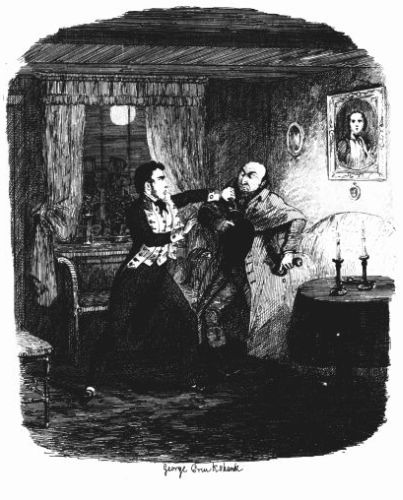
Frank Heartwell seizing Brady as the murderer of his Father.
The question was like an electric shock to the stranger—he started, his countenance became contorted, and in the wild rolling of his eye, Frank was instantly reminded of the period at which he had first seen it when a child in the lawyer's room at Lincoln's Inn. He sprang from his chair, and grasping the man by the collar, exclaimed, "You—you are my father's murderer!" Brady drew a pistol, and presented it at Frank's head—the lieutenant knocked up the muzzle, and the ball flew harmlessly to the ceiling. At this moment two men rushed in to the lawyer's rescue, but[253] not till Frank had wrenched the pistol from his hand, and struck him a severe blow with the butt—the next instant the candles were extinguished, and Heartwell lost consciousness through the stunning effects of a hit on the back of his head, and resigned his grasp; he quickly, however, regained it, and a desperate struggle ensued. At this moment the gardener returned from the manor-house—he had seen a light waggon standing on the common under the care of a boy, and on entering the gate, had been nearly knocked down by a tall stout man, who mounted a horse that was in waiting, and galloped off. Hurrying into the cottage, his timely succour turned the fate of the encounter—the two scoundrels were overmatched; one contrived to steal away, Frank still grasped the other, and having managed to get hold of his dirk that lay upon a sofa, the fellow was wounded past resistance and sank upon the floor. Lights were brought; the lieutenant gazed earnestly on the face of his prisoner—it was not Brady, but Shipkins; for the lawyer, though desperately hurt, had taken advantage of Frank's momentary weakness to throw down the candles and effect his escape, and the lieutenant had unknowingly seized the clerk in his stead.
Great were the consternation and alarm of Mrs. Heartwell on her return from the metropolis, to which she had been deluded by a pretended message got up by the vile confederates. The gardener too was similarly deceived; for the scoundrels, unaware that the treasure had been removed, had hoped to find the cottage destitute of protection, so that they might easily carry off the booty they expected to find. Frank's presence had disconcerted Brady, who invented a plausible excuse, but villany met with detection and punishment, as already described.
When calmness was somewhat restored, it was proposed to send Shipkins to prison in the waggon which had brought him out on his nefarious excursion; but the man was evidently dying, and Mrs. Heartwell conjectured that by detaining him at the cottage, and treating him with kindness, he might be induced to make admissions and confessions which would tend to elucidate the past. At first, however, he was stubborn and morose, and refused the assistance that was proffered him—he was not aware that his last hour was so near at hand, but when assured by a surgeon that he had not long to live, and he was earnestly exhorted to unburthen his mind of guilty concealment before entering the presence of his Maker, the hitherto hardened sinner was subdued—the near approach of death, and the terrors of a future state, wrought powerfully on his conscience, and these increased as his physical energies decayed.
None can tell the agonised suspense of Mrs. Heartwell and the agitation of her son as that period seemed to be drawing nearer and nearer which, they expected, would disclose the fate of a husband and a father. Frank, though much hurt, would not quit his mother, and both occasionally visited the room of the dying man. Remorse at length prevailed, and willing to atone as far as practicable for his misdeeds, he requested that a magistrate might be sent for to take his deposition. Mr. Wendover, acting in that capacity, promptly attended, and to him he revealed acts of enormity and crime in which he and Brady had for years been engaged, particularly the circumstances connected with the victim of their diabolical practices—Lieutenant Heartwell.
[254]