A Deadly Enemy—In the Service of Steinvor—The Way to Church—Crossing the Quivering Flood—The Priest's Caution—A Weird Tale—The Old Hag—The Stream-churl—Steinvor's Husband's Death—The Foundation of the Story—The Troll-woman of Grettir—The Basaltic Troll-wife—The Search under Goda-foss—Grettir's Dive—The Fight with the Stream-churl—Runes of the Fight—A Bag of Bones
The summer was passing away, and Grettir could not remain without shelter through the winter; so he considered what was best to be done. He could not ask any farmer in the north-east to shelter him, because they were all afraid of Thorir of Garth, who would have pursued with implacable animosity the man who befriended and housed the outlaw. Moreover, Thorir had his spies everywhere, and Grettir found he had to shift quarters repeatedly to escape his deadly enemy.
Now, when the first snows fell Grettir sent his man away with his horses across country to Biarg, and he went further away from where Thorir was; but never stayed long anywhere, nor gave his real name. He had no relatives in this part of the island, and no friends.
Now, a little before Yule—that is Christmas—he came to a farm called Sandheaps, on that river which is called the Quivering Flood. This farm belonged to a widow woman called Steinvor, who had recently lost her husband.
Grettir came and offered his services; he said his name was Guest, that he was out of work, and that he had come there because he heard she was short of hands.
Steinvor looked at him, and saw that he was a very powerfully-built man, and that there was a certain dignity and nobility in his face; so she accepted him, against the opinion of the rest in the house, who were frightened at the appearance of Grettir, and did not know what to make of him, whether he were an ordinary human being or a wild man, half mountain-goblin or troll.
It came to pass on Christmas-eve that the widow Steinvor was very desirous to go to church, but the church was on the further side of the river, and there was no bridge.
Grettir heard Steinvor lament that she could not go to church, so he said bluntly: "You can go. I will attend you and see you over the water."
Then she made ready for worship, and took her little daughter with her. Now, at times the river froze hard across, and then it was possible to cross on the ice. At other times it might be traversed at a ford. But when Grettir came to the side of the Quivering Flood, it was plain to him that by the ice the water could not be crossed. For there had been a rapid thaw, and now the river was overflowed and very full of water; and, moreover, it was rolling down great masses of ice.
When Steinvor saw the condition of the river, she said, "There is plainly no way across for horse or man."
"I suppose there is a ford somewhere," said Grettir.
"Yes," answered Steinvor, "there is a ford at this place; but I do not see how it is to be traversed."
"I will carry you across," said Grettir.
"Carry over the little maiden first," said the widow. "She is the lightest."
"I don't care about making two journeys when one will suffice," answered Grettir. "Come, jump up; I will carry you in my arms."
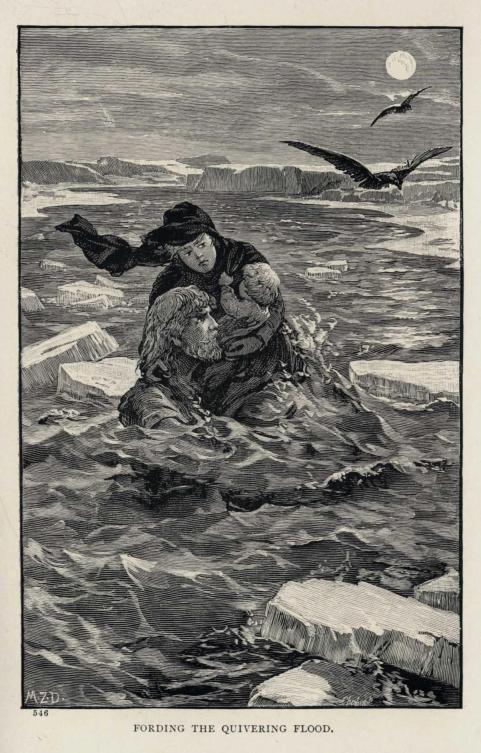 FORDING THE QUIVERING FLOOD.
The widow crossed herself, and said, "That will never do. How can you manage such a burden?"
But without more ado Grettir caught up Steinvor on his arm, and then he picked up the little girl and set her on her mother's lap, and strode into the water; they were on his left arm, but he kept the right free. They were so frightened that they durst not cry out. He waded on in the river, and the water foamed up to his breast; and then he saw a great ice-floe coming bearing down upon him. He put out his right hand, gave the mass of ice a thrust, and it was whirled past them by the current. Then he waded further, and the water washed about his shoulders, and that was the deepest point. After that the river shallowed, and he bore the mother and child safely to the shore and set them down.
Now Grettir turned to go back, and he took up a great stone and set it on his head, and so waded back. If he had tried to go through the water without a stone he would have been washed away; but the great stone on his head enabled him to stand firm and resist the current of the water. Those who have not been through an Icelandic river can hardly imagine the intensity of the cold. I have ridden through these rivers, my horse swimming under me, and when I reached the further side have thrown myself off and lain on the sand for a quarter of an hour before I could recover from the numbness caused by the deadly cold; for some of these rivers are as broad as the Thames at London Bridge, and the water is milky because full of undissolved snow.
When Steinvor reached the church every one was astonished to see her, and asked how she had managed to get across the Quivering Flood. But when the priest heard the story, he called Steinvor aside, and said:
"Mind and do not say too much about your new man; do not talk about his strength, and set folk a-wondering who he may be. I have my own opinion, and I think you will do well to house him, and say nothing to anyone about his being in any way remarkable."
And now there comes into the saga of Grettir a story which is certainly untrue, but how it comes in can be made out pretty easily.
The real truth was, as the saga writer confesses, that Grettir remained hidden at Sandheaps all that winter, and no one in the country round knew that he was there. But then, the saga writer did not feel satisfied with such a dull winter, in which nothing happened; so, to fill out his story and say something interesting, he worked into his history a wonderful tale. The story, which I tell in my own words, is this:—
The Story of the Stream-Troll
There is on the Quivering Flood some miles below Sandheaps a mighty foss, or waterfall. The whole river pours over a ledge in a thundering, magnificent cascade. The stream in the middle is broken by an island. You can hear the roar of the falling water for a long way around, and see the spray thrown up from the fall like a cloud or column of steam rising high into the air. This waterfall is called Goda-foss, and was long supposed to be the finest in the island; but there is another, which I was the first to see, on the Jokull-river, called Detti-foss, which is infinitely finer, but which is in a region of utter desert of sand and volcanic crater, many miles from any human habitation.
It happens that there is a curious black lava rock standing near the river, higher up than the fall, which bears a quaint resemblance to an old woman, and this stone is called The Old Hag; and the story goes that it is a troll-woman turned to stone.
Now, you must know that throughout Norway and Iceland, and, indeed, wherever the Scandinavian race is found, a superstition exists that every river has its spirit, that lives in the river; and it was held that these river-spirits demanded a sacrifice of a human life, at least once a year. If a sacrifice were not given to them, then they took some man or woman, when crossing the water, and carried the victim away. And in heathen times there can be no doubt whatever that human sacrifices were offered to every river; generally an evildoer or a prisoner was thrown in and drowned, to propitiate the Stream-churl, as he was called, so that he should not snap at and carry off other and more valuable lives. Wherever there was a cataract, there the Stream-churl was believed to live, hidden away behind the curtain of falling water. If the stream was small, then this spirit or demon was small; if, however, it were a mighty river, then the spirit was a great troll or giant. Even to this day in Iceland and Norway, the ignorant and superstitious believe that there are these Stream-churls, and tell stories about them, and cannot but suspect that, when anyone is drowned, it is the Stream-churl exacting his toll.
Now, it is quite certain that Steinvor, although she was a Christian, believed in there being a great Stream-churl living under Goda-foss; and as she had lost her husband and one of her servants who had been drowned in the Quivering Flood, she held that they had been carried off by the Troll of the waterfall.
There had been, as it happened, something mysterious about the death of Steinvor's husband. Two years before Grettir came to Sandheaps, on Christmas-eve, he had disappeared. She had gone off to see some friends at a distance, and when she returned home next day she heard that her husband had not been seen—he was gone, and not a trace of him remained. It occurred to her that in all probability he had gone across the river to church, and had been carried off by the river—that is, by the Stream-churl. But she could be certain of nothing, and she was greatly distressed because she could not give his body burial. A year passed and not a word about her husband could she hear. His body had not be found anywhere washed up by the river, supposing he had been drowned.
Next year she lost one of her men-servants in the same way. He vanished, and none knew how or whither he had gone. If he had run away, she would probably have had tidings of him; but she heard none, and his body was also never found.
I have no doubt that she told Grettir about this, and also that she believed that the Stream-churl who lived under Goda-foss had carried off both her husband and the servant. I believe also that, to satisfy her, Grettir undertook to look, and that he actually dived under the fall, and came up and searched between the sheet of falling water and the rock, and found—nothing.
That is the foundation of a wonderful story which has found its way into the saga. It did not satisfy those who told the tale of Grettir that he should have spent the winter at Sandheaps and done nothing—that he should have dived under Goda-foss and found nothing.
So by degrees old nursery tales got mixed up with this incident about Grettir's search for the Stream-churl, and all was worked into a wonderful story, which you shall hear.
On that night on which Grettir had carried Steinvor across the river, he returned to the farm, and lay down in his bed.
When midnight arrived, then a great din was heard outside, and presently the hall door was thrown open and in through it came a gigantic woman, a Troll-wife, with a trough in one hand and a huge chopper in the other.
As she entered she peered about her, and saw Grettir where he lay, and she ran at him. Then he jumped up and went to meet her, and they fell a-wrestling terribly, and struggled together so furiously, that all the panelling of the hall side was broken.
She was the stronger, and she dragged Grettir towards the door, and forth towards the entrance, in spite of all his efforts. She had got him as far as the entrance, when there he made a final struggle, and in the struggle the door-posts and fittings were torn from their place, and fell outwards.
Then the Troll-woman laboured away with him towards the river, and right down towards the gulfs.
Grettir was exceedingly weary, yet he saw that his only chance was to make a last effort, or be flung by her over the edge into the deep, boiling river.
All night they contended in such fashion, and ever was he drawing nearer to the edge. But just as she was preparing to fling him into the water, he got his right hand free, and he swiftly seized his short-sword, and struck off her arm; and at that moment the sun rose, and the Troll-woman was turned into stone. There she stands with her amputated arm-socket, as a mass of black basalt or lava to this day.
If the reader will recall the story of Grettir's struggle with Glam at Thorod's-stead, in the valley of Shadows, he will see that this is only the same story over again almost in every particular,—except that the first fight was with a man, and this is with a woman. The reason why this story was concocted and put in here, was to account for the stone figure which stands by the river, and which is called the Troll-wife. So far the story carries its character on its face.
Now we will go on to the next part of the tale. It did not satisfy people that Grettir should have dived under Goda-foss and found nothing, so the story was thus told:
When the goodwife, Steinvor, came from church, she thought that her house had been rudely handled; so she went to Grettir and asked him what had occurred. Then he told her all, and she prayed him to go and make a search for her husband's bones, under Goda-foss.
Grettir consented, but he asked that the priest might be sent for. His name was Stone. Steinvor sent for him, and Stone was curious to know whether his suspicions about this stranger were true. So he asked him questions, but Grettir answered that if the priest wanted to know who he was, he must find out. The priest laughed at the story of the Troll-wife, and said he did not believe a word about the struggle.
Then Grettir said, "Well, priest, I see that you have no faith in my tale; now I propose that you accompany me to Goda-foss, and we will search for the Troll himself, and see if we can recover the bones of Steinvor's husband."
The priest, Stone, agreed, and they went together to the side of the waterfall, and they had a rope with them.
Stone shook his head, and he said, "It would be too risky for anyone to venture down there."
"I will go," said Grettir. "But you mind the rope."
The priest drove a peg into the sward on the cliff, and heaped stones over it, so as to make the end firm, and then he seated himself by the heap.
Then Grettir made a loop in the end of the rope, and put a stone through the loop, and threw the stone down, and the end of the rope went to the bottom of the gulf.
"How are you going down?" asked Stone.
"I shall dive," said Grettir.
Then he stripped, but girt on a short-sword, and so leaped off the cliff into the foss. The priest saw only the soles of his feet as he went into the water, and then saw no more.
Now, Grettir had gone in below the fall, and he dived and went under the curtain of water and came up near the rock. The whirlpool below the falls was so strong that he had a desperate struggle with the water before he could reach the rock.
When he rose, he saw that the water fell over a lip of rock, quite clear, and that in the face of the rock was a cavern, and that smoke issued from this cave, and mingling with the spray and foam passed away, and was not discerned beyond.
Grettir climbed over the stones into the cave, and there he saw a great fire flaming from amidst brands of drift-wood; and there was the Stream-churl seated there, a great Troll with a hideous face. When he saw Grettir he roared and jumped up, and caught a glaive that was near him, and smote at the newcomer. Grettir hewed back at him with his short-sword, and smote the handle of the glaive and broke it. Then the giant stretched back for a sword that hung up to a peg against the side of the cave, but as he was thus leaning back Grettir smote him across the breast, and cut through to the ribs, and gashed open his belly. The blood poured forth out of the cave and mingled with the stream. When the priest saw the bloody foam beneath the fall, he was so frightened that he ran away, for he made sure that Grettir was dead.
Grettir remained in the cave, standing across the giant, till he had killed him. Then he took up a flaming brand and searched the cave through. He found nothing more than dead men's bones, and these he put together into a bag, threw that over his shoulder, and went again into the water.
He rose beyond the foss and looked up, but could see nothing of the priest; so he caught the rope, and by means of that he swarmed up to the top of the cliff.
Then he sat down, and with a sharp knife he cut runes on a staff. And what he wrote was this:
"Down into the gulf I went, Where the rocks are widely rent; Where the swirling waters fall O'er the black basaltic wall; Where, with voice of thunder, leap In the foaming darkling deep. There the stream with icy wave Washes the grim giant's cave."
He had cut as much as he could on one stick, so now he took another, and on that he cut:
"Dreadful dweller in the cave Underneath the falling wave, Fierce at me he brandished glaive; Full of rage at me he drove, Desperate we together strove. Lo! I smote his halft in twain, Lo! I smote and he was slain, Bleeding from each riven vein."
Then Grettir carried the bag of bones and the staves to the church, and laid them in the porch.
Next morning when the priest came to the church he found the bag of bones and the staves.
Such is the story.
Now, it is clear that a good bit of it is simply transferred from the story of Grettir going down into the cairn of Karr the Old.
The real truth of the tale is no more than what has been stated, that Grettir went under the waterfall and found nothing. It is, of course, possible that he may have hoaxed the priest; but I think it more probable that all this marvellous matter is simply tacked on to one simple fact, and that it was taken, partly from the story of Grettir in the barrow of Karr, and partly from that of his struggle with Glam.
What the saga writer does admit is that the versions of the story do not quite agree, and that—in spite of this wonderful achievement, folks did not know that Grettir was at Sandheaps that winter.