“All the particulars of the woodwork,” continued Eugène, “ought to be furnished before a house is begun to be built, for the first consideration in work of this kind is selecting the materials, and only employing wood that is thoroughly dry, and has been sawn out some years. We have had but a short notice, and have not been able to pay attention to this important part of our undertaking. Fortunately I am acquainted with a joiner at Chateauroux, who has a stock of well-seasoned wood of good quality, which he is not very willing to part with, as he keeps it for special work; but he will let us have some, as your father has rendered him some services.
“But while only sound and dry wood must be employed in our joiner’s work, it is not less necessary to combine the parts according to the nature of the materials, and not infringe the conditions imposed by them. Wood is sawn according to certain dimensions dictated by custom and the size of the trees. Thus, for example, a plank is only 8 or 10 inches broad, because trees fit for joiner’s work are scarcely of larger diameter, when the sap-wood is removed; in making panels, therefore, it is advisable not to have them more than 8 or 10 inches wide, that they may not exceed the width of a plank. If two or more boards are joined to make a panel, they will[Pg 215] separate in drying, and leave a space between them; whereas, if we give each panel only the width of a plank, even if it should shrink, the shrinking occurs in the tongue, and there is no disjointing. These tongues must, however, be wide enough to bear the shrinking without leaving the rebate. You will understand that better by and by.
“In the last century many doors were made wide-framed, that is, doors the panels of which, framed in moulding, are from 16 to 20 inches wide; this was the fashion. But at that time they employed none but very dry wood, that had been felled and cut up for several years; and these panels, made of two boards, notched or simply jointed, did not shrink. You see doors thus made in your father’s drawing-room, and there is only one in which the panel has opened. In the present day such wood cannot be got for love or money; we must therefore be content to give up those wide panels. Or, if we insist upon having them, they must be made of white wood—of sycamore, because this wood dries quickly, does not split nor warp, that is, it does not curve across the grain. But sycamore is a soft wood, liable to be attacked by worms, especially in the country. Let us therefore keep to oak, and construct our doors so that the panels may be only about 8 inches wide. We have folding and single doors. The folding doors are 4 feet wide; the doors of a single leaf 32 to 40 inches. Their height varies from 7 ft. to 7 ft. 4 in.; for it is quite useless to make them higher, as we do not walk into our rooms with crosses and banners, and the human stature rarely exceeds six feet. There are many inconveniences in having doors too high; they are liable to twist, are not easily shut, and, if it is cold, every time they are opened they let a considerable volume of damp, freezing air penetrate into the rooms, chilling them proportionately.
[Pg 216]
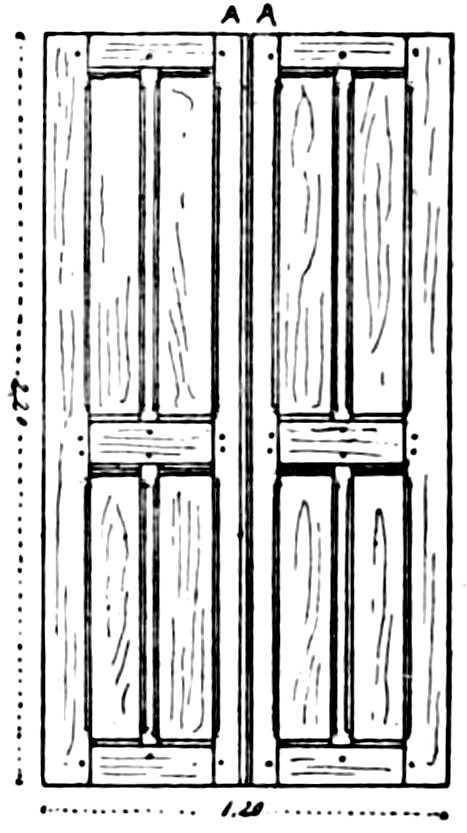
Fig. 56.
“Let us begin, then, by drawing a folding-door. We shall make the framing of this door of wood 1¾ inch thick. We call the outer upright pieces (Fig. 56) the hanging-stiles; the pieces, A, the meeting-stiles; the horizontal pieces between them, the rails. The stiles and the top and bottom rails shall be each 4¼ inches wide, the intermediate uprights, or munton, 2 inches. Now each leaf—deducting ½ an inch for the rebate, or overlap, in the middle—will be 2 feet wide, since the doorway must have an opening of 4 feet: deducting 4¼ in. + 2 in. + 3¾ in. for the two stiles and the munton—total, 10 inches—there remain 14 inches for the two panels, i.e., 7 inches for each panel. The middle rail must be placed so that its centre shall be 3 ft. 4 in. from the ground; for it is on this rail the lock is fixed, and this rail should not be less than 6 inches wide, so that deducting for the mouldings, say 2 in., there still remains 4 in. for the room of the lock, whose box is usually from 3 to 4 in. wide. This kind of door is called square-framed: all the joints being square, without mitres,[Pg 217] and the panels being narrow, these doors do not give, and are perfectly ridged.
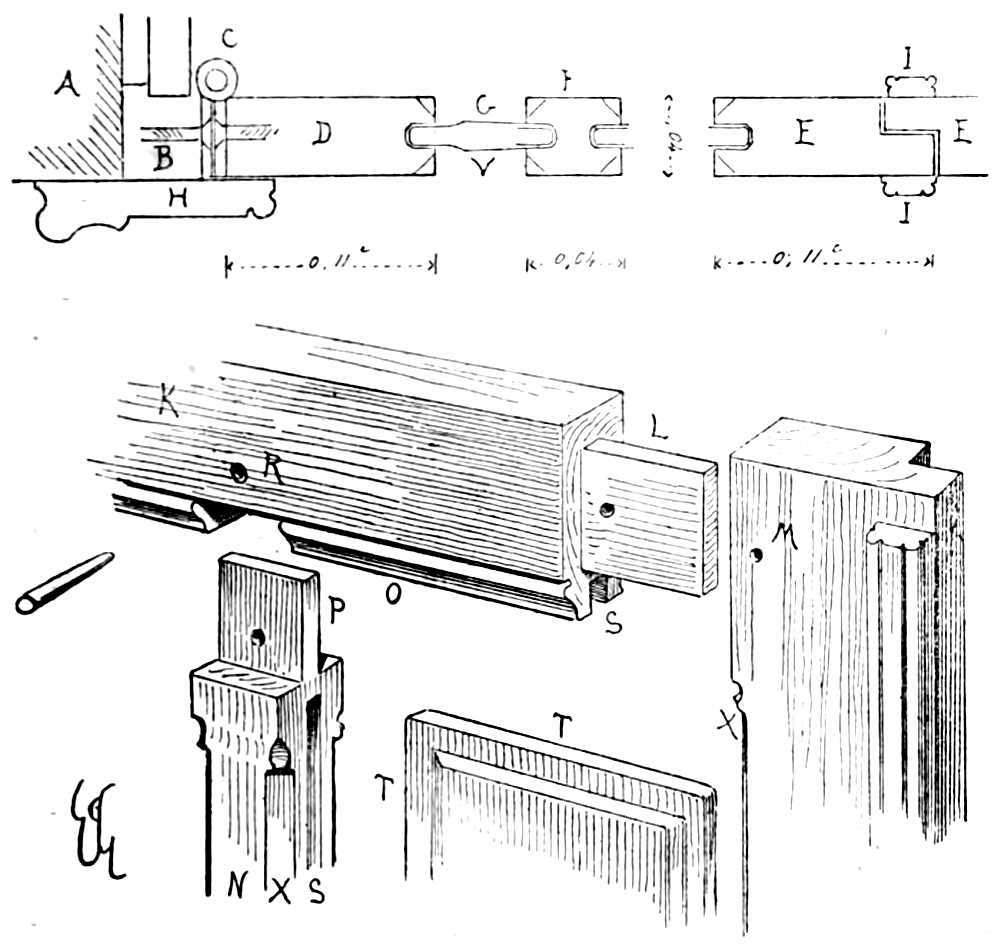
Fig. 57.
“Here is a detail of this framing (Fig. 57): Let A be the wall-jamb of the doorway; a door-frame, B, is fixed by means of iron stays to this jamb. To it are fastened with screws the hinges, C, on which the door-leaves swing. D is the hanging-stile; E E, the meeting-stiles; F, the intermediate munton; G, the panels, with their tongues in the grooves. The architraves, H, form a rebate around the hanging-stiles and the top rail. Moulded strips, I, are affixed along the rebate of the meeting-stiles, in order to strengthen the rebate, and to present to the hand a rounded[Pg 218] edge that does not hurt the hand or fray the dress. At K is denoted the top rail, with its tenon, L, fitting into a mortice, M, which should be cut right through the stile. At the juncture of the intermediate munton, N, the moulding, O, is cut square off to make way for the head of the munton, whose tenon, P, goes into a mortice, R. At S you see the groove into which fits the tongues, T, of the panels; which are increased in thickness at a certain distance from the tongue, as you see at V, to about ⅞ths of an inch. You will observe that the chamfers, X, of the stiles stop beneath the joints, in order to leave these all the strength of the wood. Doors of these dimensions will require three hinges to each leaf.
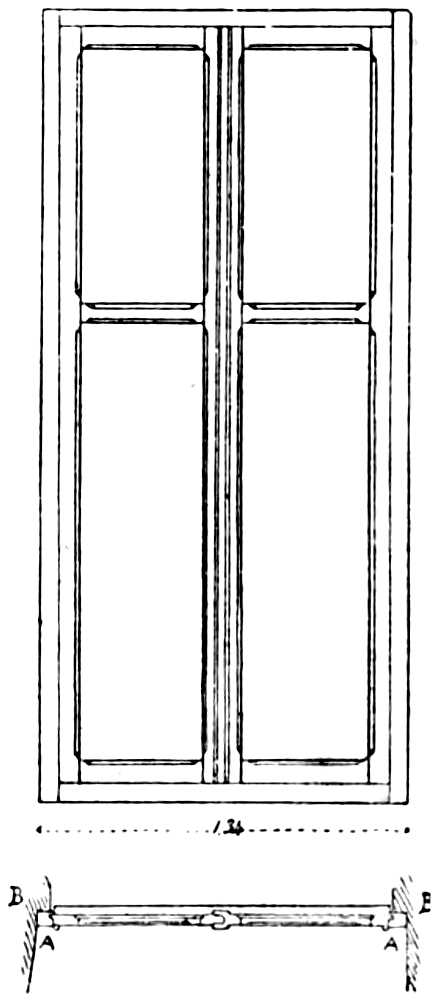
Fig. 58.
“This explanation gives you the key to all good ordinary house joinery. The rule is a simple one: never to weaken the wood at the joints, always to make these square, and not to exceed the sizes of ordinary scantling.
“Our single-leaved doors will be made according to this system. We have lastly to consider the window-casements. In these we shall follow the same principle, that is, we shall avoid the defective mitre joints, and have none but square joints. Here (Fig. 58) is one of these casements, which consists of a fixed frame, A, fastened into the rebate of the stone-work, B, and of two folding casements. The wood of the casements shall be[Pg 219] 1½ in. thick, and the meeting-stiles shall lock one into the other. To lessen the difficulty of glazing, or to avoid the necessity of using plate-glass, we will divide the length by a small bar, C. You will require the details of these window-casements. I give them to you drawn in Fig. 59.
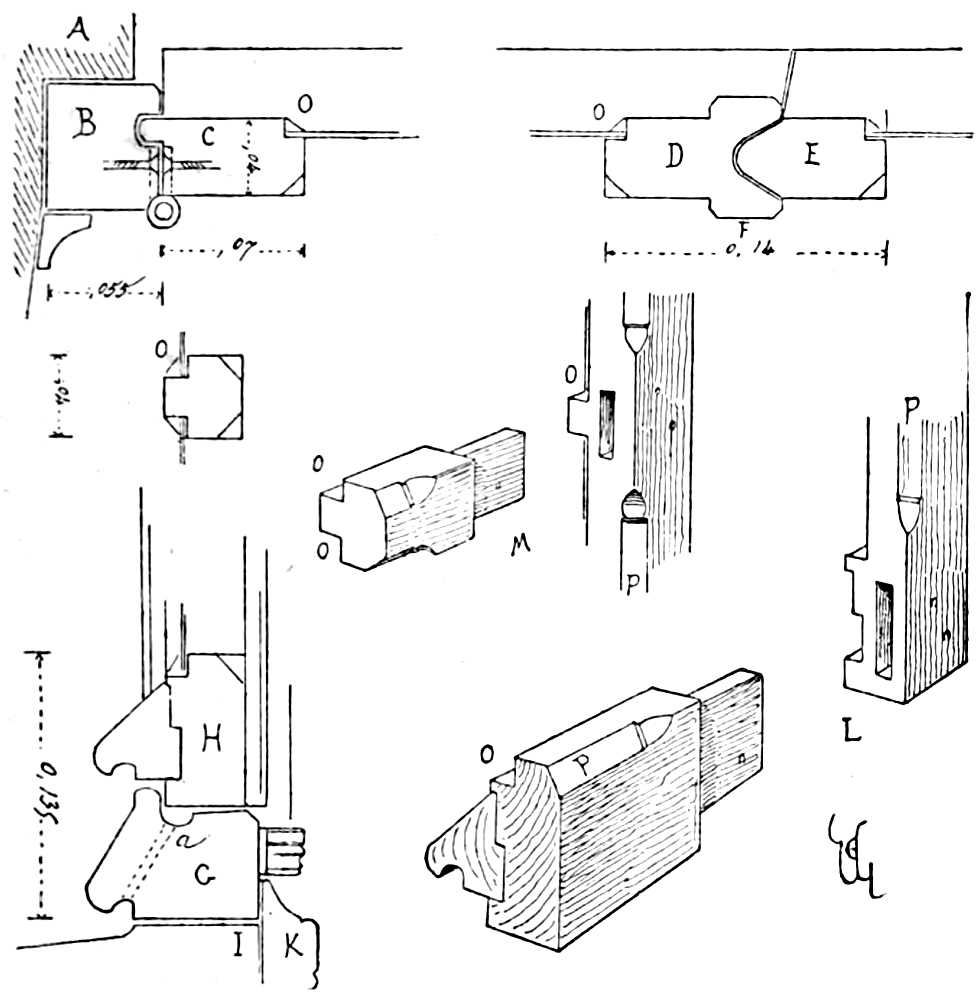
Fig. 59.
“At A I have marked the rebate of the window-jamb; at B the fixed frame; at C one of the stiles which works into the frame, with the tongue to stop the passage of the air; at D and E, the right and left hand meeting-stiles, with their method of locking. On the projection, F, is affixed the crémone, or fastener. The detail, G, gives you[Pg 220] the section of the sill-rail of the frame, with its water-stop, intended to hinder the rain or snow from penetrating to the inside. But as it happens that in spite of this precaution the driving rain sometimes finds its way into the rebate, a small channel, a, must be sunk in this rebate, with two escapes, that the water may not flow through, and down the inner surface of the sill, I. In order to cover the junction of the wood sill-rail and the stone sill, we shall affix the moulding, K. At L I denote for you the framing of the bottom rail of the casement and the stile; and at M that of the glazing-bar and the same stile. At O you will observe the outside rebates to receive the glass, and the chamfers, P, with stops on the inside to leave at the joints all the strength of the wood. Besides the three hinges necessary for each leaf, we must take into account the angle-plates at top and bottom to secure the casement from straining the joints and giving down in the middle, for the glass cannot serve like door panels, which stiffen the framing. On the contrary, the glass, by its weight, tends to put these casements out of shape.
“You are going to set to work at these details, Paul, and I will correct your drawings. Furnished with these designs, you will then go to Chateauroux and show them to the person who undertakes the work, and he will fix his prices. You will supplement the drawings by explanations, keeping clearly in mind what I have told you, and bring back his estimate. I will also give you an introduction to an engineering friend of mine at Chateauroux who will receive you as a relation, and who will be able to give you any further information you require.”
Madame de Gandelau at first objected to Paul’s journey; but being assured that Eugène’s friend would be at the station to receive the young architect, and that he would[Pg 221] be entertained by a family who would be glad to receive him, his mother was satisfied. Besides, his absence would be for three or four days only, and Chateauroux is but fifty miles from M. de Gandelau’s residence.
[Pg 222]