Although Paul could have returned to the Lyceum at Paris in June, Madame de Gandelau insisted upon her son remaining at home during the summer. She was afraid of typhus. Anxiety, moreover, was felt respecting the tranquillity of the great city which had been so cruelly tried and injured. A tutor in the neighbourhood—a man of more learning than is usually possessed by those modest substitutes for the highest class of educators—came therefore every day to read with Paul for an hour or two, that he might not forget his Latin; and the rest of his time was devoted to superintending the works, which were visibly advancing. The walls were built, the floor-joists fixed, and they were beginning to raise the timber-work of the roofs; and though there were no longer so many details to be given to the workmen, the surveillance had to be more minute, especially as Eugène would not allow anything to escape observation, and insisted upon having an account of everything. Sometimes, when Paul returned from the works, Eugène would ask him if he had seen such or such a part. If Paul hesitated, he would say to him, “Well, my dear fellow, you must go back and see that, and bring me an account of it—not to-morrow, mind, but directly.” And Paul would have to mount his pony again. So in order to avoid these goings and comings, which seemed to him at least monotonous, he had acquired the habit of not[Pg 231] returning till he had examined in detail all the points respecting which his cousin could possibly question him. It was especially to the chain-rods that he had directed Paul’s attention. He would ask him repeatedly how the claw ends were bedded; and if the explanations did not agree, Paul had to return to the works, and not leave them till he had seen with his own eyes that things had been done according to order. Besides this, Eugène visited the works three times a week with Paul, and instructions were given to the builders in his presence. The former always took care to make his clerk of works repeat these instructions to him, to be certain that they were understood.
The gutters, the discharge of the rain-water, and the roofing now required attention.
“Country builders generally manage roofing but indifferently,” said Eugène, “and especially the plumber’s work. We shall therefore have to be specially careful about this important part of our undertaking; for a house badly roofed is in the same condition as a man incompletely or badly clothed. Both contract incurable maladies. We have no good roof-plumbers here, and must make up our minds to send for some from Paris. That will cost us a little more; but it will be a saving in the end, for we shall avoid incessant repairs and irreparable bungling. As for the slating, we will fasten it with hooks.
“Slates are commonly fastened on deal battens, by means of nails; but to drive these nails into the laths the slate must have two holes made in it, since each is secured by two nails. With the force of the wind the slates shake about, make the holes larger, and ultimately slip off the head of the nails; then they fall. To replace a single slate several must be removed, and the last must necessarily be pierced below the overlap, that is, in the uncovered part of the slate. With hooks we avoid these disadvantages, and anyone can repair the roof. These[Pg 232] hooks are made of copper, which allows them to be opened and closed many times without breaking them. Moreover, the slate, being held down at its bottom end, cannot rattle with the wind, and nothing can displace it. In the ordinary mode of (French) slating there are—one over the other—three thicknesses of slate. The exposed part being 4½ inches—the slate is then 13½ inches long. The laths are nailed on the rafters 4½ inches apart from centre to centre (Fig. 60). Thus at A you see the position of the laths and that of each slate. The hooks lie upon the under slate, in the interval between the intermediate slates, and clip the lower end of the outer slate. At B I show you, in section half full size, the lath, C, nailed upon the rafters, and the hook, whose point is driven into the lath, with its return, E, clipping the exposed end of the slate. So much for the plain parts of the roof; and now for the returns—the hips and valleys. Where these occur, as the slates are not flexible, we must make use of lead or zinc; the first of these metals is much the best, and is less liable to crack and to oxidize. We shall cover the hips with short lengths of lead bent to the form, nailed, and worked in with the courses of slate. In the valleys we shall lay a sheet of lead, on which at either side the slates will lie.
“But you will study the manifold details of roofing when the men are at work, for labour of this kind requires minute care. We have to struggle with a subtle foe—water. It discovers every interstice, and takes advantage of the least negligence to make its inroads; and so much the more since, driven by the wind, it acquires a power and an activity which it would not possess if it fell vertically, like properly-behaved rain. So in climates where showers are gentle and fall only in calm weather, the roofs are simple, and do not require the innumerable precautions demanded among ourselves; and that is why I adopt the plan of[Pg 233] securing the slates with hooks. Here the westerly and north-westerly winds are violent, and drive the rain and snow under an angle of 30°. Slates held only at the top do not lie close, and tilt up at their outer extremities, and the rain and snow soon get in. That is also the reason why we have given our roofs an angle of 60°; for the rain, when violently driven, generally descends perpendicularly to this inclination, and there is then no danger of its getting under the outer extremity of the slates.
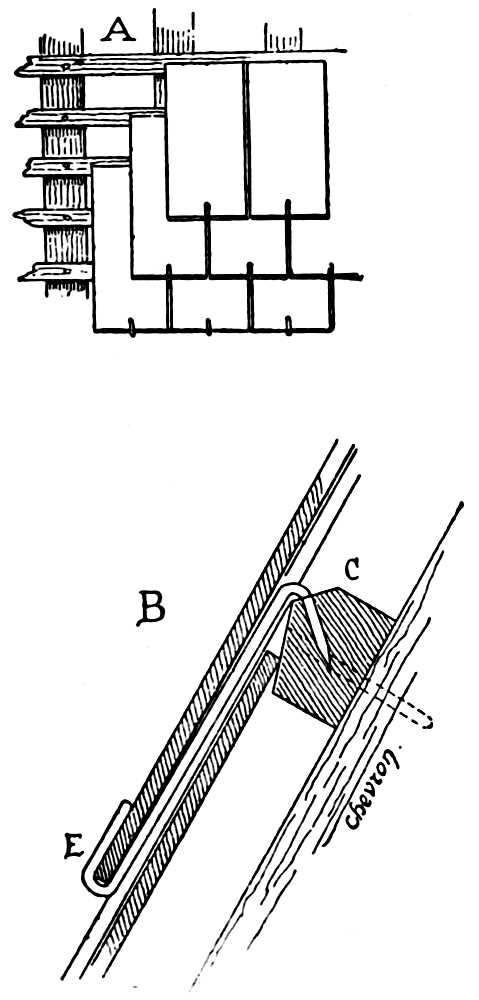
Fig. 60.
[Pg 234]
“The arrangement of the gutters also requires great attention. Their channel should have a sufficient inclination—say an inch in a yard—to ensure thorough clearance; but each length of lead or zinc forming the channel should have a drip—a slight step of 1½ to 2 inches—that the water may not find its way under the joints. These requirements necessitate our giving to the gutters a sufficient depth to get these falls from the culminating points to the discharges, or down-pipes, and that these pipes may not be too far from each other, so that the water may not have too long a course to make. Besides this, we should contrive on the front of the gutters, issues, or small spouts for overflows, so that if the snow or ice should encumber the orifices of the down-pipes the water may run off. It is, moreover, desirable to give the back of the gutter a greater height than the front, that the water may in no case get inside. This, then (Fig. 61), is the section we shall give to our gutters. The stone course, A, behind the gutter being 16 inches high, the board which forms the front of the gutter shall be 13 inches. You remember that upon the cornice-table we left a slope forming a hollow between each joint, to ventilate the bottom of the gutter and to ensure the escape of the water in the event of an overflow. Our gutter, then, will consist of an oak board, B, forming the bottom, of a side, C, forming the front, and of a roll or bead fastened on the top edge of the front. This front board is to be slightly inclined, that the lead lining may have less tendency to give down.
“The eaves of the roof being at D, our lead lining shall be fastened at E by nailing, follow the section of the gutter, and be doubled over at its edge, G. We shall cover the front with another sheet of lead, also doubled over at its top and bottom edges, H I, with clips of zinc screwed to the board. This lead covering of the front will be held by screws, whose heads must be covered with little caps, a, [Pg 237]soldered over; then a roll, K, will cover the bead and fold under the doubled edges, G and H.
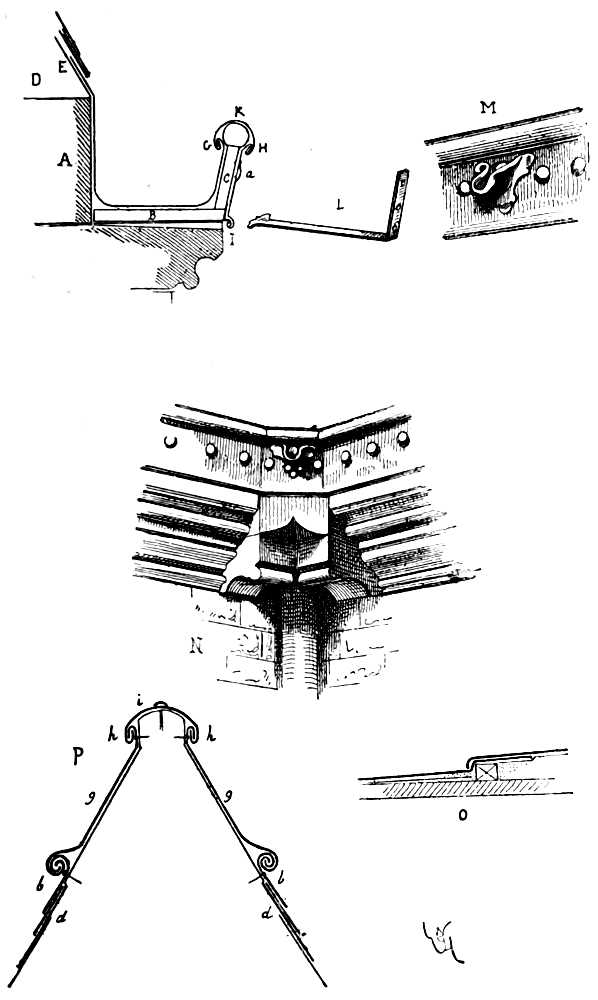
Fig. 61.—Details of the Plumber’s Work.
“But previously, the bottom and fronts of the gutters will be attached by means of angle-irons, L, sunk-in flush, and which are let into the wall at the bottom of the course, A. These angle-irons will come on the outside, and not on the inside of the gutter. At regular distances, in the gutter-front, we shall bore the holes for the little spouts, M, which serve as overflows.
“The down-spouts, placed in the angles of the building, will pass, at their upper orifice, through an opening contrived in the cornice, as shown by the detail, N. A funnel of lead will connect the bottom of the gutter with the orifice of the cast-iron down-pipe, and will be soldered, of course, only to the bottom of the gutter, resting loose in the part which enters the down-pipe.
“In order to obtain the necessary falls in the bottom of the gutter, we shall run in a thickness of plaster, with stops of wood for the drips at the end of each length of the lead lining, as you see at O. These sheets of lead should not exceed 10 feet each in length.
“The ridges of the roofs and dormers shall also be of lead doubled and folded, as shown by the sketch, P. Two strips of lead, b, are first nailed on to cover the slate, d; then the upper half of these strips are rolled and folded into the sheet, i, which covers the ridge roll. This last piece of lead is, besides, held by screws, whose heads are covered by a bit of lead; thus there is no danger of its being displaced by the wind.
“I describe to you here only the principal points in the roof-plumber’s work, which requires very great judgment and extreme care. You will be able to study it practically in detail when we have good plumbers at work. Some of the Parisian plumbers possess remarkable skill. They will also attend to the arrangements for the supply[Pg 238] of water in the house—the water-closets, baths, &c. But I have an important piece of advice to give you: Lead laid on oak that has not been steeped in water oxidizes very rapidly. The acetic acid which this kind of wood contains changes the sheets of lead placed on it into ceruse in a few months, especially if the wood is not sufficiently ventilated on the opposite side. I will therefore point out to you the only kinds of wood that should be employed for the gutters and ridge rolls. We will take old wood from the remains of the old mill, which when cut up will be in the condition required, for this wood has long ago discharged its sap.
“Your business, as clerk-of-works, when the plumbers begin their operations, will especially consist in having the metal that is brought in carefully weighed, and having the clippings safely put by in your presence. These men, accustomed to occupy themselves with their craft, work somewhat after the fashion of artists, and are inclined to disregard material interests; they leave their lead and tin about in every corner. You must be aware that we ought not to expose our country fellows to such strong temptations.
“You must therefore weigh all the materials as they come in, and then the clippings. These will have to be put by in your presence in a place securely locked. The difference between the weight of metal that comes in and that of this residue is the amount with which we are chargeable, as lead work is paid by weight.
“The joiner’s contract you have brought me promises, I believe, that the flooring, doors, and window-frames shall be sent at the end of August?”
“Yes; and as regards the floorings, the contractor tells me that, having a good store of wood, he could begin laying them on the 1st of August.”
“That would be too soon; we must let the whole building[Pg 239] dry a little first. He is an energetic man; if he begins on the 1st of September he will have finished by the 1st of October. We will have the painters in then, and by the 1st of December our house may be considered finished.
“We must remember the marble-mason also, and send him an order for the mantelpieces. It is not too soon to think about it. Have you given the joiner the dimensions of the fireplaces?”
“Yes; they were marked on the plans.”
“Well, make a copy of these plans, and we will send it to the marble-mason. For this article also we shall have to deal with a Paris house; it will be cheaper to do so, and we shall have a greater choice. It is a very troublesome thing to be obliged, as we are now-a-days, to have recourse to Paris for a hundred matters of detail with which building is concerned.
“But except in certain great cities, such as Lyons, Tours, Bordeaux, Rouen, Nantes, and Marseilles, where you may find warehouses tolerably well furnished, the provinces supply nothing. It was not so formerly; this is one of the results of our excessive centralization.
“I do my best to oppose this fatal tendency; but when time presses we must have recourse to those great centres of manufactures connected with building. If we ordered our chimney-pieces at Chateauroux, or even at Tours, we should have to wait half-a-year and pay more for them. The dealer of whom we ordered them would be sure to send to Paris for them, and we may quite as well go to the fountain-head ourselves. As regard the conservatory vestibule opening on the garden, and the shelter over the entrance, our blacksmith aided by a full detail of particulars will be able to execute them; he is an intelligent workman. Country carpenters and blacksmiths are generally competent men.”
“Why are they so?”
[Pg 240]
“Because the carpenters have kept up their organization or corporations, or at least something equivalent, and workmen have to give proof of their efficiency before they can enter the guild.
“The blacksmiths, on the other hand, have kept up their habit of working at the forge; and the forge is the soul of blacksmiths’ work. In the large towns, on the contrary, casting is all the fashion; and artisans connected with the building trades have lost their skill in the finer labour of the forge. They have become mere fitters. However there has been a reaction during the past few years, and at the Exhibition of 1867 you might have seen excellent specimens of wrought-iron. Architects also have become unaccustomed to work of this kind, and very few know how iron is wrought by the hammer, or how welding is done; so they give instructions to contractors which are incapable of being executed, or which occasion them much useless labour. Architects ought therefore to be acquainted with the methods of workmanship in every department of labour they call into requisition, and it is not at the École des Beaux-Arts they will learn that. It is now more convenient to persuade them that matter was made to obey all the fancies of the artist; that serves as an excuse for explanations, and makes teaching less complicated. The tax-payer and the owner of property who has occasion to employ an architect pay for this admirable doctrine rather dearly; while, without superior guidance, the manufactures connected with building suffer perversion in endeavouring to realize the fancies of these gentlemen.”
[Pg 241]