Matters had been proceeding according to arrangement; the painters’ work, begun at the commencement of February, in fine weather, was finished in April, and likewise all the accessories. M. de Gandelau, who had returned to his estate at the end of January, had caused the small park round the house to be planted, and had ordered the most indispensable furniture, wishing to leave his daughter to make choice herself of those articles which would express her own particular taste.
Madame Marie had announced April as the time of her return, and subsequently May. In the correspondence between her mother and herself nothing had been said about the house since the war. Madame Marie had probably not regarded as serious what had been written to her respecting it; and the disastrous events of the years 1870 and 1871 seemed to have made all parties forget the project.
Paul had set his heart on a surprise, and had entreated Madame de Gandelau to say nothing about the house to her daughter. And we may be sure that Madame de Gandelau had readily acquiesced in his wish.
They therefore wrote to Madame Marie that the family would not assemble at the château till Whitsuntide, and that as her father had some journeys in prospect in the[Pg 248] interior, she need not hurry herself about returning to France before that date. Madame de Gandelau received, on the 8th of May, a letter informing her that her daughter and her husband would reach the station nearest to the château on the morning of the 19th, Whit Sunday.
Great was Paul’s joy when he received the news. He would be able to be at home and enjoy his sister’s surprise, for he had been sadly afraid she might come while he was at the Lyceum. That would have been a dreadful disappointment to him. So he worked harder than ever during the days between that and Whitsuntide! He had set his heart on giving pleasure to all at home by carrying off one of the highest prizes.
The holidays impatiently waited for, at length arrived. M. de Gandelau, on account of the distance, and Paul’s satisfactory progress, had obtained permission for his son to return on Saturday morning. Paul therefore reached the château at noon, after more than seven months’ absence. We need not state that Eugène had been invited to this family fête. Paul would hardly take time to eat his breakfast, he was so impatient to see the house.
“Don’t be in such a hurry,” his mother said more than once. “The house won’t run away.”
During breakfast, his father put one or two questions to him respecting his studies; but Paul gave only short answers, and then returned to the subject of the house, overwhelming his cousin with inquiries.
“And the woodwork, is that a success? And the painting? What colour is the drawing-room? And the plumber—has he put the cresting on the roof that he promised?”
“You are going to see all that directly, and before night you will have plenty of time to examine everything in detail. A little patience! Patience is the very first virtue of an architect.”
The aspect of the new house was much changed since[Pg 249] Paul’s departure. The ground had been cleared and neatly gravelled. The borders exhibited their spring attire; and as some old trees had been left standing in the neighbourhood of the house, it had quite the look of a place already occupied. Paul could not help jumping for joy on seeing how charming and picturesque the building was. On turning down into the valley, he began to run, eager for a nearer view, and Eugène reached the steps only a few minutes after him. Paul had seen neither the shelter at the entrance, nor the conservatory opening into the billiard-room. The lead-work was not quite finished when he left, and the vanes and cresting were not put up. The dormer windows were not surmounted by their finials. The casements were just put in, but not glazed. These last additions are like the bordering round a drawing, or the frame inclosing a picture; to unpractised eyes the last accessory seems to put every part in its proper place, clears the whole, and gives it the unity that seemed to be wanting.
Paul was satisfied with the exterior aspect.
The interior, though simple, according to M. de Gandelau’s express instructions, was in good taste; there was nothing to be seen in the way of plaster ornament or gilding. The entrance-hall was surrounded by a low oak wainscot, forming part with the door-cases. The wood of the latter and of the wainscot had preserved its natural colour, and was simply dressed with linseed-oil and wax. Above the wainscot, the walls, painted stone-colour, set off by a few red lines, gave a neat and inviting aspect to the entrance. The drawing-room was surrounded by a wainscot five feet high, painted white; the fireplace, wide and lofty, could warm a numerous circle. The jambs of the fireplace were cased with wood, and on the lofty mantelpiece, in an oaken frame, was prettily painted a bird’s-eye view of M. de Gandelau’s estate. The ceiling, with its two beams[Pg 250] and joists, painted in light tones, set off by black and white lines, seemed to enlarge the apartment, and gave it a warm and habitable appearance, presenting on hot days lights and shades of an amber tint. The wall between the ceiling and the wainscot was hung with painted canvas. The chimney-piece stood out in bold relief on this back-ground. The entrance end of the drawing-room would have been rather sombre if the wide opening into the billiard-room had not flooded it with light, softened by the verdure of the plants within the little conservatory. But what gave the drawing-room a character which fascinated Paul at once, was the bay-window, all brilliant with light, and furnished with a chintz-covered divan. The billiard-room, also, was surrounded by a wainscoting of unpainted oak, and the same painted hangings. A portière closing over the bay-window made it serve the purpose of a little boudoir, whence there was a charming view on three sides. The plants placed in the conservatory, transmitted on the south side only a softened and tranquil light into the billiard-room. The dining-room had been decorated almost in the same style as the billiard-room, and two large oaken sideboards formed part with the wainscoting in the two recesses reserved for them.
Paul was eager to run up stairs to see his sister’s rooms. Hung entirely with Indian chintz, with a plain brown dado, this apartment exhibited great simplicity. The ceiling, however, treated like those of the ground-floor, gave it an original and pleasing aspect.
Paul wanted to see everything, and at the end of an hour, his cousin having made an appointment with some workmen to give them orders about details, left him to wander at will in the house.
The sun was already low when they thought of returning to the château.
“Well, my young cousin, are you satisfied with your[Pg 251] work? Have things been done during your absence as you intended they should be?”
“I wish it was really my work,” replied Paul; “and I regret that I could not follow it to the end, for now I see all finished, it seems to me as if there was scarcely anything done when I went away.”
“It is with buildings, my dear fellow, as with all other human productions. You know the saying: ‘Finis coronat opus.’ Finishing is everything. Finishing may not require the greatest labour and knowledge, but it does, perhaps, require the highest degree of persistency, method, and care, as I think I have already told you. You have been really useful to me during the building—I may say so without flattery, because you have thrown your energy and your whole mind into the endeavour to understand the instructions I have given, and to see that they were duly executed. But you would have had nothing to occupy you seriously while the work was being finished, since most of the recent additions came from the work-shops ready made; you have nothing to regret, therefore; you would have lost your time here, whereas you have, it seems, employed it well at the Lyceum.”
“I never saw any hangings like this painted canvas before; they look very well; one might fancy they were tapestry.”
“Yes, I cannot imagine why these kind of hangings, which were formerly much used, should have been abandoned; for it is clear that everybody could not have Flemish or Gobelin tapestry, any more than Cordova leather. Those things were very costly; whereas, painted canvas hangings do not cost much more than wall papers and less than upholstery hangings, chintz excepted. But it would scarcely do to hang a drawing-room or a dining-room with chintz; it does not look substantial enough, though it may be well enough for a bedroom. In the[Pg 252] principal apartments hangings should have a velvety, warm, substantial effect.”
“And are these of painted canvas substantial?”
“In appearance, certainly, and in reality also; in proof of which you may see at Rheims some dating from the fifteenth century, and which are perfectly well preserved.”
“And how are these hangings made?”
“Canvas cloths are taken, either cross-woven or twilled, of coarse texture, manufactured for the purpose, rather like the cloths of which sacks are made. These cloths are stretched on a floor with tacks; then they size them, that is to say, give them a coating of leather size, to which is added a little Spanish white. Then when this coat is dry they proceed to paint them in distemper, as for theatre decorations. On this ground anything we choose can be painted—diapers, such as we have adopted here, and which do not cost much, as we stencil them; or ornaments, landscapes, flowers, and even figures. The cost of the material is trifling, and the value of the hangings depends on the artist’s work. When dry, the cloths are rolled up, and can be sent anywhere at small expense; then on the spot they are stretched again on very thin frames, called tapestry stretchers. There is, therefore, a space between the wall and the hanging, which is necessary in the country where sized papers always spoil; and this is so much the more convenient, as if the rooms are not warmed in winter, and if damp is feared, the cloths can be taken down, rolled up, and put in a dry place, to be replaced in the spring, as we do with tapestry.”
“I thought when I opened the drawing-room door that it was tapestry.”
“The coarse texture of the cloth does in fact resemble the tapestry stitch, and the painting in distemper has the flat tone of wool. On the whole, the hangings of our house scarcely cost more than the high-priced papers that[Pg 253] are made now-a-days, and they last longer, to say nothing of our being sure not to see our own patterns on everybody’s walls.”
“Very true; often on going into a drawing-room I have recognized a paper which I had seen elsewhere. But tell me, cousin, you have had lightning-conductors put up, have you not?”
“Certainly; it was prudent to do so. I have had two constructed: one at the top of the staircase, and the other on the centre-point of the main-ridge.”
“Would not one have been enough?”
“I think not; because lightning-conductors only protect the points inclosed in a cone of which they are the summit: at least, this is the recognized theory. For between ourselves, physicists are not quite agreed respecting the effects of the electric fluid, the relative efficiency of conductors, and the precautions to be used in putting them up. I rely on my own experience, which has proved to me that no building, however exposed, has been struck by lightning when the lightning-rods were numerous, made of good conductors, put in communication with each other, and with their lower extremity dipping in water, or very damp earth. You know that water is a conductor of electricity; if the lightning-rod terminates in dry earth the electricity accumulates, and produces return shocks, which are very dangerous. The same effect results if the conducting-wire is interrupted; the lightning-rod then produces the effect of a Leyden jar—it becomes charged, and is more dangerous than useful. Sockets with glass insulators have also been recommended; but I have never observed that lightning-conductors otherwise well arranged caused accidents for want of insulators. I consider this precaution superfluous, because the fluid seeks the most direct path. The rod properly arranged is that path; so it should not make rapid angular turns, but as far as possible[Pg 254] be conducted by the shortest way, and that which is nearest the vertical, into the damp soil.”
At dinner nothing was talked about but the new house and Madame Marie’s arrival. There was a lively discussion about the way of making the surprise complete. The ceremonial, to which M. de Gandelau had given some thought, was soon arranged. The contractors and craftsmen of the neighbourhood who had worked at the house were invited, and a dinner was to be provided for them in the garden. The gentleman who had given Paul lessons, the mayor, the curé of the parish, and some neighbours and friends, among others M. Durosay, who had again made his appearance in the neighbourhood, were asked to be present at the house-warming. The workmen had not been forgotten—they were all to receive some gratuity. There was to be a ball in the new park for all the country people, with the customary refreshments; and in the morning the poor of the parish were to receive gratuities in kind.
Paul was very much afraid that his sister had some inkling of the intended surprise. He said that if no mention was made of the house, which had been talked so much of before the war, in the letters written to Madame Marie, the very silence might appear to her suspicious.
“He is right,” said Madame de Gandelau. “If Marie asks us what has become of the project and of the programme she sent, if she asks us how we have been occupied during the past year, we shall be obliged to prevaricate considerably. We shall contradict each other, and I really am rather averse to anything of the sort. We shall not be able to keep up a mystification for two or three hours together. Besides, Lucie is sure to let out the secret.”
“Oh, no!” said Lucie; “I shall say nothing, you may be quite sure.”
“Your eyes will speak for you, my dear child. But I will manage the matter. Leave me alone for a few[Pg 255] moments with Marie. I will tell her that Paul, for the sake of some occupation during his over long holiday, has been building a small house, with his cousin’s assistance. I shall allow her to suppose it to be a mere schoolboy’s fancy. She will think it is only done for amusement—a little building model, cleverly constructed. We can then talk to her about it without embarrassment, in a jocular way. Then after dinner we will propose to her to go and see Paul’s house.”
And so matters were arranged.
Paul slept but little during this night, though he had started very early from Paris, and had been using—in fact, over-using—his legs all day.
The 19th of May, 1872, at 9.40, Monsieur and Madame N—— were getting out of the train at X—— Station, where Monsieur de Gandelau was awaiting them with a new chaise. Twenty minutes after they were entering the court of the château. We need not dwell upon the embraces, the transport mingled with tears, that occupied the first minutes of their return.
Madame de Gandelau had arranged their rooms with all possible care, as if they were going to make a long stay at the château.
Of course the mother thought her daughter improved; Madame Marie considered Paul grown—almost a man, in fact, and Mademoiselle Lucie almost a young woman.
Thanks to Madame de Gandelau, Paul’s house was referred to during breakfast only as a matter of no importance. The adventures of travel and the war were talked of. After nearly two years’ absence subjects of conversation could not be wanting. But Paul was agitated and absent. His sister remarked it. Paul blushed up to his very eyes.
“I think Paul has some scheme in his head,” said M. N——.
[Pg 256]
Monsieur and Madame de Gandelau looked at each other, smiling.
“What is in the wind, then,” said Madame Marie; “a conspiracy?”
“Perhaps,” replied Madame de Gandelau; “but let us allow him the pleasure of carrying it out.”
“Conspire, dearest mother! I will help you with all my heart,” said Madame de N——, with a smile that expressed archness as well as affection.
They could say nothing for the moment of the projected excursion, for they were on the point of betraying themselves. Madame de Gandelau wished her daughter to take some rest after her journey. M. N—— asked leave to despatch some letters that required immediate attention, and silence reigned again in the château. The day was hot, and nothing was heard but the buzzing of insects on the lawns. Paul, however, could not keep quiet.
“You are not a diplomatist yet,” his cousin said to him. “Do, my dear fellow, remain still. There’s nobody but you stirring in the house. You will let out the secret if you go on in this way. Go to your room, take a book—a dull one; you will get to sleep, and the time will pass away.”
“But what about all the people who have been invited and are waiting down at the house?”
“Ah!—yes—true. Well, mount your pony, go to the house and tell all the guests to admire the wonders of the new domain and to have patience. Say that Madame Marie is a little fatigued, and that she will not be able to have the pleasure of meeting them till the afternoon. Then return.”
Paul did not allow this to be repeated, so impossible did rest seem to him. He would have given at this moment ten years of his life to make his sister resolve to get into the carriage.
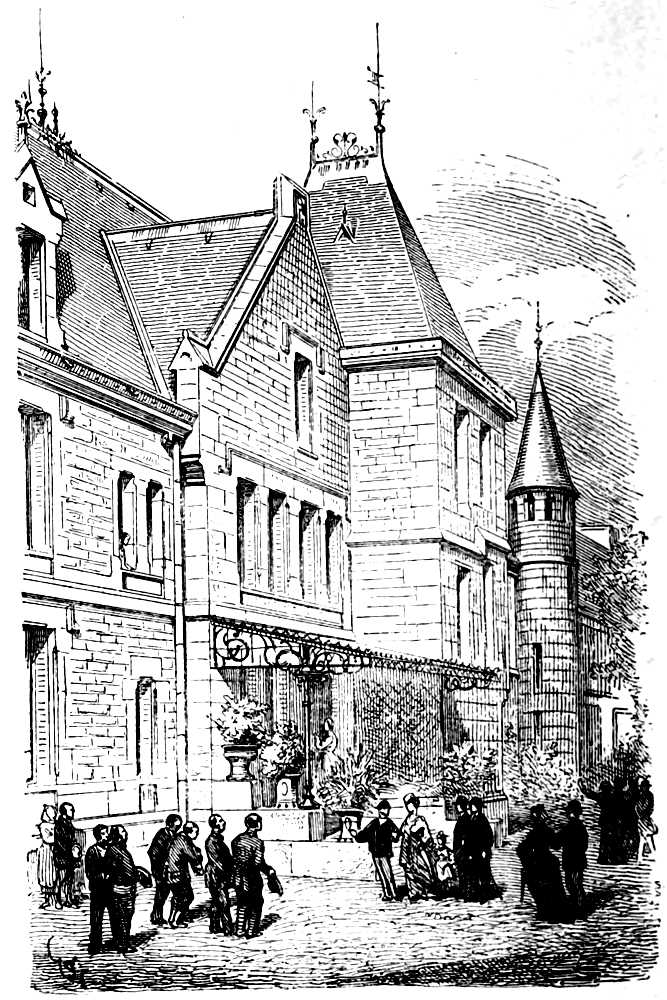
Fig. 62.
It is impossible to say what the pony thought of the pace [Pg 259]Paul made him go, at a temperature of 77° Fahr. in the shade. He arrived in a foam at the new house, so that most of the persons already assembled suspected that some accident had happened. When Paul, quite out of breath, told them that Madame Marie had put off her visit for an hour or two because she wanted rest, they exclaimed,
“If it is only that, there’s no need of any great hurry; it is quite natural she should need rest after so long a journey.”
Then everyone wanted to hear news of the travellers, and then they asked Paul to see this and that. Paul was in a fever.
“You are not going to ride back again in this state,” said the mayor; “you are in a bath of perspiration, and your pony is white with foam. Rest a little, and drink a glass of wine.”
It would have been discourteous not to comply, for the mayor had brought a basket of petit vin de Saumur. They drank the health of the future occupants, and the prosperity of the house, so that Paul lost a good hour. At last he was able to retrace his road to the château, at the same rate as before. But on reaching the edge of the plateau he saw the chaise at a distance, going towards the house. He made a detour, so as to join the party from the rear, and reached them just as the new domain was coming in sight.
“Look!” said his sister; “there’s a horseman in a great heat. Where does he come from? Is it he who is directing the whole plot?”
“Certainly,” replied her mother. “Look!”
They were in fact just beginning to see the outlines of Paul’s house, with its slated roof glistening in the rays of the sun. There was silence, and, it must be confessed, a little emotion.
“I had my suspicions about it,” said Madame Marie,[Pg 260] kissing her mother and father. “And so during your painful experiences of last year you were thinking of us so much as to have realized that project of a house which I thought was only a fancy? And Paul!”
“Paul,” replied M. de Gandelau, “has had his share in the work, and has contributed substantially to the success of the project. If he ever becomes an architect you will have been the first cause of it.”
“And you, dear friend,” said Madame de Gandelau to her son-in-law, who was kissing her hand tenderly, “you say nothing!”
“M. de Gandelau had written to me about it, and I was in the secret. Marie can tell you whether I have kept it or not.”
“So we were betrayed, my poor Paul,” exclaimed his mother.
“M. de Gandelau wished to know whether settling in this neighbourhood would not disconcert our plans for the future. I replied to him that, on the contrary, it would further them; and that the only cause which had hindered my building a house here after our marriage was the fear of distressing you, and making you suppose that we did not attach to your maternal hospitality the value it most justly claims. Marie wishes to reside here a great part of the year; she is known and beloved in this her native place; nothing could be more agreeable to her than to follow your example—near to you, almost under your eyes—without giving you the trouble which a permanent residence in your house would have occasioned. I had no need to consult her, for I knew that you were realizing a dream which she was secretly cherishing, without hoping for its speedy realization.”
“All is then for the best,” resumed Madame de Gandelau, looking at her husband, for she was thinking of what she had said to him one evening, two years before.
[Pg 261]
The family were received with vivats in front of the entrance steps. Previous to entering the building, they went round it; and when they came to the group of master-workmen and foremen, Paul introduced them to his sister, saying that it was owing to their zeal, and their desire to see her soon settled in the neighbourhood, that the completion of the work in less than two years, was owing. Paul’s compliment (which was neatly turned), but more particularly the courteous bearing of his sister, who asked each what he had done, inquired about their families, and expressed to them her wish to employ them often, gained her the heart of these good people, who for the most part had known her as a child.
Madame Marie wanted to see everything. At each step exclamations of joy were uttered, and Paul was embraced twenty times by his “client.” Monsieur N—— had taken possession of Eugène, who, we need scarcely say, was warmly congratulated.
M. Durosay did not fail to express his admiration every moment, and was incessantly repeating, “It is a charming feudal manor-house!”
“But, why, my dear sir,” said Madame Marie, at last quite weary of the phrase, “Why do you call it a ‘manor-house,’ and ‘feudal’? I have neither manor nor vassals, and I have no wish to possess any. Call it a house, built for me by those who love me, and which will always be open to our friends, and always accessible to those who may need our help.”
We may be sure that Paul’s resolution to become an architect was strengthened by what he felt on this occasion.
Let us hope that his career may be as successful as that of the house whose history is here recorded.
[Pg 263]