It cannot be imagined that Titania, who had survived so many shocks, was ill for nothing. When Bob discovered what she was ill of, he stood outside on the lawn with his hands deep in his pockets and with his legs wide apart.
"I must tell 'em this at once," said Bob, gloomily. "If I don't tell Gordon, he'll forget he's invested a hundred of mine in something to make hair curl, and I shall lose the money. I mean to make money to keep up Goring by and by. And he said he'd make me a director, too. For the sake of the family, I can't neglect him. Or De Vere, either. Or any of 'em. But—but I never thought it of Pen!"
With his pockets full of money derived from the sale of dogs to De Vere, he rushed off to the station and caught a train for town. When he reached London, he sent a wire to "Old Guth."
"I'm in town on important business. Break it to grandmother between fits. I hope to be back to-morrow."
He rushed off to Park Lane to find Gordon.
"Mr. Gordon has gone to Spilsborough, sir," said Gordon's man.
"D— I mean confound it!" said Bob. He went to Plant's.
"Mr. Plant went to Spilsborough in a great hurry this afternoon, sir," said Plant's landlady. The American millionaire still lived in Bloomsbury, though not on ten shillings a week.
"Oh," said Bob, "I wonder what this means. There's a secret here!"
He drove in a hansom to find Bramber. A very ingenuous piece of humanity in buttons told Bob that Lord Bramber came in about four o'clock torn to ribbons, and found a telegram waiting him.
"And off he went in his motor-car."
"Where?" asked Bob.
"I don't know," said the buttons. But on Bob's going to Bramber's room, he found the ABC open on the table at the page with Spilsborough on it.
"Sherlock Holmes would say he has gone to Spilsborough," cried Bob. "And if Gordon and Plant have gone there, too, I'll bet all the rest have gone. I'll go, too."
But there was no train for three hours!
"I'm done," said Bob, "No, I'm not. I'll hire a motor-car."
He went to the nearest place in Regent Street and hired one.
"Very well, sir," said the man, "but it's rather expensive, you know."
Bob pulled out a handful of sovereigns.
"Take as many as you think fair," he said, grandly. "And don't forget I want a speedy one, and a man that can drive, and I'll pay the fines of course!"
That was how he came to Spilsborough just in time and about the hour when the moon was to rise. He passed a motor-car in the ditch about ten miles out of the cathedral city, and did not stop to find out what was the matter. He thus missed the discovery that Bramber and his chauffeur were both sitting upon the wreck, using very awful language to each other on the subject of losing the way and coming bolt down a side road into the opposing hedge. It is astonishing how an accident at thirty miles an hour brings owners and mechanics down to the same human level.
When Bob reached Spilsborough, he was covered with dust, but was as spry as a grasshopper and awfully full of his news.
"You can drive," said Bob to his man. "I'm very much pleased with you. Stop at this hotel."
He went into the Angel, and staggered blithely to the office.
"Is Mr. Gordon here, or Mr. Plant, or the Marquis of Rivaulx?" he demanded.
He thus discovered the marquis.
He drove off to the Grand, and found Plant and Goby and De Vere and Gordon were there. They were all in bed but Plant, and Plant had gone to see the cathedral by moonlight.
"All right, we'll put up here," said Bob, "and I'll see if I can find Plant. I say, I wonder what Baker will think of this? It beats me!"
He got to the cathedral precincts just about an hour after Rivaulx and Plant had run into each other's arms. Much had occurred since then.
For Rivaulx started back from Plant and almost forgot the existence of Bramber.
"You are a scoundrrrel," said Rivaulx, rolling his r's in the most fearful manner.
"You are a lunatic," replied Plant, coolly; "when did you escape?"
"I have not escaped, I am here," snorted Rivaulx, "but you shall not escape. I meant to kill Lord Bramber upon this spot, but I prefer to keel you. I let him go; he is nothing. You are the scoundrrel!"
"Oh, dry up!" said Plant, crossly. "You tire me, you fatigue me very much. I am exhausted by looking at you. Go home, or I will break you in three pieces and eat them!"
Rivaulx foamed at the mouth.
"Do you refuse to fight me, sare?"
"Certainly not," said Plant. "Take your coat off and hang it on a tombstone, and I'll leave nothing of you but a smear."
"I do not fight with fists," said Rivaulx, contemptuously. "I fight with swords, with steel, with guns or pistols."
Plant shook his head.
"I've none of 'em about me, my son!"
"At the hotel I have swords," cried Rivaulx, eagerly. "I brought them to kill Bramber, who punched my eye in the Rotten Row, and we rolled in bushes. But I will first fight you. Wait and I fetch the swords."
He ran violently into the darkness, and Plant sat on a railing.
"What am I to do? Am I to wait and fight a lunatic? Or shall I go back to the hotel? I think I'll go back. If that raging idiot is found prancing about here with swords, they will run him in."
But he did not know how fast the marquis could run and how near the hotel was. Before he had made up his mind to go, Rivaulx came back again. He flung the swords at Plant's feet.
"Take one and let us begin," he said.
"I think on the whole I'll have both," said Plant, suiting the action to the word. "Now go home, marquis, like a good little boy, and come to the Grand Hotel in the morning and tell me why you want to be hanged in England."
He put both the weapons under his arm.
"You will not fight?" said the marquis, gasping like a dying dolphin.
"What kind of a galoot do you reckon me?" asked Plant, quite unintelligibly.
"Ha!" said the marquis, "I know not what a galoot is, but I will fight you here and leave your body on the grass."
Neither of them had observed the approach of a portly and pleasant gentleman behind them. He was now leaning upon the railing, watching them with a great deal of kindly curiosity.
"I think, gentlemen, that the dean will object," he said at length, and they both turned around suddenly.
"You must not interfere," said Rivaulx; "we do not know you."
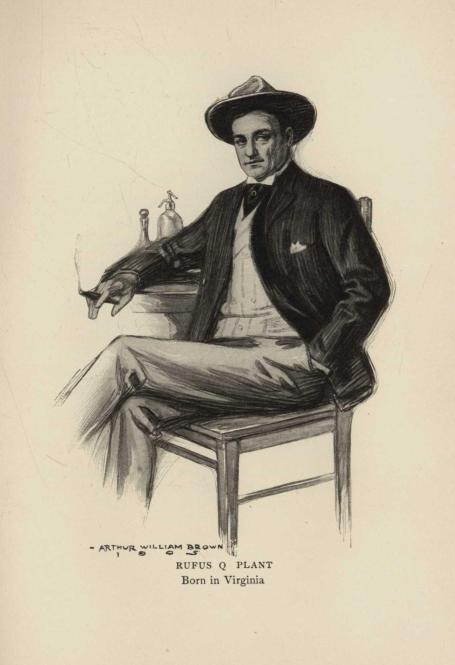 RUFUS Q. PLANT. Born in Virginia
"To be sure, to be sure," replied the gentleman, who was dressed very curiously, as Rivaulx noticed. "I hate interfering, especially with anything belonging to a dean. Deans, gentlemen, are very touchy about matters connected with their cathedrals. Now Dean Briggs, gentlemen, takes the very greatest care of that grass on which you both are now illegally trampling, and I understand that he has made a rule never to have duels upon it. He is very firm on that point. Do I mistake you if I say that it looks to an unprejudiced observer as if you were going to fight a duel?"
Rivaulx bowed.
"I do not know you, sare, and I do not want to. I want to keel this man, who is a scoundrrel."
The stranger addressed Plant.
"And are you equally anxious to break this very rigid rule of the dean's?" he asked, suavely.
"Certainly not," replied Plant; "I want to go to bed."
"I am delighted to hear it. I am intensely gratified to hear it. If one duellist, having possession of both deadly weapons, desires to go to bed, I cannot see anything to hinder him, unless, indeed, he wants to lie down on Mr. Dean's grass. You see, gentlemen, I am a bishop, and a bishop's first desire is to be on good terms with the dean. If Mr. Dean heard that I encouraged any one to break his rules about duelling or going to bed in the precincts of this cathedral, I should not be on good terms with him, I assure you."
"I do not understand," said Rivaulx. "I want to fight, that is all I want to do!"
"Stay!" said the bishop, mildly. "If the somewhat excited gentleman, who is, I gather, not an Englishman, will accompany me a few yards, we will go to the dean's, with whom I have been dining, and will refer the matter to him."
"Of course," said Plant, "that is the right thing to do. Marquis, his lordship the bishop suggests the only course open to gentlemen. I trust you will accept his offer, and, if you do, I undertake to fight you if the dean gives his permission."
"Stay, sare, my lord the bishop," said Rivaulx, "one moment, sare, the bishop. Is this dean of whom you speak a gentleman?"
"Certainly, certainly," replied the bishop, hastily. "He is of the highest breeding, and in his youth he fenced like a fencing-master."
"Then he understands the code of honour, sare the bishop?"
"Absolutely, for a dean," replied his lordship.
"Then I agree, sir lord," cried Rivaulx.
"Ha, we will go to his house, then," said the bishop, "if you will step over this railing. But stop here one moment and observe the moon rising over Mr. Dean's cathedral. Is it not a peaceful, pleasant spot, gentlemen?"
"It beats thunder," said Plant.
"It does, it does," nodded his lordship. "Many Americans, who admire this cathedral immensely, have made the same acute observation. May I ask your names, gentlemen? I am the bishop of this diocese."
"My name is Plant, Rufus Q. Plant, and my friend is the Marquis of Rivaulx."
"Indeed," returned the bishop, "is the gentleman the French nobleman who is interested in balloons?"
"Yes," said Plant.
"Dear me! I am delighted," said his lordship. "I, too, am interested in balloons. I saw one go up once."
"You like them?" asked Rivaulx, warmly. "That is good! I will take you up in one."
"We will talk of it later," said the bishop, rather hastily for a man of his gentle flowing speech. "But this is the dean's house. If I knock at this window, he will put his head out."
He knocked at the window, and Mr. Dean did put his head out.
"I am so loath to disturb you, Mr. Dean," said his lordship, "but, as I was leaving you and taking a little stroll before retiring, I met two gentlemen, one from the United States and one a French marquis, who were engaged in a warm discussion on a point of honour. I am ignorant of the exact point, and I dare say there is no necessity for our knowing. As a result of this discussion, the French marquis desired to fight a duel with swords (you will observe them under the arm of the gentleman from the United States), and I ventured to intervene, as the duel was to take place upon your grass."
"Humph, indeed!" said the dean, in great astonishment. "And what did you say?"
"I said that it was against your rules to allow any one to fight duels there. Was I not right?"
"Rather!" said the dean. "I should say so."
"And on the other hand," continued the bishop, "the gentleman from across the Atlantic wished to go to bed."
"Then why the—why doesn't he?" asked the dean.
"It seemed to me that the gentleman from across the water wanted to go to bed upon your grass," said the bishop. "I pointed out to him that there was a very old and strict rule dating from the time beyond record which forbade this. Was I not right?"
"You were," said the dean. "I never go to bed on the grass myself, and do not permit others to do so. I never fight duels there, either, and do not allow it."
"You see, gentlemen," said the bishop, but before he could add another word Bob rushed right upon the group outside the dean's windows, and saw that Plant made one of them. He saw the swords also, and then recognized Rivaulx.
"Oh, I say," said Bob, "you were going to fight a duel about Pen! I've come in time! It's no good. She has married Timothy Bunting, her groom!"