Titania fell on Bradstock's neck when he came back with the bishop. She very nearly fell on the bishop's neck, too, which alarmed him very much indeed, though he had all that confidence with women which marks the celibate clergy, especially when they are beautiful.
"My dear-r Augustin," said Titania, "I came at once. I felt I had to. I felt I must. There is no sympathy at home for me in my troubles. The duke laughs, laughs in my face, and says Penelope is damn fine sport!"
"Tut, tut!" said the bishop, who was loath to think that dukes could use bad language. "I very much regret to hear it."
Titania waved her hands at large.
"But I do not care. I am wrapped up in woe, and in Robert. Where is he? Show me the telegram he sent."
They showed her the telegram.
"Not black! Oh, Augustin, that might mean anything."
"So it might. What did I say, bishop?" asked Augustin.
"Nonsense!" said the bishop. "I do not believe it is even dark. This is all waste of time. Time cannot now be wasted. This scandal grows. Ridley tells me all these unfortunate gentlemen, but Lord Bramber and Mr. Carew, are in the town. I have had telegrams from both of those asking for information, most excited telegrams. Mr. Carew says he is delirious with fever, and I believe him. Lord Bramber says his father is delirious, which I much regret. I think the son is also delirious, though he does not say he is. He implores me to remember that he is entitled to know first where Penelope is, as he is her husband. This is the telegram."
Augustin and Titania read it.
"If we could only believe it," said Titania.
"We cannot," said the bishop. "Ridley declares they all say the same. They also say the infant is an adopted one. I do not remember, in the course of all that wide experience which comes to a country clergyman in a place like Ray Pogis, any situation equal to this. As a bishop with a wider experience, I have seen nothing so absurd even in the conduct of my clergy, who are indeed hard to beat in stupidity. I regret we did not go on to Waynfleet and Spilsby, Bradstock."
"So do I," said Bradstock, eyeing Titania.
"We will go to-morrow," said the bishop. "I have an intuition that to-morrow we shall find her. I feel sure of it."
"I will come with you," said Titania. "I must! I must! I cannot help fearing, Augustin, that the very worst may have happened. I have now no confidence whatever in dear, misguided Penelope's morals. I do not feel sure that the child is not black, or that it is adopted!"
"Good heavens!" said Augustin.
"Good heavens!" echoed the bishop.
"I haven't," affirmed Titania, dreadfully. "No such thing has happened in our family since the time of Charles the Second, which was lamentable but natural, and has long since been forgiven. I mistrust the general attitude of all these men, bishop. I mistrust it!"
"Certainly they seem in great distress," said the bishop.
Titania rose and looked awful.
"Only upon one supposition can I account for it, bishop. This is their remorse. They are remorseful. They have treated her badly, and she has fled from them in her shame and will not see them!"
"Ha!" said the bishop, "there is something in that!"
"A great deal in it," boomed Titania, in her deepest tone of tragedy. "It explains everything."
But Bradstock said:
"Infernal nonsense, Titania! Bishop, I am surprised at you. They can't all be remorseful."
"Why not?" demanded Titania; "why not, Augustin?"
"Of course not," interjected the bishop, hastily.
"Why not, I ask?" repeated the duchess.
"Oh, well, you know," said Bradstock, "when you come to think of it, wouldn't one be enough to be remorseful for having behaved like a scoundrel?"
The duchess collapsed.
"Dear me! so it would," she said, weakly. "Now I come to think of it, one would be sufficient. Nothing is explained or can be explained till we find Penelope."
The same feeling of desperation inspired the lovers in the various hotels. Their hopeless passion grew upon them. The sense of mystery deepened. They were sorry for Penelope, for the others, for themselves. What did she mean by it? They were all agreed now about the adoption theory, though they stuck to it manfully that they were married to her. Each one believed the infant was adopted, while he nobly claimed it as his own. They were really noble creatures, and showed themselves worthy of a better fate. A peculiar feeling of sympathy grew up among them, as it does among the unfortunate who are yet strong enough not to be overwhelmed. They spoke to each other again. Goby took De Vere's arm and walked about with him.
"I wish I could tell you all the truth, old chap," sighed Goby.
"Ah, so do I," said the poet. "A great passion is a wonderful thing, Goby."
"So it is, old chap," said Goby. "Do you remember the happy days we spent in your home when we read Browning and Shelley together, and you explained your poems to me?"
Austin de Vere sighed.
"Ah, they were happy days, when my nose peeled on the water and my hands were blistered by rowing."
"Do you remember the bulldog?" asked Goby.
"Ah, and the terrier he bit!"
"And the howling retriever?"
"And the bald, bronchitic Borzois," said De Vere, with enthusiasm. "I bought them all of Bob because she loved him."
"I didn't like you then, Austin, old chap," said Goby.
Austin gripped his arm.
"Plantagenet, we will be friends always. Now I can confess that I loathed you. I told Bradstock so. I said you were an ass."
"So I am," said poor Goby. "I admit now I can't understand Browning."
Austin looked about him:
"My dear chap, no more do I," he said, in an alarmed whisper. "He's a much overrated man."
"I never overrated him myself," said Goby, sagely. "Look here, Austin. You know, of course, that I'm married to Penelope?"
"Of course," said Austin. "And you know that I am?"
"We'll quarrel about nothing now. To-morrow we'll look for her. Ridley, the bishop's butler, told me Bradstock and the bishop were going to Spilsby to-morrow. I gave him a sovereign."
"So did I," said Austin. "Let's go in to dinner. I'm glad we are friends, Plantagenet."
"So am I, old chap," said Goby.
At a near table to them were Rivaulx and Gordon. Farther off Plant was with Carteret Williams. Plant regretted that Bramber wasn't there. Williams sighed for the artistic company of the delirious Carew. Not one look of envy or hatred or malice passed between any of them.
"Marquis," said Gordon, gloomily, "will you come to-morrow with me to find my—I mean, Penelope?"
"I will, my dear Gordon," replied the marquis. "To Spilsby."
"How did you know?"
"Ridley, the bishop's man, said it."
"He told me, too. I gave him five pounds," said Gordon.
"I gave him four."
"I'll bet he's told 'em all," said Gordon. "I say, marquis, those were jolly, happy days before this misery came on, when you and I dined together."
"And went up in balloons," said the marquis.
Gordon shook his head.
"Well, yes, even the balloons. Do you know, marquis, I hated you then. I don't now. I think you a real good chap."
The marquis held out his hand, and Gordon shook it.
"Gordon, I used to despise you. It was a great trial to dine with you. I'm glad I did it now. I'm a wiser, better man for the trials. I see that Jews can be noble by nature just as they can be barons by creation. I finally absolve Dreyfus. I almost love you now!"
"Good old marquis," said Gordon. "When we get up to town, I'll put you on the betht thing in the market. I will, so help me!"
Carteret Williams and Plant got on well together. They talked first of Bramber and Carew.
"Carew's all right," said Williams; "all right for an artist. I was in the Ashanti war with an artist once. I put his head in a bucket of water!"
"Why?" asked Plant.
"Because he was too drunk to draw," said Williams. "He hated me when he got sober, and caricatured me. I never liked artists afterward. But when Penelope put me into harness with Carew, I found there was good stuff in him. He could work. He talked awful rot, but there was something at the back of it. I had to own it. How did you get on with Bramber?"
"I thought him a damn fool," said Plant. "But I found out he wasn't. There's stuff in Bramber. My—I mean, Penelope knew that. I say, as he isn't here, poor chap, will you come to Spilsby with me to-morrow?"
Williams started.
"How did you come to think of Spilsby?" he asked, suspiciously.
"The bishop's butler told me. I gave him five pounds," said Plant.
"I gave him two," said Williams. "Yes, I'll go with you, as Carew isn't here. I like Carew now. Poor Carew!"
"And I like Bramber, poor chap," said Plant. "And now I'll go and shake hands with the marquis, who wanted to kill me last time I was here."
"I wish I'd seen that," said Williams, simply. "I like seeing fights!"
They spent a happy evening together and talked of Bob. Austin was great upon Bob. And so was Gordon. Austin told them all about the dogs. Goby spoke about the spavined pony he had bought. Gordon told them how Bob had borrowed a hundred pounds of him to be put into something.
"I owe him fifty thousand pounds, at least," said Gordon. "The boy is a financier. I wish I had a boy like Bob."
And just then Carew walked into the room. He looked ill, but was as handsome as paint. Williams jumped to his feet.
"Oh, Jimmy, I heard you were delirious," he said, anxiously.
"I was," said Jimmy, "very delirious, extraordinarily so. I'm not sure that I'm not delirious now."
He looked around the room anxiously, and drew Williams into a corner.
"Do you know anything about delirium?" he asked, anxiously.
"A lot about delirium tremens," said Williams. "Most of the artists I've been with in Africa had it. They said it was malaria. But have you been drinking?"
Carew shook his head.
"Not much, but I see the room is full of 'em!"
"Full of what?"
"Things, visions, phantasms!" said Jimmy, creepily. Williams looked around in alarm.
"You don't say so!"
"Yes," said Jimmy. "This influenza is awful! I could swear I see the marquis and Gordon and that ass Goby and De Vere!"
"Pull yourself together," said Williams. "They're here all right!"
"Are they real?" asked Jimmy. "They're not delusions?"
"Devil a bit!" said Williams.
"Oh," said Jimmy, "then I think I'll have some brandy. What are they doing here?"
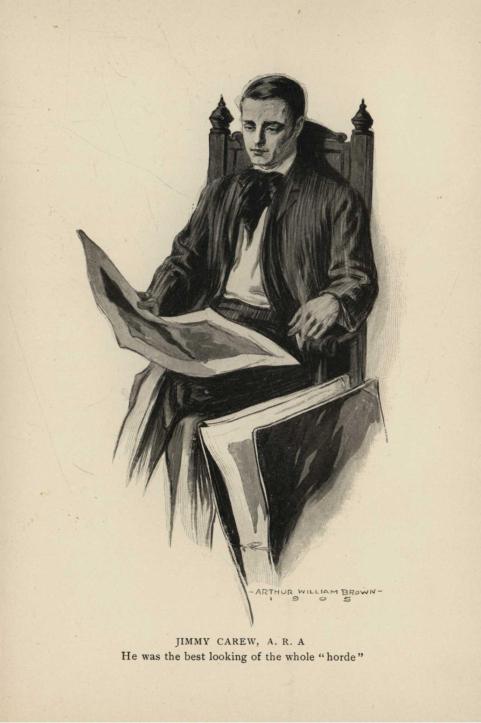 JIMMY CAREW, A.R.A. He was the best looking of the whole "horde"
"What are we doing here?" asked Williams. "We're mad! Oh, but, Jimmy, I'm dashed glad to see you," said Williams, with a lurid string of emphatic war expressions. "Those were happy days when I learnt about art with you, and you learnt about life with me!"
"They were," said Jimmy. "But now I'm almost sick of art."
Williams implored him not to say so.
"Think of Rembrandt and Velasquez and Whistler!"
"I can't think of them. I think of Penelope!"
"Try to think of Monet and Manet," said Williams. "They'll do you good."
"To be sure, to be sure," sighed Jimmy. "I'll try to."
They talked till two in the morning, and the only man missing was Bramber.
"Perhaps he's chucked it," said Williams. "The last time I saw him he looked sick enough to chuck anything. But I suppose the old earl is so rocky he can't get away."
"I hate earls," said Jimmy, jealously. He added with extraordinary irrelevance, "But I'm glad she adopted him."
No doubt he referred to the infant.