(1819-1861)
BY CHARLES ELIOT NORTON

he intellectual mood of many of the finest spirits in England and New England during the second quarter of the nineteenth century had something of the nature of a surprise to themselves, no less than to those who came within their influence. It was indeed a natural though unforeseen result of forces, various in kind, that had long been silently at work. The conflicting currents of thought and moral sentiment, which in all ages perplex and divide the hearts of men, took a new direction and seemed to have gathered volume and swiftness. Hardly since the Reformation had there been so deep and general a stirring of the questions, the answers to which, whether they be final or merely provisional, involve conclusions relating to the deepest interests of men. Old convictions were confronted by new doubts; ancient authority was met by a modern spirit of independence. This new intellectual mood was perhaps first distinctly manifest in England in Carlyle's essays, and correspondingly in New England in the essays and poems of Emerson; it was expressed in 'In Memoriam' and 'Maud'; it gave the undertone of Arnold's most characteristic verse, and it found clear and strikingly distinctive utterance in the poems of Clough. His nature was of rare superiority alike of character and intellect. His moral integrity and sincerity imparted clearness to his imagination and strength to his intelligence, so that while the most marked distinction of his poems is that which they possess as a mirror of spiritual conditions shared by many of his contemporaries, they have hardly less interest as the expression and image of his own individuality.
Arthur Hugh Clough was born at Liverpool on New Year's Day, 1819.[A] His father, who came of an old Welsh family (his mother, Anne Perfect, was from Yorkshire), had established himself in Liverpool as a cotton merchant. Toward the end of 1822 he emigrated with his wife and four children to Charleston, South Carolina, and here for four years was their home. For Arthur they were important years. He was a shy, sensitive boy, "already considered as the genius of the family." He was his mother's darling. She was a woman "rigidly simple in her tastes and habits, of stern integrity"; of cultivated intelligence, fond of poetry, a lover of nature, and [Pg 3822]quickly sympathetic with high character, whether in real life or in the pages of romance. While his father taught him his Latin grammar and his arithmetic, his mother read with him from Pope's Iliad and Odyssey, from Scott's novels and other books fitted to quicken the imagination. Her influence was strong in the shaping of his taste and disposition.
In 1828 the family returned for a visit to England, and Arthur was put to school at Chester, whence in the next year he was transferred to Rugby. Dr. Arnold had then very lately become the headmaster at Rugby, and was already giving to the school a tone and quality unknown previously to the public schools of England. He strove to impress upon the boys the sense of personal responsibility, and to rouse their conscience to the doing of duty, not so much as a matter essential to the discipline of the school as to the formation of manly and religious character. The influence of his high, vigorous, and ardent nature was of immense force. But its virtue was impaired by the artificiality of the ecclesiastical system of the Church of England, and the irrationality of the dogmatic creed which, even to a nature as liberal as Dr. Arnold's, seemed to belong to the essentials of religion, and to be indissoluble from the foundation of morality.
Clough became Arnold's devoted disciple, but he had intellectual independence and sincerity enough to save him from yielding his own individuality to any stream of external influence, however powerful. What he called "the busy argufying spirit of the prize schoolboy" stood him in good stead. But the moral stress was great, and it left him early with a sense of strain and of perplexity, as his mind opened to the wider and deeper problems of life, for the solution of which the traditional creed seemed insufficient. His career at school was of the highest distinction; and when he was leaving Rugby for Oxford in 1836, Dr. Arnold broke the rule of silence to which he almost invariably adhered in the delivery of prizes, and congratulated Clough on having gained every honor which Rugby could bestow, and on having done the highest credit to the school at the University,—for he had won the Balliol Scholarship, "then and now the highest honor which a schoolboy could obtain."
Clough went into residence at Oxford in October, 1837. It was a time of stirring of heart and trouble of mind at the University. The great theological controversy which was to produce such far-reaching effects upon the lives of individuals, and upon the Church of England as a whole, was then rising to its height. Newman was at the acme of his popularity and influence. His followers were zealous and active. Ward, his most earnest disciple, was one of Clough's nearest friends. Clough, not yet nineteen years old, but morally and intellectually developed beyond his years and accustomed already to independent speculation in regard to creed and conduct, was inevitably[Pg 3823] drawn into the deep waters of theological discussion. He heard, too, those other voices which Matthew Arnold in his admirable lecture on Emerson has spoken of as deeply affecting the more sensitive youthful spirits of the Oxford of this time,—the voices of Goethe, of Carlyle, and of Emerson. He studied hard, but his studies seemed, for the moment at least, to be of secondary importance. Although unusually reserved in demeanor and silent in general company, his reputation grew, not merely as a scholar, but as a man distinguished above his fellows for loftiness of spirit, for sweetness of disposition, and for superiority of moral no less than of intellectual qualities. With much interior storm and stress, his convictions were gradually maturing. He resisted the prevailing tendencies of Oxford thought, but did not easily find a secure basis for his own beliefs. In 1841 he tried for and missed his first class in the examinations. It was more a surprise and disappointment to others than to himself. He knew that he had not shown himself in the examinations for what he really was, and his failure did not affect his confidence in his own powers, nor did others lose faith in him, as was shown by his election in the next year to a fellowship at Oriel, and the year later to his appointment as tutor.
His livelihood being thus assured, he led from 1843 to 1848 a "quiet, hard-working, uneventful tutor's life, diversified with reading parties" in the vacations. He was writing poems from time to time, but his vocation as poet was not fully recognized by himself or by others. He had been obliged, in assuming the duties of tutor, to sign the Thirty-nine Articles,—though as he wrote to a friend, "reluctantly enough, and I am not quite sure whether or not in a justifiable sense. However, I have for the present laid by that perplexity, though it may perhaps recur at some time or other; and in general, I do not feel perfectly satisfied about staying in my tutor capacity at Oxford."
The perplexity would not down, but as the years went on, the troubled waters of his soul gradually cleared themselves. He succeeded in attaining independence of mind such as few men attain, and in finding, if not a solution of the moral perplexities of life, at least a position from which they might be frankly confronted without blinking and without self-deception. It became impossible for him to accept, however they might be interpreted, the doctrines of any church. He would not play tricks with words nor palter with the integrity of his soul. This perfect mental honesty of Clough, and his entire sincerity of expression, were a stumbling-block to many of his more conventional contemporaries, and have remained as a rock of offense to many of the readers of his poetry, who find it disturbing to be obliged to recognize in his work a test of their own[Pg 3824] sincerity in dealing with themselves. With how few are conviction and profession perfectly at one! The difficulty of the struggle in Clough's case, the difficulty of freeing himself from the chains of association, of tradition, of affection, of interest, which bound him to conformity with and acceptance of the popular creed in one or the other of its forms, has led superficial critics of his life and poetry to find in them evidence that the struggle was too hard for him and the result unsatisfactory. There could not be a greater error. Clough's honest acceptance of the insolubility of the vain questions which men are perpetually asking, and his recognition of the insufficiency of the answers which they are ready to accept or to pretend to accept, left him as regards his most inward soul one of the serenest of men. The questions of practical life, of action, of duty, indeed presented themselves to his sensitive and contemplative nature with their full perplexity; but his spiritual life was based on a foundation that could not be shaken. He had learned the lesson of skepticism, and accepted without trouble the fact of the limitation of human faculties and the insolubility of the mystery of life. He was indeed tired with the hard work of years, and worried by the uncertainty of his future; when at length, in order to deliver himself from a constrained if not a false position, and to obtain perfect freedom of expression as well as of thought, he resigned in 1848 both his fellowship and tutorship.
It was a momentous decision, for it left him without any definite means of support, it alienated the authorities of the University, it isolated him from many old friends. Immediately after resigning his tutorship Clough went to Paris with Emerson, then on a visit to Europe, as his companion. They were drawn thither by interest in the strange Revolution which was then in progress, and by desire to watch its aspects. The social conditions of England had long been matter of concern to Clough. He had been deeply touched by the misery of the Irish famine in 1847, and had printed a very striking pamphlet in the autumn of that year, urging upon the students at Oxford retrenchment of needless expenditure and restrictions of waste and luxury. His sympathies were with the poor, and he was convinced of the need of radical social reform. He therefore observed the course of revolution on the Continent not merely with curiosity, but with sympathetic hope.
In the autumn of this year, after his return home, and while at Liverpool with his mother and sister, he wrote his first long poem, 'The Bothie of Tober-na-Vuolich; a Long-Vacation Pastoral.' It had no great immediate success, but it made him known to a somewhat wider public than that of Oxford. It was in its form the fruit of the reading parties in the Highlands in previous summers. It was in[Pg 3825] hexameters, and he asked Emerson to "convey to Mr. Longfellow the fact that it was a reading of his 'Evangeline' aloud to my mother and sister, which, coming after a re-perusal of the Iliad, occasioned this outbreak of hexameters." It is a delightful poem, full of vitality and variety, original in design, simple in incident. It has the freshness and wholesomeness of the open air, the charm of nature and of life, with constant interplay of serious thought and light humor, of gravity and gayety of sentiment.
Its publication was followed speedily by a little volume entitled 'Ambarvalia,' made up of two parts; one, of poems by Clough, and one, of those by an old school and college friend, Mr. Burbidge. Clough's part consisted, as he wrote to Emerson, of "old things, the casualties of at least ten years." But many of these "casualties" are characteristic expressions of personal experience, to which Clough's absolute sincerity gives deep human interest. They are the records of "his search amid the maze of life for a clue whereby to move." They deal with the problems of his own life, and these problems perplex other men as well. "I have seen higher, holier things than these," he writes in 1841:—
"I have seen higher, holier things than these,And therefore must to these refuse my heart,
Yet I am panting for a little ease;
I'll take, and so depart."
But he checks himself:—
"Ah, hold! the heart is prone to fall away,Her high and cherished visions to forget;
And if thou takest, how wilt thou repay
So vast, so dread a debt?"
The little volume appealed to but a small band of readers. The poems it contained did not allure by fluency of fancy or richness of diction; they were not of a kind to win sudden popularity: but they gave evidence of a poet who, though not complete master of his art, and not arrived at a complete understanding of himself, had yet a rare power of reflection and expression and a still rarer sincerity of imaginative vision. They were poems that gave large promise, and that promise was already in part fulfilled by the 'Bothie.'
Early in 1849 the headship of University Hall in London was offered to Clough and accepted by him. This was an institution professedly non-sectarian, established for the purpose of receiving students in attendance upon the lectures at University College. He was not to enter upon the duties of the place until October, and he spent the greater part of the intervening period in a fruitful visit to[Pg 3826] Italy. He reached Rome in April. All Italy was in revolution. The Pope had fled from Rome. The Republic had been declared, and Mazzini was in control of the government. The French army was approaching to besiege the city, and Clough resolved to await the event. No more vivid and picturesque account of aspects of the siege exists than is to be found in his poem of 'Amours de Voyage,' written in great part at Rome, under the pressure and excitement of the moment; then laid aside in the poet's desk, and not published till long afterward. It consists of a series of letters supposed to be written by various persons, in which a narrative of passing events is interwoven with a love story. The hero of the story is a creation of extraordinary subtlety and interest. He has much of the temperament of Hamlet: not wanting in personal courage, nor in resolution when forced to action, but hesitating through sensitiveness of conscience, through dread of mistaking momentary impulse for fixed conviction, through the clearness with which diverging paths of conduct present themselves to his imagination, with the inevitable doubt as to which be the right one to follow. The character, though by no means an exact or complete image of the poet's own, is yet drawn in part from himself, and affords glimpses of his inner nature, of the delicacy of his sensitive poetic spirit, of his tendency to subtle introspective reflection, of his honesty in dealing with facts and with himself. To see things as they are, to keep his eyes clear, to be true to
"The living central inmost IWithin the scales of mere exterior—"
was the principle of his life. The charm of 'Amours de Voyage,' however, consists not merely in animated description, in delicate sentiment, and in the poetic representation of sensitive, impressionable, and high-minded youth, but in its delicate humor in the delineation of character, and in its powerful, imaginative, picturesque reproduction of the atmosphere and influence of Rome, and of the spirit of the moment to which the poem relates. It is as unique and as original in its kind as the 'Bothie.' It is a poem that appeals strongly to the lovers of the poetry of high culture, and is not likely to lack such readers in future generations.
From Rome in July Clough went to Naples, and there wrote another of his most striking poems, 'Easter Day.' In the autumn of 1850 he again went during a short vacation to Italy, but now to Venice; and while there began his third long poem, 'Dipsychus,' of which the scene is in that city. In this poem, which represents the conflict of the soul in its struggles to maintain itself against the temptations of the world and the Devil, Clough again[Pg 3827] wrote out much of his inner life. It is not so much a piece of strict autobiography of the spirit of an individual, as an imaginative drama of the spiritual experience common in all times to men of fine nature, seeking a solution of the puzzle of their own hearts. In none of his other poems is there such variety of tone, or such an exhibition of mature poetic power. It is indeed loosely constructed; but its separate parts, each contributing to the development of its main theme, with their diversity of imagination, reflection, wit, and sentiment, combine in an impressive unity of effect.
The position at University Hall proved not altogether satisfactory; and no other opening for him offering itself in England, Clough determined after much hesitation and deliberation to try his fortune as a teacher and writer in America. He sailed in October, 1852, on a steamer on which he had Lowell and Thackeray for fellow passengers. He spent the next eight months at Cambridge, employed in tutoring and in literary work, winning the warm regard of the remarkable group of men of letters who then gave distinction to the society of Cambridge and of Boston, and especially keeping up his friendship with Emerson by frequent visits to Concord. There seemed a fair prospect of success for him in his new career. But his friends at home, deeply attached to him, and ill content that he should leave them, obtained for him an appointment as examiner in the Education Department of the Council Office. The salary would give to him a secure though moderate income. He was the more drawn to accept the place, because shortly before leaving England he had become engaged to be married; and accordingly in July, 1853, he returned home and at once entered on the duties of his office. In June 1854 he married. For the next seven years his life was tranquil, laborious, and happy. The account of these years contained in the beautiful sketch of his life by his wife, which is prefixed to the collection of his 'Letters, Poems and Prose Remains,'[B] gives a picture of Clough's domestic felicity, and of the various interests which engaged him outside of the regular drudgery of official work. His own letters bear witness to the content of his days. He had little leisure for poetry. He was overworked, and in 1860 his health gave way. Leave of absence from the office was given to him. He went to the seashore; he visited the Continent: but though at times he seemed to gain strength, there was no steady recovery. In the autumn of 1861 he went to Italy, accompanied by his wife; he enjoyed the journey, but they had only reached the Lakes when he experienced a touch of fever. They went on to Florence; he became more seriously ill. He began however apparently to recover, but a [Pg 3828]sudden blow of paralysis struck him down, and on the 13th day of November he died.
Among the most original and beautiful of Matthew Arnold's poems is his 'Thyrsis, a Monody,' to commemorate his friend Arthur Hugh Clough. Thyrsis his mate has gone:—
"No purer or more subtle soul"than he ever sought the light that
"leaves its seeker still untired,—Still onward faring by his own heart inspired."
The lament is as true as it is tender. The singer continues:—
"What though the music of thy rustic fluteKept not for long its happy country tone;
Lost it too soon, and learnt a stormy note
Of men contention-tost, of men who groan,
Which tasked thy pipe too sore, and tired thy throat,—
It failed, and thou wast mute!
Yet hadst thou always visions of our light."
Yes, always visions of the light! But Arnold's usual felicity of discrimination is lacking in this last stanza. The stormy note is not the characteristic note of Clough's mature song, nor does his art betray the overtasked pipe. His pipe indeed is not attuned, as was Arnold's own, to the soft melancholy of regret at leaving behind the happy fields of the past in the quest for the light that shines beyond and across the untraveled and dim waste before them; its tone was less pathetic, but not less clear. The music of each is the song of travelers whose road is difficult, whose goal is uncertain. Their only guide is the fugitive light, now faint, now distinct, which allures them with irresistible compulsion. Their pathways at times diverge; but when most divergent, the notes of their accordant pipes are heard in the same direction.
The memory of Clough remains, with those who had the happiness of knowing him in life, distinct and precious. It is that of one of the highest and purest souls. Sensitive, simple, tender, manly, his figure stands as one of the ideal figures of the past, the image of the true poet, the true friend, the true man. He died too young for his full fame, but not too young for the love which is better than fame.
[Pg 3829]
THERE IS NO GOD
"There is no God," the wicked saith,"And truly it's a blessing,
For what he might have done with us
It's better only guessing."
"There is no God," a youngster thinks,
"Or really, if there may be,
He surely didn't mean a man
Always to be a baby."
"There is no God, or if there is,"
The tradesman thinks, "'twere funny
If he should take it ill in me
To make a little money."
"Whether there be," the rich man says,
"It matters very little,
For I and mine, thank somebody,
Are not in want of victual."
Some others, also, to themselves,
Who scarce so much as doubt it,
Think there is none, when they are well,
And do not think about it.
But country folks who live beneath
The shadow of the steeple;
The parson and the parson's wife,
And mostly married people;
Youths green and happy in first love,
So thankful for illusion;
And men caught out in what the world
Calls guilt, in first confusion;
And almost every one when age,
Disease, or sorrows strike him,—
Inclines to think there is a God,
Or something very like him.
[Pg 3830]
THE LATEST DECALOGUE
Thou shalt have one God only: whoWould be at the expense of two?
No graven images may be
Worshiped, save in the currency.
Swear not at all; since for thy curse
Thine enemy is none the worse.
At church on Sunday to attend
Will serve to keep the world thy friend:
Honor thy parents; that is, all
From whom advancement may befall.
Thou shalt not kill; but need'st not strive
Officiously to keep alive.
Adultery it is not fit
Or safe (for woman) to commit.
Thou shalt not steal: an empty feat,
When 'tis as lucrative to cheat.
Bear not false witness: let the lie
Have time on its own wings to fly.
Thou shalt not covet; but tradition
Approves all forms of competition.
TO THE UNKNOWN GOD
O Thou whose image in the shrineOf human spirits dwells divine;
Which from that precinct once conveyed,
To be to outer day displayed,
Doth vanish, part, and leave behind
Mere blank and void of empty mind,
Which willful fancy seeks in vain
With casual shapes to fill again!
O Thou that in our bosom's shrine
Dost dwell, unknown because divine!
I thought to speak, I thought to say,
"The light is here,"—"Behold the way,"—
"The voice was thus,"—and "Thus the word,"—
And "Thus I saw,"—and "That I heard,"—
But from the lips that half assayed
The imperfect utterance fell unmade.
[Pg 3831] O Thou, in that mysterious shrine
Enthroned, as I must say, divine!
I will not frame one thought of what
Thou mayest either be or not.
I will not prate of "thus" and "so,"
And be profane with "yes" and "no";
Enough that in our soul and heart
Thou, whatsoe'er Thou may'st be, art.
Unseen, secure in that high shrine
Acknowledged present and divine,
I will not ask some upper air,
Some future day to place Thee there;
Nor say, nor yet deny, such men
And women say Thee thus and then:
Thy name was such, and there or here
To him or her Thou didst appear.
Do only Thou in that dim shrine,
Unknown or known, remain, divine;
There, or if not, at least in eyes
That scan the fact that round them lies,
The hand to sway, the judgment guide,
In sight and sense Thyself divide:
Be Thou but there, in soul and heart,—
will not ask to feel Thou art.
EASTER DAY
NAPLES, 1849
Through the great sinful streets of Naples as I past,With fiercer heat than flamed above my head,
My heart was hot within me; till at last
My brain was lightened when my tongue had said—
Christ is not risen!
Christ is not risen, no—
He lies and molders low;
Christ is not risen!
What though the stone were rolled away, and though
The grave found empty there?—
If not there, then elsewhere;
If not where Joseph laid him first, why then
Where other men
[Pg 3832]Translaid him after, in some humbler clay.
Long ere to-day
Corruption that sad perfect work hath done,
Which here she scarcely, lightly, had begun:
The foul engendered worm
Feeds on the flesh of the life-giving form
Of our most Holy and Anointed One.
He is not risen, no—
He lies and molders low;
Christ is not risen!
What if the women, ere the dawn was gray,
Saw one or more great angels, as they say
(Angels, or Him himself)? Yet neither there, nor then,
Nor afterwards, nor elsewhere, nor at all,
Hath he appeared to Peter or the Ten;
Nor, save in thunderous terror, to blind Saul;
Save in an after-Gospel and late Creed,
He is not risen, indeed,—
Christ is not risen!
Or what if e'en, as runs a tale, the Ten
Saw, heard, and touched, again and yet again?
What if at Emmaüs's inn, and by Capernaum's Lake,
Came One, the bread that brake—
Came One that spake as never mortal spake,
And with them ate, and drank, and stood, and walked about?
Ah! "some" did well to "doubt"!
Ah! the true Christ, while these things came to pass,
Nor heard, nor spake, nor walked, nor lived, alas!
He was not risen, no—
He lay and moldered low;
Christ was not risen!
As circulates in some great city crowd
A rumor changeful, vague, importunate, and loud,
From no determined centre, or of fact
Or authorship exact,
Which no man can deny
Nor verify;
So spread the wondrous fame;
He all the same
Lay senseless, moldering low;
He was not risen, no—
Christ was not risen!
[Pg 3833] Ashes to ashes, dust to dust;
As of the unjust, also of the just—
Yea, of that Just One, too!
This is the one sad Gospel that is true—
Christ is not risen!
Is he not risen, and shall we not rise?
Oh, we unwise!
What did we dream, what wake we to discover?
Ye hills, fall on us, and ye mountains, cover!
In darkness and great gloom
Come ere we thought it is our day of doom;
From the cursed world, which is one tomb,
Christ is not risen!
Eat, drink, and play, and think that this is bliss:
There is no heaven but this;
There is no hell,
Save earth, which serves the purpose doubly well,
Seeing it visits still
With equalest apportionment of ill
Both good and bad alike, and brings to one same dust
The unjust and the just
With Christ, who is not risen.
Eat, drink, and die, for we are souls bereaved:
Of all the creatures under heaven's wide cope
We are most hopeless, who had once most hope,
And most beliefless, that had most believed.
Ashes to ashes, dust to dust;
As of the unjust, also of the just—
Yea, of that Just One, too!
It is the one sad Gospel that is true—
Christ is not risen!
Weep not beside the tomb,
Ye women, unto whom
He was great solace while ye tended him;
Ye who with napkin o'er the head
And folds of linen round each wounded limb
Laid out the Sacred Dead;
And thou that bar'st him in thy wondering womb;
Yea, Daughters of Jerusalem, depart,
Bind up as best you may your own sad bleeding heart:
[Pg 3834]Go to your homes, your living children tend,
Your earthly spouses love;
Set your affections not on things above,
Which moth and rust corrupt, which quickliest come to end:
Or pray, if pray ye must, and pray, if pray ye can,
For death; since dead is he whom ye deemed more than man,
Who is not risen: no—
But lies and molders low—
Who is not risen!
Ye men of Galilee!
Why stand ye looking up to heaven, where him ye ne'er may see,
Neither ascending hence, nor returning hither again?
Ye ignorant and idle fishermen!
Hence to your huts, and boats, and inland native shore,
And catch not men, but fish;
Whate'er things ye might wish,
Him neither here nor there ye e'er shall meet with more.
Ye poor deluded youths, go home,
Mend the old nets ye left to roam,
Tie the split oar, patch the torn sail:
It was indeed an "idle tale"—
He was not risen!
And oh, good men of ages yet to be,
Who shall believe because ye did not see—
Oh, be ye warned, be wise!
No more with pleading eyes,
And sobs of strong desire,
Unto the empty vacant void aspire,
Seeking another and impossible birth
That is not of your own, and only mother earth.
But if there is no other life for you,
Sit down and be content, since this must even do;
He is not risen!
One look and then depart,
Ye humble and ye holy men of heart;
And ye! ye ministers and stewards of a Word
Which ye would preach, because another heard—
Ye worshipers of that ye do not know,
Take these things hence and go:—
He is not risen!
[Pg 3835] Here, on our Easter Day
We rise, we come, and lo! we find Him not,
Gardener nor other, on the sacred spot:
Where they have laid Him there is none to say;
No sound, nor in, nor out—no word
Of where to seek the dead or meet the living Lord.
There is no glistering of an angel's wings,
There is no voice of heavenly clear behest:
Let us go hence, and think upon these things
In silence, which is best.
Is He not risen? No—
But lies and molders low?
Christ is not risen?
IT FORTIFIES MY SOUL TO KNOW
It fortifies my soul to knowThat though I perish, Truth is so;
That howsoe'er I stray and range,
Whate'er I do, Thou dost not change;
I steadier step when I recall
That if I slip, Thou dost not fall!
SAY NOT, THE STRUGGLE NAUGHT AVAILETH
Say not, the struggle naught availeth,The labor and the wounds are vain,
The enemy faints not, nor faileth,
And as things have been, they remain.
If hopes were dupes, fears may be liars;
It may be, in yon smoke concealed,
Your comrades chase e'en now the fliers,
And but for you, possess the field.
For while the tired waves, vainly breaking,
Seem here no painful inch to gain,
Far back, through creeks and inlets making,
Comes silent, flooding in, the main.
And not by eastern windows only,
When daylight comes, comes in the light;
In front, the sun climbs slow, how slowly!
But westward, look, the land is bright.
[Pg 3836]
COME BACK
Come back, come back! behold with straining mastAnd swelling sail, behold her steaming fast:
With one new sun to see her voyage o'er,
With morning light to touch her native shore.
Come back, come back!
Come back, come back! while westward laboring by,
With sailless yards, a bare black hulk we fly.
See how the gale we fight with sweeps her back
To our lost home, on our forsaken track.
Come back, come back!
Come back, come back! across the flying foam
We hear faint far-off voices call us home:
Come back! ye seem to say; ye seek in vain;
We went, we sought, and homeward turned again.
Come back, come back!
Come back, come back! and whither back, or why?
To fan quenched hopes, forsaken schemes to try;
Walk the old fields; pace the familiar street;
Dream with the idlers, with the bards compete.
Come back, come back!
Come back, come back! and whither and for what?
To finger idly some old Gordian knot,
Unskilled to sunder, and too weak to cleave,
And with much toil attain to half-believe.
Come back, come back!
Come back, come back! yea, back indeed do go
Sighs panting thick, and tears that want to flow;
Fond fluttering hopes upraise their useless wings,
And wishes idly struggle in the strings.
Come back, come back!
Come back, come back! more eager than the breeze
The flying fancies sweep across the seas,
And lighter far than ocean's flying foam
The heart's fond message hurries to its home.
Come back, come back!
[Pg 3837] Come back, come back!
Back flies the foam; the hoisted flag streams back;
The long smoke wavers on the homeward track;
Back fly with winds things which the wind obey:
The strong ship follows its appointed way.
AS SHIPS BECALMED
As ships becalmed at eve, that layWith canvas drooping, side by side,
Two towers of sail, at dawn of day,
Are scarce long leagues apart descried.
When fell the night, up sprang the breeze,
And all the darkling hours they plied;
Nor dreamt but each the self-same seas
By each was clearing, side by side:
E'en so—but why the tale reveal
Of those whom, year by year unchanged,
Brief absence joined anew, to feel,
Astounded, soul from soul estranged?
At dead of night their sails were filled.
And onward each rejoicing steered;
Ah! neither blame, for neither willed
Or wist what first with dawn appeared.
To veer, how vain! On, onward strain,
Brave barks!—in light, in darkness too!
Through winds and tides one compass guides
To that and your own selves be true.
But O blithe breeze! and O great seas!
Though ne'er that earliest parting past,
On your wide plain they join again,
Together lead them home at last.
One port, methought, alike they sought,—
One purpose hold, where'er they fare;
O bounding breeze, O rushing seas,
At last, at last, unite them there.
[Pg 3838]
THE UNKNOWN COURSE
Where lies the land to which the ship would go?Far, far ahead, is all her seamen know;
And where the land she travels from? Away,
Far, far behind, is all that they can say.
On sunny noons upon the deck's smooth face,
Linked arm in arm, how pleasant here to pace!
Or, o'er the stern reclining, watch below
The foaming wake far widening as we go.
On stormy nights, when wild Northwesters rave,
How proud a thing to fight with wind and wave!
The dripping sailor on the reeling mast
Exults to bear, and scorns to wish it past.
Where lies the land to which the ship would go?
Far, far ahead, is all her seamen know.
And where the land she travels from? Away,
Far, far behind, is all that they can say.
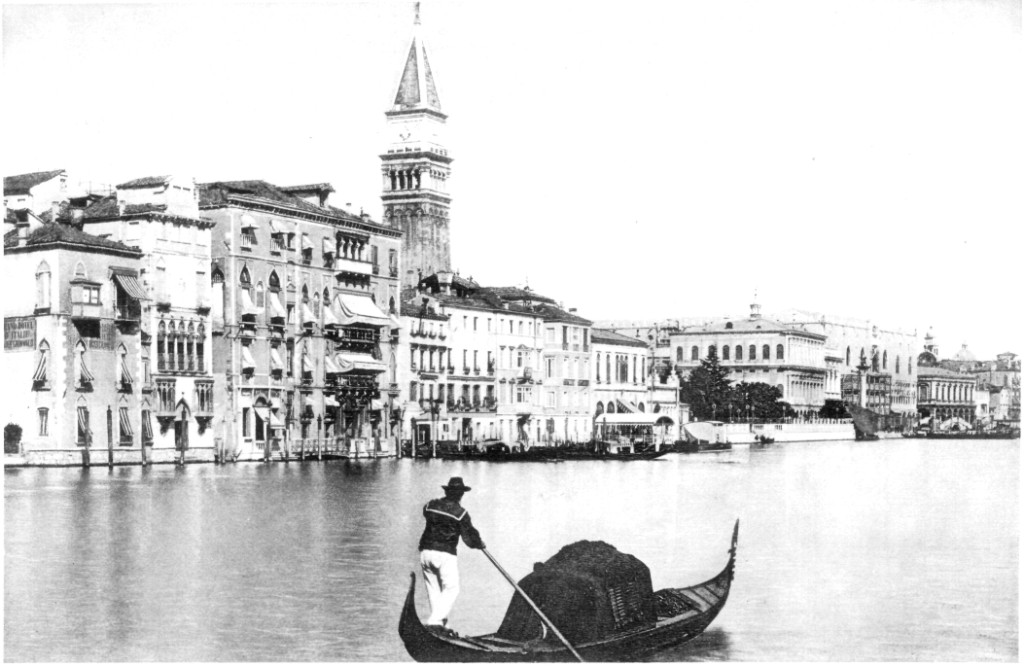 THE GONDOLA.
View on the Grand Canal in Venice. Photogravure from a Photograph.
THE GONDOLA
Afloat; we move—delicious! Ah,What else is like the gondola?
This level flow of liquid glass
Begins beneath us swift to pass.
It goes as though it went alone
By some impulsion of its own.
(How light it moves, how softly! Ah,
Were all things like the gondola!)
How light it moves, how softly! Ah,
Could life, as does our gondola,
Unvexed with quarrels, aims, and cares,
And moral duties and affairs,
Unswaying, noiseless, swift, and strong,
For ever thus—thus glide along!
(How light we move, how softly! Ah,
Were life but as the gondola!)
With no more motion than should bear
A freshness to the languid air;
[Pg 3839]With no more effort than expressed
The need and naturalness of rest,
Which we beneath a grateful shade
Should take on peaceful pillows laid!
(How light we move, how softly! Ah,
Were life but as the gondola!)
In one unbroken passage borne
To closing night from opening morn,
Uplift at whiles slow eyes to mark
Some palace-front, some passing bark;
Through windows catch the varying shore,
And hear the soft turns of the oar!
(How light we move, how softly! Ah,
Were life but as the gondola!)
THE POET'S PLACE IN LIFE
Come, Poet, come!A thousand laborers ply their task,
And what it tends to, scarcely ask,
And trembling thinkers on the brink
Shiver, and know not what to think.
To tell the purport of their pain,
And what our silly joys contain;
In lasting lineaments portray
The substance of the shadowy day;
Our real and inner deeds rehearse,
And make our meaning clear in verse—
Come, Poet, come! for but in vain
We do the work or feel the pain,
And gather up the evening gain,
Unless before the end thou come
To take, ere they are lost, their sum.
Come, Poet, come!
To give an utterance to the dumb,
And make vain babblers silent, come;
A thousand dupes point here and there,
Bewildered by the show and glare;
And wise men half have learnt to doubt
Whether we are not best without.
Come, Poet; both but wait to see
Their error proved to them in thee.
[Pg 3840] Come, Poet, come!
In vain I seem to call. And yet
Think not the living times forget.
Ages of heroes fought and fell
That Homer in the end might tell;
O'er groveling generations past
Upstood the Doric fane at last;
And countless hearts on countless years
Had wasted thoughts, and hopes, and fears,
Rude laughter and unmeaning tears,—
Ere England Shakespeare saw, or Rome
The pure perfection of her dome.
Others, I doubt not, if not we,
The issue of our toils shall see;
Young children gather as their own
The harvest that the dead had sown—
The dead forgotten and unknown.
ON KEEPING WITHIN ONE'S PROPER SPHERE
From 'The Bothie of Tober-na-Vuolich'
[A party of Oxford men spend their long vacation in Scotland. In due course they return to their colleges. Adam, one of the party,—
"The grave man nicknamed Adam,White-tied, clerical, silent, with antique square-cut waistcoat,"
receives a letter at Christmas from Philip (Hewson),
"The Chartist, the poet, the eloquent speaker."]What I said at Balloch has truth in it; only distorted.
Plants are some for fruit, and some for flowering only;
Let there be deer in parks as well as kine in paddocks,
Grecian buildings upon the earth, as well as Gothic.
There may be men perhaps whose vocation it is to be idle,
Idle, sumptuous even, luxurious, if it must be:
Only let each man seek to be that for which Nature meant him,
Independent surely of pleasure, if not regardless,
Independent also of station, if not regardless;
Irrespective also of station, as of enjoyment;
Do his duty in that state of life to which God, not man, shall call him.
If you were meant to plow, Lord Marquis, out with you and do it;
If you were meant to be idle, O beggar, behold I will feed thee:
[Pg 3841]Take my purse; you have far better right to it, friend, than the Marquis.
If you were born for a groom,—and you seem by your dress to believe so,—
Do it like a man, Sir George, for pay, in a livery-stable;
Yes, you may so release that slip of a boy at the corner,
Fingering books at the window, misdoubting the Eighth Commandment.
What, a mere Dean with those wits, that debtor-and-creditor headpiece!
Go, my detective D.D., take the place of Burns the gauger.
Ah, fair Lady Maria, God meant you to live and be lovely:
Be so then, and I bless you. But ye, ye spurious ware, who
Might be plain women, and can be by no possibility better!
Ye unhappy statuettes, ye miserable trinkets,
Poor alabaster chimney-piece ornaments under glass cases,
Come, in God's name, come down! the very French clock by you
Puts you to shame with ticking; the fire-irons deride you.
Break your glasses; ye can! come down; ye are not really plaster,
Come, in God's name, come down! do anything, be but something!
You, young girl, who have had such advantages, learnt so quickly,
Can you not teach? Oh, yes, and she likes Sunday-school extremely,
Only it's soon in the morning. Away! if to teach be your calling,
It is no play, but a business: off! go teach and be paid for it.
Surely that fussy old dowager yonder was meant for the counter;
Oh, she is notable very, and keeps her servants in order
Past admiration. Indeed, and keeps to employ her talent
How many, pray? to what use? Away! the hotel's her vocation.
Lady Sophie's so good to the sick, so firm and so gentle:
Is there a nobler sphere than of hospital nurse and matron?
Hast thou for cooking a turn, little Lady Clarissa? in with them,
In with your fingers! Their beauty it spoils, but your own it enhances;
For it is beautiful only to do the thing we are meant for.
But they will marry, have husbands, and children, and guests, and households—
Are there so many trades for a man,—for women one only,
First to look out for a husband and then to preside at his table?
[Pg 3842]
Have you ever, Philip, my boy, looked at it in this way?When the armies are set in array, and the battle beginning,
Is it well that the soldier whose post is far to the leftward
Say, I will go to the right, it is there I shall do best service?
There is a great Field-Marshal, my friend, who arrays our battalions;
Let us to Providence trust, and abide and work in our stations.
CONSIDER IT AGAIN
"Old things need not be therefore true."O brother men, nor yet the new;
Ah! still awhile the old thought retain,
And yet consider it again!
The souls of now two thousand years
Have laid up here their toils and fears,
And all the earnings of their pain,—
Ah, yet consider it again!
We! what do you see? each a space
Of some few yards before his face;
Does that the whole wide plan explain?
Ah, yet consider it again!
Alas! the great world goes its way,
And takes its truth from each new day;
They do not quit, nor yet retain,
Far less consider it again.
FOOTNOTES:
[A] Ruskin and Lowell were his close contemporaries; they were born in February of the same year.
[B] It is on this sketch of his life that the present account of him is mainly based.
[Pg 3843]