At the sight of the archduke, the officers turned aside respectfully, and M. Pascal, who seemed to have lost control of himself, cried:
"Zounds! monseigneur, you receive people here singularly!"
The prince, remembering the appointment that he had made with M. Pascal, and fearing for his own dignity some new insult from this brutal person, said, making a sign to him:
"Come, monsieur, come."
And before the eyes of the silent officers the door closed on the prince and the capitalist.
"Now, monsieur," said the archduke, pale with anger and hardly able to restrain himself, "will you tell me the cause of this scandal?"
"What! you make an appointment for me at three o'clock; I am punctual; a quarter of an hour passes,—nobody; a half-hour,—nobody; my faith! I lose patience, and I ask one of your officers to inform you that I am waiting. They answer that you have an audience. I begin to champ my bit, and at last, at the end of another half-hour, I tell your gentlemen, positively, that if they do not inform you I will go in myself."
"That, monsieur, is an insolence—"
"What, an insolence! Ah, well, monseigneur, is it I who have need of you, or you who have need of me?"
"M. Pascal!"
"Is it I who come to you, monseigneur? Is it I who have asked for the loan of money?"
"But, monsieur—"
"But, monseigneur, when I consent to interrupt my own business to come here and wait in your antechamber,—what I do for nobody,—it seems to me that you ought not to let me go to the devil for one hour, and the most important hour, too, on the Exchange, which, thanks to you, monseigneur, I have missed to-day; and in addition to that vexation, I think it very strange that your officers repulse me, when, on their refusal to announce me, I take the liberty of announcing myself."
"Discretion and the simplest propriety command you to wait the end of the audience I was giving, monsieur."
"That is possible, monseigneur, but, unfortunately, my just impatience contradicts discretion, and, frankly, I think I deserve a different reception, especially when I come to talk with you of a service that you have implored me to do for you."
In the first moment of his anger, increased by the persistent coarseness of M. Pascal, the prince had forgotten that the Marquise de Miranda could hear his conversation with his rude visitor from the adjoining room; so, overwhelmed with shame and feeling the necessity of appeasing the angry humour of the man, he endeavoured with all his self-control to appear calm, and tried to lead M. Pascal, as he talked with him, over to the embrasure of one of the windows, where Madeleine would not be able to hear the interview.
"You know, M. Pascal," said he, "that I have always been very tolerant of your bluntness, and I will continue to be so."
"Really, you are very good, monseigneur," replied Pascal, sarcastically, "but you see each one of us has his little contrarieties, and at the present moment I have very large ones, which make it impossible for me to possess the gentleness of a lamb."
"That excuse, or, rather, that explanation suffices for me, M. Pascal," replied the prince, dominated by his need of the financier's services. "Opposition often exasperates the gentlest characters, but let us talk no longer of the past. You asked me to anticipate by two days the appointment we had made to terminate our business. I hope that you bring me a satisfactory reply."
"I bring you a thoroughly complete yes, monseigneur," replied our hero, growing gentle. And he drew a pocketbook from his pocket. "And more, to corroborate this yes, here is a draft on the Bank of France for the tenth of the amount, and this contract of mine for the remainder of the loan."
"Ah, my dear M. Pascal!" cried the prince, radiant, "you are a man—a man of gold."
"'A man of gold!' that is the word, monseigneur. That is no doubt the cause of your liking for me."
The prince did not observe this sarcasm. Delighted with the whole day, which seemed to fulfil his various desires, and impatient to dismiss the financier so as to return to Madeleine, he said:
"Since all is settled, my dear M. Pascal, we need only exchange our signatures, and to-morrow or after, at your hour, we will regulate the matter completely."
"I understand, monseigneur; once the money and the signature in your pocket, the keenest desire of your heart is to rid yourself as soon as possible of your very humble servant, Pascal, and to-morrow you will turn him over to some subaltern charged with the power of arranging the affair."
"Monsieur!"
"Good! monseigneur, is not that the natural course of things? Before the loan, one is a good genius, a half or three-quarters of God; once the money is loaned, one is a Jew or an Arab. I know this, it is the other side of the medallion. Do not hasten, monseigneur, to turn over the said medallion."
"Really, monsieur, you must explain yourself."
"Immediately, monseigneur, for I am in a hurry. The money is there, my signature is there," added he, striking the pocketbook. "The affair is concluded on one condition."
"Still conditions?"
"Each, monseigneur, manages his little affairs as he understands them. My condition, however, is very simple."
"Let us hear it, monsieur, let us come to an end."
"Yesterday I told you that I observed a handsome blond young man in the garden, where he was promenading, who lives here, you inform me."
"Without doubt, it is Count Frantz, my godson."
"Certainly, one could not see a prettier boy, I told you. Now then, as you are the godfather of this pretty boy, you ought to have some influence over him, ought you not?"
"What are you aiming at, monsieur?"
"Monseigneur, in the interest of your dear godson, I will tell you in confidence that I think the air of Paris is bad for him."
"What!"
"Yes, and you would do wisely to send him back to Germany; his health would improve very much, monseigneur, very much indeed."
"Is this a pleasantry, monsieur?"
"It is serious, monseigneur, so serious that the only condition that I put to the conclusion of our affair is that you must make your godson depart for Germany in twenty-four hours at the latest."
"Truly, monsieur, I cannot recover from my surprise. What interest have you in the departure of Frantz? It is inexplicable."
"I am going to explain myself, monseigneur, and that you may better understand the interest I have in his departure, I must make you a confidence; that will enable me to point out exactly what I expect from you. Now then, monseigneur, such as you see me I am madly in love. Eh, my God! yes, madly in love; that seems queer to you and to me also. But the fact remains. I am in love with a young girl named Mlle. Antonine Hubert, your neighbour."
"You, monsieur, you!" exclaimed the prince, dismayed.
"Certainly, me! Me! Pascal! And why not, monsieur? 'Love is of every age,' says the song. Only, as it is also of the age of your godson, Count Frantz, he has in the most innocent way in the world begun to love Mlle. Antonine; she, not less innocently, returns the love of this pretty boy, which places me, you see, in an exceedingly disobliging frame of mind; fortunately, you can assist me in getting out of this frame of mind, monseigneur."
"I?"
"Yes, monseigneur; I will tell you how. Assure me that you will require Count Frantz to leave France this instant,—and that is easy,—and demand also that he is not to set foot in France for several years; the rest belongs to me."
"But there is another thing you do not think of, monsieur. If this young person loves Frantz?"
"The rest belongs to me, I tell you, monseigneur. President Hubert has not two days to live; my batteries are ready, the little girl will be forced to go to live with an old relative who is horribly covetous and avaricious; a hundred thousand francs will answer to me for this old vixen, and once she gets the little girl in her clutches I swear to God that Antonine will become, willing or unwilling, Madame Pascal, and that, too, without resorting to violence. Come now, monseigneur, all the love affairs of fifteen years will not hold against the desire to become, I will not say madame the archduchess, but madame the archmillionaire. Now, monseigneur, you see it all, I have frankly played the cards on the table; having no interest in acting otherwise, it is of little or no moment to you that your godson should marry a little girl who has not a cent. The condition that I impose is the easiest possible one to fulfil. Again, is it yes, or is it no?"
The prince was overwhelmed, less by the plans of Pascal and his odious misanthropy, than by the cruel alternative in which the condition imposed by the capitalist placed him.
To order the departure of Frantz, and oppose his marriage with Antonine, was to lose Madeleine; to refuse the condition imposed by M. Pascal was to renounce the loan, which would enable him to accomplish his projects of ambitious aggrandisement.
In the midst of this conflict of two violent passions, the prince recollected that he had only given his word to Madeleine for the pardon of the exile, the tumult caused by the fury of M. Pascal having interrupted him at the very moment he was about to swear to Madeleine to consent to the marriage of Frantz.
Notwithstanding the facility which this evasion left to him, the archduke realised how powerful was the influence of Madeleine over him, as that morning even he had not hesitated to sacrifice Frantz to his ambition.
The hesitation and perplexity of the prince struck Pascal with increasing surprise; he could not believe that his demand concerning Frantz was the only question; however, to influence the determination of the prince by placing before him the consequences of his refusal, he broke the silence, and said:
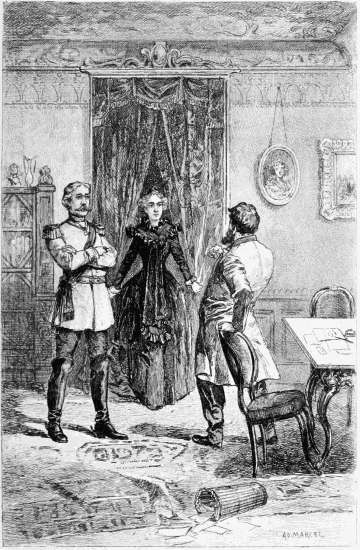
"'It is no.'"
Original etching by Adrian Marcel.
"Really, monseigneur, your hesitation is incomprehensible! What! by a weak deference to the love affair of a schoolboy, you renounce the certainty of obtaining a crown? For, after all, the duchy whose transfer is offered to you is sovereign and independent. This transfer, my loan only can put it in your power to accept, which, I may say in passing, is not a little flattering to the good man Pascal. Because, in a word, through the might of his little savings, he can make or unmake sovereigns, he can permit or prevent that pretty commerce where these simpletons of people sell and sell again, transfer and reassign, no more nor less than if it were a park of cattle or sheep. But that does not concern me at all. I am not a politician, but you are, monseigneur, and I do not understand your hesitation. Once more, is it yes? is it no?"
"It is no!" said Madeleine, coming suddenly out of the adjoining room, where she had heard the preceding conversation, notwithstanding the precautions of the prince.