MARY'S MARRIAGE.
His vacation ended, after a busy season at the farm, Ralph Jackson returned to his work in the city, strong and robust. He had acquired the coat of tan which Mary's Uncle had predicted. Physically strong as the "Cave Man" of old, he felt capable of moving mountains, and as was natural, he being only a human man, longed for the mate he felt God had intended should one day be his, as men have done since our first gardener, Adam, and will continue to do until the end of time.
When visiting the farm, an event which occurred about every two weeks, Ralph constantly importuned Mary to name an early day for their marriage.
Mary, with a young girl's impulsiveness, had given her heart unreservedly into the keeping of Ralph Jackson, her first sweetheart. Mary was not naturally cold or unresponsive, neither was she lacking in passion. She had had a healthy girlhood, and a wholesome home life. She had been taught the conventional ideals of the marriage relations that have kept the race strong throughout the centuries. Mary possessed great strength of character and fine moral courage. Frequently, not wishing to show her real feeling for the young man; too well poised to be carried off into the wrong channel, defended and excused by many over-sentimental and light-headed novelists of the day, she sometimes appeared almost indifferent to the impetuous youth with warm, red blood leaping in his veins, who desired so ardently to possess her.
Mary's Aunt had taught her the sanctity of parenthood, also that women are not always the weaker sex. There are times when they must show their superiority to "mere man" in being the stronger of the two, mentally if not physically, and Ralph Jackson knew when he called Mary "wife" she would endow him with all the wealth of her pure womanhood, sacredly kept for the clean-souled young man, whose devotion she finally rewarded by promising to marry him the second week in October.
Sibylla Linsabigler, a good but ignorant girl, accustomed to hearing her elder brothers speak slightingly regarding the sanctity of love and marriage, was greatly attached to Mary, whom she admired exceedingly, and looked up to almost as a superior being. She unconsciously imitated many of Mary's ways and mannerisms, and sought to adopt her higher ideals of life and standard of morals.
One Sunday, as Jake Crouthamel was spending the evening with Sibylla, as was his usual custom, he attempted some slight familiarity, which annoyed Sibylla greatly. Jake, noticing the young girl's displeasure at his action, remarked, "I think me Sibylla, you are stuck up yet" (a grave fault in the Bucks County farm hand's opinion).
"No, Chake," Sibylla replied, "I ain't, but Mary, she say a man gives a girl more respect what keeps herself to herself before she is married, and I lofe you Chake and want that you respect me if we marry."
Fritz and Elizabeth Schmidt, on hearing the news of Mary's approaching marriage, promptly begged the privilege of decorating the old farm house parlor for the expected ceremony. They scoured the surrounding woods and countryside for decorations; along old stone fences and among shrubbery by the roadside they gathered large branches of Bitter Sweet. Its racemes of orange-colored fruit, which later in the season becomes beautiful, when the orange gives place to a brilliant red, the outer covering of the berry turns back upon the stems, forming one of the prettiest pictures imaginable in late Autumn. They also gathered branches of feathery wild clematis, which, after the petals had fallen, resembled nothing so much as a cluster of apple seeds, each seed tipped with what appeared like a tiny osprey feather. From the woods near the farm they gathered quantities of trailing ground pine and rainbow-tinted leaves from the numerous brilliant scarlet and yellow maples, which appeared brighter in contrast to the sober-hued trees of shellbark, oak and chestnut.
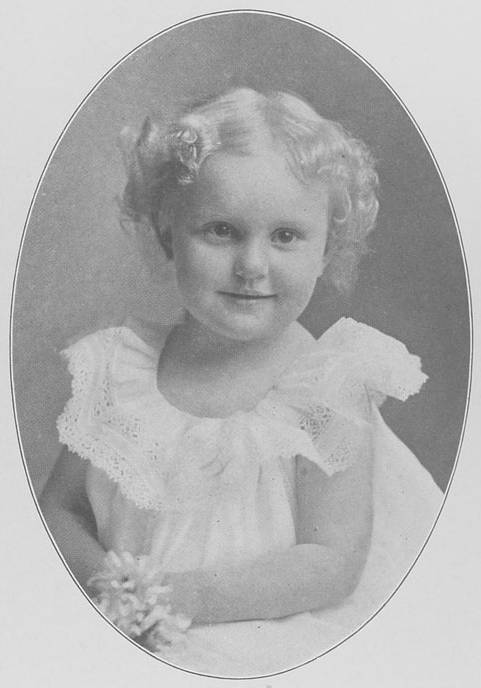
POLLY SCHMIDT.
The wedding gifts sent to Mary were odd, useful and numerous. The Campfire Girls, to whom she became endeared, gave her a "Kitchen Shower," consisting of a clothes basket (woven by an old basketmaker from the willows growing not far distant), filled to overflowing with everything imaginable that could possibly be useful to a young housekeeper, from the half dozen neatly-hemmed linen, blue ribbon tied, dish clothes, to really handsome embroidered articles from the girls to whom she had given instructions in embroidery during the past summer.
Sibylla's wedding present to Mary was the work of her own strong, willing hands, and was as odd and original as useful. 'Twas a "door mat" made from corn husks, braided into a rope, then sewed round and round and formed into an oval mat. Mary laughingly told Sibylla she thought when 'twas placed on her kitchen doorstep she'd ask every one to please step over it, as it was too pretty to be trod on, which greatly pleased the young girl, who had spent many hours of loving thought and labor on the simple, inexpensive gift.
Mary received from Professor Schmidt a small but excellent copy of one of the world's most famous pictures, "The Night Watch," painted by Rembrandt, in 1642.
"My dear," said the old Professor, "I saw what was said to be the original of this painting, the property of Queen Wilhelmina of Holland, at the St. Louis Exposition in 1904. It was in a small, separate building. The size of the picture was fifteen feet by twenty feet. It is the largest and best known of Rembrandt's works. It acquired the wrong title of 'Night Watch' in a period when, owing to the numerous coats of varnish and the effect of smoke and dust, it had gotten so dark in appearance that only the most lucid parts could be discerned. Nowadays, nobody doubts that the light falling from the left on the boisterous company is that of the sun. The musketeers are remarching out of the high archway of their hall, crossing the street in front of it, and going up a bridge. The architecture of the building is a product of Rembrandt's imagination. The steps, also, which we see the men descending, were put there simply to make those at the back show out above those in the front ranks. The march out was to be above all a portrait group. Sixteen persons had each paid their contributions, a hundred guilders on the average, to have their likenesses transmitted to posterity, and every one of them was therefore to be fully visible."
"It is certainly a wonderful picture," said Mary, "and while I have seen few pictures painted by old masters, I think, even with my limited knowledge of art, I cannot fail to appreciate this excellent copy, and I thank you heartily. Professor, and shall always be reminded of you when I look at this copy of a great work."
Mary would not go empty-handed to Ralph at her marriage. Her "hope chest" in the attic was full to overflowing, and quite unique in itself, as it consisted of an old, in fact ancient, wooden dough-tray used in times past by Aunt Sarah's grandmother. Beside it stood a sewing table, consisting of three discarded broom handles supporting a cheese-box cover, with wooden cheese-box underneath for holding Mary's sewing; stained brown and cretonne lined. Mary valued it as the result of the combined labor of herself and Ralph Jackson. A roll of new, home-made rag carpet, patchwork quilts and "New Colonial" rugs, jars of fruit, dried sweet corn, home-made soap, crocks of apple butter, jellies, jams and canned vegetables all bore evidence of Mary's busy Summer at the farm.
The day of Mary's marriage, the twelfth of October, dawned clear and bright, sunshine warm as a day in June. In the centre of the gayly-decorated old farm house parlor, wearing a simple, little, inexpensive dress of soft, creamy muslin, we find Mary standing beside Ralph, who is looking supremely satisfied and happy, although a trifle pale and nervous, listening to the solemn words of the minister. Ralph's "I will" sounded clearly and distinctly through the long room. Mary, with a sweet, serious, faraway look in her blue eyes, repeated slowly after the minister, "I promise to love, honor and"—then a long pause. She glanced shyly up at the young man by her side as if to make sure he was worth it, then in a low, clear tone, added, "obey."
Ralph Jackson certainly deserved the appellation "Cave Man" given him by Fritz Schmidt. He was considerably more than six feet in height, with broad, square shoulders, good features, a clear brain and a sound body. He had never used intoxicants of any description. He sometimes appeared quite boyish in his ways, for on account of his matured look and great size he was frequently judged to be older than he really was.
Aunt Sarah had provided a bounteous repast for the few friends assembled, and while looking after the comfort of her guests tears dimmed the kindly, gray eyes at the thought of parting from Mary.
Small Polly Schmidt, as flower girl at the wedding, was so excited she scarcely knew if she should laugh or cry, and finally compromised by giving Mary what she called a "bear hug," much to Mary's amusement. Fritz gravely said: "Allow me to congratulate you, Mr. Jackson," and turning to Mary, "I wish you a beautiful and happy life, Mrs. Jackson." Mary blushed becomingly on hearing her new name for the first time.
Bidding farewell to friends, Mary and Ralph, accompanied by her Uncle, were driven by "Chake" to the depot in a near-by town, where they boarded the train for the little, newly-furnished home in the suburbs of Philadelphia, the deed of which was Mary's wedding gift from her Uncle, in appreciation of her faithful service on the farm during the summer and for the brightness she had brought into his life and the lives of those with whom she had come in contact, as every one at the farm had felt the captivating charm and winning sweetness of the young girl.
As the train came in sight, the old gentleman, in a voice husky with emotion, bade the young couple, just starting the journey of life together, an affectionate farewell, and repeated solemnly, almost as a benediction, "Es Salamu Aleikum."