 Chapter XI headpiece
The Walk had got through Sunday as best it could. It had gone to church; it had read good books; the Admiral had carefully laid "Hervey's Meditations among the Tombs" open on his knees, and his bandana over his head, and had tried to sleep his Sunday sleep. But it was only a fitful slumber. Too many things had happened and were happening in the Walk. There was Jack, concealed in Doctor Sternroyd's house, for one. What did that mean? Sir Peter had called on Doctor Sternroyd, but the latter stood in his doorway with the door only ajar, and would not allow him to cross the threshold. He had kept a wary eye on the Walk and he was sure Jack and Marjolaine had not met. He himself had sat under the elm to an unconscionable hour, and had made it impossible for the lovers to meet. He would not betray them, but on the other hand there should be no underhand goings on. He had tried to intercept Marjolaine and talk to her like the Dutch uncle he had alluded to, but she laughed in his face, and ran away. But that was not all that troubled him. He had undoubtedly been embraced, in the presence of the whole Walk, by Mrs. Poskett. There was no blinking that fact; and he felt that his neighbours, with gross unfairness, put the blame on him. After the morning service, Miss Ruth Pennymint, who had gone to church alone, refused to walk home with him for the first time in his experience, and only gave a very lame excuse. Mr. Brooke-Hoskyn looked at him with a disapproving eye. Mrs. Poskett had not shown herself since the awful scene with the cat. He had instructed Jim to reconnoitre; I don't know how Jim carried out that delicate task, but he came back to his master with the report that Mrs. Poskett was mortal bad, to be sure. Even Basil Pringle had been very distant with him when they met after church.
The Admiral turned and twisted in his chair. Surely the flies were more troublesome than usual so early in the summer.
He was so put about that, contrary to his usual custom, he went to church again in the evening. Madame Lachesnais was there, and to his confusion asked him to escort her home. Marjolaine walked on in front with Mr. Pringle and Ruth.
Madame had noticed the curious discomfort that pervaded the Walk. She had seen and heard nothing of yesterday's occurrences, as she had been shut in her own little room at the back of the house, busy with her own troubles. She took the Admiral into her confidence. Did he know what was the matter with the Walk? It seemed as if some imp of mischief had set everybody by the ears. She had ventured to address Doctor Sternroyd that morning, and he had turned even paler than usual—positively green—and had run away from her. What was the matter with Mrs. Poskett? Why had not Barbara been to church all day? And he, himself, why was he so silent? Why did he seem to wish to avoid her?
The Admiral was greatly troubled. He could only stammer that he supposed it was the change in the weather. "Well," said Madame, "I cannot let our good friends go on like this. Why, we should be unable to live together in the Walk, if we were not all on excellent terms with each other." And so the next morning all the inhabitants of the Walk received a pretty little three-cornered note, asking them to an al fresco tea-party that evening, under the elm.
Jack had never spent such a Sunday, and privately registered a vow he would never spend such another. Doctor Sternroyd did all his own housekeeping; he said he would rather spend his money on a book than on a cook. He invariably rose at six. He routed Jack out at that hour. At half-past six he was at work in his study, even on Sundays. At nine he made his breakfast, a thin cup of tea and a very thin rasher of bacon. What Jack did between six and nine, I do not know. After breakfast the Doctor went back to his study and he gave Jack his great manuscript work on "Prehistoric Remains found in the Alluvial Deposit of the Estuary of the Thames, together with Observations on the Cave-dwellers of Ethiopia," to while away the time. When the Doctor went to church he locked Jack in his room. After church he went for a long walk and forgot all about Jack. And he had forgotten all about him when he came back, so that Jack was forced to raise a perfect riot before he could get released. By midday on Monday Jack had worked his way through every edible thing in the house, and on Monday afternoon the Doctor not only had to go and see the Archbishop of Canterbury on the subject of the licence, but had been strictly enjoined by Jack to bring home food.
Fortunately for Madame's tea-party, that Monday evening was an ideal one. June had come and the roses in the little gardens had taken the opportunity to burst into bloom. The elm was in its fresh summer garb. The setting sun shone level through its leaves and turned them all to burnished gold. It gilded the entire Walk, and set the panes in the windows flashing and flaming; even the dirty little oil lamps were glorified as they reflected the golden blaze. The river shimmered with opal and amethyst; and a great barge, drifting down with the tide, might have borne Cleopatra and all her retinue, so gorgeously was it transfigured.
Not all the Walk was present. The Doctor, as we have just seen, was engaged with the Archbishop, and with his own marketing. Miss Barbara had sent a polite excuse. Her actual words were "Miss Barbara Pennymint presents her Compliments to Madame Lachesnais and is much obliged for her kind invitation to tea. Miss Barbara Pennymint much regrets she cannot avail herself of Madame Lachesnais' proffered hospitality as I am engaged in an educational experiment."
Mrs. Brooke-Hoskyn, of course, was absent, as usual, for purely personal and private reasons.
But all the others were there. Mr. Brooke-Hoskyn was resplendent in a plum-coloured suit, of which the breeches fitted so tightly, and of which the waist was so narrow, that he scarcely dared breathe.
Mrs. Poskett and Ruth had put on their best gowns; the Admiral wore his gala uniform with all his medals, and his three-cornered hat. Madame herself was a vision of loveliness. She had discarded her half-mourning for the occasion; but what she wore I cannot tell you, except that it was a soft blue, and that there was graceful lace about her neck and wrists. If you wish to see what she looked like, you have only to examine a Book of the Modes of 1805, and you will find her there. Even Mr. Basil Pringle was brushed.
Nanette and Jim—Jim in his best clothes—waited on Madame's guests. The latter were all on their best behaviour. You never saw anything more elegant than the way Mr. Brooke-Hoskyn stuck out his little finger as he raised his cup to his lips; you never heard prettier protests than when Marjolaine offered Mrs. Poskett a third helping of cake. "I couldn't! I reely and truly couldn't!—Well, since you insist!"
But do what Madame would she could not put her guests quite at their ease. A sort of blight brooded over their spirits. This was particularly noticeable in their attitude towards Sir Peter. They treated him with unaccustomed aloofness; they kept him at arm's length; they did not respond to his sallies; with the result that his sallies became more forced as the evening wore on. As a contrast to this gentle gloom, Marjolaine's high spirits amazed her mother. This child, who only last Saturday was broken-hearted, to-day was laughing and blithe, rallying her guests, prettily playing the hostess, the only life in the party. Madame watched her with puzzled anxiety.
Mr. Brooke-Hoskyn, with the calf of his leg well displayed, and his little finger well at right angles to his cup, bowed elegantly. "Ah, Ladies, there is nothing so comforting as a dish of tea after dinner. It is prodigiously soothing!"
There seemed no appropriate rejoinder, but Mrs. Poskett exploded with "Nothing can soothe the broken heart." She spoke into her cup, but her eyes wandered towards the Admiral.
Sir Peter tried to change the conversation. Also he felt it was time to assert himself. Mr. Brooke-Hoskyn had been monopolising the notice of the ladies far too long.
"Hah!" he cried, "I 've always said Pomander Walk was a Haven of Content. Look at it!" You remember that the last time he made a similar remark everybody obediently turned at his command. Imagine his feelings, then, when on this occasion nobody paid the slightest attention. On the contrary, they ostentatiously turned to each other and began spirited conversations about nothing in particular. He repeated, "I say, look at it!" but only drew a glare from Brooke-Hoskyn.
Marjolaine came to the rescue. She tripped up to him and put her arm through his. "There 's something the matter with the Walk this evening, Sir Peter. I 'm the only merry one among you!"
Madame could not help exclaiming with grave remonstrance, "Marjolaine!"
Marjolaine came close to her mother. "Oh, let me laugh, Maman!" She proceeded in a whisper, "They are so droll! Sir Peter is afraid of Mrs. Poskett; Mrs. Poskett is almost in tears; Mr. Basil is gloomy; Ruth is in a bad temper; and Mr. Brooke-Hoskyn has n't got over Saturday's banquet."
"But you, Marjolaine—!" exclaimed Madame with quiet reproof.
"You told me to fight it, Maman," said Marjolaine, with a shy laugh. Then she ran across to Basil, who was watching the door through which Barbara might still come. He was wondering what demon had persuaded him to accept this invitation, which had brought him out of doors, when he might have stayed indoors where he would at least have been under the same roof as Barbara.
The Admiral had bravely recovered from his rebuff. He came up to Brooke-Hoskyn. "Well, Brooke, my boy! Did n't see you in church yesterday. Too much turtle on Saturday—what?" and down came the flat of his hand with a round thwack on Mr. Brooke-Hoskyn's broad back.
To be accused of having overeaten yourself when you are suffering from a bad headache is extremely annoying; to be slapped on the back when you are swallowing hot tea is infuriating. Mr. Brooke-Hoskyn turned on Sir Peter. "Nothing of the sort, sir!—I deprecate these unseemly familiarities. I was detained from divine service because I chose to sit at home and hold my dear Selina's hand!" And he turned his back on Sir Peter.
"Um," said the latter. His playful banter was certainly not being well received.
Mrs. Poskett looked up at Mr. Brooke-Hoskyn with melancholy eyes. "How is your wife?" she said, "that dear, innocent lamb."
"Gambolling, Ma'am," he answered, airily. "Figuratively speaking, Selina is gambolling."
"How wonderful!" exclaimed Mrs. Poskett, sympathetically.
Basil Pringle felt that something drastic must be done if they were to live through the evening. He addressed Marjolaine. "Miss Marjory, won't you cheer us with a song?"
Madame Lachesnais interposed quickly: this was putting her poor child's courage to too severe a test. "I am sure she would prefer not to sing this evening."
But Marjolaine exclaimed merrily, "Oh, yes, Maman, if they would like it!"
Madame could only admire her indomitable pluck. "Brave child!" she murmured.
"Sing that pretty little thing about the blue ribbon," cried the Admiral, and hummed the first bar.
"Ha!" mockingly cried Mr. Brooke-Hoskyn.
The Admiral faced him angrily: "Well, sir?"
Mr. Brooke-Hoskyn eyed him calmly through his quizzing glass, and said coldly, "What, sir?"
Madame interposed with her most amiable smile. "Sir Peter, Mrs. Poskett's cup is empty."
"Is it?" growled Sir Peter, without moving. But Madame's hand was stretched out to receive it, and he had to yield.
"Oh hang!—Your cup, Ma'am." He almost snatched it from her.
"How kind and gentle you are," almost sobbed Mrs. Poskett, with an adoring glance.
The Admiral answered her with a glare. "Kind be—" he was silenced by a stern "Hush!" from Basil, and had to relieve his feelings by inarticulate splutterings.
Marjolaine stood in the centre of the circle, with her hands folded in front of her, and sang very simply and unaffectedly:
"Oh, dear! What can the matter be? Dear, dear! What can the matter be? Oh, dear! What can the matter be? Johnny 's so long at the fair. He promised he 'd buy me a fairing should please me, And then for a kiss, oh! he vowed he would tease me, He promised he 'd buy me a bunch of blue ribbons To tie up my bonny brown hair."
Mr. Brooke-Hoskyn applauded in the grand manner with the tips of his fingers, as if he had been at the Opera. "Brava! Brava!" he cried, with the discrimination of a connoisseur.
"Brava be hanged!" roared the Admiral. "Capital!" He turned to Miss Ruth. "Where's little Miss Barbara?"
To his consternation Miss Ruth hissed a fierce "Hsssh!" at him.
"Well, I 'm—!" he muttered to himself.
Marjolaine sang the second verse. You are to understand that she made a very pleasant picture as she stood warbling the quaint old ballad with unaffected simplicity. Jack evidently thought so, for, braving the danger of discovery, he stood, gaunt and hungry, watching her from behind the curtains in Doctor Sternroyd's window. Indeed, all the Walk was affected by her charm. Heads nodded to the tune; feet kept time to the rhythm; hearts melted—Mrs. Poskett's heart, especially. She gazed reproachfully at the Admiral. What, indeed, could the matter be? and why, indeed, was her Johnnie, whose name was Peter, so long at the fair? Jim and Nanette had come into the circle, fascinated by the song. Jim was trying to insinuate an arm round Nanette's ample waist, but only got pinched for his pains.
"He promised he'd buy me a basket of posies, A garland of lilies, a garland of roses, A little straw hat to set off the blue ribbons That tie up my bonny brown hair. And it's oh, dear! What can the matter be? Dear, dear! What can the matter be? Oh, dear! What can the matter be? Johnny 's so long at the fair!"
Almost unconsciously the whole Walk drifted into the song, so that the last lines were being sung by everybody. The Admiral, indeed, who never knew when a song was over, went on long after everybody else had finished. In his enthusiasm he added weird shouts to the words:—"Oh! Damme! Ahoy! What can the matter be?"
Mrs. Poskett burst into loud sobs. "Oh, don't!—I can't bear it!"
Ruth turned fiercely on the Admiral. "Brute!" she cried.
Mr. Brooke-Hoskyn was stopping both ears with his hands. "Mong doo! Mong doo!" he drawled. And then in that curiously official manner he sometimes dropped into, "Pray silence for the Admiral's song!" It was a very irritating manner.
Sir Peter made furiously towards him. "By Jehoshaphat—!"
But Madame, ever alert, stopped him. She held out a full cup. "Sir Peter," she said, with her sweetest smile, indicating Mrs. Poskett, "take her another dish of tea."
"Me, Ma'am!" protested the outraged Admiral; but there was no resisting that smile, and he took it like a lamb—an angry lamb. "It's a confounded conspiracy," he growled. He thrust the tea under Mrs. Poskett's nose. "Your tea, Ma'am!"
"How sweet of you!" sobbed Mrs. Poskett.
The Admiral danced with rage. "Dash it and hang it, Ma'am, you're crying into it!"
Marjolaine had taken Miss Ruth aside. "Where is Barbara?" she asked.
"It's enough to make a saint swear," answered Ruth, snappishly. "She's been locked in with Doctor Johnson since Saturday. Locked in! Only comes out for meals." Marjolaine laughed quietly to herself.
Sir Peter had been moving restlessly round the Walk. He now found himself face to face with Basil. "Pringle," he said, "can you tell me what's come over the Walk?"
Basil drew himself up. "The Walk has lofty ideals, sir," he said sternly. "Perhaps you have fallen short of them." He turned away and stalked towards Barbara's house.
The Admiral was left speechless. He—he! Admiral Sir Peter Antrobus—had been snubbed by Mr. Brooke-Hoskyn, by Ruth, and now by this—this fiddler-fellow! He could only mutter, "Well!—blister my paint—!"
He was aroused by the booming of Mr. Brooke-Hoskyn's voice.
"Yes, Ladies," that great man was saying, "Sherry was in fine condition on Saturday!"
The Admiral was not going to hoist the white flag. Mr. Brooke-Hoskyn must be put in his proper place. "And port, too, eh, Brooke, my boy?"
Mr. Brooke-Hoskyn eyed him sternly and haughtily. "My name is Brooke-Hoskyn, sir, and I was referring to my Right Honourable friend, Richard Brinsley Sheridan!"
"Why couldn't you say so?" grumbled Sir Peter.
Mr. Brooke-Hoskyn continued. "As I was about to say when—" he looked contemptuously at the Admiral—"when I was interrupted—What wit! What brilliance!"
"Oh, do tell us!" cried Ruth. The ladies all hung on his lips. He tasted the full flavour of popularity. He let it linger on his palate. He was in no hurry. "In order to appreciate the point, you must remember how sultry the weather was on Saturday."
"Gave you a headache, what?" put in the irrepressible Admiral.
Mr. Brooke-Hoskyn did his best to wither him with a look. Then he resumed. "Brooke, says he—Brooke, my boy"—just like that—all craned forward: they must not miss the point—"it's a very warm night." His audience waited. Yes? The rest of the story? He looked from one to the other a little uncomfortably. When they found nothing more was coming they turned to each other, puzzled. Could this be all? Was their perspicacity at fault? or where was the joke? The Admiral, bolder than the rest, gave voice to the general feeling. "H'm. I don't see much in that."
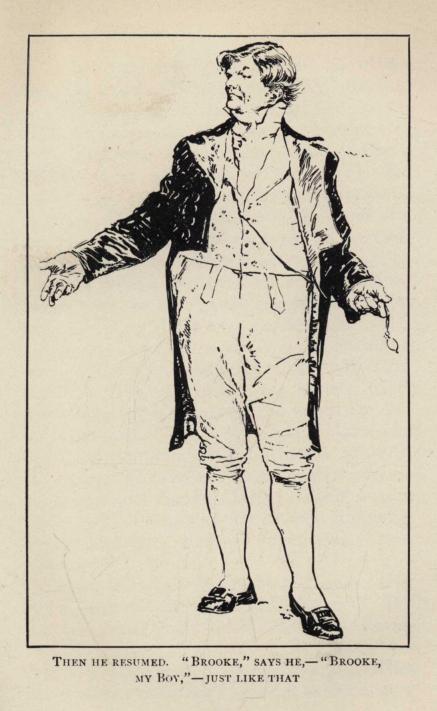 THEN HE RESUMED. "BROOKE," SAYS HE,—"BROOKE, MY BOY,"—JUST LIKE THAT
"Nobody ever suspected you of having a sense of humour," said Mr. Brooke-Hoskyn, severely. However, he felt that his first effort had not been the success he had hoped for, and he tried again. "Ah!"—said he, brightening up, "and my friend, H.R.H. the P. of W.!" He uttered the cabalistic letters with a mixture of mystery and airy familiarity. There was an awed "Oh-h!" from all his hearers except Sir Peter. The latter exclaimed impatiently, "Your friend who?"
The reply came with crushing weight. "His Royal Highness the Prince of Wales, sir!" The Admiral reeled under the shock of this broadside.
Mrs. Poskett leant forward eagerly. "What did the dear Prince say? My poor husband knew him well," she explained. "When Mr. Alderman Poskett was Sheriff, the dear Prince frequently dined with the Corporation, and many 's the time he said to Poskett, 'Mr. Sheriff, you must be knighted,' but Poskett went and died—"
Mr. Brooke-Hoskyn was annoyed. He was being interrupted, which is a thing intolerable, and his own anecdote was being supplanted. He held up a deprecatory hand. "It was not so much what he said," he explained, "as his manner of saying it. Just:—'Ah, Brooke!'—but oh! the elegance! Oh, the condescension!"
Sir Peter broke out with, "Well, of all the—!"
But Madame stopped him with a touch on his arm. "Do you ever make speeches, Mr. Brooke-Hoskyn?" she asked sweetly.
The great man looked at her with something like suspicion. For a moment he was undeniably flustered. But he mastered himself with an effort and replied with a fair assumption of carelessness, "Short ones, Ma'am. Frequent, but short. I have proposed the health of many gentlemen of distinction."
"How clever you must be!" cried Ruth, admiringly.
"Oh—!" protested Mr. Brooke-Hoskyn, with exquisite modesty.
Madame pointed to the river, now gleaming in the afterglow. "How strangely empty the Walk looks without our fisherman!"
"I was wondering what I missed," said Basil, "of course! The Eyesore!"
"He leaves a blank," added Ruth.
Marjolaine laughed. "He was a sort of statue."
Mrs. Poskett confided tearfully to her tea-cup. "The Walk is not the Walk without him."
Sir Peter was genuinely astonished. "Why, he tried to drown your cat, Ma'am!"
Madame playfully shook her finger at him, "Oh, Sir Peter! have you driven the poor man away?"
The Walk eyed him severely, and all cried as with one voice, "For shame, Sir Peter!" Mr. Brooke-Hoskyn went on booming, "Shame! Shame!" all by himself, long after the others were silent.
The Admiral's patience was nearly exhausted. Here was Madame turning against him now. The injustice of it infuriated him. He stamped with rage. "But, hang it and dash it, I haven't seen him!" he roared. But nobody believed him. All shook their heads gloomily, and said "Ah!"