 Chapter XIII headpiece
Mrs. Poskett found herself—if you did not count the Eyesore: and nobody ever had counted him, yet—alone in the Walk. The sun had set, and the evening twilight itself had almost merged into night. The river gleamed a pale green, as if it were loath to surrender the last remnant of day. It was a propitious hour for amorous dalliance, but Mrs. Poskett felt she had much to do ere she could hope to be engaged in any such pleasant pastime. She sat some moments under the elm considering her position. She was face to face with a difficult problem. Here she was, under the elm, and there was Sir Peter, safely barricaded in his own house. That he was not in a good humour she knew. The house looked forbidding. The door was tightly closed. The windows were shut, and the blinds drawn. Somewhere behind those drawn blinds the Admiral was fuming. She yearned to hold his hand and comfort him and soothe his feelings, wounded, as well she knew, by the sneers and open mutiny of the Walk. But how to get at him? She could not go to his house. She could not call him. All the conventions and proprieties rose up like an impregnable wall against either of those courses. And even if she called him, he would not come. On the contrary, he would retire like Hamlet to some more remote part of his ramparts, and pretend he had n't heard her. She must employ some stratagem. But what stratagem? Pomander Walk was not a good nursery for stratagems, she thought, little knowing how many plots and schemes and conspiracies had been concocted and were still seething all around her.
She was on the point of giving up in despair when she caught sight of the Eyesore. She looked at his back—which was all she could see of him—and brooded a long time. At last she rose and stole over to him on tip-toe. She felt for a coin in the little bead-embroidered bag that hung from her wrist. Two or three times she opened her mouth as if about to speak, but each time she closed it again upon the unspoken word. Finally, however, she made up her mind.
"My good man," she said, rather condescendingly.
The Eyesore never stirred. She might as well have addressed one of the chain-posts. She tried again: this time a trifle more urbanely. "Mister!—"
A sort of wave of acknowledgment ran down the back of the Eyesore's coat, just as a horse shivers at the touch of a fly; but that was all. She made one more effort: now with a courteous appeal. "Sir!—You threw Sempronius into the river on Saturday—here's a crown for you."
I cannot explain what connection there was in her mind between the crime and the reward, except that in some confused way she considered the former as a sort of introduction entitling her to address him.
The Eyesore only put his hand behind his back with the open palm upward. When Mrs. Poskett had dropped the huge coin into it, he brought it slowly round, bit it, spat on it, and pocketed it. But he said no word. Mrs. Poskett proceeded hastily, indicating the Admiral's house. "Now I want you to knock at that door."
The Eyesore followed the direction of her finger with a bleary eye. What! He knock at the door of his enemy and persecutor! and be captured by him! That was her little game, was it? And she thought to lure him to his doom with a miserable bait of five shillings. But he'd show her! To Mrs. Poskett's amazement, alarm, and admiration, he picked up a stone, hurled it with unerring aim at the door, and incontinently bolted round the corner. Mrs. Poskett fled behind the elm and awaited the upshot with a beating heart.
Jim appeared, red-faced, at the door. He looked up and down the Walk, but seeing it empty, muttered, "Cuss them boys!" and was turning to go in again, when Mrs. Poskett called him.
"Good evening, Mr. Jim," she said, in her blandest tones.
"'Evening, mum!" answered Jim, touching his forelock. "Them boys ought to be drownded, is what I says; and I wish I had the doing of it."
"You have a responsible post, Mr. Jim."
"Ay, ay, mum. Bosun o' the Admiral's gig."
"Oh, more than that, Mr. Jim. Chief officer, and cook, and gardener—what lovely peas!" It was much too dark to see the peas, but she knew they grew all around Jim's heart.
"Ah," he assented, and added with meaning, "takes a oncommon lot o' moistenin', though."
"It is thirsty weather, Mr. Jim." Mrs. Poskett was searching in her bag again.
Jim's eyes gleamed. "And a truer word you never spoke, Lady."
"Mr. Bosun," said Mrs. Poskett, insidiously, "I want to see the Admiral."
Jim shook his head gloomily. "Ah! 'tis dirty weather he's makin' of it, sure 'nough. He've a-locked hisself in by hisself if you'll believe me; an' he's a-swearin' somethin' 'orrible for to 'ear!"
"Mr. Bosun," said Mrs. Poskett, holding up a beautiful, bright new crown-piece between her finger and thumb, "would five shillings quench your thirst?"
Jim wiped his mouth with the back of his hand. "Well, Lady, I can't say but 'twould take the edge off it."
To his disgust, Mrs. Poskett retreated a step. "But I must see Sir Peter."
Jim scratched his head—which was his way of expressing deep reflection. He caught sight of the Admiral's flag hanging motionless. "I've got it!" he cried. "Sheer off a cable's length, Lady."
Mrs. Poskett retired to the extreme end of the Walk. Jim made a speaking-trumpet of both hands and bellowed, "Admiral, ahoy!"
The Admiral's window went up so suddenly, the Admiral's head shot out so abruptly, and his voice was so fierce, that Mrs. Poskett could not suppress a little scream.
"D'ye want to wake the dead?" roared the Admiral.
"Axing your pardon, Admiral—sunset."
"What of it, you lubber?" The Admiral was quite unaware of Mrs. Poskett's presence, or I am sure he would not have used such an expression.
"Shall I haul the flag down, Admiral?" asked Jim, with well-feigned astonishment.
You may judge of what the Admiral had gone through from the fact that this was the first time in recorded history he had neglected to perform this ritual.
"On your life!" he cried, in great agitation. "I've hoisted it and struck it with my own hands, morning and night, any time these five years. D' ye think I'll have a lubberly son of a sea-cook like you do it now?"
He vanished from his window as abruptly as he had appeared. Jim hobbled towards Mrs. Poskett. "Got him, Lady!" he chuckled.
Mrs. Poskett handed him the coin. "Here, and thank you."
"Thank you, mum."
Sir Peter appeared at the door. Unfortunately he caught sight of Mrs. Poskett. He retreated, half-closed the door, and only showed his head through the opening.
"Jim!" he cried.
"Ay, ay, sir!"
"Haul it down yourself."
Mrs. Poskett gave a cry of disappointment. Had she spent ten shillings in vain?
But Jim was equal to the occasion. His voice was a beautiful blend of pathos and wounded dignity. "No, Admiral. Not after what passed your lips."
"Damme! I can't leave it hoisted all night!" roared the Admiral.
"That's as mebbe," said Jim, beginning to stump off. "Even the lubberly son of a sea-cook 'as 'is feelin's, same as them wot's 'igher placed." And he stumped round the corner.
"Here! Jim!" roared the Admiral, in distress and fury. "Come back! you mutinous scoundrel!" But Jim was gone.
What was the Admiral to do? Was he to leave the flag up, contrary to all precedent? That was unthinkable. On the other hand was he to offer himself as a target for Mrs. Poskett's sarcasms? Yet again, was he to show the white feather in the presence of the enemy? No! He'd be hanged if he would. He slapped himself on the chest to give himself courage, and came down the steps. "Cheer up, my hearty!" he cried; and then he hummed what he thought was the tune of "Oh! dear! what can the matter be?" and began hauling down the flag.
Meanwhile Mrs. Poskett had sidled casually along the railings, as if she were going nowhere in particular and didn't mind when she got there. But she timed herself carefully, so that she was close to Sir Peter just as he was entangled in the lines.
"Admiral!" she said, very gently.
"Ma'am?" growled he, continuing to extricate himself.
"Why do you force me to address you?" she asked reproachfully, and with great dignity.
Sir Peter was taken aback. "Me! Force you! Gobblessmysoul!" he exclaimed, "Well, I'm—"
"For your own good," said Mrs. Poskett, solemnly. "Oh, Sir Peter, you was King of the Walk on Friday. Now Mr. Brooke-Hoskyn will usurp that title."
This fetched him. He left the flag lying at the foot of the mast, and came out into the open. "Will he so, Ma'am!" he said, fiercely.
"So he will!" Having enticed him from behind the security of his railings, Mrs. Poskett knew he would follow wherever she led him. She led him at once towards the elm.
"The Walk says you have lowered the prestige of His Majesty's Navy."
The Admiral had indeed turned to go back; but this brought him to her side. "Dash it and hang it, Ma'am! what do you mean?"
"Well, you know what I mean," said Mrs. Poskett, with pretty confusion. "The entire Walk saw you press me to your heart!"
The Admiral was helpless. His own recollections of what had happened on Saturday were extremely vague. What with the rescue of the cat and the sudden appearance of Caroline Thring, together with the subsequent escape of Jack, he had lost all sense of actualities. Moreover, it was impossible for him to accuse Mrs. Poskett of having embraced him. A gentleman does not do such things. So he could only stammer weakly, "I didn't, did I?"
Mrs. Poskett flashed at him indignantly. "The entire Walk witnessed the outrage, and the entire Walk is indignant that nothing has come of it."
"Gobblessmysoul!" muttered the Admiral.
Mrs. Poskett followed up her advantage. "'Oh, how unsailor-like!'"—that is what the Walk says: "'How unsailor-like!'"
Imagine the stab. He, Admiral Sir Peter Antrobus, with more than forty years of service in His Majesty's Navy to his credit; the hero of Copenhagen; the friend of Nelson; he, who had given an eye for his country—unsailor-like!
He pushed his wig back and mopped his brow. "It doesn't say that!" he murmured, horrified.
But Mrs. Poskett was mercilessly emphatic. "It says that." Then she steered on another tack. "I 'm only a lone widow," she said, with an air of martyrdom. "If Alderman Poskett were alive, he 'd see you did the right thing by his wife. But I!—I must leave my once happy home!"
"But—dash it and hang it—!" protested Sir Peter, struggling in the web that was being woven around him.
"You cannot alter facts by swearing," said the widow. "Can I bear the sneers of a Pennymint? the arched eyebrows of a Brooke-Hoskyn? I cannot. I must let my beautiful house," with a side glance at him and considerable stress, "my freehold house. Let it to an undesirable tenant: a person with a mangle."
A mangle in Pomander Walk! "Gobblessmysoul!" said the Admiral. Also he had been set thinking. Freehold, eh?
"To be sure, the expense of moving is nothing," proceeded Mrs. Poskett, airily, "when one has Four-hundred a year in the Funds. But oh! my lovely furniture will be chipped! and, oh! how shall I part from my friends?"
The Admiral was moved. He was undeniably moved. A freehold house, Four-hundred a year in the Funds, and lovely furniture.—And, mind you, the widow was buxom; he himself had described her as a "Dam fine woman." As she stood there in tearful confusion, she looked distinctly agreeable; plump and comfortable. To be sure, the sun had gone down.
"But it's not so bad as that?" said the Admiral, with something approaching sympathy.
"It's worse!" cried Mrs. Poskett. "And that innocent cat, Sempronius!—What will he say? He took a chill on Saturday and he's lying before the kitchen fire wrapped up in a piece of flannel. When I move, the change will kill him. Oh, why did n't you leave him to drown?" she sobbed aloud.
The Admiral was much stirred. A woman's tears always bowled him over. He could stand anything but that.
"Dash it and hang it, Ma'am, don't cry!"
"It is n't as if I was older," sobbed Mrs. Poskett. "I could be much older! But I'm young enough to have a tender heart!" She mastered herself with an heroic effort; swallowed her sobs; drove back her tears; and stood before him, the picture of stoic calm, of noble resignation. "But never mind! I will be brave! You—you—shall—not—see—me—weep!" Then she howled.
Sir Peter was indescribably distressed. "But—Gobblessmysoul!—" he stammered—"what am I to do with Jim, and the flagstaff, and the brass gun, and the thrush, and the sweet peas?" and, pointing to his house, "What am I to do with Number One?"
Mrs. Poskett raised one tear-bedewed eye from her handkerchief. "Knock a door through and make one house of them!" she exclaimed, as if sweeping away an absurdity. "Oh, these paltry details!" Then she lifted her face to his with a smile. Thus does the sun look when it emerges from behind a rain-cloud. "Sweet peas? What could be more appropriate? Ain't I Pamela Poskett? and ain't you Peter?"
The tearful smile, so winsome, so appealing, was irresistible. "Damme, you 're right!" cried the Admiral, surrendering at discretion. "You've swept me fore and aft! You've blown me out of the sea! By George, Ma'am, I 'll marry you if you 'll have me!"
Once more, as when he saved her cat, Mrs. Poskett threw her comfortable arms round Sir Peter's neck. "I 'll have you, Peter," she cried joyfully; and she added in a tone which clinched the matter, "I've got you!"
There was an eloquent silence. The old elm shook its leaves with a ripple of laughter. It had seen many things in its long life, but never anything so epically grand as the widow's victory and the Admiral's surrender. Troy town was besieged in vain during ten long years, and was then only conquered by a horse. Five years Mrs. Poskett had besieged Sir Peter and her victory was due to a cat. You seize the analogy? When you remember, further, that Basil had been inveigled by a parrot, you will realise the danger—or utility, according to your point of view—of keeping domestic pets: the undoubted risk of having any commerce with other peoples' domestic pets—especially if they are Greeks or widows. I mean, the people.
The Admiral was conquered, and like a gentleman, he made the best of his defeat. That is the way to turn it into a moral victory. "I 'll haul out the brass gun and fire it to-night!" he cried, enthusiastically. "That'll tell the Walk!"
"I 'll tell the Walk!" said Mrs. Poskett, masking her quite legitimate triumph under renewed endearments.
They say drowning men see all their past lives in a flash. As the Admiral felt Mrs. Poskett's arms tighten round his neck, he had a similar experience. All the eyes he had ever looked into seemed to be gazing reproachfully at him out of the darkness; all the names he had ever whispered seemed now to be whispering in his ear. Dolores, Inez, Mariette, Suzette, Paquita, Frederike, Jette, Karen—I know not how many more—like a swarm of bees they buzzed around him. Then, too, he suddenly remembered that upstairs in his old sailor's chest; the chest that had accompanied him all over the world, there was a splendid and varied assortment of locks of hair: black, brown, golden, auburn, frankly red, straw-coloured, chestnut, and one off which the dye had faded and shown it uncompromisingly grey. He must remember to destroy them before—well, before the door was knocked through.
What escapes he had had! What a mercy he had not married that fiery Spaniard; that still more blazing Brazilian; that fickle Portuguese; that frivolous Mam'selle; that straw-coloured Dane. He began to realise that Mrs. Poskett was, like the Walk itself, a Harbour of Refuge. Here was no rhapsodical nonsense, but safe comfort, with a freehold house, solid furniture, and Four-hundred a year. Almost unconsciously his arms closed round her. She gave a great, contented sigh, as her head sank on his shoulder. To have drawn this response from him was, indeed, victory! I wonder what she would have done if she could have read his thoughts, if she could have seen the long procession of seductive females that was passing across his mental vision. I am convinced that the prospective title would have consoled her, and that she would have accepted his past for the sake of her future.
They were abruptly aroused from their happiness, however. Unperceived by them, Lord Otford had entered the Walk. He had come slowly along the crescent, examining each house in turn, evidently trying to make up his mind to knock at one of them. He retraced his steps and had his hand on the handle of the Admiral's gate, when his attention was attracted by the sound of murmuring voices. Evidently the voices of lovers. Quickly and angrily he came down, just in time to witness the Admiral implant a chaste but conclusive salute on Mrs. Poskett's ample brow.
"Peter!" he cried, scandalised.
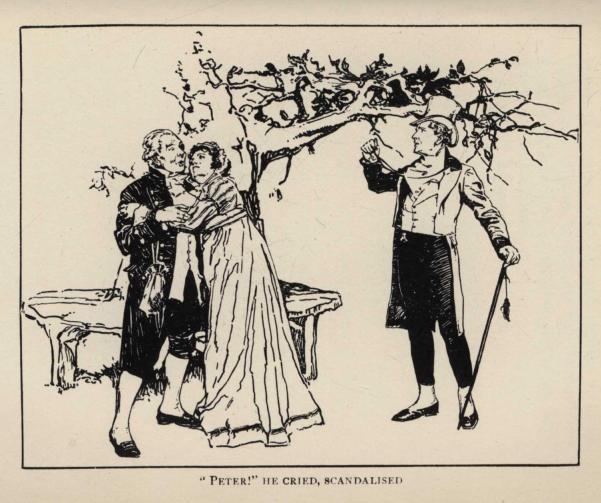 "PETER!" HE CRIED, SCANDALISED