 Chapter XV headpiece
"Lord Otford!" cried Madame.
"Forgive me," he said, very gently.
"Pray allow me to pass!" for he was standing right in her road. "I am very anxious about my child."
"If I am any judge," said he, with a smile, "that young lady is in the best of health and spirits."
Madame was indignant. "You are mistaken. She is—" but this would never do; she was just going to let out that Marjolaine was heart-broken because of Jack Sayle's desertion: the very last thing Lord Otford must know. "Yes, of course," she corrected herself. "She is well and happy, but—"
"Then," said Lord Otford, "will you favour me with a few moments?"
She could not help noticing with some satisfaction how different his manner was from when they had last met. Then he had tried to bluster and bully; now he was all deference. But she would not yield a jot. She drew herself up proudly.
"I can see no use in renewing our painful—"
He interrupted her deprecatingly. "I am in a grave perplexity. My son has disappeared—"
Madame took him up quickly. "And you suspect us of harbouring him!" she cried, with genuine anger.
"No, no!" he protested. "On my honour, no!"
"Then—?"
"Ah, do be patient," he continued, almost humbly. "I am here on an errand of conciliation."
"Conciliation!" echoed Madame, with a touch of scorn.
"Jack," Lord Otford began explaining, "is very dear to me."
"Marjolaine is very dear to me," said Madame, defiantly.
Lord Otford bowed. "Precisely. I have been considering. Are we justified in keeping these two young people apart?"
Madame looked at him in amazement. "Do you say that?"
"I do," he smilingly affirmed. "Marjolaine, being her mother's daughter, must be a charming gel."
Madame waved the compliment aside. He went on.
"And although Jack is my son, he is a thoroughly good fellow."
"But he is contracted to marry—" Madame interrupted.
"That is all upset," said Lord Otford; and the curious thing was that he did not seem at all put out. "Carrie Thring has taken the bit between her teeth and eloped with the curate."
Madame looked at him sharply. "And your hopes being dashed in that quarter, you come—"
"No, you are not fair!" protested Lord Otford. "I think I should have come in any case. Seeing you on Saturday has revived many memories—"
"It needed some such shock."
Lord Otford winced; but he continued bravely. "I made up my mind not to act my own father over again. If Jack loved your daughter, he was to marry her."
"That is no longer the question," said Madame with emphasis. "My daughter refuses to marry your son."
"Why? Because she does not love him?" His voice was very grave and very searching. Madame tried to answer. She would have given worlds to have been able to say "Yes." But she could not say it, and she was silent. Lord Otford was watching her keenly.
"No!" he said, almost severely. "No; but only because you tell her to refuse. She simply obeys out of habit. You are undertaking a heavy responsibility. Ah! Why punish these children because I behaved like a fool years ago, when I knew no better?"
Madame sank on the seat under the elm. Was he right? Had she acted in mere selfishness? Was she breaking Marjolaine's heart only to gratify something very like spite?
Lord Otford leant over her, and now there was a ring of passion in his voice. "And why punish me now, so late? Is it not possible for me to atone—Lucy?"
"Lord Otford!" she cried, trying to rise.
"Don't stop me now! Don't go away!" he entreated, motioning her back. "Ah! we are poor creatures at best! We go blindly past our happiness. Let us hark back, Lucy, and try to find the trail we missed!"
"We!" cried Madame.
"I."
Madame was profoundly stirred. His voice had not changed at all in all those years: just so had he murmured passionate words in the old vicarage garden. She must take care, or she would fall under the spell of it again—and that must not be. She must take care; harden her heart; put on a panoply of steel.
"I have been quite happy," she said at last, very defiantly.
"I know it," he answered, "and I am glad to know it."
"But I purchased my happiness dearly." She turned on him with bitter resentment. "You have never realised the suffering you inflicted on me!"
"I can imagine it," he answered, almost voicelessly.
"No, you cannot," she retorted. "Only those who have gone through it can imagine it. Ah! think of pride insulted; ideals smirched; faith trampled on; tenderness turned back on itself!"
"I know it all," he murmured.
Madame went on, more as if she were communing with herself. "Nature is very strong, very merciful. I had not forgotten! Never, for one moment! But life covered the memory." She paused a moment, sunk in thought. When she spoke again it was in a gentler voice. "Then Jules came, and offered me his companionship. I gave him all I could, and he was content. Oh! the good, true, generous man!"
Once more Lord Otford winced; but he contrived to say with genuine feeling, "I honour him." After all, Jules was dead.
"And I honour his memory," said Madame, gravely.
Lord Otford spoke very earnestly. "We are quite frank, Lucy: you loved your husband; I loved my wife—"
"And there is no more to be said," concluded Madame, rising, with a little sigh.
"Ah! but there is!" he exclaimed, standing and facing her. "Face your own soul, Lucy, and tell me: did the thought of the old vicarage garden at Otford never haunt you?"
She looked straight into his eyes. "Never with any suggestion of disloyalty to Jules," she said firmly.
"That I am sure of. But it came. I know." He dropped his voice, came closer, and spoke with deep feeling. "Lucy, Lucy, it was always there! It never left you, as it never left me! It was the fragrant refuge, into which we crept in our solitary moments—never with disloyalty on your side or mine—but for consolation, for rest. Is that true?"
"It was merely the echo of an old song—" she murmured, under her breath.
"But how sweet! How tender!"
"And how sad!" Her strength was going. Every word he said seemed to draw the strength out of her. Her heart yearned to him; her whole soul cried out for him; and only her will resisted. She made one more effort. "No! No!" she cried, "I banished the memories! I banish them now!"
"You could not! You cannot!" he whispered, passionately. "No one can!—Think of these two children: Marjolaine and Jack. Suppose we part them now: suppose they go their different ways: do you think either of them will forget the flowing river, the sheltering elm, or the words they have whispered under it? Never!—Lucy, Lucy—" he was bending over her where she sat, and his voice had all the old thrill—"though we go astray from first love; though we undervalue it; yes! though we desecrate it, it never dies!—On revient toujours à ses premiers amours!"
But the years that had flown! the unrelenting years! what of them?
"We cannot retrace our steps," she said, sadly, "we cannot undo suffering; we cannot win back innocence."
"We can!" he cried. "We started from the garden; we have been a long journey with all its chances and adventures; and now we are at the garden gate again: the flowers we loved are beckoning to us; the birds we loved are calling us; we have but to lift the latch—Lucy, shall we not open the gate and enter the garden?"
"We cannot recall the sunrise—"
"But the sunset can be as beautiful!"
"We are old," she said; but her voice had no conviction. As a matter of fact, at that particular moment she felt she was eighteen.
"I deny it!" he laughed. He felt assured of victory. "Do I feel old? Do you look old?—I can't vault a five-barred gate, but I can open it and get on the other side just as quickly!"
She looked up at him with a wistful smile. "But—but there are other things—"
"There is, above all, happiness! If we have no children of our own, Lucy, we shall have our grandchildren."
"No!" she cried, rising, and shaking her head. "I have been too persuasive. Marjolaine's love has been nipped in the bud. And besides, Jack has run away from her."
"Not he, if I know the young rascal!" He took both her hands in his. "You tell me Marjolaine is well and happy?"
"Yes; but hysterical. You saw for yourself, just now."
"Is she a flighty coquette?"
"Certainly not!"
"Then I 'll bet you a new hat—No! a diamond tiara!—she knows where Jack is, and there 's an understanding between them!"
"Oh!" exclaimed Madame, as the possibility of this idea struck her.
"Lucy!" cried Lord Otford, drawing her to him, "both couples shall be married on the same day!"
You have no idea how pretty Madame looked in her confusion and happiness. You have no idea how young and handsome Lord Otford looked in his victory. Love had set the clock back for both of them—and they were young man and young maid again.
What had become of Madame's resentment? What had become of all the arguments she had thought of when he first began to speak? His voice had effaced them all. It was so natural to be loved by him and to love him, that no other thing seemed possible. She had nothing to say. She could only breathe a great sigh of contentment as he touched her: she felt as if she had parted with him in the garden only last night; and to-night he had come again; and all was as it should be; and all was well.
But suddenly she started away from him.
"Jack!" she cried, with horror, "we shall have to tell them!"
"Oh, Lord!" exclaimed Otford with comic dismay.
"I can't face Marjolaine!" said Madame, with a pretty blush, which, however, was wasted in the darkness.
"Jack'll roast me properly!" groaned Lord Otford.
"You see it's hopeless! We've been telling them how utterly impossible their marriage is, and now we propose to get married ourselves! How they 'll laugh at us!"
"Let 'em!" cried Lord Otford. "By Gad, it shall be happy laughter!" And therewith he drew Madame into his arms and kissed her; and I cannot honestly say she resisted.
But they were interrupted by Doctor Sternroyd, who at that very moment came stumbling out of his house. Also the Eyesore and Jim came round the corner together, with their arms affectionately round each other's necks and every symptom of having spent the larger part of Mrs. Poskett's bribes. The Eyesore found his box with difficulty and sank on it with relief. It was with a shaky hand he took up his rod and fell to fishing again. Jim meandered deviously into the Admiral's house.
"Sh!" whispered Madame, warningly, as she saw the antiquary. She turned to him with that preternatural calmness which ladies know so well how to assume under such circumstances, and said, alluding to something he was carrying in his hand, "Why, Doctor, are you fetching milk so late? I can give you some."
"No, Ma'am," said the Doctor, with suppressed rage. "I am not seeking the lacteal fluid. As you see me, I, the Reverend Jacob Sternroyd, Doctor of Divinity and Fellow of the Society of Antiquaries, am on my way to procure Ale!—" And with a face expressive of the utmost disgust he held out a very diminutive white milk-jug.
"Oh!" said Madame, with a tinge of astonishment. Then, in order to account for the presence of a stranger, she added, "This is Lord Otford."
With a cry of "Good Heavens!" the conscience-stricken Doctor let the jug fall. Happily it fell on the lawn and was not damaged.
With native courtesy Lord Otford picked it up and handed it to its owner. "Allow me: your jug, I think." Then, as a sudden idea occurred to him, "By the way, Doctor—" he cast a meaning glance at Madame—"can you tell me anything about a marriage-licence?"
Madame looked down, with another very becoming blush: but the Doctor's behaviour was quite extraordinary. He threw up his hands in guilty despair. "I said so! I knew it would come out!—" He appealed to Madame. "Miss Barbara told you!"
"Yes—but—" answered Madame, puzzled and astonished.
The Doctor continued rapidly, while the couple could only stare at him in mute amazement.
"I wash my hands of it! Two whole days, one of which was the blessed Sabbath, I have been up to my neck in cabals and intrigues! I have done!—" He fumbled in his pockets and ultimately produced a legal-looking document. "My Lord, it was very kind of you to approach the subject so considerately, but here is what you ask for. His Grace was very reluctant, but the pipe, which I now fear was not genuine, did it." Then, as if he had unburdened himself of some oppressive load of guilt, he cried, "Hah! My conscience is white again! I will tell the young fire-brand!" And with that he hurried back into the house, calling, "Jack! Jack!"
"But what is all this?" cried Lord Otford. He unfolded the paper and took it under the lamp. As soon as he had read the first lines, he gave a cry of amused surprise. "What do you say now, Lucy?"—Then he read aloud, "John Sayle, of Pomander Walk, in the Parish of Chiswick, bachelor, and Marjolaine Lachesnais, also of Pomander Walk, spinster—"
"Under our very noses!" exclaimed Madame, half vexed and half amused.
"And old Dryasdust has been harbouring Jack! And now he 's gone to tell him!—Lucy, let's see what desperate thing they 'll do next. Come!" He drew her gently into the Gazebo, and for a moment there was complete silence in the Walk.
But suddenly this was shattered by a fierce outcry in Doctor Sternroyd's passage. The door was flung open and the Doctor appeared, vainly trying to bar Jack's way.
"But, my dear young friend—" the Doctor was protesting.
"Let me pass!" shouted Jack, livid, and thrusting his host aside. "For five years I 've been a sailor, and I can't think of the words I want!"
"Dear, dear! Tut, tut!" said the Doctor; but he did not wait. The conspiracy at any rate was off his mind. He retired into his house, and carefully locked the door.
Jack rushed to Marjolaine's house and boldly performed a long rat-tat with the brass knocker, muttering to himself all the time, "The old fool! Oh, my stars! the silly old fool!"
Nanette appeared.
"Tell Miss Marjory that—" began Jack, violently.
"Plait-il?" said Nanette, impassively.
"Oh, hang!—Er—deet ah Madermerzell—"
But Marjolaine ran into the passage. "Jack!" she cried, much alarmed. "Oh! What is it?"
"Come out! Come out!" cried Jack, seizing her hand and dragging her hastily down the steps, to Nanette's horror and indignation.
"Ah, mais!" the latter exclaimed, "Oú est donc Madame?" and went in to look for her.
Jack was incoherent. "Sternroyd!" he gasped. "He had the licence! Had it! We were to be married to-morrow! And he 's gone and given it—to whom do you think?—to my father!"
"Oh!" exclaimed poor Marjolaine, "then all is over!"
"No!" he cried, with magnificent determination. "All 's to begin again! Take me to your mother. Then I 'll take you to my father."
Lord Otford and Madame Lachesnais had come out of the summer-house.
"That is what you should have done at first, sir!" said Lord Otford.
"Father!" cried Jack, amazed.
With a half-frightened cry of "Maman!" Marjolaine threw herself in her mother's arms.
But Jack was not to be trifled with. He faced his father heroically. "It's no use, sir! You can cut me off with a shilling, but I mean to marry Marjory!"
Marjolaine was not to be outdone in courage. "Maman!" she said, with a radiant face, "he came back; and I 'm going to marry him."
Lord Otford turned gravely to Madame. "What do you say?"
"I say, God bless them."
"Maman!" cried Marjolaine, hugging her.
"And I, too, say God bless them!" cried Lord Otford, heartily.
"Marjory!" shouted Jack; and in a moment the lovers were in each other's arms.
"H'm," suggested Lord Otford, drily, "I believe this is a public thoroughfare!"
The lovers separated abashed. "Oh, sir!" said Jack, "please give me back that document."
"Why, no, Jack," answered his father, "I want that." And he and Madame glanced at each other guiltily.
"But, sir!" protested Jack.
"Um—the fact is—" Lord Otford had never felt so shy in his life. In vain he appealed to Madame for support; she was much too busy examining the very pretty point of her very pretty shoe. "I say, the fact is—with slight alterations—it may come in useful. Er—I, too, am John Sayle—and—um—I, too, am going to get married."
"Marjory," said Jack, very gravely, "my father's trying to be funny."
But Marjolaine's attention was divided between her mother and Lord Otford. The clumsy shyness of the one and the pretty confusion of the other gave her, as she would have said in French, furiously to think. Besides which, we must not forget she was in her Mother's confidence.
"Maman," she said, roguishly, "I believe!—Lord Otford! I believe—!"
"Believe, my child, believe!" cried Lord Otford, glad not to have to enter into further explanations. He took her pretty head between his hands, and kissed her. "Here 's the document, Jack; and—ah—there is a pleasant seat under the elm; and agreeable retirement in the—ah—Gazebo."
So he and Madame sat in the arbour, and Jack and Marjolaine sat under the elm, and the leaves of that wise old tree having been awakened by Jack, asked each other with a pleasant rustle which couple was the happier of the two.
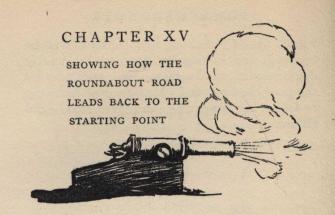
There was a great to-do at the Admiral's. I think Mrs. Poskett had been watching the lovers; for now the door burst open, and the Admiral and Jim hauled out the little brass cannon, followed by Mrs. Poskett, all in a flutter with pleasant alarm. While they were planting the gun close behind the unconscious Eyesore's back, the lamplighter came running in—he always ran—and put out the first lamp. Barbara and Basil came slowly out of their house, and leant over the railings in a close embrace, while Ruth stood watching them from the upper window. Basil, indeed, had brought his fiddle.
"Haul her out!" roared Sir Peter, alluding to the gun.
Mrs. Poskett uttered a little scream. "Oh, Peter! I 'm frightened!"
Jim reassured her in a hoarse grunt. "It 's all right, Mum, I 've emptied her."
The lamplighter put out the lower lamp.
"What are you doing that for?" cried Jack.
The lamplighter pointing over his shoulder, replied laconically, "Moon!" and ran off.
Sir Peter was just about to apply a lighted candle to the touch-hole of the gun, when Mr. Jerome Brooke-Hoskyn, much dishevelled, threw open his window, and cried in a horrified whisper, "Sir Peter! Sir Peter!—For Heaven's sake, don't fire that gun!"
"Why the devil not, sir?" roared Sir Peter, angrily.
"Sh!" cried Mr. Brooke-Hoskyn, waving a frantic hand. "It's a boy!"
"Gobblessmysoul!" cried Sir Peter, "I'll be godfather!"
And all the Walk was delighted, and the leaves of the elm clapped their hands together in the evening breeze.
Basil gently disengaged his arm from Barbara's waist and began playing the slow movement of the Kreutzer Sonata very, very softly.
Suddenly, behind the tower of Chiswick Church, up leapt the great full moon, turning the river to molten light, and flooding the Walk with gold.
The Admiral and Mrs. Poskett hurried to the Gazebo—but that was full. They turned to the seat under the elm—but that was occupied. "Gobblessmysoul!" said the Admiral.
So they had to be content to stand very close together, watching the river. And Sempronius came and rubbed his arched back against the Admiral's legs. Jim and Nanette looked on from their door-steps in amazement.
In his bow-window Doctor Sternroyd was gazing fondly at a faded miniature, while with his other hand he raised a glass of punch on high. "Araminta!" he sighed, and drank to her memory.
"Oh, Selina!" exclaimed Mr. Brooke-Hoskyn.
In the Gazebo there was a very tender whisper:—"Lucy!"
Marjolaine's head sank on her lover's shoulder with a happy, "Oh, Jack!"
Ruth was showering blossoms of jasmine on Barbara and Basil.
There was a great silence, emphasized by the yearning notes of Basil's fiddle. And through the silence came Ruth's voice, tender and wistful:—
"Ah, well!—I'm sure we all hope they'll live happily ever after!"—
And, for the first time in his life, the Eyesore caught a fish.
 Chapter XV tailpiece