 Chapter VIII headpiece
Now Marjolaine did not want to talk to Miss Ruth just at that moment, and it says much for her sweetness of character that she came back docilely. "Marjory," said Miss Ruth, looking at her searchingly, "you haven't had a singing-lesson this week."
Marjolaine was confused, and a little angry. She had just exhausted the subject with her mother, and it was too bad to be thrust into the midst of it again by this comparative stranger. So she answered rather coldly, "I have n't been quite myself."
"So I saw," said Miss Ruth, examining her over her spectacles. A hot flush rose to Marjolaine's cheeks. Had she really been wearing her heart on her sleeve, and showing the whole Walk the state of her feelings? She must be more careful in future.
"Anything the matter?" asked Miss Ruth.
Marjolaine answered hastily, "Oh, nothing. Nothing to speak of."
"H'm," said Miss Ruth, violently biting off a cotton-end. Then she added, "Barbara was quite upset."
"How sweet of her!" cried Marjolaine.—Dear, sympathetic little Barbara!
"Oh! Not so much about you," said Miss Ruth rather acidly. "But she looks forward to sitting with you and Mr. Pringle, when you are singing."
"Is she so fond of music?" asked Marjolaine, glad to turn the conversation into a less personal channel.
"Bless your dear heart, no!" exclaimed Miss Ruth sharply. "Now, would she sit and listen to you if she were? She does n't know one note from another."
It seemed to Marjolaine that the conversation was becoming rather personal, so she held her tongue.
But Miss Ruth evidently had something on her mind of which she was anxious to relieve herself.
"No, it is n't that," she said with a world of meaning which challenged enquiry.
Marjolaine obliged her, although she felt no interest. "What is it, then?"
Having succeeded in getting the question she wanted, Miss Ruth made a feint of retreating. "Pfft!" she said, with the action of blowing some annoying insect away, and then, cryptically, "Oh! grant me patience!"
"Ruth!" exclaimed Marjolaine, astonished at her violence.
"Well!" cried Ruth, still more sharply. "It seems to me the whole house is bewitched—that ever I should say such a thing."
Marjolaine grew more and more surprised. "Oh! I thought you were so happy!"
"I 'm happy enough," snapped Ruth, "because I 'm not a fool. But what with that feller upstairs, and Barbara down, a body has no peace of her life."
Now, what could she mean? Of course Mr. Pringle was upstairs, and of course Barbara was downstairs. How could that perfectly natural state of things affect the peace of Miss Ruth's life?
"Tell me," said Marjolaine.
"Ha' n't you noticed anything? No. I s'pose you 're too young. Don't know sheeps' eyes when you see 'em!"
What on earth had sheeps' eyes come into the story for?
"Sheeps' eyes?" Marjolaine asked, utterly puzzled.
"'T is n't for me to say anything," Miss Ruth continued, "but with him mooning about the house, like"—words failed her—"like I don't know what; and her moping, like a hen with the pip, it's enough to give a body the fantoddles—as my poor, dear mother used to say."
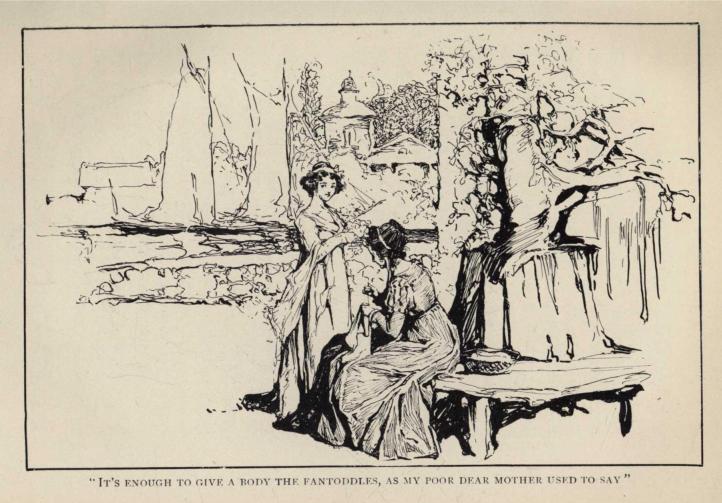 "IT'S ENOUGH TO GIVE A BODY THE FANTODDLES, AS MY POOR DEAR MOTHER USED TO SAY"
Marjolaine suddenly saw light. Here, under her very eyes, was another romance, like her own—only, of course, on an infinitely lower plane, because it held no thread of tragedy—and she had been blind to it. This was lovely! But she must make sure. She turned to Miss Ruth and asked eagerly—"Are they—are they fond of each other?"
Ruth quite unnecessarily bit off another cotton-end. "I don't know!" she cried crossly; but at once added, "Yes, of course they are!"
Marjolaine was more puzzled than ever. "Then, why don't they say so?" she asked, quite simply.
"That's what I want to know," said Miss Ruth.
Lovers who might be perfectly happy, kept apart for want of a word, thought Marjolaine. How wicked, and how silly! "You should speak to Mr. Basil," she said, with all the gravity of her nineteen years and of her bitter experience.
"Me!" cried Miss Ruth. "Bless your dear heart, he 'd up and run away. He 's that shy a body can't look at him but he wants to hide in a cupboard. He 's got it into his silly head he is n't good enough. As if anybody'd notice his shoulder!"
"Perhaps," said Marjolaine, pensively, "if Barbara showed him she liked him—Why don't you speak to her? Sympathetically."
"So I did, just now. Told her she was an idiot. What did she do? She burst out crying, and went and shut herself up with that parrot."
"Ah!" sighed Marjolaine, with a pathetic look at the Gazebo, where she had been so happy so short a time, so long ago, "Ah, yes! The old love!" How well she understood!
"Old frying-pan!" cried Ruth.
"Ruth!" exclaimed Marjolaine, deeply shocked. "The poor parrot."
"Oh, that bird!—Marjory!" said Ruth, firmly, as if the time had come to utter a bitter but necessary truth at all costs, "Marjory, there are times when I 'd give anybody a two-penny bit to wring that bird's neck!"
But Marjolaine had not been listening to her. The mention of the parrot had set her thoughts working; her face suddenly lighted up with the inspired look of one who has just conceived an epoch-making idea. "Ruth!" she cried, running up to her.
Ruth naturally thought she was shocked. "Well, I don't care! I mean it. If it was n't for that bird—"
But Marjolaine had snatched Ruth's needlework away and was trying to drag her from the seat by both hands. "I was n't thinking of the bird! Yes, I was thinking of the bird, but I was n't thinking what you thought I was thinking. Oh! what nonsense you make me talk!"
"Whatever's got into the child's head?" cried Miss Ruth, swept off her feet.
"Come!" insisted Marjolaine. "Quick! Come, and tell Barbara I want her."
"What do you want her for?" asked Miss Ruth, struggling.
"I must n't tell you yet, she may refuse."
"Bless us and save us!" cried Miss Ruth, now on her feet, and struck by the change in Marjolaine's appearance, "now your cheeks are glowing again!"
"Maman said they would!" laughed Marjolaine. Positively, for the moment she had forgotten her sorrows. "Come along!"
"Wait! My mouth 's full of pins!"
Seeing the two ladies under the tree, Sir Peter Antrobus had come out, anxious for a little conversation. He was much disappointed when he observed they were leaving the lawn.
"Going in, just as I'm coming out?" said he, reproachfully.
"Yes," laughed Marjolaine on the top step, and looking up at the threatening sky, "like the little people in the weather cottages: you come out for the rain; and I go in for the sunshine." Which, of course was extremely inaccurate, but the correct statement would have spoiled her meaning entirely.
"How are the peas coming on, Admiral?" asked Miss Ruth, for the sake of politeness.
Sir Peter's temper was already ruffled by the disappointment of his sociable intentions. Now he burst out, "How the doose can they come on, Ma'am, when that everlasting cat roots 'em up every night?"
I am sorry to say, Miss Ruth laughed as he disappeared into the house. The Admiral came towards Sempronius, who was now wide awake and watching the Eyesore's float with lively interest; he shook his fist at him—I mean the Admiral shook his fist at the cat—with comic fury, and found himself shaking his fist at Lord Otford, who had just turned the corner.
"Shaking your fist at me, Peter?" asked Lord Otford, with a grim laugh.
"Hulloa, Otford!" cried the Admiral, feeling rather foolish.
Moreover, he was not particularly pleased to see Otford at that precise moment. Only half-an-hour ago he had surprised Marjolaine's confidence. He had not had time to think the matter over and make up his mind, and now that he found himself without warning face to face with Jack's father, he was torn between two conflicting emotions. On the one hand he felt he ought to tell Otford about Jack and Marjolaine. That was his plain duty; but it was one of those forms of duty which everybody tries to find some plausible excuse for evading. He had surprised Marjolaine's confidence: she had not given it voluntarily. On the other hand he suspected that Jack's breach of faith in not coming near the Walk for a whole week was due to some interference on the part of his father, and he was so fond of Marjolaine, and so jealous of the status of the Walk, that he resented such interference even before he knew whether Otford had interfered. His keen eye saw, even while they were shaking hands, that there was something on his friend's mind.
"How are you?" asked Lord Otford, perfunctorily. "Have you a moment to spare?"
"All day; thanks to this confounded government," growled the Admiral.
Lord Otford plunged into the thick of his business at once. "I am in great trouble," he blurted out, in the tone of a man who expects sympathy.
He didn't get it. "Damme! you're in trouble once a week!" said the Admiral. "Here! Come into the Gazebo."
Lord Otford started at the word. "The Gazebo?—Ha! Very appropriate!"
"Eh? Why?" asked Sir Peter, sitting on the seat in the summer-house and making room for his friend beside him. Lord Otford produced a crumpled letter from his pocket. "Here! Read this!" said he, thrusting it under Sir Peter's nose.
"Can't," said the latter, curtly, "haven't my spy-glass on me!"
"Well, listen." Lord Otford read the letter aloud, with ill-suppressed fury.—"'My lord—It is my painful duty to inform your Lordship that your Lordship's son, the Hon. John Sayle, is carrying on a clandestine love-affair with Mademoiselle Marjolaine Lachesnais, of Pomander Walk—'"
The Admiral had grown purple in the face. "Belay, there!" he roared.
Lord Otford took no notice, but went on reading: "'Yesterday they were together for an hour in the Gazebo—'"
The Admiral would have no more of it. "When did you get that, and who sent it?" he roared. The fact that the information was true was quite outweighed by the implication that an inhabitant of the Walk could have been guilty of the lowest form of treachery.
"It's signed, 'Your true Friend and Well-wisher,'" said Lord Otford, "and I had it on Sunday."
The Admiral could hardly speak. "Do you mean to say that damned, anonymous, Sabbath-breaking rag came from Pomander Walk?"
"I presume so."
"Who sent it?" cried the Admiral, jumping up and walking to and fro in a towering rage. "Show me the white-livered scoundrel, and by Jehoshaphat! I 'll break every bone in his body!" He turned sharply towards Otford. "Is it a man's writing, or a woman's?"
"It's vague: might be anybody's."
The Admiral was passing the houses of the Walk in review. "Can't be Sternroyd—Brooke-Hoskyn—Pringle—We 're none of us anonymous slanderers." His eye fell on the Eyesore with momentary suspicion. "Was it the Eyesore?"
"The Eyesore?" repeated Lord Otford, not understanding.
"That scare-crow, fishing. No; of course not. He does n't know you, and I don't believe he can write.—But, what of it, Jack? You're not worried by that rubbish! Why, it's a pack o' lies!" (Oh, Admiral, Admiral!) Lord Otford tried to speak. "Don't interrupt!—I'm here all the time. Nothing happens in Pomander Walk that I don't know. Don't interrupt!—I was here when Jack came last Saturday. He went back in his boat before you could say 'Jack Robinson,' because Madame swooned!"
He wiped his brow, and had the grace to add "Lord, forgive me!" as a silent prayer. After all, he had told no lie. He had only omitted to say how long Jack had been there before he saw him. And as he did n't know, what could he have said?
Otford found his opportunity of speaking at last. "Now, perhaps you 'll allow me to say it's all true," he shouted.
The Admiral shouted louder. "Do you take this blackguard's word rather than mine?" he roared, pointing to the letter. It was intolerable he should be doubted, even if he were not telling the whole truth.
"You confounded old porcupine," Lord Otford roared back at him, "Jack 's owned up to the whole thing!"
"What!" yelled the Admiral. "Don't shout like that! D' ye want the whole Walk to hear?—Sit down. Tell me again: quietly!"
"When I 'd read this letter, I taxed him with it," said Lord Otford, "and he owned up. He came here last Saturday: met the damned little French gel—"
"Jack!" roared the Admiral, flaring up.
"I'll withdraw 'damned.' Sat an hour in this infernal what-d'-ye-call-it, and thinks he 's in love with her." Sir Peter was about to speak. "Don't interrupt!—You know the Sayles when their blood 's up. My blood was up. Jack's confounded blood was up. You can imagine the scene we had. He's as pig-headed and obstinate as—as—"
"As his father," put in Sir Peter.
"Don't interrupt!" roared Lord Otford. "He's thrown over Caroline Thring—won't hear of her." Sir Peter chuckled. "The utmost I could get out of him was that he 'd wait a week to make sure of what he calls his mind."
"Aha!" said Sir Peter, delighted.
"Mind! Puppy! All the week he's gone about like a bear with a sore head! Had the impudence to refuse to speak to me! This morning he had the impudence to speak! And what d' ye think he said?"
"Serves ye right, whatever it was!" cried Sir Peter.
Lord Otford didn't hear him. "He said, 'The week 's up, and I 'm going to Pomander Walk!'"
"Good lad!" roared Sir Peter, slapping his thigh, and breaking into a loud guffaw.
"What!" shouted Lord Otford, jumping up. "You're mad! Think of what's at stake! Ninety-thousand acres!—For the daughter of a Frenchwoman from the Lord knows where. Who was the gel's father?—Or, rather, who was n't?"
"Jack!" roared the Admiral, in a burst of fury, jumping up in his turn and facing Otford.
"I withdraw!" cried Otford. "But think of it!" He was looking at the Walk. In the grey light of the coming shower the houses were certainly not seen at their best. "Think of it!" he said with a sweep of his cane condemning the whole Walk to instant annihilation. "An Otford taking his wife from these—these—Almshouses!"
The Admiral was livid—apoplectic—hysterical. Words failed him. His voice failed him. He could only gasp, "Almshouses!—Pomander Walk!—Almshouses!"
Lord Otford was alarmed at the effect his words had produced. "There! there!" he cried, almost conciliatorily, "I withdraw 'Almshouses!'"
"Withdraw more, sir!" said the Admiral, and for all his almost grotesque rage, there was a ring in his voice which compelled respect. "How dare you come here, abusing the sweetest, brightest, most winsome—"
"I believe you 're in love with her yourself!" cried Otford.
"And, damme, why not?—Take care how you talk about innocent ladies you 've never set eyes on!"
"That's it!" cried Otford, glad to get on safer ground. "That's why I 'm here. You are to present me to this Madame—whatever her confounded name is."
"In your present temper?" roared Sir Peter, whose own temper was at boiling point. "I'll walk the plank first!" He pointed to Madame's house. "There's her house: the white paint. Go and pay your respects." He came close up to Otford, and spoke straight into his face. "Your respects, Jack! You 'll find you have to!"
"I can't force my way into the house, unaccompanied, and you know it!"
"Then stay away, and be hanged!"
Lord Otford was nonplussed. He caught sight of the Gazebo. "I 'll stay here," he said doggedly, sitting down like a man who means never to move again, "and if Jack shows his nose—!"
The Admiral had begun to stride towards his house. He came back and put his red face round the side of the Gazebo. "I shall be watching, sir!" this with blood-curdling calmness. "And if you dare raise a disturbance, I 'll—" he could not think of anything bad enough. "I 'll—damme! I 'll set the Eyesore at you!"
He stumped off towards his home again, while Lord Otford sank back in his seat, folded his arms, and said, "Ha!" with grim determination.
At that moment Jack came hurrying round the corner and ran straight into the Admiral's arms. At that fateful moment also Madame must needs come out of her house. Fortunately she was preoccupied and did not see the frantic pantomime with which Sir Peter tried to explain to Jack that his father was hidden in the Gazebo. Madame called, "Marjolaine! Marjolaine!" As we know, Marjolaine was with the Misses Pennymint, and Madame received no answer. Lord Otford heard her from his hiding-place. "Aha!" he said to himself, "the mother!" and he sat up at attention.
"Gobblessmysoul!" whispered the Admiral, hoarsely. "The father here, and the mother there! Jack! Get away!"
Madame had turned to her house and was calling her old servant. "Nanette!"
Jack refused to budge. What he said I do not know; but Sir Peter grew still more frantic. Nanette appeared at the upstairs window. "Quoi, Madame?"
"I 'll be hanged if I stir!" said Jack.
"Où est donc Mademoiselle?" said Madame.
"Je ne sais pas, Madame." Madame went back into her little garden, and looked into the ground-floor window.
"Come inside, then!" said Sir Peter to Jack. But Jack saw the Eyesore, who was placidly fishing, and a broad grin spread all over his face. "No! Better idea!" he chuckled. He imparted the idea to the horrified Admiral in a whisper.
Madame spoke to Nanette again. "Vite! Allez voir si son chapeau est dans sa chambre!"
Nanette disappeared from the window, and Madame stood impatiently looking up at it awaiting her return.
Whatever Jack had said to the Admiral was of such a nature as to fill that ancient salt with horror. He threw up his arms, cried, "I wash my hands of it!" and dashed into his house. Jack quickly said something to the Eyesore which caused the latter to fling his rod down with alacrity, and, amazing to relate, he and Jack hurried round the corner and out of sight together.
Nanette reappeared with a huge Leghorn straw hat. "Oui, Madame, voilà le chapeau de Mademoiselle." Then, pointing to the Gazebo, "Mademoiselle doit être au pavillon."
"Non," said Madame, "je viens de l'appeler." But a sudden suspicion flashed across her mind. Could Marjolaine be there with Jack, and afraid to show herself? "Serait-il possible?"—she cried, and came hurriedly towards the summer-house.
Lord Otford had heard her conversation with Nanette, and had risen; so that Madame found herself abruptly face to face with her faithless lover.