"Well," said Lola, after she and Rutledge had effervesced in a few minutes of commonplaces and conventionalities, "is your money still on the Englishman?"
"No," said Rutledge, "I've quit gambling."
"Lost your sporting nerve?"
"No, not that; but a man who bets against himself deserves to lose, and I can't afford to lose."
"But your self-respect?" laughed Lola.
"Now Miss—ah—Mrs. Hazard, don't jump on a fellow when he's down. Self-respect is nothing less than an abomination when it comes between a man and a girl like—that,—and besides, she didn't mean it that way."
"Oh, didn't she?"
"No, she didn't, and she's just the finest, dearest woman in the whole wide—unmarried state!"
"Thank you," said Lola, "but you needn't have minded. And so I'm to congratulate you? I've been so anxious to hear, but our mail has never caught up with us since the day we left New York."
"Oh, bless your heart, there are no congratulations—only good wishes, I hope. Take note of the exact mathematical equality in the distances by which Richland and Sir Monocle and I are removed from the chair of the Lady Beautiful. Could anything be more beautifully impartial?"
"And who is the ancient gentleman with Elise?" Lola asked.
"Some old party from York State. Bachelor uncle or cousin or some such chap—quite a character too, it seems—danced with Dolly Madison or Martha Washington or the Queen of Sheba or somebody like that in his youth. Miss Phillips was telling me of him awhile ago."
"That was a very safe subject of discussion," said Lola.
"Yes," Rutledge replied grimly, "and do you know I tried my very hardest to lose him out of the conversation and he just wouldn't drop. Miss Phillips must be greatly interested in him."
"Anything will do in a pinch, Mr. Rutledge. What were you trying to talk about?"
"Oh, that's it, you think? Well I wish I had ten good minutes with her. I'd make the talk—for half the time—or know the reason why."
"I think I remember that Elise told me once that you could be very abrupt."
"Yes, and I'm going to do a few stunts in abruptness that will surprise her the next time I have a chance. I've tried the easy and graceful approach for the last six weeks, and it's getting on my nerves."
"I tell you what, Mr. Rutledge," Lola laughed, "Elise is to be with me to-morrow evening. You come around after dinner, and I promise you shall have a square deal and ten minutes at least for your very own. Come early and avoid the rush."
"Good. I'll do it. You are a trump!"
"And you may run along now if you wish," she said as they came out of the dining-room, "and take her away from the old party before the others get a chance at her."
"You'll go to heaven when you die," Rutledge whispered as he left her....
Evans met some difficulty in cutting Elise out of the herd. It took time and determination and some strategy to carry the smiling young hostess off down the hall alone; but he brought it to pass, and drew a breath of exultation when he had shaken himself free. However, turn where he would, every nook and corner seemed to be occupied. He was not openly on the hunt for a retired spot, but he was wishing for one with a prayerful heart and wide-open eyes.
Now a man can make love to a girl right out in the open—in full view of the multitude—in fact there is a sort of fascination in it—in telling her what a dear she is with the careless air and gesture which, to the onlookers, suggests a remark anent the blizzard in the west or the hot times in South Carolina; but when it comes to putting the cap-sheaf on the courting and running the game to earth, in pushing the inquiry to ultimate conclusions and demanding the supreme reply,—a man who dares to hope to win and whose blood has not been thinned by promiscuous flirtations ever wants the girl to be in a situation grab-able.
When Evans became convinced that the fates were against him on that evening, he set definite plans in order for the next.
"Mrs. Hazard tells me that you are to be with her to-morrow evening," he said to Elise, with something of that abruptness. "May I not call upon you there? There is something I wish very much to tell you, and the crowd here is always too great."
Elise looked up at him quickly. The something he wished to tell her was to be read in his face, but she could not presume to assume it had been said. The man waited quietly for his answer.
"Why, certainly, yes, I will be very glad to see you," she said in a tone of conventional politeness; but assuredly, Rutledge thought, the light in her gray eyes was not discouraging.
"But I must be going now, if you will take me back," she said; and they turned to go up the hall. A lumbering crash and a stifled little cry changed their purpose.
Three minutes before, they had seen Helen and Harry Lodge turn a corner in the hall and pass round behind some of the overflowing greenery which almost shut off a side entrance. Lodge was as intent upon the pursuit of Helen as Rutledge of Elise, and was making more of his opportunities. Helen was welcoming any excitement that carried her out of herself. With Lodge's pushfulness and her indifference to consequences, it did not take long to bring the issue to a point. From her manner Harry did not gather the faintest idea of losing. She listened to his speeches with a smile which was not in the least false but none the less deceiving. She did not offer the slightest objection to his wooing nor put the smallest obstruction in the way of it. In his enthusiasm he developed an eloquence, and, taking her unresisting hand, he rushed along to the climax of a rapturous declaration.
"—And will you be my wife?" he asked, with his arm already half about her.
"No," Helen answered dispassionately, drawing herself back from him as if his meaning were but just now made clear to her: but that "no" came too late.
A pair of eyes in which the lightnings had gathered and gone wild had looked upon the whole of this tender scene except the last moments of it. Hayward Graham felt the devils in the blood of all his ancestors white and black cry to be uncaged as he looked upon Lodge in his ecstasy of love-making, and when Lodge took Helen's hand and it was not withdrawn, the devils broke the bars.
"So," cried Hayward in his soul, "it's for you—to resign her to your arms—that I am asked to die! No! If I may not possess her, not you, you hound!"
A door was wrenched open and Lodge had only time to straighten himself before he was knocked senseless by the infuriated husband.
Hayward drew himself up, terrible, before his wife, and Helen in the moment of recognition threw herself into his arms with a glad cry.
"Oh, you have come at last!" she moaned. "You got my letter at last and have come to me!"
"No. What letter?" asked Hayward—but as he asked it Helen was pushing herself from him as savagely as she freely had thrown herself to him. Her ear had caught the sound of people approaching. Hayward was too confused to notice that. He was in consternation at the lightning change from love to aversion, and clung to her desperately.
A second later he was lying prone upon the floor with Evans Rutledge standing above him, murder in his eyes. He made a wild attempt to rise, when another terrific blow from Rutledge's arm sent him again to the floor. The hall was in an uproar, and a couple of palms were knocked aside as President Phillips burst into the midst of the mêlée in time to restrain another smash from Rutledge's clenched fist.
"In the name of God, what's the row?" he asked.
"This nigger has assaulted Miss Helen," said Rutledge, gasping and choking with fury.
Mr. Phillips trembled with a fearful passion, but, seeing Helen apparently unhurt, pulled himself down to a terrible quiet.
"Get up," he growled to Hayward. "Now"—when the footman was on his feet—"what have you to say for yourself?"
Hayward looked for the hundredth part of a second in Helen's eyes.
"I have no excuse," he answered simply.
Only silence could greet such an admission. For five seconds the silence and the stillness were torturing.
As Mr. Phillips moved to speak, Helen took two quick steps to the negro's side. His renunciation, his silent, unhesitating committal of the issue—of his life—to her decision, had touched her heart.
"I am his wife," she said, as she took his hand and turned to face the circle of her friends.
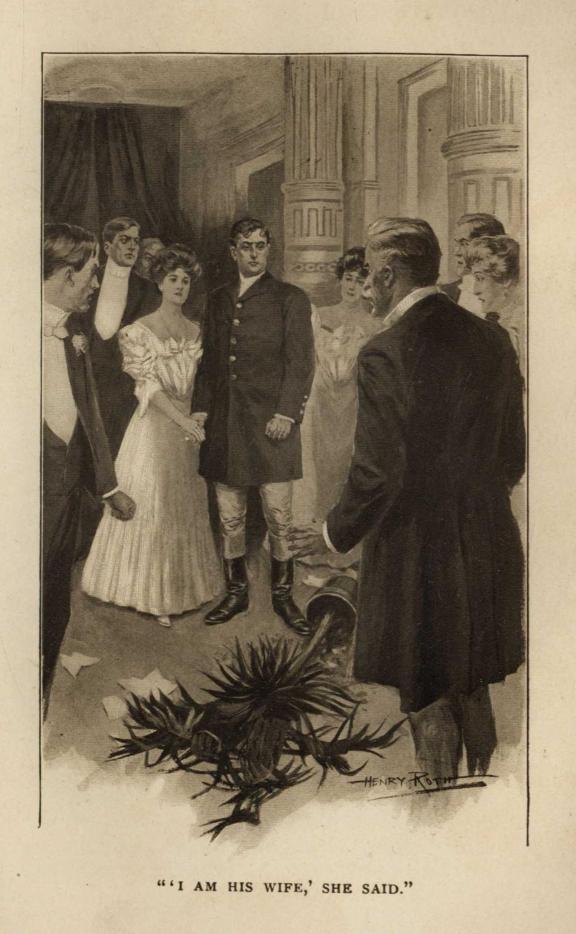 "'I AM HIS WIFE,' SHE SAID."