"Well, well, little girl," the father said soothingly as he smoothed the hair on her temple, "don't cry any more. The waiting is over now and we won't be away from you so long again. I could not get away from Washington a day earlier. I have been very busy, you know—doubly busy with the official work and the political campaign too."
"Oh, yes, daddy, I want to ask you. Are you going to get the renomination?" There was an excitement in Helen's question that her father saw was unusual for her, with all her characteristic interest in his political fortunes.
"Why child, I—I think so. We'll know certainly in a very short time now. The convention is in session and they will have the first ballot to-morrow, I think."
"But do you really think you will win, daddy? Is there no danger of losing?"
"I really think I'll win, little woman; but you know politics is a most uncertain thing."
"Then you do think there is some danger! Oh, daddy, is what I've done going to hurt you?" There was distress in her accents.
"What you've done?"
"Yes, daddy. It never occurred to me till yesterday. I've seen very little of the papers since we've been up here, but none of them had ever mentioned such a thing—until last night in the very first one the nurse would let me look at even for a minute it said that 'just how many or just how few votes the President will lose in the convention because of his daughter's having married a negro it is impossible at this time to forecast. Southern delegations this year are unusually uncertain quantities.' It said just that, daddy—and oh, I'm so sorry if—"
"Oh, no—no—child. You haven't hurt me, my chance of renomination, in the least. The idea is ridiculous. Haven't you learned by this time that the papers will say anything? They must say something, you know; and when they haven't anything sensible to say they are compelled to say things that are absurd. Suppose the Southern delegates are uncertain. They always have been, except when the machine had them tied hard and fast. Don't distress your heart about political rumours, little girl. I'll win all right. I've never failed in my life."
"Oh, I'm so glad if it is false, daddy. It would break my heart if I thought I had done anything to defeat you. I wish there were no Southern delegates—and no Southern people, with their bigoted notions!"
"You are forgetting, little woman, that your grandmother was a South Carolinian—and the dearest, gentlest soul! If she could have lived to know you she would have loved you more than any other girl in all the world, I think. And you would have loved her, Helen.... Don't quarrel with the Southern people. Their ideas about the—about the negro are in the blood, and cannot be eradicated in two or three generations."
Helen began to speak and turned her face casually toward the baby lying tucked in on the far side of the bed—when her father snatched the conversation suddenly from her and, taking it thoroughly in hand, gave her little time except to listen.
The blow had fallen! And with all his preparation he was unprepared! Helen was confused and bewildered by the incoherency of his talk, by his hurried, disjointed speeches, by his half-made questions. He was making a blind effort to put off and push back the inevitable. His eyes had grown accustomed to the subdued light of the room and as his vision became clear his heart almost ceased to beat. The baby! In that half light was revealed the darkness of the little fellow's face!—many, many shades darker than the face of Hayward Graham: and the spectral fear that had been with Mr. Phillips at noonday, at morning, at evening, at all the midnights through the last months, was now a real, weakening, flesh-and-blood terror.
With a hope that was faltering indeed had he prayed for the miracle that might deliver Helen entirely from the consequences of her thoughtless folly, but with all his faith had he besought a merciful Heaven that the child which would come to her should not fall below a fair average of its parental graces. Even that were a torture, that were horrible enough: that Helen's gentle blood should be evenly mixed and tainted with a baser sort. But this recession below the father's type!—this resurgence of the negro blood, with its "vile unknown ancestral impulses!"—there came to him an almost overpowering desire, such as had come of late with increasing frequency but never with such physical weakness as now: the desire to lie down at full length and to rest.
As he talked volubly and scatteringly to Helen, his shaking soul cried against fate. Why should Nature have chosen his Helen, the very flower of his heart, as a subject upon which to demonstrate her eccentric laws! Why, oh—but he must keep his tongue going to distract Helen from his distress—why, oh, why should atavism have thought to play its tricks and assert its prerogative here! Were there not enough other mongrel children in all the earth through whom heredity could establish her heartless caprices without the sacrifice of Helen and of Helen's baby! Oh, the sarcasm of pitiless Chance, that the most dear, the very highest, should be sacrificed to establish the law of the Persistence of the Lowest in the blood of men! Surely, in this lesson, that law had been taught at an awful cost: and, as if to show that it had been taught beyond cavil, there was poked out from under the white coverlet a tight-shut baby fist that was almost black.
* * * * *
All things human must have an end,—and Mr. Phillips' subterfuge was very human. His expedients finally failed, he had not a word more to say: and yet he was no nearer being prepared for the inevitable than before. The supreme test was come, and his spirit cowered before it. For the first time in his life he greeted flight as a deliverer, and decided to run away from danger.
"Well, little woman, I must go and rid myself of the dust of travel;" and he was half way to the door when Helen's weak voice arrested him.
"Are you not going to notice the baby, daddy?"
The pathos in that trembling question would have called him to go against all the Furies. Turning, he hesitated an instant, of which the double would have been fatal: but he saved the moment from disaster.
"Dear me, I was about forgetting the youngster."
He walked quickly around the bed and sat down beside the boy. Pulling the covering a little away, he took the tiny hand in his, and grandfather and grandson looked for the first time each into the face of the other.
It was a negro baby: the colour that was of Ethiopia, the unmistakable nose, the hair that curled so tightly, the lips that were African, the large whites of the eyes. Verily a negro baby: and yet in an indefinable way a likeness to Helen, a caricature of Helen, a horrible travesty of Helen's features in combination with—with whose? Not Hayward Graham's. But whose, then? Helen's and whose? ... Mr. Phillips could not answer his own question—he had never seen Guinea Gumbo.
In a moment the smaller hand closed over the man's finger as if in approval; but the man straightened up as if to get a freer breath, and glanced involuntarily at the pale mother. Her eyes were painfully intent upon him. Driving himself, he turned. Murmuring a nursery commonplace, he leaned over and kissed the little darkey as tenderly as he might.
There was no escape from Helen's eyes. He prayed that she had not seen that his were shut when he kissed her son—it was his only concession to himself.
With another pat or two of the small fist he stood up by the bedside, bracing his knees against the rail that he might stand steadily. The fever was not yet gone from Helen's eyes. She had smiled when he caressed the boy, but she was yet expectant. On her father's verdict hung all her hopes, and his face for once in her life she was unable to read. She was vaguely uneasy. His manner was inscrutable, and she had never seen him look just like that. Their eyes met, and the unconscious pleading in hers would have wrung any verdict from him.
"He's a fine boy, isn't he, little woman? ... So strong and healthy looking.... Shakes hands as if he meant it.... And he looks somewhat like you, missy. That will be the making of him.... But I must go now,"—and he went rather precipitately.
"And will you hurry back to us, daddy?" Helen called to him.
"Yes, child; I'll hurry back," he answered,—as he hurried away.
His secretary handed him a telegram. He took the yellow envelope and, without so much as glancing at it, went into the library and shut the door.
* * * * *
Very late in the afternoon the library door was opened, without invitation from within. Mr. Phillips was sitting in a chair with his arms upon his desk and his face upon his arm—dead.
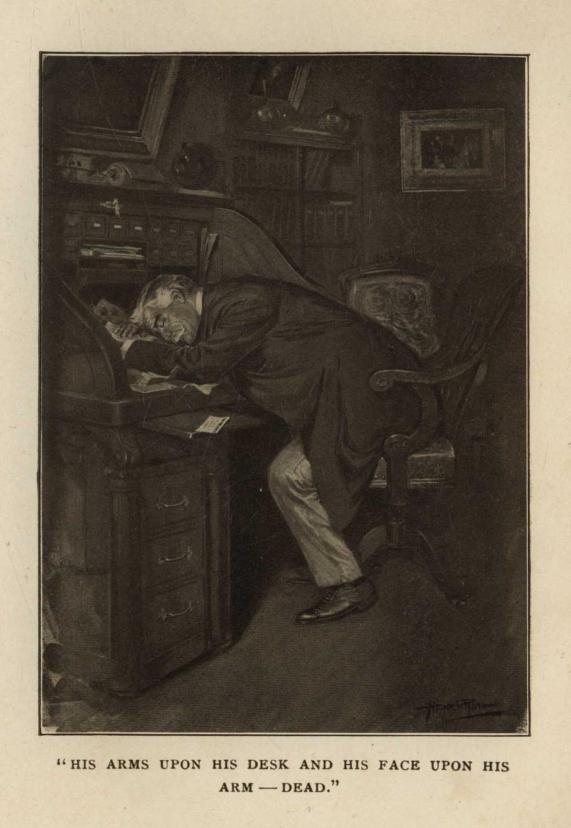 "HIS ARMS UPON HIS DESK AND HIS FACE UPON HIS ARM—DEAD."