“Your coffee, my lord?”
It was Fletcher’s usual inquiry, repeated night and morning—the same words that on the Ostend packet had told his master that his wanderings were shared. After these many months in Venice, where George Gordon had shut upon his retreat the floodgates of the world, the old servant’s tone had the same wistful cadence of solicitude.
Time for Gordon had passed like wreckage running with the tide. The few fevered weeks of wandering through Switzerland with Jane Clermont—he scarcely knew where or how they had ended—had left in his mind only a series of phantom impressions: woods of withered pine, Alpine glaciers shining like truth, Wengen torrents like tails of white horses and distant thunder of avalanches, as if God were pelting the devil down from Heaven with snowballs. And neither the piping of the shepherd, nor the rumble of the storm; not the torrent, the mountain, the glacier, the forest or the cloud, had lightened the darkness of his heart or enabled him to lose his wretched identity in the Power and the Glory above and beneath him.
[174]In that night at Geneva the tidal wave of execration which had rolled over his emerging manhood had left as it ebbed only a bare reef across which blew cool, infuriate winds of avid recklessness; and through these insensate blasts he moved in a kind of waking somnambulism, in which his acts seemed to him those of another individual, and he, the real actor, poised aloft, watching with a sardonic speculation.
At Rome his numbed senses awakened, and he found himself alone, and around him his human kind which he hated, spying tourists and scribblers, who sharpened their scavenger pencils to record his vagaries. He fled from them to Venice, where, thanks to report, Fletcher had found his master.
But it was a changed Gordon who had ensconced himself here, a Gordon to whom social convention had become a sneer, and the praise or blame of his fellows idle chaff cast in the wind. He ate and drank and slept—not as other men, but as a gormand and débauché. Such letters as he wrote—to his sister, to Tom Moore, to Hobhouse—were flippant mockeries. Rarely was he seen at opera, at ridotto, at conversazione. When he went abroad it was most often by night, as though he shunned the daylight. More than one cabaret in the shadow of the Palace of the Doges knew the white satiric face that stared out from its terrace over the waterways, where covered gondolas crept like black spiders, till the clock of St. Mark’s struck the third hour of the morning. And more than one black and red-sashed boatman whispered tales of the Palazzo Mocenigo on the Grand Canal and the “Giovannotto Inglese who spent great sums.”
[175]The gondolieri turned their heads to gaze as they sculled past the carved gateway. Did not the priests call him “the wicked milord”? And did not all Venice know of Marianna, the linen-draper’s wife of the street Spezieria, and of Margarita Cogni, the black-eyed Fornarina, who came and went as she pleased in the milord’s household? They themselves had gained many a coin by telling these tales to the tourists from the milord’s own country, who came to watch from across the canal with opera-glasses, as if he were a ravenous beast or a raree-show; who lay in wait at nightfall to see his gondola pass to the wide outlying lagoon, haunted the sand-spit of the Lido where he rode horseback, and offered bribes to his servants to see the bed wherein he slept. They took the tourists’ soldi shamefacedly, however, for they knew other tales, too: how he had furnished money to send Beppo, the son of the fruit peddler, to the art school at Naples; how he had given fifty louis d’or to rebuild the burned shop of the printer of San Samuele.
“Your coffee, my lord?” Fletcher repeated the inquiry, for his master had not heard.
“No; bring some cognac, Fletcher.”
The valet obeyed, though with covert concern. He had seen the inroads that year had made; they showed in the lines on the pallid face, in the brown hair now just flecked with gray, in the increasing fire in the deep eyes. The brandy sat habitually at his master’s elbow in these days.
It was two hours past midnight, for to Gordon day and night were one, and sleep only a neutral inertness, worse with its dreams than the garish day he dreaded.[176] On the hearth a fire blazed, whose flame bred crimson marionettes that danced over the noble carved ceiling panels, the tall Venetian mirrors supported by gilt lions, the faded furnishings and the mildew-marked canvases whose portraits looked stonily from the walls.
A gust of voices and the sound of virginals, flung up from the canal, came faintly through the closed casement. He moved his shoulders wearily. Yesterday had been Christmas Day. To-night was the eve of St. Stephen, the opening of the carnival season, with every corner osteria a symphony of fiddles, when Venice went mad in all her seventy islands. What were holidays, what was Christmas to him?
Even in the warm blaze Gordon shivered. Ghosts had troubled him this day. Ghosts that stalked through the confused mist and rose before him in the throngs that passed and repassed before his mind’s eye. Ghosts whose diverse countenances resolved themselves, like phantasmagoria, into a single one—the pained eager face of Shelley. The recurring sensation had brought a sick sense of awakening, as of something buried that stirred in its submerged chrysalis, protesting against the silt settling upon it.
But brandy had lost its power to lay those ghosts. He went to the desk which held the black phial, the tiny glass comforter to which he resorted more and more often. Once with its surcease it had brought a splendor and plenitude of power; of late its relief had been lent at the price of distorted visions. As he drew out the thin-walled drawer, its worm-eaten bottom collapsed and its jumble of contents poured down on the mahogany.
He paused, his hand outstretched. Atop of the[177] mélange lay a silver-set miniature. He picked it up, holding it nearer the light. A girl’s face, hued like a hyacinth, looked out of his palm, painted on ivory. A string of pearls was about her neck.
For an instant he regarded the miniature fixedly, his recollection travelling far. The pearls aided. It was the one he had found in the capsized boat at Villa Diodati! He had purposed sending it after the two strangers. The events of that wild night had effaced the incident from his mind, as a wet sponge wipes off a slate. Fletcher, finding the oval long ago in a pocket lining, had put it in the desk-drawer for safe-keeping, where until this moment it had not met his master’s eye.
“Teresa.” Gordon suddenly remembered the name perfectly. With the memory mixed a sardonic reflection: the man who had lost the miniature that day in Switzerland had hastened away with clothing scarce dried. Well, if that brother had deemed himself too good to linger with the outcast, the balance had been squared. The sister, perforce, had made a longer stay!
He put down the miniature, found the phial of laudanum and uncorked it, but the face drew him back. It was not the external similitude now, but something beneath, unobserved the day he had found it—the pure sensibility, shining unsullied through the transparent media. A delicate convent slip, she seemed, not yet transplanted to the unsifted soil of the world! A strange portrait for him to gaze upon here in this palace of ribaldry—him, the moral Caliban, the dweller in Golgotha on whose forehead was written the hic jacet of a dead soul!
The antithesis of the picture, bold, Medea-like, tall[178] as a Pythoness, with hair of night, black flashing eyes and passion blent with ferocity, projected itself, like a materialization in a séance, from the air. He turned his head with a sensation of bodily presence, though he knew the one of whom he thought was then in Naples. If she should enter and find him with that ivory in his hand, what a rare sirocco would be let loose!
He tried to smile, but the old arrant raillery would not come. The miniature blotted out the figure of the Fornarina. Against his will, it suggested all the pure things that he had ever known—his youthful romance, his dreams, Ada, his child!
Holding it, he walked to a folded mirror in a corner of the wall and opened its panels. There had been a time when he had said no appetite should ever rule him; the face he saw reflected now wore the lines of incorrigible self-indulgence, animalism, the sinister badge of the bacchanal.
“Is that you, George Gordon?” he asked.
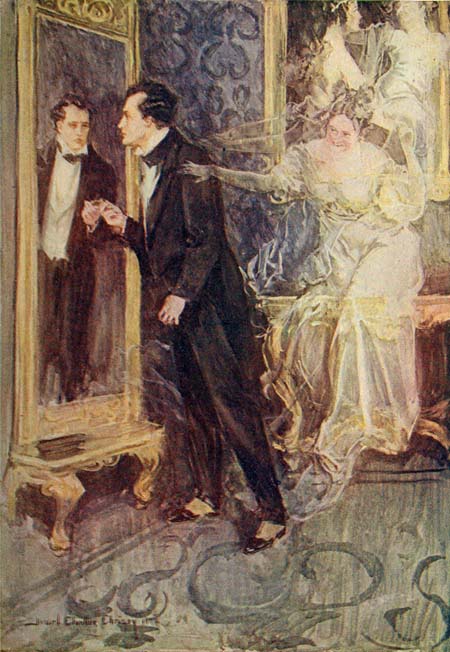
“IS THAT YOU, GEORGE GORDON?” HE ASKED. p. 178.
The ghosts drew nearer. They peered over his shoulders. He felt their fingers grasping at him. He cursed them. By what right did they follow him? By what damnable chance, ruled by what infernal jugglery, came this painted semblance to open old tombs? Something had awakened in him—it was the side that recollected, remorseless and impenitent but no longer benumbed, writhing with smarting vitality. Awake, it recoiled abashed from the voiceless vade retro of that symbol. What part had he in that purity whose visible emblem mocked and derided him? What comradeship did life hold for him save the hideous Gorgon of memory, the[179] Cerberus of ill fame, spirits of the dark, garish fellows of the half-world—“they whose steps go down to hell!”
A fury, demoniac, terrible, fell on him. He seized the miniature, dashed it on the floor, stamped it with his heel and crushed and ground it into indistinguishable fragments.
Then he sprang up, and with an oath whose note was echoed by the tame raven croaking on the landing, rushed down the stairway and threw himself into his gondola.
The moon rose red as a house afire. Before it paled, he had passed the lagoon. In the dim light that presaged the sodden dawn he leaped ashore on the mainland, pierced the damp laurel thickets that skirted the river Brenta and plunged into the forest.
[180]