OR THE TRIP TO BRIGHTON.
     Improvements in Travelling—Contrast of ancient and modern
     Conveyances and Coachmen—Project for a new Land Steam
     Carriage—The Inn-yard at the Golden Cross, Charing Cross—
     Mistakes of Pas-sengers—Variety of Characters—Advantages
     of the Box-seat—Obstructions on the Road—A Pull-up at the
     Elephant and Castle—Move on to Kensington Common—Hew
     Churches—Civic Villas at Brixton—Modern Taste in
     Architecture described-Arrival at Croydon; why not now the
     King's Road?—The Joliffe Hounds—A Hunting Leader—
     Anecdotes of the Horse, by Coachee—The new Tunnel at
     Reigate—The Baron's Chamber—The Golden Ball—the Silver
     Ball—and the Golden Calf—Entrance into Brighton.
[275] That every age is an improved edition of the former I am not (recollecting the splendid relics of antiquity) prepared to admit; but that the present is particularly distinguished for discoveries in science, and vast improvements in mechanical arts, every accurate observer must allow: the prodigious inventions of late years cannot fail in due time of producing that perfectibility, the great consummation denominated the Millennium. Of all other improvements, perhaps the most conspicuous are in the powers of motion as connected with the mode and means of travelling. With what astonishment, were it possible to reanimate the clay-cold relics, would our ancestors survey the accelerated perfection to which coaching is brought in the present day! The journey from London to Brighton, for instance, was, half-a-century since, completed at great risk in twenty-four hours, over a rough road that threatened destruction at every turn; and required the most laborious exertion to reach the summit of precipices that are now, like a ruined spendthrift, cut through and through: the declivities too have disappeared, and from its level face, the whole country would appear to have undergone another revolutionary change, even to the horses, harness, and the driver of the vehicle. In such a country as this, where a disposition to activity and a rambling propensity to seek their fortunes forms one of the most distinguishing characteristics, it was to be expected that travelling would be brought to great perfection; but the most sanguine in this particular could never have anticipated the rapidity with which we are now whirled from one end of the kingdom to the other; fifty-two miles in five hours and a quarter, five changes of horses, and the same coachman to whisk you back again to supper over the same ground, and within the limits of the same day. No ruts or quarterings now—all level as a bowling-green—half-bred blood cattle—bright brass harness—minute and a half time to change—and a well-bred gentlemanly fellow for a coachman, who amuses you [276]with a volume of anecdotes, if you are fortunate enough to secure the box-seat, or touches his hat with the congee of a courtier, as he pockets your tributary shilling at parting. No necessity either for settling your worldly affairs, or taking an affectionate farewell of a long string of relations before starting; travelling being now brought to a security unparalleled, and letters patent having passed the great seal of England to ensure, by means of safety coaches, the lives of her rambling subjects. There requires but one other invention to render the whole perfect, and that, if we may believe the newspapers, is very near completion—a coach to go without horses: to this I beg leave to propose, the steam apparatus might be made applicable to all the purposes of a portable kitchen. The coachman, instead of being a good judge of horse-flesh, to be selected from a first rate London tavern for his proficiency in cooking, a known prime hand at decomposing a turtle; instead of a book of roads, in the inside pocket should be placed a copy of Mrs. Glasse on Cookery, or Dr. Kitchener on Culinaries; where the fore-boot now is might be constructed a glazed larder, filled with all the good things in season: then too the accommodation to invalids, the back seat of the coach, might be made applicable to all the purposes of a shampooing or vapour bath—no occasion for Molineux or his black rival Mahomed; book your patients inside back seat in London, wrap them up in blankets, and give directions to the cook to keep up a good steam thermometer during the journey, 120°, and you may deliver them safe at Brighton, properly hashed and reduced for any further medical experiments. (See Engraving, p. 274.) The accommodation to fat citizens, and western gourmands, would be excellent, the very height of luxury and refinement—inhaling the salubrious breeze one moment, and gurgling down the glutinous calipash the next; no [277]exactions of impudent waiters, or imposing landlords, or complaints of dying from hunger, or choking from the want of time to masticate; but every wish gratified and every sense employed. Then how jovial and pleasant it would appear to see perched up in front a John Bull-looking fellow in a snow-white jacket, with a night-cap and apron of the same, a carving-knife in a case by his side, and a poker in his hand to stir up the steam-furnace, or singe a highwayman's wig, should any one attack the coach; this indeed would be an improvement worthy of the age, and call forth the warmest and most grateful tributes of applause from all ranks in society. For myself, I have always endeavoured to read "men more than books," and have ever found an endless diversity of character, a never-failing source of study and amusement in a trip to a watering-place: perched on the top in summer, or pinched inside in winter of a stage-coach, here, at leisure and unknown, I can watch the varied groups of all nations as they roam about for profit or for pleasure, and note their varieties as they pass away like the retiring landscape, never perhaps to meet the eye again.
The excursion to Brighton was no sooner finally arranged, than declining the proffered seat in D'Almaine's travelling carriage, I packed up my portmanteau, and gave directions to my servant to book me outside at the Golden Cross, by the seven o'clock morning coach, for Brighton; taking care to secure the box-seat, by the payment of an extra shilling to the porter.
An inn-yard, particularly such a well-frequented one as the Golden Cross, Charing Cross, affords the greatest variety of character and entertainment to a humorist. Vehicles to all parts of the kingdom, and from the inscription on the Dover coaches, I might add to all parts of the world, via Paris. "Does that coach go the whole way to France?" said an [278]unsuspecting little piece of female simplicity to me, as I stood lolling on the steps at the coach-office door. "Certainly," replied I, unthinkingly. "O, then I suppose," said the speaker, "they have finished the projected chain-pier from Dover to Calais." "France and England united? nothing more impossible," quoth I, correcting the impression I had unintentionally created. "Are you going by the Brighton, mam?" "Yes, I be." "Can't take all that luggage." "Then you sha'n't _take_ me." "Don't wish to be __taken for a waggon-man." "No, but by Jasus, friend, you are a wag-on-her," said a merry-faced Hibernian, standing by. "Have you paid down the dust, mam?" inquired the last speaker. "I have paid for my place, sir," said the lady; "and I shall lose two, if I don't go." "Then by the powers, cookey, you had better pay for one and a half, and that will include luggage, and then you'll be a half gainer by the bargain." "What a cursed narrow hole this is for a decent-sized man to cram himself in at?" muttered an enormous bulky citizen, sticking half-way in the coach-door, and panting for breath from the violence of his exertions to drag his hind-quarters after him. "Take these hampers on the top, Jack," said the porter below to the man loading the coach, and quietly rested the baskets across the projecting ultimatum of the fat citizen (to the no little amusement of the bystanders), who through his legs vociferated, "I'll indict you, fellows; I'll be——if I don't, under Dick Martin's act." "It must be then, my jewel," said the waggish Hibernian, "for overloading a mule." "Do we take the whole of you to-day, sir?" said coachee, assisting to push him in. "What do you mean by the whole? I am only one man." "A master tailor," said coachee, aside, "he must be then, with the pickings of nine poor journeymen in his paunch." "Ish tere any room outshide te coach?" bawled out a black-headed little Israelite; "ve shall be all shmotered vithin, [279]tish hot day; here are too peepels inshite, vat each might fill a coach by temselves." "All right—all right; take care of your heads, gemmen, going under the gateway; give the bearing rein of the near leader one twist more, and pole up the off wheeler a link or two. All right, Tom—all right—stand away from the horses' heads, there—ehewt, fee'e't!"—smack goes the whip, and away goes the Brighton Times like a Congreve rocket, filled with all manner of combustibles.
The box-seat has one considerable advantage—it exempts you from the inquisitive and oftentimes impertinent conversation of a mixed group of stage-coach passengers; in addition to which, if you are fond of driving, a foible of mine, I confess, it affords an opportunity for an extra lesson on the noble art of handling the ribbons, and at the same time puts you in possession of all the topographical, descriptive, and anecdotal matter relative to the resident gentry and the road.
The first two miles from the place of starting is generally occupied in clearing obstructions on the road, taking up old maids at their own houses, with pug-dogs, pattens, and parrots, or pert young misses at their papas' shop-doors; whose mammas take this opportunity of delaying a coach-load of people to display their maternal tenderness at parting, while the junior branches of the family hover round the vehicle, and assail your ears with lisping out their eternal "good b'yes," and the old hairless head of the family is seen slyly tipping coachee an extra shilling to take care of his darling girl. The Elephant and Castle produces another pull-up, and here a branch-coach brings a load of lumber from the city, which, while the porter is stowing away, gives time to exhibit the lions who are leaving London in every direction. King's Bench rulers with needy habiliments, and lingering looks, sighing for term-time and [280]a horse,{1} on one side the road, and Jews, newsmen, and touters, on the other; who nearly give away their goods, if you believe them, for the good of the nation, or force you into a coach travelling in direct opposition to the road for which you have been booked, and in which your luggage may by such mischance happily precede you at least half a day. At length all again is declared right, the supervisor delivers his way-bill, and forward moves the coach, at a somewhat brisker pace, to Kennington Common. I shall not detain my readers here with a long dull account of the unfortunate rebels who suffered on this spot in 1745; but rather direct their attention to a neat Protestant church, which has recently been erected on the space between the two roads leading to Croydon and Sutton, the portico of which is in fine architectural taste, and the whole building a very great accommodation and distinguished ornament to the neighbourhood. About half a mile farther, on the rise of Brixton hill, is another newly erected church, the portico in the style of a Greek temple, and in an equally commanding situation: from this to Croydon, ten miles, you have a tolerable specimen of civic taste in rural architecture.
On both sides of the road may be seen a variety of incongruous edifices, called villas and cottage ornées, peeping up in all the pride of a retired linen-draper, or the consequential authority of a man in office, in as many varied styles of architecture as of dispositions in the different proprietors, and all exhibiting (in their possessors' opinion) claims to the purest and most refined taste.
For example, the basement story is in the Chinese or Venetian style, the first floor in that of the florid Gothic, with tiles and a pediment à-la-Nash, at the Bank; a doorway with inclined jambs, and a hieroglyphic à-la-Greek: a gable-ended glass lean to on
1 A day-rule, so called.
[281]one side, about big enough for a dog-kennel, is called a green-house, while a similar erection on the other affords retirement for the tit and tilbury; the door of which is always set wide open in fine weather, to display to passers-by the splendid equipage of the occupier. The parterre in front (green as the jaundiced eye of their less fortunate brother tradesmen) is enriched with some dozens of vermilion-coloured flower-pots mounted on a japanned verdigris frame, sending forth odoriferous, balmy, and enchanting gales to the grateful olfactory organs, from the half-withered stems of pining and consumptive geraniums; to complete the picture, two unique plaster casts of naked figures, the Apollo Belvidere and the Venus de Medici, at most a foot in altitude, are placed on clumsy wooden pedestals of three times that height before the parlour-windows, painted in a chaste flesh-colour, and guarded by a Whitechapel bull-cdog, who, like another Cerberus, sits growling at the gate to fright away the child of poverty, and insult the less wealthy pedestrian.
Happy country! where every man can consult his own taste, and build according to his own fancy, amalgamating in one structure all the known orders and varieties, Persian, Egyptian, Athenian, and European.
Croydon in 1573 contained the archiepiscopal palace of the celebrated Archbishop Parker, who, as well as his successor Whitgift, here had frequently the honour to entertain Queen Elizabeth and her court: the manor since the reign of William the Conqueror has belonged to the Archbishops of Canterbury. The church is a venerable structure, and the stately tower, embowered with woods and flanked by the Surrey hills, a most picturesque and commanding object; the interior contains some monuments of antiquity well worthy the attention of the curious. The town itself has little worthy of note except the hospital, [282]founded by Archbishop Whitgift for a warder and twenty poor men and women, decayed housekeepers of Croyden and Lambeth: a very comfortable and well-endowed retirement.
"This was formerly the King's road," said coachee, "but the radicals having thought proper to insult his majesty on his passing through to Brighton during the affair of the late Queen, he has ever since gone by the way of Sutton: a circumstance that has at least operated to produce one christian virtue among the inhabitants, namely, that of humility; before this there was no getting change for a civil sentence from them."
To Merstham seven miles, the road winds through a bleak valley called Smithem Bottom, till recently the favourite resort of the cockney gunners for rabbit-shooting; but whether from the noise of their harmless double-barrel Nocks, or the more dreadful carnage of the Croydon poachers, these animals are now exceedingly scarce in this neighbourhood. Just as we came in sight of Merstham, the distant view halloo of the huntsman broke upon our ears, when the near-leader rising upon his haunches and neighing with delight at the inspiring sound, gave us to understand that he had not always been used to a life of drudgery, but in earlier times had most likely carried some daring Nimrod to the field, and bounded with fiery courage o'er hedge and gate, through dell and brake, outstripping the fleeting wind to gain the honour of the brush. Ere we had gained the village, reynard and the whole field broke over the road in their scarlet frocks, and dogs and horses made a dash away for a steeple chase across the country, led by the worthy-hearted owner of the pack, the jolly fox-hunting Colonel, Hilton Jolliffe, whose residence caps the summit of the hill. From hence to Reigate, four miles farther, there was no circumstance or object of interest, if I except a very romantic tale coachee [283]narrated of his hunting leader, who had of course been bred in the stud of royalty itself, and had since been the property of two or three sporting peers, when, having put out a _spavin_, during the last hunting season, he was sold for a __machiner; but being since fired and turned out, he had come up all right, and was now, according to coachee's disinterested opinion, one of the best hunters in the kingdom. As I was not exactly the customer coachee was looking for, being at the time pretty well mounted, I thought it better to indulge him in the joke, particularly as any doubt on my part might have soured the whip, and made him sullen for the rest of the journey.
At Reigate a trifling accident happened to one of the springs of the coach, which detained us half an hour, and enabled me to pay a visit to the celebrated sand cavern, where, it is reported, the Barons met, during the reign of King John, to hold their councils and draw up that great palladium of English liberty, Magna Charta, which was afterwards signed at Runnymede.
There was something awful about this stupendous excavation that impressed me with solemn thoughtfulness; it lies about sixty feet from the surface of the earth, and is divided into three apartments with arched roofs, the farthest of which is designated the Barons' Chamber. Time flowed back upon my memory as I sat in the niches hewn out in the sides of the cavern, and meditation deep usurped my mind as I dwelt on the recollections of history; on the
          "Majestic forms, and men of other times,
          Retired to fan the patriotic fire,
          Which, bursting forth at Runnymede,
          With rays of glory lightened all the land!"
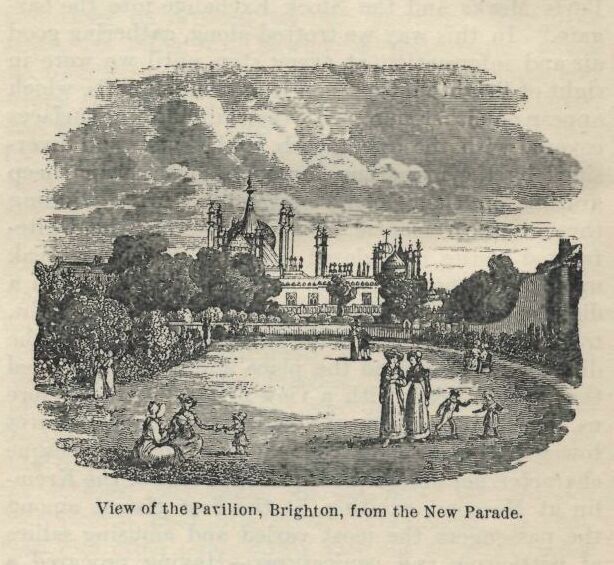
Near to the mouth of this cavern stands the remains of Holms Castle, celebrated in the history of the civil wars between Charles the First and his parliament; and on the site of an ancient monastic establishment, [284]near to the spot, has been erected a handsome modern mansion called the Priory of Holmsdale, the name of the valley in which the town is situate. Returning to the inn I observed the new tunnel, which we had previously passed under, a recent work of great labour and expense, which saves a considerable distance in the approach to the town; it has been principally effected by a wealthy innkeeper, and certainly adds much to the advantage and beauty of the place. Coachee had now made all right, and his anxious passengers were again replaced in their former situations to proceed on our journey. The next stage, ten miles, to Crawley, a picturesque place, afforded little variety, if I except an immense elm which stands by the side of the road as you enter, and has a door in front to admit the curious into its hollow trunk. Our next post was Cuckfield, nine miles, where I did not discover any thing worthy of narration; from this to Brighton, twelve miles, coachee amused me with some anecdotes of persons whom we passed upon the road. A handsome chariot, with a most divine little creature in the inside, and a good-looking roué, with huge mustachios, first attracted my notice: "that is the golden Ball," said coachee, "and his new wife; he often rolls down this road for a day or two—spends his cash like an emperor—and before he was tied up used to tip pretty freely for handling the ribbons, but that's all up now, for Mamsell Mercandotti finds him better amusement. A gem-man who often comes down with me says his father was a slopseller in Ratcliffe Highway, and afterwards marrying the widow of Admiral Hughes, a rich old West India nabob, he left this young gemman the bulk of his property, and a very worthy fellow he is: but we've another rich fellow that's rather notorious at Brighton, which we distinguish by the name of the silver Ball, only he's a bit of a screw, and has lately [285]got himself into a scrape about a pretty actress, from which circumstance they have changed his name to the Foote Ball. I suppose you guess where I am now," said coachee, tipping me one of his knowing winks. "Do you see that machine before us, a sort of cabriolet, with two horses drove in a curricle bar? that is another swell who is very fond of Brighton, a Jew gentleman of the name of Solomon, whom the wags have made a Christian of by the new appellation of the golden calf; but his godfathers were never more out in their lives, for in splitting a bob, it's my opinion, he'd bother all Bevis Marks and the Stock Exchange into the bargain." In this way we trotted along, gathering good air and information at every step, until we were in sight of Brighton Downs, a long chain of hills, which appear on either side; with their undulating surfaces covered with the sweet herb wild thyme, and diversified by the numerous flocks of South-down sheep grazing on their loftiest summits. After winding through the romantic valley of Preston, the white-fronted houses and glazed bricks of Brighton break upon the sight, sparkling in the sun-beams, with a distant glimpse of the sea, appearing, at first sight, to rise above the town like a blue mountain in the distance: we entered the place along what is called the London Road, with a view of the Pavilion before us, the favourite abode of royalty, shooting its minaret towers and glass dome upwards in the most grotesque character, not unlike the representations of the Kremlin at Moscow; exciting, at the first glance, among the passengers, the most varied and amusing sallies of witticisms and conjectures.—Having procured a sketch of it from this view, I shall leave you to contemplate, while I retire to my inn and make the necessary arrangements for refreshment and future habitation.
By way of postscript, I enclose you a very entertaining scene I witnessed between D'Almaine and [286]his wife the night previous to my journey: they are strange creatures; but you love eccentrics, and may be amused with this little drama, which formed the motive for my visit.
Horatio Heartly.