One of the rooms in Janney's suite had been turned into an office for General Bent, and here it was that all the conferences between the officers of the Amalgamated Reduction Company and their underlings had taken place. The big men of Denver had all called to pay their respects to the bigger man from the East, and some of them had taken part in the business of reorganizing the Denver and California and its subsidiary companies.
But in spite of the conditions which had made Bent's control of the railroad possible and the money the crowd would make out of it, everybody in this intimate circle knew that the real object of the General's financial operations was the fight of the Amalgamated Reduction Company for the ownership of the Saguache Smelter. The reorganization of the Denver and California had now been completed, and this morning orders had gone forth removing Clinton, Symonds, and all the old crowd from the active management of the road.
General Bent sat at the end of the long desk table in conference with Curtis Janney, Cortland Bent, and a youngish-oldish, keen-eyed man in a cutaway coat and white waistcoat. This was Henry McCabe of Denver—attorney for the Amalgamated—the shrewdest lawyer west of the Missouri River, and one of the shrewdest east of it. In front of McCabe on the desk was a leather portfolio from which a number of papers protruded. Behind him sat a clerk who had been taking down in shorthand his questions and the replies of two men at the farther end of the table. These men were roughly dressed, and, though at the present moment each of them smoked one of Curtis Janney's remarkable cigars, they sat aloof and uncomfortable on their gilt chairs, assuming attitudes of ease they were far from feeling. One of the strangers was Max Reimer, the man who had discovered the lost vein in the "Lone Tree" mine. The other was Fritz Weyl, one-time barkeeper of Pete Mulrennan's saloon in Mesa City.
McCabe's examination had hardly been concluded when two cards were brought in by a page and handed to Cortland Bent. He glanced at them, and then, without comment, laid them on the table before his father.
"H—m! He's here now," muttered the General, staring grimly. "He's saved us the trouble of sending for him." He tossed the cards on the table and rose. "There's nothing more you wanted to ask, was there, McCabe?"
"No, sir, nothing. I know all I need to."
"I thought so. Will you take these men downstairs? But have them within call—I may need them. Have Harbison handy, too. Curtis, you'll stay, of course—and you, Cort." Then to the waiting servant, "Show these gentlemen up."
When Wray and Berkely entered, General Bent had resumed his chair at the head of the table, and Cortland and Curtis Janney sat on either side of him. The General's head was bent forward in its customary pose, his shaggy brows lowered so that his eyes were scarcely visible, but in the smile that twisted one end of his thin lips Berkely read a sardonic confidence in the outcome of the interview. On entering the room Wray fixed his wide gaze on General Bent, his eyes gleaming strangely, and kept it on him as though fascinated, until, at a word from Cortland Bent, he sank into a chair beside Berkely. Aside from this civility, no amenities passed. General Bent had sunk back in his armchair, coolly swinging his glasses by their cord, while he keenly eyed Berkely, who had begun talking. Curtis Janney, trying to bury his personal animosities in the present issue, folded his stout arms resolutely and leaned forward upon the table.
"We understand, General Bent, that it is you—representing Eastern interests—who have obtained a majority of the stock of the Denver and California Railroad Company. Am I correctly informed?"
General Bent's head dropped the fraction of an inch. "Your information is correct," he said shortly.
"As general counsel for the Saguache Short Line," Berkely went on, "I am here to inform you that, in accordance with a contract entered into in March of last year, the Denver and California made certain traffic arrangements with my Company conditional upon the completion of the Saguache Short Line upon a specified date. My company accepted these conditions and has succeeded in carrying out to the letter the terms of its agreements——"
"One moment, Mr. Berkely," put in the General with a vague attempt to be humorous, "if I may ask, what is the Saguache Short Line? A telegraph, stage, or railroad company?"
Wray's jaw set, and he glared angrily, but Berkely only smiled.
"A railroad company, sir," he said with suave directness, "controlling a right of way from Pueblo to Saguache—the most direct line from the Saguache to the market. Our tracks are laid, our signals in place, our stations built, and this morning we are advised that the Denver and California is running its first train through from Pueblo to Saguache!"
The three men started, and Berkely grinned.
"I may add that in addition to Mr. Clinton (who at ten o'clock this morning had not yet retired from the presidency of your road), the train also carries other officers of your company as well as stockholders of mine. A lunch has been provided at the northern terminus of the road, and a spirit of harmony dominates the occasion—one which I'm sure you'll admit is noteworthy in every particular."
General Bent's brow twitched ominously. "I hope, Mr. Berkely, you'll come to the point without delay," he said.
"Willingly. The Saguache Short Line has fulfilled its part of the contract. The present officers of your company are willing to carry out theirs. The object of our visit was merely to reassure ourselves of your friendly disposition—the friendly disposition of the newly elected officers of your road—and to arrange with all proper haste a practical schedule for the operation of the line."
Larry paused and sank back in his chair with a smile. General Bent had risen and was leaning forward over the table toward Berkely, his face a thunder-cloud.
"You want a schedule, do you?" he growled, his voice deepening. "Well, I'll give you one—I'll give it to you now, and it won't take a great while, either. As long as I'm in control of the Denver and California Railroad Company not a wheel shall turn on your little jerk-water line within a mile of Pueblo. That's my answer to your proposition. Our yard limit marks your terminus—do you understand? Get your ore there if you can find any," he finished brutally.
But Berkely refused to lose his temper.
"You're aware, of course," he said coolly, "that such a policy is likely to prove expensive?"
"You'll have to show that."
"I think we will. But I can't believe that you repudiate this contract," said Larry, tapping a paper with his forefinger.
"I didn't make that contract. I would never have made it. The courts will pass on its validity."
"Then this is final?"
"Absolutely. Is there anything more you want to say?"
"I think that's all, General Bent," said Berkely, rising. "I had hoped you would have been willing to meet us in a fair spirit. Failing to discover that—either in your attitude or your demeanor—I suppose there is nothing else to be said."
"One moment," interrupted the General, sinking back in his chair with an effort at self-control. "Sit down, please. There's something more to be said—something which you both may be interested to hear." And he addressed his remarks directly to Wray. "I can't say that I've watched your efforts to put your plans through without some interest, Mr. Wray. Under other circumstances I may say that I would have been compelled to a kind of admiration for your fruitless perseverance. It's all the more remarkable in the face of the obstacles with which you had to contend. But we are fully informed as to your actual financial strength, and I think the time has come when we may draw aside the veil and speak frankly. Mr. Berkely informs me that he intends to proceed against the Denver and California Railroad Company. To do this, of course, he must have the proper authority. Are you sure that he can get it?"
Larry smiled. "I think so."
"To do so he requires, does he not, a majority vote of the Denver and Saguache Railroad Company as well as that of the Short Line—those two companies and the Development Company, as I understand it, being in a way dependent one upon the other?"
"That is correct."
The General settled back in his chair, swinging his gold eyeglasses daintily.
"How is he going to get that authority?" he asked.
His smile infuriated Wray, who replied quickly.
"By virtue of my control of all companies," he said crisply.
"Your control?" said Bent; "you have no control. I know your resources to a dollar, Mr. Wray. To-day at twelve o'clock your Denver and Saguache Railroad Company stock will be in my possession."
Wray exchanged a glance with Berkely and laughed dryly.
"Oh, you're really coming in with us at last, are you, General?" he said. "That's fine!" And then with a chuckle, "Your name on the directorate of the Denver and Saguache ought to have some weight with the new officers of the Denver and California."
The frown on Bent's brows deepened. The point of this joke did not dawn on him.
"That stock has always been for sale," Wray went on. "Everything I have is for sale when the man comes along who can afford to buy it. It's funny, though, General Bent, that you haven't said anything to me about it."
A slight twitching of Bent's lips and the nervous movement of his fingers among the papers on the table. Was this really a joke or only the last manifestation of Wray's colossal impudence? He chose to think it the latter.
"It hasn't been necessary to say anything to you about it, sir," he said sternly. "To-day at noon two million and a half of that stock is thrown on the market at a bargain—at a very great bargain. But I'm the only man in the United States who would dare to touch it. I'm the only man in the world, except yourself, to whom it's worth a dollar. I know your resources down to the last dime. You haven't the money to take it up. I have. At noon that stock will be mine, so will you be mine—your two railroads and your smelter, at the price I choose to pay for them."
Jeff sat quietly, one of his hands toying with the top of an inkstand, which he was regarding with friendly interest.
"Are you sure, General?" he asked calmly.
General Bent clasped his twitching fingers to keep them still. "Why, sir—what do you mean?"
"That you're mistaken, that's all. That stock is for sale, but you'll still have to come to me to buy it."
"How——"
"Because I paid off those notes this morning. That stock is in my safe-deposit vault, where it's going to stay—unless"—and he smiled sarcastically—"unless you still want it."
General Bent's face paled and grew red, then purple. He struggled to his feet with difficulty. His plans didn't often miscarry, and the fact that one of the links of the chain he had tested so carefully had failed to hold completely mystified him. How—where had Jeff Wray succeeded in raising eight hundred thousand dollars when the limit of his borrowing capacity had long ago been reached? For months the wonderful secret organization of the Amalgamated had been at work prying into the affairs of Wray's companies and had figured his possible resources to the thinnest part of a hair. He had not sold the "Lone Tree" or even the smallest interest in it, and yet there he was apparently entrenched as firmly as ever. General Bent gasped in amazement. Only the interposition of Providence could have made such a thing possible. Cortland Bent had gone into the adjoining room suddenly, and Wray knew he was verifying this information over the telephone. But General Bent did not wait for him to return. To his mind this news needed no verification. It was time for him to play his last card—and his best.
"You d—d young scoundrel," he said in a hoarse whisper, his voice trembling with fury, while Wray and Berkely rose angrily and faced him. "I won't mince matters with you any longer. You thought when you stole that mine three years ago that you had covered all your tracks and made yourself safe from civil suits. Mr. Berkely planned well. We fought you in the courts and lost. I suppose you thought we had given up. We did let up, but it was only to get a firmer hold. We've got it now, and we're going to use it. You stole that mine—trespassed on our property at night and tried to murder one of our employes. You assaulted him and would have killed him if you hadn't been interrupted——"
"That's a lie!" said Jeff calmly.
"You'll have a chance to prove that. You lured Max Reimer into a gambling den and put him out of business so that he couldn't prevent my son from signing that lease."
"That's another lie! He was drunk and violent and drew a gun on me. My partner struck him down. His head hit the edge of a table."
"Nonsense, sir. We have a witness who verifies Reimer in every particular, who swears he saw from the doorway——"
"Who is your witness?"
"Fritz Weyl—I see you remember him. He——"
Wray laughed uneasily. "Yes, I remember Fritz?"
Bent came one step nearer, waving a trembling hand at Cortland, who had returned and was trying to restrain him. But the General shook him off.
"We dropped those civil suits because we thought it was wise to do so, and because we knew that in time we would be in a position to win in other ways. There are other processes of law besides the civil ones, and those are the ones we choose to take. Before you can leave Denver you'll be arrested on charges of abduction and conspiracy. I suppose you know what that means?"
Jeff grew a shade paler, his eyes blazing their resentment at the old man who stood tottering before him.
"You'd do that—you?" cried Jeff, hoarsely, struggling hard to keep himself under control. "You'd hire men to send me to the penitentiary because I've balked your plans—because I've beaten you in a fair fight against odds;—you?—you?" Wray clenched his fist and took a step forward, but Larry Berkely seized him by the arm, and Cortland Bent stepped between.
General Bent pushed his son aside.
"Go, Cort—call McCabe. We'll see——"
At this moment there was an interruption.
"Wait a moment, Cort, please," said a voice.
The door into Mr. Janney's parlor had opened suddenly, and Mrs. Cheyne had entered the room. And while the General eyed her angrily, too amazed to speak, she strode quickly forward into the group and continued quietly,
"There has been a mistake—a terrible mistake. If you'll let me explain——"
General Bent was the first to recover his senses. "Rita! Leave the room at once!" he commanded.
"No," she said firmly, "not until you hear what I have to say——"
"I can't listen now—another time," he fumed.
"No, now. I'm going to save you from doing something that you'll regret the rest of your life."
While the General questioned, Jeff had turned and seized her by the arm, his eyes pleading.
"Rita!" he muttered, "You know? .... For God's sake, don't! ... Not now!"
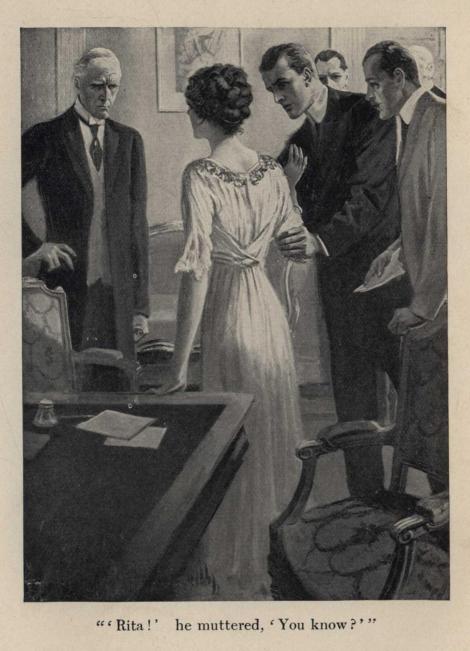 "'Rita!' he muttered, 'You know?'"
"Yes," she said firmly. "No one else will. I must."
Cornelius Bent and Cortland had watched Wray in amazement. His face had suddenly grown white and drawn.
"You have no right to tell him, Rita," he persisted. "It's my secret!—not yours! You can't! I tell you."
But she eluded him and faced the General.
"You must listen to me, Cousin Cornelius."
Curtis Janney, who had been watching Wray closely, now interposed.
"Let her speak, General. It seems to be something of more than usual importance."
"Very well," he growled, "but be brief."
"I can't tell it here," she insisted. "I must speak to you alone."
"Alone? Why?"
"It's a private matter. Will you come into the next room, there's no one there——"
She turned and was moving toward the door when Jeff's large figure blocked the way.
"You don't know what you're doing, Rita," he whispered. "You can't. I forbid it." But Berkely, who had been watching the General, took Jeff by the arm and held him by main force.
"Stand aside, sir," said General Bent, roughly brushing by. "If there's something you want concealed, it's something I want to hear." And he followed, banging the door behind him.
Jeff made a movement as though he would follow—then turned toward Cortland Bent and Janney, who had watched this extraordinary change in the demeanor of their enemy with wonder and some curiosity. Jeff stared at them wildly and took up his hat, saying in a strange voice,
"Come, Larry, I must get away from here—at once," and, opening the door, he fled madly down the corridor.
Berkely paused a moment. "We have no intention of dodging any issues," he said quietly. "If any of you gentlemen want to see Mr. Wray or me, you can find us both at the Wetherall Ranch to-morrow."