In doubt and fear, the phantom of a dreadful certainty creeping always closer, the final years went by. When the world came to be in its very last days, when the little bent man was drooping lower than ever, and Prudence was seventeen, there came another Prince of Israel to save her into the Kingdom while there was yet a time of grace. On this occasion the suitor was no less a personage than Bishop Warren Snow, a holy man and puissant, upon whom the blessed Gods had abundantly manifested their favour. In wives and children, in flocks and herds, he was rich; while, as to spiritual worth, had not that early church poet styled him the Entablature of Truth?
But Prudence Rae, once so willing to be saved by the excellent Wild Ram of the Mountains, had fled in laughing confusion from this later benefactor, when he had made plain one day the service he sought to do her soul. A moment later he had stood before her father in all his years of patriarchal dignity, hale, ruddy, and vast of girth.
“She’s a woman now, Brother Snow,—free to choose for herself,” the father had replied to his first expostulations.
“Counsel her, Brother Rae.” In the mind of the Bishop, “counsel,” properly applied, was a thing not long to be resisted.
“She would treat my counsel as shortly as she treated your proposal, Brother Snow.”
The Entablature of Truth glanced out of the open door to where Tom Potwin could be seen, hastening importantly upon his endless and mysterious errands, starting off abruptly a little way, stopping suddenly, with one hand raised to his head, as if at that instant remembering a forgotten detail, and then turning with new impetus to walk swiftly in the opposite direction.
“There ain’t any one else after her, is there, Brother Rae,—any of these young boys?”
“No, Bishop—no one.”
“Well, if there is, you let me know. I’ll be back again, Brother Rae. Meantime, counsel her—counsel her with authority.”
The Entablature of Truth had departed with certain little sidewise noddings of his head that seemed to indicate an unalterable purpose.
The girl came to her father, blushing and still laughing confusedly, when the rejected one had mounted his horse and ridden away.
“Oh, Daddy, how funny!—to think of marrying him!”
He looked at her anxiously. “But you wanted to marry Bishop Wright—at least, you—”
She laughed again. “How long ago—years ago—I must have been a baby.”
“You were old enough to point out that he would save you in the after-time.”
“I remember; I could see myself sitting by him on a throne, with the Saints all around us on other thrones, and the Gentiles kneeling to serve us. We were in a big palace that had a hundred closets in it, and in every closet there hung a silk dress for me—a hundred silk dresses, each a different colour, waiting for me to wear them.”
“But have you thought sufficiently—now? The time is short. Bishop Snow could save you.”
“Yes—but he would kiss me—he wanted to just now.” She put both hands over her mouth, with a mocking little grimace that the Entablature of Truth would not have liked to see.
“He would be certain to exalt you.”
She took the hands away long enough to say, “He would be certain to kiss me.”
“You may be lost.”
“I’d rather!”
And so it had ended between them. Ever since a memorable visit to Salt Lake City, where she had gone to the theatre, she had cherished some entirely novel ideas concerning matrimony. In that fairyland of delights she had beheld the lover strangely wooing but one mistress, the husband strangely cherishing but one wife. There had been no talk of “the Kingdom,” and no home portrayed where there were many wives. That lover, swearing to cherish but one woman for ever, had thrilled her to new conceptions of her own womanhood, had seemed to meet some need of her own heart that she had not until then been conscious of. Ever after, she had cherished this ideal of the stage, and refused to consider the other. Yet she had told her father nothing of this, for with her womanhood had come a new reserve—truths half-divined and others clearly perceived—which she could not tell any one.
He, in turn, now kept secret from her the delight he felt at her refusal. He had tried conscientiously to persuade her into the path of salvation, when his every word was a blade to cut at his heart. Nor was he happy when she refused so definitely the saving hand extended to her. To know she was to come short of her glory in the after-time was anguish to him; and mingling with that anguish, inflaming and aggravating it, were his own heretical doubts that would not be gone.
In a sheer desperation of bewilderment he longed for the end, longed to know certainly his own fate and hers—to have them irrevocably fixed—so that he might no more be torn among many minds, but could begin to pay his own penalties in plain suffering, uncomplicated by this torturing necessity to choose between two courses of action.
And the time was, happily, to be short. With the first day of 1870 he began to wait. With prayer and fasting and vigils he waited. Now was the day when the earth should be purified by fire, the wicked swept from the land, and the lost tribes of Israel restored to their own. Now was to come the Son of Man who should dwell in righteousness with men, reigning over them on the purified earth for a thousand years.
He watched the mild winter go, with easy faith; and the early spring come and go, with a dawning uneasiness. For the time was passing with never the blast of a trumpet from the heavens. He began to see then that he alone, of all Amalon, had kept his faith pure. For the others had foolishly sown their fields, as if another crop were to be harvested,—as if they must continue to eat bread that was earth-grown. Even Prudence had strangely ceased to believe as he did. Something from the outside had come, he knew not what nor how, to tarnish the fair gold of her certainty. She had not said so, but he divined it when he shrewdly observed that she was seeking to comfort him, to support his own faith when day after day the Son of Man came not.
“It will surely be in another month, Daddy—perhaps next week—perhaps to-morrow,” she would say cheerfully. “And you did right not to put in any crops. It would have been wicked to doubt.”
He quickly detected her insincerity, seeing that she did not at all believe. As the summer came and went without a sign from the heavens, she became more positive and more constant in these assurances. As the evening drew on, they would walk out along the unsown fields, now grown rankly to weeds, to where the valley fell away from their feet to the west. There they could look over line after line of hills, each a little dimmer as it lay farther into the blue through which they saw it, from the bold rim of the nearest shaggy-sided hill to the farthest feathery profile all but lost in the haze. Day after day they sat together here and waited for the sign,—for the going down of the sun upon a night when there should be no darkness; when the light should stay until the sun came back over the eastern verge; when the trumpet should wind through the hills, and when the little man’s perplexities, if not his punishment, should be at an end.
And always when the dusk came she would try to cheer him to new hope for the next night, counting the months that remained in the year, the little time within which the great white day must be. Then they would go back through the soft light of the afterglow, he with his bent shoulders and fallen face, shrunk and burned out, except for the eyes, and she in the first buoyant flush of her womanhood, free and strong and vital, a thing of warmth and colour and luring curve, restraining her quick young step to his, as she suppressed now a world of strange new fancies to his soberer way of thought. When they reached home again, her words always were: “Never mind, Daddy—it must come soon—there’s only a little time left in the year.”
It was on these occasions that he knew she was now the stronger, that he was leaning on her, had, in fact, long made her his support—fearfully, lest she be snatched away. And he knew at last that another change had come with her years; that she no longer confided in him unreservedly, as the little child had. He knew there were things now she could not give him. She communed with herself, and her silences had come between them. She looked past him at unseen forms, and listened as if for echoes that she alone could hear, waiting and wanting, knowing not her wants—yet driven to aloofness by them from the little bent man of sorrows, whose whole life she had now become.
His hope lasted hardly until the year ended. Before the time was over, there had crept into his mind a conviction that the Son of Man would not come; that the Lord’s favour had been withdrawn from Israel. He knew the cause,—the shedding of innocent blood. They might have made war; indeed, many of the revelations to Joseph discriminated even between murder and that murder in which innocent blood should be shed; but the truth was plain. They had shed innocent blood that day in the Meadows. Now the Lord’s favour was withdrawn and His coming deferred, perhaps another thousand years. The torture of the thing came back to him with all its early colouring, so that his days and nights were full of anguish. He no longer dared open the Bible to that reddened page. The cries already rang in his ears, and he knew not what worse torture might come if he looked again upon the stain; nor could he free himself from these by the old expedient of prayer, for he could no longer pray with an honest heart; he was no longer unselfish, could no longer kneel in perfect submission; he was wholly bound to this child of her mother, and the peace of absolute and utter sacrifice could not come back to him. Full of unrest, feeling that somehow the end, at least for him, could not be far off, he went north to the April Conference. He took Prudence with him, not daring to leave her behind.
She went with high hopes, alive with new sensations. Another world lay outside her valley of the mountains, and she was going to peep over the edge at its manifold fascinations. She had been there before as a child; now she was going as a woman. She remembered the city, bigger and grander than fifty Amalons, with magnificent stores filled with exotic novelties and fearsome luxuries from the land of the wicked Gentile. She recalled even the strange advertisements and signs, from John and Enoch Reese, with “All necessary articles of comfort for the wayfarer, such as flour, hard bread, butter, eggs and vinegar, buckskin pants and whip-lashes,” to the “Surgeon Dentist from Berlin and Liverpool,” who would “Examine and Extract Teeth, besides keeping constantly on hand a supply of the Best Matches, made by himself.” From William Hennefer, announcing that, “In Connection with my Barber Shop, I have just opened an Eating House, where Patrons will be Accommodated with every Edible Luxury the Valley Affords,” to William Nixon, who sold goods for cash, flour, or wheat “at Jacob Hautz’s house on the southeast corner of Council-House Street and Emigration Square, opposite to Mr. Orson Spencer’s.”
She remembered the hunters and trappers in bedraggled buckskin, the plainsmen with revolvers in their belts, wearing the blue army cloak, the teamsters in leathern suits, and horsemen in fur coats and caps, buffalo-hide boots with the hair outside, and rolls of blankets behind their high Mexican saddles.
More fondly did she recall two wonderful evenings at the theatre. First had been the thrilling “Robert Macaire,” then the romantic “Pizarro,” in which Rolla had been a being of such overwhelming beauty that she had felt he could not be of earth.
This time her visit was an endless fever of discovery in a realm of magic and mystery, of joys she had supposed were held in reserve for those who went behind the veil. It was a new and greater city she came to now, where were buildings of undreamed splendour, many of them reaching dizzily three stories above the earth. And the shops were more fascinating than ever. She still shuddered at the wickedness of the Gentiles, but with a certain secret respect for their habits of luxury and their profusion of devices for adornment.
And there were strange new faces to be seen, people surely of a different world, of a different manner from those she had known, wearing, with apparent carelessness, garments even more strangely elegant than those in the shop windows, and speaking in strange, soft accents. She was told that these were Gentiles, tourists across the continent, who had ventured from Ogden to observe the wonders of the new Zion. The thought of the railroad was in itself thrilling. To be so near that wonderful highway to the land of the evil-doers and to a land, alas! of so many strange delights. She shuddered at her own wickedness, but fell again and again, and was held in bondage by the allurements about her. So thrilled to her soul’s center was she that the pleasure of it hurt her, and the tears would come to her eyes until she felt she must be alone to cry for the awful joy of it.
The evening brought still more to endure, for they went to the play. It was a play that took her out of herself, so that the crowd was lost to her from the moment the curtain went up in obedience to a little bell that tinkled mysteriously,—either back on the stage or in her own heart, she was not sure which.
It was a love story; again that strangely moving love of one man for one woman, that seemed as sweet as it was novel to her. But there was war between the houses in the play, and the young lover had to make a way to see his beloved, climbing a high wall into her garden, climbing to her very balcony by a scarf she flung down to him. To the young woman from Amalon, these lovers’ voices came with a strange compulsion, so that they played with her heart between them. She was in turn the youth, pleading in a voice that touched every heart string from low to high; then she was the woman, soft and timid, hesitating in moments of delicious doubt, yet almost fearful of her power to resist,—half-wishing to be persuaded, half-frightened lest she yield.
When the moment of surrender came, she became both of them; and, when they parted, it was as if her heart went in twain, a half with each, both to ache until they were reunited. Between the acts she awoke to reality, only to say to herself: “So much I shall have to think about—so much—I shall never be able to think about it enough.”
Feverishly she followed the heart-breaking tragedy to its close, suffering poignantly the grief of each lover, suffering death for each, and feeling her life desolated when the end came.
But then the dull curtain shut her back into her own little world, where there was no love like that, and beside the little bent man she went out into the night.
The next morning had come a further delight, an invitation to a ball from Brigham. Most of the day was spent in one of the shops, choosing a gown of wondrous beauty, and having it fitted to her.
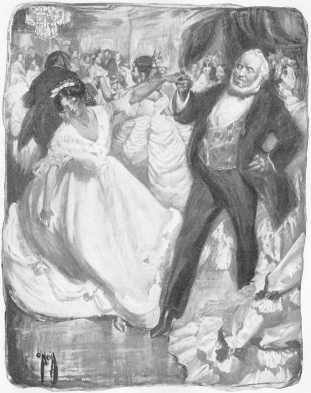
FULL OF ZEST FOR THE MEASURE AS ANY YOUTH
When she looked into the little cracked mirror that night, she saw a strange new face and figure; and, when she entered the ballroom, she felt that others noted the same strangeness, for many looked at her until she felt her cheeks burn. Then Brigham arose from a sofa, where he had been sitting with his first wife and his last. He came gallantly toward her; Brigham, whom she knew to be the most favoured of God on earth and the absolute ruler of all the realm about her—an affable, unpretentious yet dignified gentleman of seventy, who took her hand warmly in both his own, looked her over with his kindly blue eyes, and welcomed her to Zion in words of a fatherly gentleness. Later, when he had danced with some of his wives, Brigham came to dance with her, light of foot and full of zest for the measure as any youth.
Others danced with her, but during it all she kept finding herself back before the magic square that framed the land where a man loved but one woman. She remembered that Brigham sat with four of his wives in one of the boxes, enthusiastically applauding that portrayal of a single love. As the picture came back to her now, there seemed to have been something incongruous in this spectacle. She observed the seamed and hardened features of his earliest wife, who kept to the sofa during the evening, beside the better favoured Amelia, whom the good man had last married, and she thought of his score or so of wives between them.
Then she knew that what she had seen the night before had been the truth; that she could love no man who did not love her alone. She tried to imagine the lover in the play going from balcony to balcony, sighing the same impassioned love-tale to woman after woman; or to imagine him with many wives at home, to whom would be taken the news of his death in the tomb of his last. So she thought of the play and not of the ball, stepping the dances absently, and, when it was all over, she fell asleep, rejoicing that, before their death, the two dear lovers had been sealed for time and eternity, so that they could awaken together in the Kingdom.
They went home the next day, driving down the valley that rolled in billows of green between the broken ranges of the Wasatch and the Oquirrh. It was no longer of the Kingdom she thought, nor of Brigham and his wives; only of a clean-limbed youth in doublet and hose, a plumed cap, and a silken cloak, who, in a voice that brought the tears back of her eyes, told of his undying love for one woman—and of the soft, tender woman in the moonlight, who had trusted him and let herself go to him in life and in death.
The world had not ended. She thought that, in truth, it could not have ended yet; for had she not a life to live?