At last he stood up, slowly, unsteadily, grasping Follett by the arm for support. He spoke almost in a whisper.
“Come back here first—to talk—then I’ll go with you.”
He entered the house, the young man following close, suspicious, narrowly watchful.
“No fooling now,—feel the end of that gun in your back?” The other made no reply. Inside the door he took a candle from the box against the wall and lighted it.
“Don’t think I’m trying anything—come here.”
They went on, the little bent man ahead, holding the candle well up. His room was at the far end of the long house. When they reached it, he closed the door and fixed the candle on the table in some of its own grease. Then he pointed Follett to the one stool in the little cell-like room, and threw himself face down on the bed.
Follett, still standing, waited for him to speak. After a moment’s silence he grew impatient.
“Come, come! What would you be saying if you were talking? I can’t wait here all night.”
But the little man on the bed was still silent, nor did he stir, and after another wait Follett broke out again.
“If you want to talk, talk, I tell you. If you don’t want to, I can say all I have to say, quick.”
Then the other turned himself over on the bed and half sat up, leaning on his elbow.
“I’m sorry to keep you waiting, but you see I’m so weak”—the strained little smile came to his face—“and tremble so, there’s so much to think of—do you hear those women scream—there! did you hear that?—but of course not. Now—wait just a moment—have you come to kill me?”
“You and those two other hellions—the two that took me and that boy out that night to bury us.”
“Did you think of the consequences?”
“I reckoned you’d be called paid for, any time any one come gunning for you. I didn’t think there’d be any consequences.”
“Hereafter, I mean; to your soul. What a pity you didn’t wait a little longer! Those other two are already punished.”
“Don’t lie to me now?”
The little smile lighted his face again.
“I have a load of sin on me—but I don’t think I ever did lie to any one—I guess I never was tempted—”
“Oh, you’ve acted lies enough.”
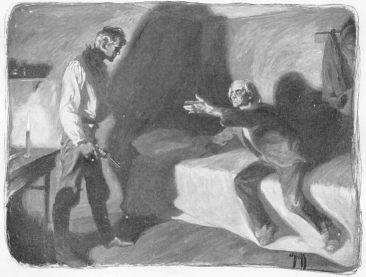
“OH, MAN ... HOW I’VE LONGED FOR THAT BULLET OF YOURS!”
“You’re right—that’s so. But I’m telling you truth now—those two men had both been in the Meadows that day and it killed them. One went crazy and ran off into the desert. They found his bones. The other shot himself a few years ago. Those of us that live are already in hell—”
He sat up, now, animated for the moment.
“—in hell right here, I tell you. I’d have welcomed you, or any other man that would kill me, any time this fifteen years. I’d have gone out to meet you. Do you think I like to hear the women scream? Do you think I’m not crazed myself by this thing—right back of me here, now—crawling, bleeding, breathing on me—trying to come here in front where I must see it? Don’t you see God has known how to punish me worse than you could, just by keeping me alive and sane? Oh, man! you don’t know how I’ve longed for that bullet of yours, right here through the temples where the cries sound worst. I didn’t dare to do it myself—I was afraid I’d make my punishment worse if I tried to shirk; but I used to hope you would come as you said you would. I wonder I didn’t know you at once.”
He put his hands to his head and fell back again on the pillow, with a little moan.
“Well, it ain’t strange I didn’t know you. I was looking for a big man. You seemed as big as a house to me that day. I forgot that I’d grown up and you might be small. When those fellows got tight up there and let on like it was you that some folks hinted had took a child and kept it out of that muss, I couldn’t hardly believe it; and everybody seeming to regard you so highly. And I couldn’t believe this big girl was little Prue Girnway that I remembered. It seemed like you two would have to be a great big man and a little bit of a baby girl with yellow hair; and now I find you’re—say, Mister, honestly, you’re such a poor, broke-down, little coot it seems a’most like a shame to put a bullet through you, in spite of all your doings!”
The little man sat up again, with new animation in his eyes,—the same eager boyishness that he had somehow kept through all his years.
“Don’t!” he exclaimed, earnestly. “Let me beg you, don’t kill me! For your own sake—not for mine. I’m a poor, meatless husk. I’ll die soon at best, and I’m already in a hell you can’t make any hotter. Let me do you this service; let me persuade you not to kill me. Have you ever killed a man?”
“No, not yet; I’ve allowed to a couple of times, but it’s never come just that way.”
“You ought to thank God. Don’t ever. You’ll be in hell as sure as you do,—a hell right here that you must carry inside of you forever—that even God can’t take out of you. Listen—it’s a great secret, worth millions. If you’re so bad you can’t forgive yourself, you have to suffer hell-fire no matter how much the Lord forgives you. It sounds queer, but there’s the limit to His power. He’s made us so nearly in His image that we have to win our own forgiveness; why, you can see yourself, it had to be that way; there would have been no dignity to a soul that could swallow all its own wickedness so long as the Lord could. God has given us to know good and evil for ourselves—and we have to take the consequences. Look at me. I suffer day and night, and always must. God has forgiven me, but I can’t forgive myself, for my own sin and my people’s sin,—for my preaching was one of the things that led them into that meadow. I know that Christ died for us, but that can’t put out this fire that I have to build in my own soul. I tell you a man is like an angel, he can be good or bad; he has a power for heaven but the same power for hell—”
“See here, I don’t know anything about all this hell-talk, but I do know—”
“I tell you death is the very last thing I have left to look forward to, but if you kill me it will be your own undoing. You will never get me out of your eyes or your ears, poor wreck as I am—so feeble. You can see what my punishment has been. A little while ago I was young, and strong, and proud like you, fearing nothing and wanting everything, but something was wrong. I was climbing up as I thought, and then all at once I saw I had been climbing down—down into a pit I never could get out of. You will be there if you kill me.” He sank back on the bed again.
Follett slowly put the revolver into its holster and sat down on the low stool.
“I don’t know anything about all this hell-talk, but I see I can’t kill you—you’re such a poor, miserable cuss. And I thought you were a big strong man, handy with a gun and all that, and like as not I’d have to make a quick draw on you when the time come. And now look at you! Why, Mister, I’m doggoned if I ain’t almost sorry for you! You sure have been getting your deservance good and plenty. Say, what in God’s name did you all do such a hellish thing for, anyway?”
“We had been persecuted, hunted, and driven, our Prophet murdered, our women and children butchered, and another army was on the way.”
“Well, that was because you were such an ornery lot, always setting yourself up against the government wherever you went, and acting scandalous—”
“We did as the Lord directed us—”
“Oh, shucks!”
“And then we thought the time had come to stand up for our rights; that the Lord meant us to be free and independent.”
“Secesh, eh?” Follett was amused. “You handful of Mormons—Uncle Sam could have licked you with both hands tied behind him. Why, you crazy fool, he’d have spit on you and drowned every last one of you, old Brigham Young and all. Fighting the United States! A few dozen women-butchers going to do what the whole South couldn’t! Well, I am danged.”
He mused over it, and for awhile neither spoke.
“And the nearest you ever got to it was cutting up a lot of women and children after you’d cheated the men into giving up their guns!”
The other groaned.
“There now, that’s right—don’t you see that hurts worse than killing?”
“But I certainly wish I could have got those other two that took us off into the sage-brush that night. I didn’t guess what for, but the first thing I knew the other boy was scratching, and kicking, and hollering, and like to have wriggled away, so the cuss that was with me ran up to help. Then I heard little John making kind of a squeally noise in his throat like he was being choked, and that was all I wanted. I legged it into the sage-brush. I heard them swearing and coming after me, and ran harder, and, what saved me, I tripped and fell down and hurt myself, so I lay still and they lost track of me. I was scared, I promise you that; but after they got off a ways I worked in the other direction by spells till I got to a little wady, and by sunup they weren’t in sight any longer. When I saw the Indians coming along I wasn’t a bit scared. I knew they weren’t Mormons.”
“I used to pray that you might come back and kill me.”
“I used to wish I would grow faster so I could. I was always laying out to do it.”
“But see how I’ve been punished. Look at me—I’m fifty. I ought to be in my prime. See how I’ve been burnt out.”
“But look here, Mister, what about this girl? Do you think you’ve been doing right by keeping her here?”
“No, no! it was a wrong as great as the other.”
“Why, they’re even passing remarks about her mother, those that don’t know where you got her,—saying it was some one you never married, because the book shows your first wife was this one-handed woman here.”
“I know, I know it. I meant to let her go back at first, but she took hold of me, and her father and mother were both dead.”
“She’s got a grandfather and grandmother, alive and hearty, back at Springfield.”
“She is all that has kept me alive these last years.”
“She’s got to go back to her people now. She’ll want to bad enough when she knows about this.”
“About this? Surely you won’t tell her—”
“Look here now, why not? What do you expect?”
“But she loves me—she does—and she’s all I’ve got. Man, man! don’t pile it all on me just at the last.”
He was off the bed and on his knees before Follett.
“Don’t put it all on me. I’ve rounded up my back to the rest of it, but keep this off; please, please don’t. Let her always think I’m not bad. Give me that one thing out of all the world.”
He tried to reach the young man’s hand, but was pushed roughly away.
“Don’t do that—get up—stop, I tell you. That ain’t any way to do. There now! Lie down again. What do you want? I’m not going to leave that ain’t any way to do. There now! Lie down again. What do you want? I’m not going to leave that girl with you nor with your infernal Church. You understand that.”
“Yes, yes, I know it. It was right that you should be the one to come and take her away. The Lord’s vengeance was well thought out. Oh, how much more he can make us suffer than you could with your clumsy killings! She must go, but wait—not yet—not yet. Oh, my God! I couldn’t stand it to see her go. It would cut into my heart and leave me to bleed to death. No, no, no—don’t! Please don’t! Don’t pile it all on me at the last. The end has come anyway. Don’t do that—don’t, don’t!”
“There, there, be still now.” There was a rough sort of soothing in Follett’s voice, and they were both silent a moment. Then the young man went on:
“But what do you expect? Suppose everything was left to you, Mister. Come now, you’re trying to talk fair. Suppose I leave it to you—only you know you can’t keep her.”
“Yes, it can’t be, but let her stay a little while; let me see her a few times more; let me know she doesn’t think I’m bad; and promise never to tell her all of it. Let her always think I was a good man. Do promise me that. I’d do it for you, Follett. It won’t hurt you. Let her think I was a good man.”
“How long do you want her to stay here?—a week, ten days?”
“It will kill me when she goes!”
“Oh, well, two weeks?”
“That’s good of you; you’re kinder at your age than I was—I shall die when she goes.”
“Well, I wouldn’t want to live if I were you.”
“Just a little longer, knowing that she cares for me. I’ve never been free to have the love of a woman the way you will some day, though I’ve hungered and sickened for it—for a woman who would understand and be close. But this girl has been the soul of it some way. See here, Follett, let her stay this summer, or until I’m dead. That can’t be a long time. I’ve felt the end coming for a year now. Let her stay, believing in me. Let me know to the last that I’m the only man who has been in her heart, who has won her confidence and her love. Oh, I mean fair. You stay with us yourself and watch. Come—but look there, look, man!”
“Well,—what?”
“That candle is going out,—we’ll be in the dark”—he grasped the other’s arm—“in the dark, and now I’m afraid again. Don’t leave me here! It would be an awful death to die. Here’s that thing now on the bed behind me. It’s trying to get around in front where I’ll have to see it—get another candle. No—don’t leave me,—this one will go out while you’re gone.” All his strength went into the grip on Follett’s arm. The candle was sputtering in its pool of grease.
“There, it’s gone—now don’t, don’t leave me. It’s trying to crawl over me—I smell the blood—”
“Well—lie down there—it serves you right. There—stop it—I’ll stay with you.”
Until dawn Follett sat by the bunk, submitting his arm to the other’s frenzied grip. From time to time he somewhat awkwardly uttered little words that were meant to be soothing, as he would have done to a frightened child.
When morning brought the gray light into the little room, the haunted man fell into a doze, and Follett, gently unclasping the hands from his arm, arose and went softly out. He was cramped from sitting still so long, and chilled, and his arm hurt where the other had gripped it. He pulled back the blue woollen sleeve and saw above his wrist livid marks where the nails had sunk into his flesh.
Then out of the room back of him came a sharp cry, as from one who had awakened from a dream of terror. He stepped to the door again and looked in.
“There now—don’t be scared any more. The daylight has come; it’s all right—all right—go to sleep now—”
He stood listening until the man he had come to kill was again quiet. Then he went outside and over to the creek back of the willows to bathe in the fresh running water.