He was not much troubled about the men whom he had just defeated. They would probably take no further action until rejoined by the strong party who had ridden out to the hacienda. How long would that be? Nobody at the house would tell them in what direction the insurgents had marched. The Peruvian officer might suppose that they had fled to the hills, and if he pursued, it would be many hours before he could return with his troopers to San Rosario. But it was not unlikely that they had heard the sounds of firing, which would travel far across the open country in the night. In that case the party would gallop back at once. No doubt a messenger had already ridden from the town to acquaint them with what had happened, so that in all probability they would return within two hours. It was now nearly nine o'clock; by eleven the combined force, outnumbering Tim's band, would for their own credit's sake try to recapture the barracks. Behind walls Tim felt that he had a fair chance against them.
But this was only the first and the least of the dangers he had to anticipate. There were two hundred or more men in Mollendo's old camp in the hills: the news of the outbreak at the hacienda might already have been conveyed to them, with a summons to ride back to the town. If they started as soon as the call reached them, they might arrive by six or seven o'clock; but Tim hoped that with Spanish procrastination they would put off their departure until the morning. There was a much more pressing peril. San Juan was only thirty miles away--ten miles nearer than the Inca camp. The Prefect was there! Doubtless he was possessed of full information, flashed to him from San Rosario by telegraph. Spanish though he was by blood and habit, he was prompt and vigorous in action; and with his present authority and future security at stake he would surely set off within a little of receiving the news--perhaps was already hurrying across the hills. The road was bad; a march by night could not be fast; but even at the worst, by five o'clock an overwhelming force might be pouring into the town.
Tim wished that he had had the forethought to send a man to cut the telegraph wire. That would have gained five hours at the least. But he could not think of everything; he was as yet a novice in things military; and he had had no one with whom to take counsel. He reflected bitterly on Romaña's desertion. Romaña was not a soldier; but he was twice Tim's age; he had had some experience with the Mollendists, and was shrewd and far-seeing. Tim was surprised and angry to find that the man was apparently a coward.
Thrown upon his sole resources, Tim tried to think of some means of meeting the threatening dangers. His case would be hopeless as soon as the Prefect arrived with his main body of troops, unless--Tim grasped eagerly at an idea that had flashed upon him. If he could send a message to his father, the Mollendists, though ill-equipped and weak in numbers, might push down from the hills by way of the river bed and reach San Rosario in time to give him help. But they were twenty miles beyond the Inca camp, and could not arrive before the Prefect unless the approach of the force from San Juan could be hindered. That was not impossible. A few men posted on the hill road just above the place where the Mollendists had snapped up the gobernador could hold in check a much larger number in the darkness, and gain a few precious hours. Tim resolved to attempt both--to despatch a messenger to his father, and a little band to the defile on the high road to San Juan.
He had just risen from his seat in the guardroom to select men for these tasks when there was a commotion below--a shout of alarm, followed by a moment's silence, then a cheer. He looked over the balcony, and saw Romaña pushing his way from the patio through the crowd of Japanese and Cholos to the foot of the staircase.
"You are safe, señorito?" Romaña called, seeing Tim looking down at him.
Tim did not reply: he felt hurt and indignant.
"You come when the fight is over," he said, when Romaña joined him. "I thought I could trust you."
"Caramba, señorito, what do you mean?" cried Romaña, his usual forbearance giving way under a rush of hot blood. "Do you take me for a coward? I have saved you from making a thorough mess of your own hasty scheme. You did not think of the telegraph wire: I did. That is all."
"You have cut it?"
"Yes. I galloped straight to the road. I hope I cut the wire before Pardo reached the town."
"Forgive me, Nicolas," said Tim penitently, grasping his hand. "I am an ass. I ought to have known you had not deserted me."
"Say no more, señorito," said Romaña, cooling at once. "I am rejoiced at your success. But there is still much to do."
"How did you get in?"
"I climbed the wall and got over the stable roof. That must be guarded, señorito. When the men come from the hacienda they will certainly try to get in. The Prefect will hang them if they do not recapture the place."
"It shall be done: I ought to have seen to it before, but I have been thinking of other things."
He went on to tell Romaña his recent decisions.
"I thought of both, señorito," said the man. "I debated whether to ride at once from the road to Señor O'Hagan; it would have gained much time; but I felt that I must first see what had become of you. The duty is mine: I know the way: no one else does. Give me a dozen men; we will sally out on horseback down the street and get away before the men in the plaza are ready to pursue us. Galdos has my horse in the wood half a mile away, but I need a fresh one."
"What about the supplies?" asked Tim, remembering the errand on which they had come.
"I took out two laden mules to the place where we had arranged to meet. Finding that you were not there, I tied them up in the wood and went to the house to fetch petrol, as I promised. Little did I imagine what I should see there!"
"I got tired of waiting and went myself. There are several petrol cans in the shrubbery. Of course I had no intention of fighting; but I simply couldn't stand Pardo thrashing Asumi, and when the other Japs began to attack I saw a chance. It was a mad thing to do: I didn't look ahead."
"It may turn out to be the best thing that could possibly have happened. But I must go, señorito; time is precious."
They went down to the stables together, and chose twelve of the best horses. Then they selected eleven of the Cholos, who were quite at home on horseback. Tim explained the nature of the service required of them. They were eager to start. The lamp in the entrance was extinguished. Tim kept watch on the street from the window of the guardroom, with several men armed with rifles. The bars were quickly removed; the gates were thrown open; and the twelve men sallied out, turned to the right, and galloped at full speed down the street. There was instantly a rush from the plaza. But a volley from the windows checked the oncomers, and they fell back. Tim knew that before they could ride through the plaza, and down a side street in pursuit, the fugitives would have a start of at least half a mile. The gates were again closed and barred, and silence fell once more upon the scene.
Tim had little anxiety about Romaña. On reaching the outskirts of the town, he would follow a track parallel with a stream--the same which flowed past Romaña's cave--cross it a few miles to the west, then proceed across open country until he came to a wooden bridge over the river. He would then take to the high road, and in the course of little more than two hours arrive at the defile where Señor Fagasta had been captured. There posting the men, he would return to the river, and ride more rapidly upon the hard sand at the edge of the channel. In five or six hours he should reach the Mollendist camp. With nearly sixty miles to march, Mr. O'Hagan could not reach San Rosario before late on the next afternoon, even if he started with his mounted men only. But if the men posted at the defile were successful in delaying the Prefect's advance, the time gained might be enough to allow the Mollendists to secure the town.
Romaña's forethought in cutting the wire had diminished the most serious of Tim's anxieties. The telegraphist at San Rosario, of course, would soon have discovered the damage by the failure of response from San Juan, and after a certain delay no doubt a mounted courier had been despatched to convey the news--possibly a considerable party, for protection against enemies along the road. In all probability news of the affair at the hacienda had only just reached the Prefect, who might reasonably regard it as a trumpery disturbance that could be left to his subordinates. It would be some hours yet before he learnt of the attack on the barracks, and even if he then started immediately, Romaña would have placed his men on the defile before the force from San Juan could arrive.
When the gates had been secured, Tim had the lamp relit and called a parade of his men in the patio. His losses had been slight. Of the eighty-two left to him, seventy-five were still fit for service. All but eight were now armed with rifles; for the eight there were swords, bayonets, and lances, if they wished for other weapons than their own bill-hooks. A large proportion of the Japanese, having served in their national army, were expert with the rifle; and as there was plenty of ammunition in the armoury, and food in the stores on the ground floor, Tim felt himself very well situated, whether to withstand a siege or to repel an attack.
After parading the men, he told off a number of them to hold the roof of the stables on three sides of the patio. The rest were posted at all the windows overlooking the street. The rooms were left in darkness.
About an hour after Romaña's departure the sounds from the plaza, which had died down into a dull murmur, suddenly revived. Shouts and cheers mingled with the clatter of hoofs and the jingle of accoutrements. The party from the hacienda had returned. Tim sent word to the men on the stables to be on the alert.
Some time passed. The plaza had again relapsed into silence. Tim guessed that the enemy were organising an attack. He wondered whether they would attempt an assault on the gates, or trust to escalading the patio walls. The gates were of hard wood studded with iron; the bars were stout; it would not be easy to break them down. If the enemy once forced their way in and made good their position, they would have command of the stores, for Tim could not risk a hand-to-hand fight in the entrance porch. The party from the hacienda, combined with those who had been patrolling the plaza and probably with a certain number of the Prefect's supporters in the town, would outnumber his own men by at least three to one. Tim thought his best plan in the event of an inroad was to hold the balconies and staircases, and keep the enemy at bay until they were forced to retire by exhaustion of their ammunition.
He soon found that the danger was to be faced both in front and rear. Warning came first from the stables. The silence was broken by a sudden clamour. From the surrounding gardens men were attempting to scale the wall on all sides--an impossible feat in face of the forty men at their posts of vantage on the stable roof. But this attack was only designed as a means of occupying the defenders while the main assault was proceeding in front. Looking up the street, Tim saw a number of dark shapes rushing from the plaza along the opposite side. He had ordered his men to hold their fire until the enemy were well in view. But the attackers did not come far down the street. They suddenly turned to their left, and disappeared within a doorway. Their object was soon evident. In a few minutes there was a burst of flame from the houses exactly opposite the barracks, and bullets flew through the open windows at which Tim and his men had posted themselves. At the same moment a much larger body of men, all on foot, came dashing along from the plaza, keeping on the near side of the street. It was plain that under cover of the rifle fire opposite a determined attempt was to be made to break in the gates.
Tim ordered half his men, taking what cover was possible, to reply to the fire across the street, and the other half to be ready to shoot down upon the enemy below. He saw at once that at the windows his second party would be at a great disadvantage, because they could not fire effectively without exposing themselves. So he sent them up a wooden ladder to the roof, where they would be in less danger themselves, while better placed for dealing with the assailants.
Soon both patio and street were ringing with the noise of battle. At the rear and sides the troopers who tried to mount the walls, some on ladders, some by clambering up the stonework, were hurled down by the men above them. In the front, bullets rang across the street in opposite directions, and poured from the roof upon the dense mass now at the gates. Tim heard a resounding crash below; the enemy had brought with them a heavy beam which they were using as a battering ram. In the almost total darkness it was impossible to discover the effect of the fire from the roof. That it was comparatively ineffectual was soon proved. Three times the thundering blows rang on the gates; at the third one of the wings gave way, and with a yell of triumph men began to pour into the porch.
Tim at once called his men from the windows and posted them on the balconies overlooking the entrance, whence they fired on the crowd surging in. Some of the men on the stable roof, seeing by the light of the lamp what had occurred, began to shoot across the patio. Taken thus between two fires, the front ranks of the enemy lost heart and tried to push back to the street. They were checked by their comrades still pressing forward, and for a minute or two the porch was filled with a solid mass of men, into which the Japanese poured their shot as fast as they could load. The enemy were thrown into utter confusion and panic. With yells of rage and pain they struggled among themselves, fighting each other in their desperate efforts to get through the half-open gate into the street. But for the steady shooting of the men on the roof, which cleared the ground opposite the entrance, not one would have issued forth alive. An advance of their comrades had been checked. The pressure relaxed; the way was open; and in five minutes after the gate was broken the survivors of the fight were rushing headlong back to the plaza, driving the mob before them, and pursued by shots from the men on the roof.
Tim ran downstairs and across the patio to learn how his men were faring there. The assailants had been beaten back all along the wall, and were slinking away through the gardens to rejoin their friends. There had been much commotion among the horses in the stables, and a good deal of damage done by their heels when they lashed out in terror of the shots. On looking in at the quivering animals Tim was seized with an idea: why not keep the discomfited enemy on the run? They had had two rather sharp lessons: a charge on horseback might have at least the effect of discouraging another attack on the barracks. By starting at once he might even yet overtake the fugitives before they all reached the plaza.
He called up the twenty Cholos he had left; in half a minute they had led all the remaining horses into the patio, and without waiting to saddle, sprang upon their backs and followed Tim to the gate. As they came to the street, Tim saw that fortune favoured him. The men who had been firing from the opposite houses were at that moment issuing from the doorway some distance away, and moving off towards the plaza. With a wild whoop Tim led the charge. The enemy instantly picked up their heels and dashed for safety. Their comrades in the plaza were gloomily discussing their defeat. Only a few men who had been patrolling the square were mounted; the horses of the rest were ranged in a long line opposite the gobernador's house. At the sound of Tim's party galloping and the cries of the fugitives the whole body made a rush for their horses; but before they could cross the plaza the pursuers were upon them.
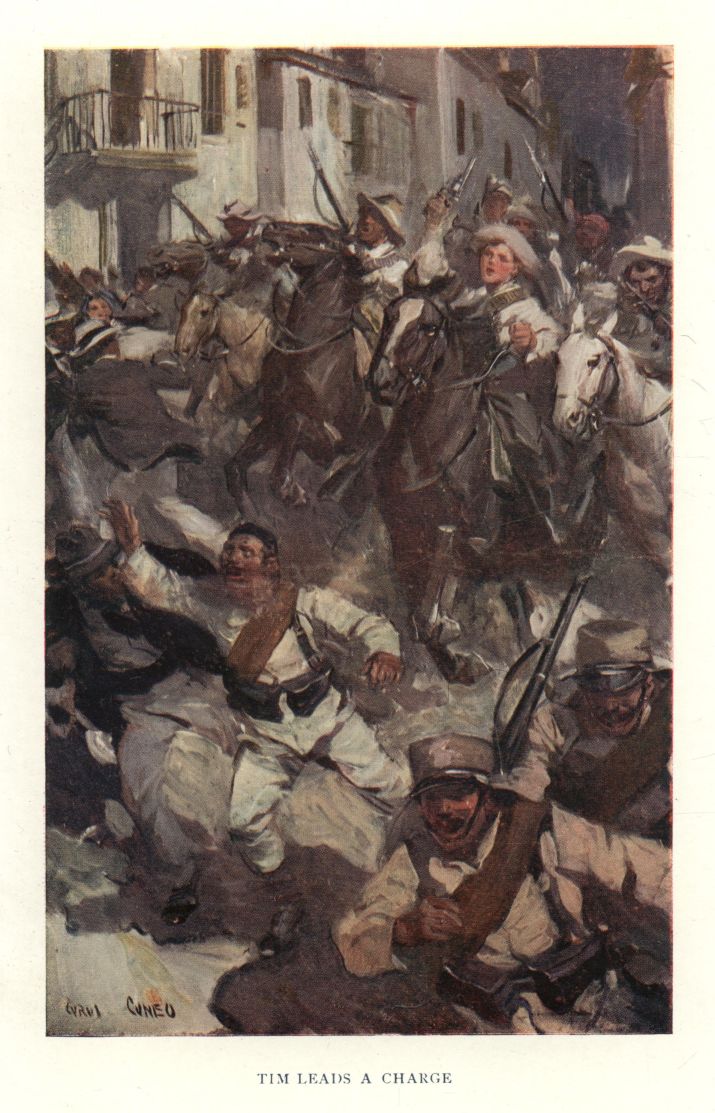 TIM LEADS A CHARGE
The place was ill lighted; the Prefect's men, even if they had not been flustered and disheartened, could scarcely have seen how small was the band clattering across the cobbles. The noise made by Tim's men, indeed, was worthy of a regiment, and being mingled with shouts and screams from the people who had been pushed back to the openings of the streets, the coolest of soldiers might have been deceived. These hirelings were not cool. One or two succeeded in mounting; the rest took panic and ran in all directions. Their horses caught the infection, and galloped riderless across the plaza, dashing in blind fear among the shrieking people. Men and animals fled helter-skelter into the dark streets and out into the open country. In a few minutes the whole garrison of San Rosario as a mounted force had ceased to exist.
Tim was prudent enough not to leave the plaza. He did not yet appreciate the full extent of his success. When the square was clear of the enemy, he hastened back to the barracks, blocked up the damaged gateway as well as he could, and then, feeling that he was safe for the rest of the night, sent his men to find a supper.