"Moreover, general," he said blandly, "since your son, with commendable modesty, has declined the colonel's commission which I offered him, it will be necessary for form's sake to appoint an officer of that rank to command the second army. I recommend for that honourable post Señor Zegarra, a gentleman of proved loyalty, upon whom I have just conferred a colonel's commission."
Mr. O'Hagan was annoyed. Señor Zegarra, the second of the trio who had formed the deputation to Tim, was a retired architect, with no military experience. Still, he was an amiable man, and Mr. O'Hagan hoped by a little judicious and tactful handling to prevent any interference with his plans.
Tim laughed heartily when his father returned and told him of the President's action.
"Old Moll means to be boss," he said.
"Old meddler!" grumbled Mr. O'Hagan. "However, it can't be helped. I'll get Zegarra to make you chief of staff, and if you go gently with him you can see that he doesn't upset the apple-cart."
Tim was secretly not ill-pleased at the change. It would give him, he hoped, greater freedom of action. As commander of the force he would have been tied to it. He could not leave his men. And since he had already made up his mind to fetch the petrol cans which he had concealed in the shrubbery, and make use of the motor-bicycle again, he needed no consolation for being superseded.
Mr. O'Hagan made a point of seeking out old Pedro Galdos, and thanking him for arranging his escape from prison. Knowing that the caballero, poor as he was, would disdain a pecuniary reward, Mr. O'Hagan had hit upon a more excellent way. He asked him to accept the appointment of commissary-general to the forces, taking care to couch the offer in the flowery terms that a Peruvian loves. Galdos accepted with dignity, straightened his shrunken old frame, and went off to harass all the provision dealers in the town.
In the afternoon the two forces rode out, Mr. O'Hagan and the President at the head of about 350 men, Tim and Señor Zegarra with 150, including his Japanese. These were on foot; all the rest were mounted. Mr. O'Hagan marched towards San Juan, Tim to the cross-roads north of the town. On reaching his post, carrying out his father's instructions, he set his men to throw up a light earthwork at the intersection, and rendered the woods on each side impassable by an abattis. He sent a number of horsemen forward for several miles on both the eastern and western tracks, to watch for the enemy and give timely warning if they should approach from the Inca camp.
Señor Zegarra was, as Mr. O'Hagan had said, a very amiable gentleman; and when Tim, after the bivouac had settled down, announced that he wished to fetch his motor-bicycle, which might be useful in scouting, the new-made colonel gave a gracious approval. Tim was rather perplexed as to the best way to set about it. To begin with, he had no petrol; but that difficulty was easily solved. He picked out four of his most trusty Japanese, explained to them clearly where they would find the cans he had hidden, and sent them through his father's plantations to bring them in. They would also report what they could discover about the state of affairs at the house: he thought it scarcely likely that Pardo had ventured back again. It was probably deserted.
But, having the petrol, how could he bring back the motor-cycle? To walk to the cave would be a long and wearisome job: to ride seemed to mean that on returning he must leave the horse behind. He could not ride both horse and cycle. He might, of course, take horsemen with him, and leave his own steed with them; but the existence of the cave was known only to Romaña and two others, and he thought it would be as well to keep the secret which was not his own. But before the Japanese returned laden with the petrol cans he had solved the problem. He would ride out on horseback, carrying just enough petrol to last for the run, leave the horse with one of his vedettes some distance from the cave, and go on alone for the cycle. The horse could be brought back at leisure.
When the petrol arrived, he filled two flasks and slung them on his saddle-bow. The messengers reported that all was quiet at the house. It appeared to be locked up and uninhabited. Tim suspected that Pardo had been among the men who had fled from the town, and had very likely gone to San Juan to stir up the Prefect. The loss of the hacienda would be a stinging blow to him. Tim wondered what had become of old Biddy and the other servants, and made up his mind to take the first opportunity of finding out.
He set off, rode along his chain of vedettes, and halting at the man nearest the cave on the San Rosario side, dismounted and proceeded on foot. In a few minutes he returned on the cycle, much to the surprise of the vedette. Colonel Zegarra smiled paternally when he rode into the camp, and made a laughing allusion to the gobernador's ludicrous appearance on that historic occasion a few days before. To Tim it seemed to have happened weeks ago.
The little force was not provided with tents. Men and officers slept on saddle cloths, spread in glades among the trees. The situation was far from pleasant. The low ground was infested with mosquitoes and other insects, whose pertinacious attentions kept awake many more than those who were on sentry duty.
During the night Tim resolved to make a circular reconnaissance next morning, if there was no warning of the enemy's advance. On his cycle he could cover the ground much more rapidly than on horseback, and, with the zeal of a novice, he was eager to examine the paths minutely from a strategical point of view. He would go by the western and return by the eastern path, trusting to the speed of his machine if he came in touch with the enemy and were pursued.
Colonel Zegarra raised no objection when Tim diplomatically suggested the importance of obtaining a thorough knowledge of the ground. The nominal commander was in fact a figure-head, conscious of his own ignorance, and quite content to leave everything to his chief of staff, and to reap the credit of the successes which he hoped that energetic young man would gain.
Tim rode off immediately after breakfast. On the way he passed the vedettes strung out at intervals of about three miles, and leaving the last vedette behind, near the cave, sped on beside the river. The only serious risk he had to guard against until he reached the cross-track leading to the eastern path was the possibility of meeting a party of the enemy approaching from round a bend. In such a case he might have scant time to turn his machine; indeed, in many places he would have to dismount to do so, owing to the narrowness of the track. If this occurred on a rising gradient, he might be overtaken before he could get away. But he had all his wits about him, and reflected that after all the enemy, if they moved, would probably follow the more direct road past Durand's house.
He arrived at the spot where his father's party had halted while Romaña scouted along the cross-track. Turning to the right, he rode for some little distance along this track, then suddenly made up his mind to return to the river, approach a little nearer to the camp, and leaving the machine well hidden, climb up to the ridge and try to see what the enemy were doing. From the top there was an uninterrupted view for many miles. The climb proved an even stiffer business than he expected, and on gaining the summit, hot, out of breath, and with trembling legs, he was disgusted to find that the Inca camp was too distant for him to distinguish anything very clearly without the aid of field-glasses. He saw figures moving about in the enclosure, but there was no sign, on the track or in the camp itself, of any general movement. It was quite possible that the events of the past two days were still unknown there. The fugitives from the town would naturally have turned towards San Juan, which was nearer than the Inca camp, and much more easily accessible. But the lack of communication between the camp and San Rosario struck Tim, raw hand though he was, as evidence of astonishing neglect of ordinary military precautions.
Returning to his machine, Tim rode along the cross-track, reversing the direction of his night escape, which already seemed ancient history. He was careful to profit by the screen of trees on his left hand, and so keep out of sight from the spot where Mollendo's scouts had been posted; and he approached the fork warily. There was no one in sight, either up or down the eastern track. He wheeled to the right, and rode on towards his own camp at the cross-roads.
Only once before had he travelled this part of the track on his cycle--when he returned home after being ransomed. He remembered how difficult he had found it, both when riding down, and when marching up with his captors. It was uneven, tortuous, and with many gradients. Its general tendency was downhill, but here and there it rose so steeply that, in spite of the power of his engine, he had to alight and push the machine. At similar descents he had some trouble in holding it in with his brakes, and where the track twisted and ran downhill at the same time, for safety's sake he dismounted again, and found that wheeling down was even more difficult than pushing up. But the worst was over when he arrived within about three miles of Durand's house. From this point the track ran almost uninterruptedly downhill, and was fairly smooth, and he sped along gaily at the rate of sixty miles an hour.
A downward run of about a mile brought him to the wooden footbridge spanning a deep fissure that cut across the track. For two hundred yards above the bridge the machine was quite beyond control; even a slight rise in the last fifty yards failed to check his speed appreciably. He dashed on to the rough timbers at a force that made him tremble for the framework of the cycle, and not until he was fifty yards up the gentle gradient on the farther side was he able to reduce his speed to a reasonable rate.
"I must have been going a tremendous lick that time," he thought, after these breathless moments. "Wonder I didn't come a cropper!"
When he reached Durand's house he decided to call and ask whether Felipe had obtained his father's consent to join the President's forces. He came away with what is colloquially termed "a flea in his ear." Señor Durand met him at the door, refused to let him see Felipe, and bundled him off as if he were a tramp. The gentleman acted very conscientiously on the old maxim that you go safest in the middle. He had subscribed to the funds of both factions impartially, and having no faith in the power of either to maintain a permanent superiority he bluntly declined to allow his son to take any part in the struggle. Tim, as he turned away, caught sight of his friend looking at him disconsolately from a window, and with a grimace which meant "Rotten bad luck, old man!" he resumed his ride.
It was early afternoon when he arrived in camp. He made a formal report to his amiable chief, whose wife and daughters had come out to admire him in his new role. Several other townspeople were chatting with their friends. Tim was very hungry after his long outing, and extricating himself from the flattering attentions of the ladies, he went away to get something to eat. Everything had been quiet during his absence. Galdos had brought a fresh supply of provisions. No news had been received from Mr. O'Hagan.
After a good meal Tim, finding that there was nothing to do except talk to the ladies, whom he thought quite out of place in a military camp, decided to ride over to his house, see for himself what his messengers had reported on the previous evening, and get a much-needed change of clothes. It was only three miles away. Leaving the cycle to be cleaned by one of the Japanese, he mounted a horse and set off. He found the house apparently deserted. The garden was trampled; the place had already taken on the signs of neglect; doors and windows were closed, and the shattered glass of the patio entrance had been replaced by boards.
Tim wondered what had become of the household. The mestizo servants had possibly taken, shelter with friends in the town; perhaps old Biddy Flanagan had sought a refuge with Señora Pereira. He tied his horse to a post and tried the front door. It was locked. Going round to the back, he found that the window of his bedroom had not been fastened. He opened it and climbed in. As he passed through the room into the patio he fancied he heard a slight sound somewhere in the house: but after listening for a moment decided that he was mistaken. All the same he moved on tiptoe, feeling an unaccountable nervousness.
He went from the patio into the corridor, glancing through the open doors into the rooms as he passed. They appeared to be just as they were left, except that the table in the dining-room was cleared. He came to the office. The door was shut, but not locked. He opened it and went in. The first thing that caught his eye was the safe, open and empty. Then he noticed a hole in the floor. The matting had been taken up, and two or three of the boards removed. At the edge of the hole lay a quantity of plate, some silver ornaments from the dining-room, the ormolu clock from the drawing-room, several porcelain vases, and other articles of more or less value.
All this he took in at a glance. Before he had time even to guess at the explanation of the strange scene there was a rush from behind the door, and he found himself grasped from the rear by two men. He tried to wrench himself away, dragging his captors about the room. It was useless to cry for help; he wished he had brought somebody with him. He managed to get one of his arms free, and twisting himself round, hit out at the man now in front of him, whom he did not recognise. There was some satisfaction in knowing that the fellow would have a black eye. But at this moment the other man flung a cloak over his head. With his one free hand he tried to tear it away, but it was drawn tighter and tighter across his mouth. His arm was caught again; he gasped for breath; his struggles became feebler; and by and by he lost consciousness.
When he came to himself, with a racking pain in his head, he found himself on the floor, gagged and securely bound. Pardo, now alone, was bundling the valuables together. Tim watched him as he corded them in a strip of canvas. In a moment Pardo glanced at him, and seeing his eyes open, smiled, and began to talk, while still going on with his occupation.
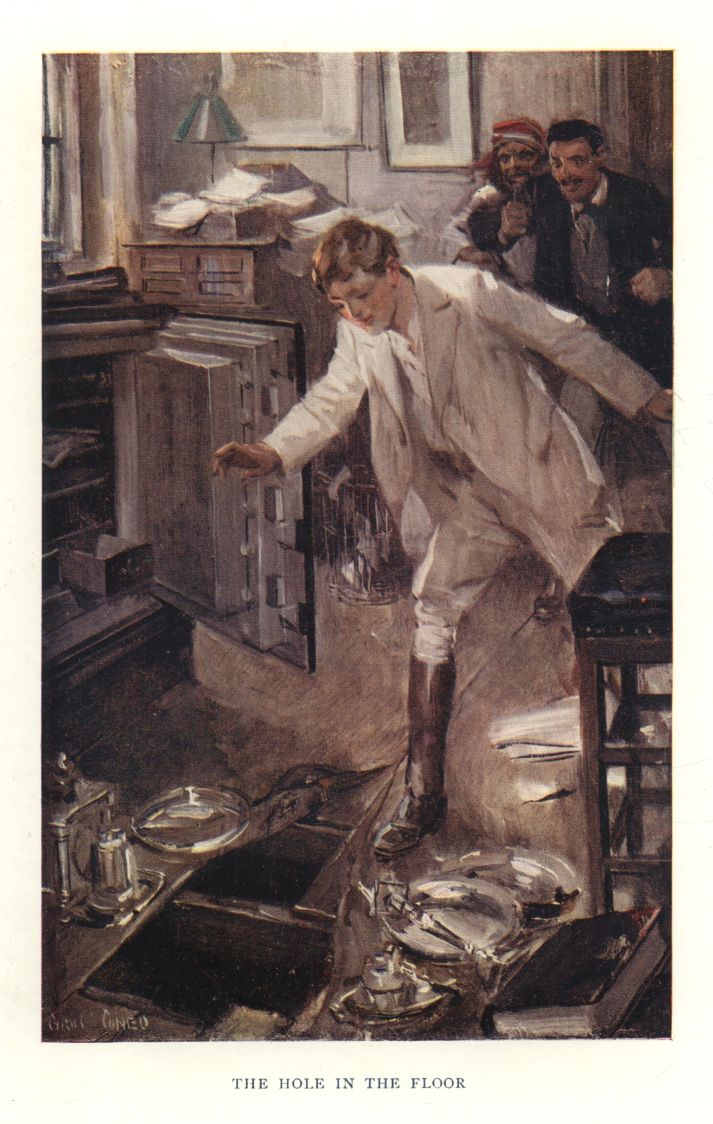 THE HOLE IN THE FLOOR
"Buenos dias, señor capitan," he said with a sarcastic intonation. "This is a little surprise, is it not? Not very pleasant; no. But strange as it may seem to you at this moment, I bear you no ill will personally. Your brigand father, to be sure, has treated me abominably. He has insulted the honour of a Peruvian gentleman, and that is an offence which, as you know, is frequently, and justly, avenged with blood. But you!--you are just a foolish boy; your impulses run away with you, and one is naturally lenient to the indiscretions of youth."
He paused while straining at the cord, then resumed:
"But one has to consider the public interest; and in fulfilment of my public duty I have felt it necessary to put a check upon your personal freedom. Having already had experience of similar restraint, you will no doubt be able to take your present condition with philosophic equanimity. If I am not mistaken, you owed your release on the former occasion to the payment of a ransom. Well, events sometimes repeat themselves. That lies in the discretion of his excellency the Prefect, whom I am about to join; he shall decide what to do with his prisoner."
Here he tied the last knot and stood erect, looking down at Tim with a sardonic grin that made his blood boil.
"But it would be inconvenient to take you with me," Pardo went on. "We might meet some of your bandit friends, who would probably jump to rash conclusions. Having a careful regard for your safety, I must leave you here, but I trust your solitude will not be protracted. In the public interest I ought perhaps to shoot you; but perhaps your market price now exceeds £250; you may be more valuable alive than dead. That thought will console you during your enforced seclusion. There is one little difficulty which it would be wrong not to mention. If any misadventure should befall me on my way to the Prefect, the secret of your hiding-place will be lost. That would be very regrettable, but I must ask you to consider that the responsibility will lie with your friends the brigands."
At this moment the second man entered.
"Is all ready?" asked Pardo.
"Yes; I have secured the horse."
"Very well. Oblige me by pulling up another board."
The man wrenched up the plank. Then the two lifted Tim, and bundled him into the cavity like a sack.
"A reveder, señor capitan," Pardo called through the hole.
The boards were replaced. Tim was in darkness. For some minutes he heard the men moving about above him, and the faint sound of laughter. Then their feet dragged heavily on the floor: no doubt they were removing the bundle. The footsteps died away; and Tim was left in solitude and silence.
The cavity into which Tim had been thrown had been excavated for the sake of keeping the rooms above dry, and extended beneath the house from end to end. It was not a pleasant place. The ground was damp; the atmosphere was stuffy; air could enter only by one narrow grating. Its humidity and the sub-tropical heat favoured the multiplication of innumerable insects, and Tim had not been there many minutes before the voracious creatures discovered him and began to make the most of their opportunity and their victim's helplessness. They crawled over his hands, up his sleeves, upon his face, into his hair. He did his best by shaking his head and twitching his features to rid himself of the tormenting pests; but they pricked and stung with great determination and vigour, and he was soon in pain and distress.
If only he could have removed the gag he would not have felt so utterly helpless. Not that shouting would have been of any use in an empty house, but the power to groan would have seemed a luxury. And when by and by he fancied that he heard shuffling footsteps about the house, he struggled in his bonds until he felt bruised and lacerated. All was in vain. His head began to ache; ideas the most incongruous jostled in his feverish brain. He tried to collect himself and keep his mind fixed; but he could not control his thoughts. Recollections of the Black Hole of history came to harass him, and in alarm and terror lest he should wholly lose his wits he strained his muscles to the uttermost. The effort exhausted him, and presently he fell into a dull stupor, in which he was conscious of nothing.