Young Tim was at an age when boys are a trifle sensitive about their personal appearance. He was glad that on returning to camp his ravaged complexion was obscured in the dark. Nobody seemed at all concerned about his protracted absence. Colonel Zegarra was playing at cards with a friend from the town; the other officers and the men were amusing themselves after their fancy. Tim made a round of the camp, and was almost surprised to find that sentries were properly posted. The vedettes along the roads had been changed at the intervals arranged; military routine had been observed. The only departure from custom, perhaps, was Colonel Zegarra's allowing Tim to append a postscript to his nightly despatch. Tim had intended to say nothing of his recent adventure; but reflecting that Pardo might visit his father for the purpose of extorting a ransom, he thought it just as well to certify his safety.
During the night, when his turn for guard duty came, he pondered the general situation. With a zeal natural in a young officer, he wanted to "do something": inactivity was boring; he wished the sluggish enemy would wake up. He wondered by which route they would march when the movement did at last begin: by the eastern track or by the western? In thinking over the probabilities, it suddenly struck him that by destroying the wooden bridge a few miles beyond Durand's house he could render the eastern road--the more likely one--impassable. The ravine was about thirty feet wide. The one other spot at which it could be crossed was several miles to the east, approachable only over very rough country. By preventing the passage of the enemy by the bridge he would compel them to return to the cross-track and come by the western route, at a loss of many hours.
To destroy the bridge would be a very simple matter. It wanted only a good charge of powder. But Tim reflected that it would be a pity to blow it up prematurely, in case the enemy elected to come by the other route after all. The bridge might be useful to his own side. So he decided to ask Colonel Zegarra's permission to mine it, to clear of all cover a space on each side of the ravine, and to leave a small detachment of his own Japanese at some distance on the south side with orders to fire the mine at the critical moment. One of the mounted vedettes might be posted at the top of the long incline beyond, to ride at full speed to the bridge as soon as he should discover signs of an approach in force. Such a headlong gallop would be dangerous in the dark, so Tim thought of replacing him at night by an infantry outpost of four men. He would station them say a hundred yards north of the bridge, and theirs would be the duty to fall back and blow it up if danger threatened.
He was explaining the scheme next morning to his complacent colonel when news arrived through his chain of vedettes that small parties of the enemy had been seen moving down from the Inca camp towards the upper junction of the paths. There was no indication of a general forward movement. They were merely feeling their way, having apparently discovered, perhaps by the want of news from the town, that something unusual was afoot. The wooden bridge being only a little more than five miles from Colonel Zegarra's position, there would probably be time to make all preparations for the explosion before the real advance of the enemy began. The colonel agreed to the suggestion. Tim was surprised at his extraordinary complaisance, his perfect contentment with the state of figure-head. Afterwards, with more knowledge, he felt considerable respect for President Mollendo's tact. Zegarra had been appointed to the command merely for the sake of appearances--to avoid any discontent among the Peruvians at being led by a foreigner. His compliance with every proposal of Tim's had been prearranged.
Tim chose the men for the work, took them out, and explained to them on the spot what he wished them to do. Then he left them. He had resolved to ride up the western road again, and see for himself what the enemy were about. Being convinced that their advance would be made along the eastern road, he intended to scout as far as the cross-track, and perhaps to ride some distance along it, till he came to a spot where any movement from the Inca camp would be visible to him.
His cycle had been well cleaned by one of the Japanese. He overhauled it finally himself, tested the sparking and the brakes, assured himself that the engine worked with the least possible noise, and that there was plenty of petrol. Having filled the chambers of his revolver, and put on a well-stocked bandolier, he took leave of the colonel and set off.
He felt safe for at least a dozen miles. There were four mounted vedettes along the track, the last of them being posted about a mile beyond Romaña's cave. If the enemy was moving on this route also, the fact would already have been reported.
The day was still young, and Tim, none the worse for his trouble of the previous afternoon, rode on in high spirits. Though continually rising, the track was not really steep for the first fifteen or twenty miles. He kept up a good speed, stopping every three miles to exchange a word with the vedettes, and had just reached the spot where he expected to find the last of them, when he was startled at seeing a man lying in a curiously huddled fashion at the side of the track a few yards ahead. He was slowing down, intending to stop and look more closely at the prone form; but suddenly there was a shot, and a bullet whistled past his head.
Instantly he clapped on the brakes, brought the cycle to a standstill, sprang off--for the track was too narrow to turn while riding--and wheeling it round, ran a few yards, remounted, and set off at full speed down the incline, bending over the handle-bar. There was a volley behind him: the bullets pattered on the cliff at his right hand; and as he wondered whether his pace would carry him out of danger, he heard the clatter of hoofs and the shouts of men at his back.
He had no doubt of being able to distance the pursuers. The cycle could leave the swiftest horse standing. They had ceased to fire, which he thought foolish. But his assurance was rudely dashed in a few seconds. A few hundred yards below the stream that crossed the track near Romaña's cavern, three men stood with levelled rifles, covering him. They were plainly waiting for him to come close enough to make certain of their aim.
It was a desperate situation. On the one side a high cliff; on the other a steep precipice; behind, an unknown number of galloping horsemen; before, the waiting marksmen. If he dashed on, the three men could scarcely fail to hit him; if he stopped, he would be quickly overtaken by the men behind.
In that critical dilemma, when a moment's hesitation would have been fatal, he remembered the cave, some little distance on his right towards the waterfall. He brought his machine up with a jerk, sprang off, pushed it into a bush--there was no time to attempt to hide it, still less to haul it with him--and dived among the scrub and saplings that fringed the banks of the little stream. Bending double he raced up the watercourse towards the beacon tree, tore aside the leafy screen at the entrance to the cave, and plunged breathless into the darkness. He was like a fox that has run to earth.
The cave must be discovered in a few minutes. He had no protection but the darkness and his weapons. Could he block up the entrance? Hurrying to the wall, he dragged the box-beds over the floor, and placed them across the gap, just within the threshold. The legs of the table were so deeply imbedded in the ground that he could not move that; but he set the stools on the boxes, thus forming a rough and very insecure barricade. It was the best that he could devise; and, posting himself in the dark a little to the left of the entrance, he hoped to be able to hold the enemy at bay for some time with his revolver.
But it was a ticklish situation. As yet he did not know with how many men he had to deal; there were probably enough to block up the track completely in either direction. The vedettes whom he had passed did not expect him to return by the same route; he would not be missed for a considerable time, unless they should have happened to hear the shots. This was unlikely. The wind was blowing from them to him; the windings of the track and the height of the hills did not favour the travel of sound. It seemed that the utmost he could hope was to be able to keep the enemy off until nightfall, and then try to steal past them in the darkness. They were probably, he thought, merely a scouting party, not an advanced guard of the main body. Evidently they had fallen upon his vedette unawares, killed him, and then divided. Seeing the motor bicycle approach, the three men scouting down the track had hidden until he had passed, knowing that he would be trapped between them and their comrades higher up.
When he had made his flimsy barricade, Tim stole to the entrance, pulled the foliage aside, and looked out. On the track he saw eleven men gathered, holding their horses. They were talking excitedly; one man pointed to the motor-bicycle, another in the direction of the cave. They must have realised that they had their quarry safe, if they could get at him. There was no way up the hill-side. He must be concealed somewhere in the patch of scrub between them and the hill. To escape he would have to come down to the track within a space of about a hundred yards above and below the stream. By thoroughly beating the scrub they supposed they could drive him out.
The discussion soon came to an end. They tied up their horses; then, leaving one man to guard the motor-cycle, so that if Tim ran from cover he could not escape them, they scattered, and began to advance. They might have been hunters stalking a tiger through jungle. They moved warily, and only now and then were visible to the anxious watcher at the cave. With a rifle he could have picked them off; the revolver was useless until they came to close quarters. He had a fleeting hope that they might pass the entrance to the cave without discovering it, and as they drew nearer he slipped back out of sight. His nerves tingled; minute after minute went by, and he had almost concluded that the men must have overshot the hiding-place when the curtain of foliage was bent aside, letting in a gleam of light. The entrance was discovered!
The screen was dropped again. No doubt the men were discussing what they should do. The opening was narrow. To attempt to carry such a place by assault might give the boldest pause. Some one must go first, and that man, if the defender was resolved to fight, was certain to be shot. The men were not particularly courageous; but there was a price on the Inglés boy, and even timorous folk will pluck up their courage when there is a reward in view.
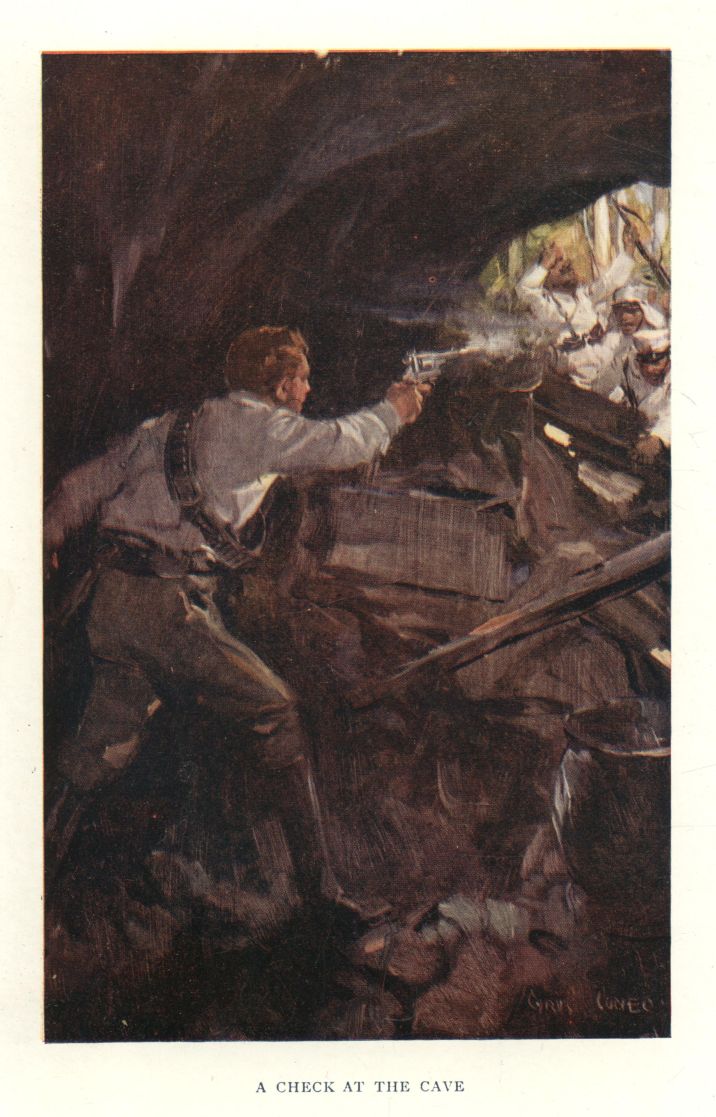 A CHECK AT THE CAVE
When some minutes had elapsed, Tim ventured to draw near to the entrance and peep out through the leaves. The men were grouped some little distance away at the brink of the stream; he heard the murmur of their voices. In a few moments they separated, and spread out to right and left of the cave, keeping as much as possible under cover. One climbed into the tree, and concealed himself amid the foliage. Tim guessed what was coming, and slipped away to the side of the cave. He was not a moment too soon. The enemy opened fire, and their shots, coming in different directions, flew criss-cross into the entrance. Fortunately the walls were soft, and the bullets dug into them instead of ricochetting or splintering. One fragment grazed Tim's wrist, a warning to retreat still farther.
After two or three volleys the firing ceased. The enemy supposed, no doubt, that some of their shots had taken effect, or had at any rate driven their quarry from the entrance. Tim rushed back to his former post, just in time to fire his revolver as the assailants, shouting to encourage one another, came with a dash through the foliage. At the threshold they were checked by the unexpected obstacle of Tim's barrier. For a few moments they stood there, trying to throw it down, cursing, yelling with pain as Tim, invisible in the inner darkness, slowly and deliberately emptied his revolver. This was too hot for them. They broke away, and Tim, running to the entrance, saw them hurrying down the slope to find cover. They were carrying one of their comrades; another lay across the threshold.
They returned to the track. There was another consultation among them; then four of them leapt on their horses and rode away northward. Three went on foot down the track, doubtless to guard against surprise in that direction; one man still remained in charge of the bicycle, the last held the horses. Clearly they had not abandoned their purpose. Tim wondered what their next move was to be. Surely the horsemen had not ridden back to the Inca camp for help! It was more than twenty miles distant. There and back the journey would take several hours. They would hardly spend so much time with the risk of assistance coming up from the Mollendists. The vedette who had been killed must be relieved ere long, and for all they knew there might be a numerous detachment of their enemy within reach.
Tim was not long left in doubt. In half an hour he saw the mounted men returning, and recognised the explanation of their absence. One of them carried an oblong object which revealed itself in a few moments as a sheet of corrugated iron. Tim wondered where they could have got it, until he remembered that some distance up the hill there was a deserted hut, which had probably been at some time occupied by a Cholo shepherd. He jumped to the use to which the iron was to be put. It was to serve as a shield against his bullets.
The riders dismounted at the stream, gave their horses to the man guarding the cycle, and disappeared into the scrub. Some time passed. When they emerged again Tim saw that they had surrounded the iron with a kind of wicker cage. It could now be carried in front of the bearer without his exposing himself in any way to Tim's fire. Wicker and iron together would be impervious to a revolver bullet.
Tim had a few moments to make up his mind how to meet this ingenious device. He slipped across the cave to the opposite side to that at which he had formerly been posted. The enemy would probably expect attack from the same quarter as before, and would turn their shield in that direction. He had just taken up his new position when bullets began to fly crosswise through the entrance. After this preparatory move the enemy made a determined rush. The first man, bearing the shield, came in and faced to the right, turning his back upon Tim, who had a momentary qualm about firing from the rear. That moment allowed the two next men time to pull away the stools. He felt that hesitation would be fatal, and fired. The first man dropped with a groan, and the shield fell clattering upon the long box. Before Tim could fire a second shot, two men had scrambled across on all fours, and the entrance was darkened by their comrades pressing behind.
One of those who had entered sprang to his feet and discharged his revolver at random in the direction of Tim, whom he was as yet unable to see, having come suddenly out of brilliant sunshine into gloom. Tim slipped back quickly along the wall until he was in complete darkness, then ran on tiptoe across the cave. Turning when he reached the wall, he fired his barrels one after another, slipped more cartridges into the chambers, and crossed again. By this manoeuvre he bewildered the enemy, who were now, however, all in the cave, and protected almost as much as himself by the darkness.
He did not fire again, lest the flashes revealed his whereabouts. All that he could hope to do was to find some defensible position in the interior and sell his life dearly. There was not even a chance of dodging his enemy and slipping out, for one man had been left near the entrance. He was determined not to surrender. Even if the men now hunting him did not butcher him on the spot to avenge their fallen comrades, the Prefect would have no mercy on his prisoner. He must defend himself to the last. Perhaps when it came to the final stand he might have an opportunity of dealing with the four men singly.
He retreated slowly along the wall, listening for the enemy, whom he was quite unable to see. All at once he remembered the opening at the farther end which Romaña had shown him. A last hope flashed into his mind. If he could slip out there, replace the turning stone before his exit was discovered, and pass through the waterfall into the open, there was a bare chance of escape. It was true that he might be discovered by the man with the cycle, or by the others on the watch down the track. But it was better to be killed in a dash for liberty than cooped up and slaughtered like a badger in a hole.
Now he hastened his steps, creeping as fast as possible along the curving wall. His hunters were no doubt feeling their way, on their guard against an ambuscade. Everything depended upon his gaining the exit before they came to a spot where the removal of the stone would let a little daylight upon the scene. He ran along on tip-toe, bruising his arms now and then when he encountered projections from the wall, and almost dashing his head against the stone when he suddenly stumbled upon it. Pressing the top, as he had seen Romaña do, he turned the stone, clambered through the gap on to a ledge, and in ten seconds restored the strange gate to its place. He reflected that the enemy, if they had seen the fleeting gleam of light, would take some time to find the stone and discover its manipulation, or, on the other hand, make their way back through the cave to the opening by which they had entered. Whatever they did, he had gained at least a few minutes.
From the ledge on which he now stood he looked eagerly about him. In front of him was the waterfall, forming a filmy screen. He could see through it and around it. There was the man on the track a hundred and fifty yards away. Farther down the three men were still posted: they were now on horseback. Tim hoped that they could not see him. He was, in fact, quite invisible to them, as a person behind a curtain in a room is invisible to those without; though it is difficult for the one within to realise this: he feels that, being himself able to see, he must himself be seen.
The rough ground and scrub in front of the cave was deserted. The solitary figure at the end of the watercourse was in charge of the horses of the men in the cave, and of the three who had fallen to Tim's shots. Near him, at the edge of the track, lay the man who had been carried away wounded after the first attack. Tim could not see the cycle, but he had no doubt that it was there.
What should he do? The men in the cave must soon discover that he was gone. If one had the courage to strike a match the discovery must be made almost at once. There was very little time. The obvious course was to steal along the watercourse, and gain possession either of a horse or of the cycle. Escape on foot was impossible. He could not go otherwise than by the track, and as soon as he appeared there he would be pursued by the horsemen and overtaken in a few minutes. He resolved to creep down to the man who stood alone, try to secure the cycle, or, if not that, a horse, and ride away.
To reach the watercourse he had to pass through the waterfall, or skirt it and appear within full view from the track. He decided on the former course. The magnified shower bath was shattering. Though it was soon over, he was almost stunned by the pelting water, and emerged breathless and wet to the skin. Pausing for a moment to recover breath, he crept down the watercourse. The channel was shallow; he had very little cover; but he could not waste time in careful scouting. At any moment the men might return to the entrance of the cave and discover him. But by taking advantage of every bush and patch of long grass that he encountered, he at last came within twenty yards of the Peruvian unperceived. The man had his eyes fixed on the cave, or he could hardly have failed to see the bent form stealing along.
Stooping until his eyes were level with the top of the bank, Tim looked ahead. There was the cycle, propped against a thick bush. It was headed down the track, as he had left it. He considered rapidly what he had better do. He could not shoot the man in cold blood. The alternatives were equally hazardous. He might make a dash for the cycle, start it, and try to get away before its guardian could seize him. But the man was only a few yards from it; this plan could hardly succeed. Or he might wriggle to within a few feet of the watchman, spring upon him with a sudden rush, and deal him a knock-out blow. He could not fail to be seen at that moment by the wounded man, if he was conscious; the alarm would be given; but there might be just time for him to get away before the three men lower down the track, or the four in the cave, could take aim at him.
The latter course was recommended by the fact that the watchman's attention was divided between the cave and the horses he held by the bridles. They were restless; the jingle of their harness and the stamping of their hoofs would mask any slight sound that Tim might make as he approached.
He slipped his revolver into his belt and crept along; then, gathering his strength, hurled himself upon the unsuspecting trooper. At the last moment of his rush the man half turned, hearing his footsteps, and gave him the opportunity for getting home a smashing blow on the point of his chin. He tumbled like a log. But the success of the attack was almost Tim's undoing. The horses kicked up their heels and stampeded wildly, some up, some down the track, one of them knocking Tim head over heels. But there were no bones broken. Springing to his feet, he rushed to the cycle, and wheeled it round. The engine was still firing; Tim ran a few yards, vaulted into the saddle, and throwing open the throttle to its full extent, rode up the hill after the galloping horses. He was scarcely conscious that the wounded man lying on the grass near by was shouting at the top of his voice.