It was a very crestfallen detective that presented himself at the Fluette home early Friday morning. I had counted so much upon unearthing the ruby myself, assured that through it I must certainly succeed in drawing some betrayal from the murderer, that its loss amounted to a thwarting of all my efforts. My feeling was that of one who has striven and failed—failed through a solitary act of gross carelessness.
But if I was dejected, I was no less determined. Only a little more than two days had elapsed since Felix Page met his untimely death; the body had not been interred yet; and I knew that I held in my hands the ends of a net which enveloped all the actors. One of them was guilty. My determination was to be no longer considerate through fear of wounding the innocent. I meant to draw in the lines of the net until everybody's position stood clear and unequivocal; but to that end I must be fortified with one more fragment of information. And here it was that I looked to Genevieve.
A neat-appearing maid admitted me, who seemed to be expecting my arrival, for she conducted me at once up-stairs, above the second story to the third, and to a room in the rear of the house. I wondered a bit at this; but I was more surprised than ever when the open door disclosed Miss Fluette instead of Genevieve. A good many startling experiences were in store for me that morning.
The maid closed the door and left us immediately. I began muttering some words expressive of my pleasure at seeing Miss Fluette able to be up and about; but something in her manner checked the speech. She had not even looked at me. In fact, I quite suddenly realized that she was studiously keeping her eyes averted from mine.
And again, she presented the appearance of one who has recently undergone a strenuous exertion. Her rich, red-gold hair was in disorder; she was breathing deeply, and her cheeks were flushed, though her movements were direct and full of purpose. Then, too, if a man may hazard the guess, I would have said that the lacey, beribboned dressing gown she wore hid her nightdress. The situation was most unusual.
When I entered the room she was standing on one side of the door, precisely as if she had moved aside to make way for me, meaning to depart as soon as I had entered. But she did not. Instead, the instant I crossed the threshold, she advanced quickly to the door. She turned the key, then withdrew it from the lock, and hastened to a chair on the side of the room farthest away from me.
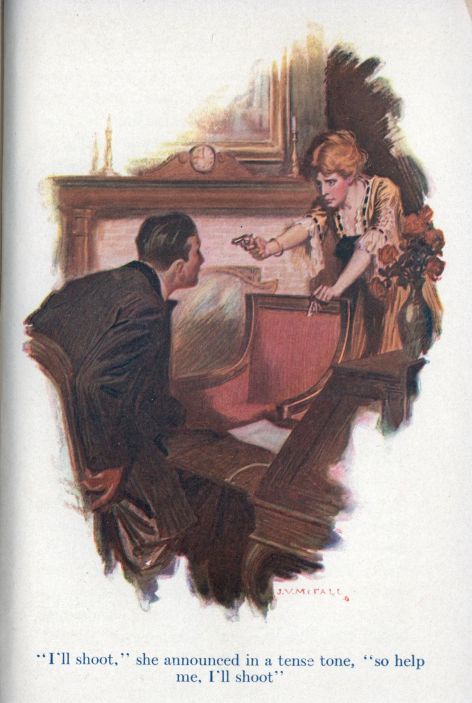
I could not repress a smile—despite my amazement at these proceedings—when I realized that the chair was placed between us as an object of defence. She stood, very erect, behind it, her hand tightly holding the back. She was prepared with a weapon of offence, also. For now her right hand appeared, for the first time, from a fold of her gown; I was startled to see that it held a small, shining revolver. For the first time, too, her hazel eyes met mine, and they burned with a light which, considering the manner of my reception, I was not slow in ascribing to a state of mind bordering upon irresponsibility.
"So I am a prisoner," I said.
"You are," she replied. She clipped the words in an uncompromising way which promised that I was in for a bad quarter of an hour. Where in the world was Genevieve? I wondered. But Miss Belle went on at once, eying me steadily with a hard, stony look.
"I shall get to the point at once. It all depends upon you, whether or not you leave this room alive. It will be for you to choose, and I think you 'll choose the wiser course. I 'm in dead earnest."
She was, whatever her purpose; there was no gainsaying that. I was profoundly curious to learn what that purpose was.
"May I sit down?" I asked, calmly.
She made an impatient gesture with the hand that clutched the chair-back—the hand that held the door-key. But there were two keys in her grasp, I observed. The flowing sleeve of her dressing-gown disclosed a momentary glimpse of white, rounded arm.
"It's useless—useless for you to play for time. I want to know why you have permitted Royal Maillot to be railroaded to jail"—she flung the word at me—"and permitted a snake like that creature, Burke, to go scathless.
"But, no, I don't care for your motives. You know Royal to be innocent. Between the two who were in that house Tuesday night—Royal, open, frank, and manly; Alexander Burke, sly, secretive, and a coward if ever there was one. What sort of intellect have you that it should make such a choice between these two? Bah! You're either base—in league with the criminals—or a fool."
She stopped for sheer lack of breath. She stood staring at me with all the dignity of an outraged queen, and for once in my life I was so astounded that I was at an utter loss for words. I sank into a nearby chair—without her permission—and for the second or so of the pause, my thoughts flew like lightning.
When Miss Fluette was carried from the Page library the previous day her condition promised a long siege of illness; Dr. De Breen had confirmed my own surmise with a declaration to that effect. Why, then, was she not at this moment in bed, with Genevieve caring for her? I had an engagement with Genevieve; she was expecting me at eight o'clock. Miss Belle's appearance indicated that she had prepared for this meeting with the utmost haste—she had probably risen and donned dressing-gown and slippers after I rang the doorbell. What, then, had she done with Genevieve?
I was not in the least frightened by her display of the pistol. To tell the truth, it was only with much difficulty that I kept from laughing. Still, I did so. The girl was plainly so overwrought that she was fairly frantic, and it would require the utmost circumspection on my part to keep her from precipitating matters before somebody came. The women folks, I fancied, would then need the assistance of a man; but for the present her condition demanded that I be at least considerate.
So I concluded to humor her.
"What is it you wish me to do?" I inquired, not forgetting my dignity.
She waved the insignificant weapon toward a writing desk.
"There are pens and ink and paper," she said, her voice tremulous with suppressed passion. "I want you to write down a plain, straightforward declaration that Royal Maillot is innocent, and then follow it with the reasons why you know him to be innocent—for you have those reasons. Doubtless it will include an exposure of the guilty; very well, this is the time for such a disclosure."
The amazing effrontery of the proposal made me gasp. Suppose I were to tell her that I believed her father to be the guilty man? Heavens and earth! Here was a pretty pass!
"Miss Fluette," I said at length, very gravely, "such a declaration from me would have no more weight than the sheet of paper itself. The matter is entirely out of my hands. Further than to procure the evidence necessary to convict the guilty, I have no influence whatever."
"So!" Her lip curled and her eyes flashed. "You would weave a rope about Royal's neck!"
"I would not," I emphatically disputed. "If Royal Maillot was instrumental in Felix Page's death, he was so innocently. He don't know now—"
She broke in, leaning with intense eagerness across the chair-back.
"Then why is he in prison?" There was a note of triumph in her voice, as if she had me cornered.
"Miss Fluette," I replied earnestly, "will you listen to me for a few minutes? Believe me, there is no occasion for this desperate manner—"
"I am desperate."
"Perhaps. I understand your feelings; you and Mr. Maillot have my deepest sympa—"
She cut me short with a rap of the pistol upon the chair-back; I looked to see the thing go off.
"We don't want sympathy," she said through her teeth. "We want justice. And justice we 'll have. Go over there and write!"
She imperiously indicated the desk.
Was a man ever caught in such an absurd predicament! I was truly sober now. I was resolved not to commit myself to anything that would only make me ridiculous; but this passionate, high-strung girl had told only the truth when she warned me that she was in dead earnest. My dilemma was most perplexing—and irritating, too. Could she be made to understand that if I exposed my hand now, before the issue was ripe, that the disclosure might work irreparable injury? Would she comprehend that such a course would immediately drive the guilty inside their defences? Could she be made to see that it was better for her lover to endure a temporary inconvenience, than to be left in a position where he could never be freed from reproach? Perhaps so, but only by showing her where her father stood. I scarcely need point how impossible such a choice was. And in her present mood!
"Where is Miss Cooper?" I asked at last.
She abruptly clutched the hand that held the keys, so that they clicked together.
"Never mind," she flared at me, with a stamp of her foot. "Obey me."
"And if I don't?"
And now she levelled the pistol at me. She threw back her head and her lips curved.
"I 'll shoot," she announced, in a tense tone. "So help me, I 'll shoot."