Marromea, where the Portuguese once had a fairly prosperous trading station, had fallen into decay. Fever had decimated the inhabitants, the railway, intended to fellow the course of the river and effect a junction with the Cape to Cairo line at Victoria Falls, had been abandoned. Long grass and tropical foliage had already hidden the melancholy remains from view.
There were scarcely thirty Portuguese in the place; the others were natives who, being partly civilized, were infinitely greater scoundrels than their unenlightened brethren. Of the thirty Portuguese, two-thirds of the number were Government officials, and with the idea of displaying their powers, threw every obstacle in Captain Restronguet's way. Dues were demanded and paid, then a peremptory request to be shown the ship's papers--documents that the "Aphrodite" did not possess.
Fortunately Hythe had a sheet of printed matter that he had brought off at Gibraltar with his purchases, and this was duly presented. After a lengthy scrutiny the officials returned it, saying the papers were quite in order but forty milreis must be paid to visé them.
"I'll see you to Jericho, first!" exclaimed Captain Restronguet wrathfully, and ordering his men to arm themselves he paraded them on deck as a gentle hint to the mercenary representatives of the Portuguese Republic.
If they knew of the presence of the "Vorwartz" in the river the authorities would not admit it; they refused to allow the telegraph to be made use of to communicate with the trading stations up-stream, and resolutely declined to provide a pilot for the navigation of the shoal-encumbered reaches as far as Kaira--a hundred miles above Marromea.
At last Captain Restronguet resolved to take stern measures. He was ready to abide by the usual customs of a foreign country, but he was not going to be fooled by a pack of rascally Portuguese.
"Clear for diving, Mr. Devoran!" he shouted.
The Portuguese officials, filled with curiosity, lined the edge of the wharf, talking volubly amongst themselves, while to show their contempt towards the foreign craft they amused themselves by throwing cigarette ends upon her deserted deck.
Down below the crew tumbled; hatches were secured, and the ballast tanks flooded. The "Aphrodite," made fast bow and stern to the wharf by the hempen hawsers, sank till her deck was only a few inches above the water. It was now just after high water, and there was a depth of forty feet alongside the quay.
Then with a jerk the strain on the ropes began to tell, a large portion of the crumbling quay was destroyed and tumbled into the river. Down sank the submarine till the tops of her conning-towers were fifteen feet beneath the surface. She was resting on the bottom of the river.
"Man the aerial torpedo tube, Mr. Kenwyn," ordered the captain. "Give them a sixteen pounds charge."
With a whizz and a roar the projectile leapt through the water and soared four hundred feet in the air. There it burst, the concussion shaking every miserable hovel in Marromea to its foundations. When the "Aphrodite" returned to the surface the quay was deserted; the terrified officials, suffering with injured ear-drums, were skulking in the bush.
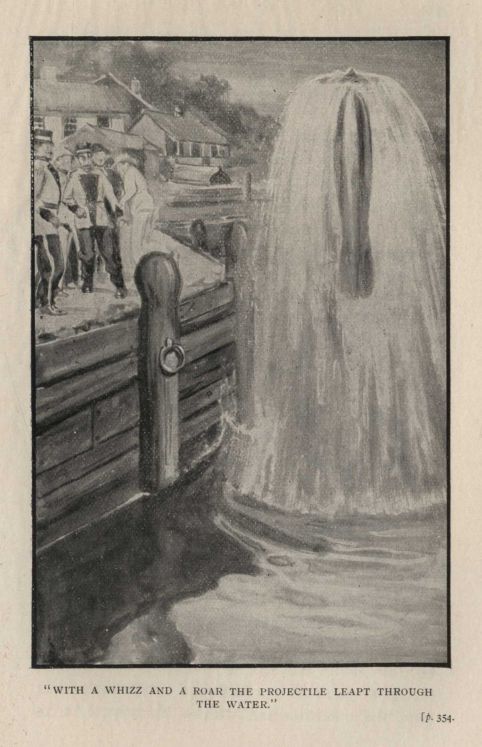 "WITH A WHIZZ AND A ROAR THE PROJECTILE LEAPT THROUGH THE WATER."
"Ah, that is what we want," remarked Captain Restronguet, pointing to a ship's whaler lying on the quay. "Under the circumstances, considering how extortionately we have been charged, I have no qualms in annexing yon craft."
The whaler was a heavy one, but a dozen men soon brought her on board. This done the "Aphrodite" cautiously made her way upstream, for mudbanks and shoals abounded, and only by the frequent use of the lead was the submarine, running light, able to keep to the main channel.
It was now within two hours of sunset, and the "Aphrodite" had to find a suitable berth in order to carry out the plans Captain Restronguet had suggested for the safeguarding of his crew.
The confiscated boat had been securely lashed down amidships. It was too large to be taken below through the hatchway, but in order that it would not burst its lashings as the submarine sank Mylor bored four fairly large holes in the garboards so that the water could easily make its way out. The holes could be plugged when the whaler was required for service afloat, and as Hythe remarked an additional washing would do a lot of good to a boat that had been left lying on the wharf of that malodorous and inhospitable town.
Fortunately a fairly deep and extensive hole was discovered in the bed of the river, the soundings giving ten fathoms. Being the rainy season the river was three or four feet higher than its normal level, a circumstance greatly in the favour of the submarine's voyage of exploration and retribution.
The night passed fairly quietly, the air within the submarine being perfectly clear. Looking through the observation scuttle the crew could see that the so-called fresh water was of a deep brown colour, while the full moon, shining through the miasmic mists looked like a ball of greenish yellow copper. Occasionally a crocodile would alight upon the deck of the "Aphrodite" and drag its armoured body over the metal plating with a dull metallic sound. Once a couple of hippopotami in their moonlight gambols brushed against the side of the conning-tower, the shock being distinctly felt by the men on watch.
In the morning the detector registered the position of the "Vorwartz" at eighty-five miles, which was precisely the same distance as it gave overnight.
Not until the mists had disappeared did Captain Restronguet order the "Aphrodite" to be brought to the surface and the hatchways opened. He would not risk the health of his crew by exposing them to the fever-laden atmosphere. Almost as far as the eye could reach the water extended, for being in flood the river, wide under ordinary circumstances, now resembled a vast lake.
Proceeding at twelve knots, that took her over the ground against the current at barely nine miles an hour, the submarine held steadily on her course, literally feeling her way between the shoals of loathsome black mud.
Just before noon a motor-launch manned by Portuguese passed, downward bound. In reply to a signal to close, the little craft ran alongside the "Aphrodite" without the faintest hesitation. Two of her crew who could speak French were interrogated by Hythe. They had neither seen nor heard anything of a vessel resembling the "Vorwartz" although they had come from Tete, a few miles below the limit for navigation. In reply to a request that one of their number should accompany the submarine as far as Sena, to act as a pilot, the Portuguese resolutely refused, saying that a qualified man could be obtained at Molonho, ten miles further up the river.
"What does the detector say, Mr. Kenwyn?" asked Captain Restronguet for the tenth time that morning.
"Eighty-three miles, sir."
"H'm; two gained. But it's very strange that that motor-boat should not have noticed the 'Vorwartz.' Perhaps the river is deeper, and Karl von Harburg took the precaution to run submerged."
"It is wide enough for a large craft to pass unnoticed," said Devoran.
"Not the actual channel; if we went half a mile to port or starboard we would be hard and fast aground."
"Is it likely that the 'Vorwartz' has taken to a backwater?" asked Hythe.
"By Jove! I hope not," exclaimed Captain Restronguet; then in a confident tone he added, "No matter, our detector will locate her. One thing we know, she hasn't ascended the Shiré--a tributary that drains Lake Nyassa. I almost wish she had, for I would like to see the final act take place in British waters."
To guard against the tropical heat awnings had been spread fore and aft, extending the whole length and breadth of the deck. Under this the officers and crew not on duty "stood easy," the former seated in deck-chairs brought from the cabins.
To Hythe the voyage seemed more like a pleasure trip than a mission of destruction. He and Kenwyn amused themselves by shooting at crocodiles and hippopotami that frequently came within a hundred yards of the "Aphrodite," while Captain Restronguet did a more practical act by bringing down a bird resembling a turkey, which, falling on the awning, was received as a welcome change to the menu.
Captain Restronguet was in high spirits, but his enthusiasm received a set-back when the "Aphrodite" ran full tilt upon a shoal. It was through no fault of the leadsman. The depth gave six fathoms but a few moments before. The discolouration of the water prevented any indication of the shoaling of the depth from being noticed. It was simply a case of sheer bad luck.
"Empty the reserve tanks," ordered Captain Restronguet, for the "Aphrodite" was now drawing ten feet for'ard and twelve aft. Quickly the foremost tank was emptied, but the after one, in spite of the action of the powerful pumps, refused to be discharged. Consequently the draught for'ard decreased while the submarine's stern sank lower into the slimy mud.
"Full speed astern," was the next order, but beyond churning up the brownish black ooze the propellers failed to do the slightest good.
"Lay out an anchor, Mr. Devoran," exclaimed his superior officer. "Be sharp, for the tide is falling."
Hastily the boat was lowered, the heaviest anchor slung underneath, and laid out a hundred yards astern. The stout hempen hawser was led to the motor capstan, but as the powerful machinery made it revolve it simply "walked home" with the anchor. The soft mud offered little or no resistance to its broad palm.
The "Aphrodite" seemed doomed to remain hard and fast for another ten hours. Night with all its terrors would envelop her ere the next tide was at its height, and to work in the germ-laden mists was to court the deadly fever.
"Can the ballast tank be got at from the inside, sir?" asked Hythe, struck by an inspiration.
"Not without flooding one of the sub-divisions of Number Three Platform," replied Captain Restronguet. "But why do you ask?"
"I thought perhaps I might put on a diving-dress, and enter the tank and examine the valves."
"It's feasible," observed Captain Restronguet. "If you attempt it and succeed I shall be still more indebted to you."
"Then I have your permission?"
"Certainly."
"Look here, Hythe," exclaimed Kenwyn. "If you tackle the job I'm with you."
"Thanks," replied the sub. "The sooner we start the better."
Donning their diving-suits and equipping themselves with brushes, spanners, rubber-sheeting for the valves, and an electric lamp each, the two men entered No. 4a compartment, as the subdivision was designated. As soon as the water-tight doors were shut they began unbolting the man-hole cover that gave access to the faulty ballast-tank, guided in their self-imposed task solely by the rays of the lamps.
Presently the water began to ooze between the partially removed cover and side of the tank, increasing in volume till the whole of the compartment was flooded with a liquid resembling thick pea-soup. It was only by the concentrated rays of the two lamps and by keeping his helmeted head within six inches of the metal lid that Hythe was able to complete the work of opening a means of communication with the ballast-tank.
As soon as this was done the sub squeezed through the manhole. His feet touched a thick layer of stiff mud on the floor of the tank. Bringing his lamp down he carefully examined the outlet valve. The secret of the defect was his: when the "Aphrodite" had been submerged by the side of the wharf at Marromea the inrush of water had brought with it a quantity of sediment sufficiently plastic to form a layer over the outlet valve and thus prevent its action.
For an hour Hythe toiled. He had neglected to bring anything of the nature of a spade, and had to recourse to his bare hands. Handful after handful of the noxious mud he scooped up and passed through the manhole into the compartment without, till the interior of the tank was perfectly free from anything of the nature to retard the action of the pumps.
After a lapse of two hours and a half from the time of entering the compartment the two men, their diving-dresses covered in slime, gave the pre-arranged signal to start the pumps. Ten minutes later both the compartment and the tank were emptied of water, and the task of replacing the cover was proceeded with.
But even then Hythe, nothing if not practical, refused to come on deck. He asked for a couple of buckets full of strong disinfectant fluid to be sent down, and, using a mop vigorously, he thoroughly scrubbed out the interior of the compartment, finishing up by mopping his companion's dress with the liquid, while Kenwyn performed the same office for him. Thus the risk of fever from the river-mud was entirely obviated.
"I would like a cold bath," exclaimed Kenwyn as the two officers rejoined their comrades.
"You jolly well won't, then," replied Hythe emphatically. "At least unless you wish to pay an indefinite visit to Davy Jones. Why, man, you are as warm as you can possibly be. Have a hot bath, if you like. I will, with plenty of disinfectant in it."
By this time the "Aphrodite," her draught aft considerately lessened, was afloat and resuming her voyage. Kenwyn had had his hot bath and foolishly sat in the fairly strong breeze to cool himself afterwards.
Before night he was lying unconscious in his bunk, prostrate with blackwater fever.