During all this time, Jane was kept a close prisoner in the Brick Tower, and neither allowed to hold any intercourse with her husband, nor to correspond with him. Heart-breaking as the deprivation was to her in the first instance, she became in some degree reconciled to it, on learning from her jailor,—who displayed as much humanity towards her as was consistent with his office,—that he bore his fate with the utmost fortitude and resignation.
Entertaining no hopes of mercy, Jane’s whole time was past in preparation for her end. Except the few hours of refreshment actually required by nature, every moment was devoted to the most intense application, or to fervent prayer. By degrees, all trace of sorrow vanished from her features, and they assumed a spiritualized and almost angelic expression. Lovely as she was before, she looked far more lovely now—or rather her beauty was of a more refined and exalted character. She was frequently visited by the queen’s confessor, Feckenham, who used every effort to induce her to renounce her religion,—but in vain. When told that the sure way to her Majesty’s favour would be to embrace the faith of Rome—she replied that, anxious as she was to obtain the queen’s forgiveness, she could not purchase it at the price of her salvation, and that the only favour she desired was to pass the brief residue of her days unmolested. Northumberland’s apostacy was a terrible shock to her. Feckenham brought the intelligence, and boasted of the convert the Catholic Church had gained.
“You may have induced the Duke to recant with his lips, sir,” replied Jane; “but of this I am assured, he died a Protestant in heart.”
“It may be so,” rejoined Feckenham. “He was hypocrite enough to act thus. It is enough for us that he publicly abjured his errors. And before long, others of his house will follow his example.”
“What mean you, sir?” demanded Jane, anxiously. “You do not surely allude to my husband?”
Feckenham made no reply, but with a significant smile departed. The insinuation was not lost upon Jane. And now she more than ever lamented that she was not near her husband, to strengthen his wavering faith, and confirm his resolution. Well knowing that his character in a great measure resembled his father’s, she feared that the inducement held out by his enemies might be too much for his resistance. Unable to communicate her fears to him—or to offer any of the counsel her heart suggested, she could only relieve her distresses by earnest supplications in his behalf. But even prayer did not on this occasion afford her the consolation it was wont to do. The Duke of Northumberland’s recantation perpetually haunted her; and the thought that her husband might be made a similar example filled her with inexpressible dread..
While suffering from these agonising reflections, she received another visit from Feckenham. The expression of his countenance, which was triumphing and sinister, alarmed her, and she almost felt unwilling, though at the same time anxious, to question him.
After enjoying her suspense for a few minutes, he said, “Daughter, you blamed the Duke of Northumberland for being reconciled to our church. What, if I inform you that Lord Guilford Dudley has been likewise converted?”
“I should indeed be grieved to hear it,” replied Jane, in a tone of anguish; “but I trust it is not so.”
“It is as I have said,” answered Feckenham.
“Heaven pardon him!” exclaimed Jane. “You bring me ill news, indeed. I had far rather you came to tell me the executioner was waiting for me—nay, that my husband was about to be led to the block—than this fatal intelligence. I thought our separation would be short. But now I find it will be eternal.”
“You are in error, daughter,” rejoined Feckenham, sternly. “You will neither be separated from your husband in this world, nor the next, if you are equally conformable.”
“Am I to understand, then, that his apostacy, for I can give it no milder term, has been purchased by an offer of pardon?” demanded Jane.
“I said not so, daughter,” replied Feckenham; “but I now tell you that his hopes of grace rest with yourself.”
“With me?” cried Jane, with a look of agony.
“With you, daughter,” repeated the confessor. “Much as it rejoices our pious Queen to win over one soul like that of Lord Guilford Dudley to the true faith—gladly as she will receive his recantation, she will pledge herself to mercy only on one condition.”
“And that is—”
“Your conversion.”
“A safe promise, for her clemency will never be exhibited,” replied Jane. “Not even to purchase my husband’s life would I consent. I would willingly die to bring him back to the paths from which he has strayed. But I will not surrender myself to Rome and her abominations.”
“Your firmness, in a good cause, daughter, would elicit my approbation,” replied Feckenham. “As it is, it only excites my compassion. I am deeply concerned to see one so richly gifted so miserably benighted—one so fair so foully spotted with heresy. I should esteem it a glorious victory over Satan to rescue your soul from perdition, and will spare no pains to do so.”
“It is in vain, sir,” replied Jane; “and if I have hitherto repressed my anger at these solicitations, it is because feeling firm in myself, I look upon them merely as an annoyance, to which it is my duty to submit with patience. But when I perceive the mischief they have done to others, I can no longer contain my indignation. Yours is a pernicious and idolatrous religion,—a religion founded on the traditions of men, not on the word of God—a religion detracting from the merits of our Saviour—substituting mummery for the simple offices of prayer,—and though I will not be uncharitable enough to assert that its sincere professors will not be saved,—yet I am satisfied, that no one to whom the true light of heaven has once been vouchsafed, can believe in it, or be saved by it.”
“Since you are thus obstinate, daughter,” replied Feckenham, “let us dispute point by point, and dogma by dogma, of our creeds, and I think I can convince you of the error in which you rest. Do not fear wearying me. I cannot be better employed.”
“Pardon me, then, sir, if I reply, than I can be far better employed,” returned Jane; “and, though I would not shrink from such a discussion—were it useful,—and do not fear its result, yet, as no good can arise from it, I must decline it.”
“As you please, daughter,” rejoined Feckenham. “But I must own that your refusal to accept my challenge seems a tacit admission of the weakness of your cause.”
“Put what construction you please upon it, sir,—so you leave me in peace,” replied Jane. “I will fight the good fight when called upon to do so. But I will not waste the little time that remains to me in fruitless disputation.”
“Before I depart, however, daughter,” rejoined Feckenham, “let me deliver your husband’s message to you.”
“What is it?” inquired Jane, eagerly,—“and yet, I almost dread to ask.”
“He implored you not to be his executioner,” answered Feckenham.
“His executioner!—my husband’s executioner!—oh, no!—no! that I can never be!” cried Jane, bursting into tears.
“That you will be, unless you consent,” replied the priest, coldly.
“I beseech you, sir, urge me no further,” rejoined Jane.
“I would lay down my life for my husband a thousand times, but I cannot save him thus. Tell him that I will pray for him night and day,—and oh! tell him that his swerving from his faith has wounded me more severely than the axe will ever do.”
“I shall tell him that I left you in the same obstinate state I found you—deaf to the voice of truth—inaccessible to natural affection, and besotted with heresy. Daughter, you love not your husband.”
“Not love him!” echoed Jane, passionately. “But no,—you shall not shake my firmness. I thought to die calmly, and I looked forward to death as to a certain restoration to my husband. This hope is now at an end. It is you, sir, who are his true executioner. Not content with robbing him of his eternal happiness, you impute his destruction to me. Tell him I love him too well to grant his request—and if he loves me, and hopes to be reunited to me in the bonds of unceasing happiness, he will remain unshaken in his adherence to the Protestant faith.”
“Then you absolutely refuse compliance?” demanded Fecken-ham.
“Absolutely,” replied Jane.
“Your husband’s blood be upon your head!” exclaimed the confessor, in a menacing voice.
And without another word, he departed.
As soon as the door of her chamber was locked, and Jane felt herself alone, she threw herself on her knees, and was about to pour out her heart in earnest supplication for her husband, but the shock had been too great for her, and she fainted. On reviving, she was scarcely able to move, and it was some time before she entirely regained her strength.
Repairing to the palace, Feckenham detailed the interview to the queen, observing in conclusion, “I still do not despair of her conversion, and shall leave no means untried to accomplish it.” The next day, he again visited Jane, but with no better success. He found her in great affliction, and she earnestly implored to be allowed to see her husband, if only for a few minutes, and in the presence of witnesses. The confessor replied that in her present frame of mind her request could not be granted. But that if she showed herself conformable she should no longer be separated from him, and he would answer for their ultimate pardon. “I have already acquainted you with my determination, sir,” rejoined Jane, “and you will seek in vain to move me. The rack should not shake my constancy; neither shall the mental torture to which you subject me.”
When Feckenham reported the result of his mission to Gardiner, the bishop decided upon holding a religious conference with the captive, feeling confident that notwithstanding her boasted learning and zeal, he could easily overcome her in argument. To induce her to assent to the plan, it was agreed that a meeting should be allowed between her and her husband on the occasion. When the matter was announced to Jane, she readily expressed her acquiescence, and begged that it might not be delayed, as she had no preparation to make. “Take heed,” she observed, in conclusion, “lest I win back from you the treasure you have gained.”
“We shall add to it a greater treasure—yourself, madam,” replied the confessor.
On the following day, she was summoned by an officer of the guard to attend the Bishop in the Beauchamp Tower. Taking up a volume of the Holy Scriptures lying on a table beside her, and wrapping herself in an ermined surcoat, she arose and followed the officer—quitting her chamber for the first time for nearly two months. On issuing into the open air, the effect was almost overpowering, and she could not repress her tears.
It was a bright, sunshiny morning, and everything looked so beautiful—so happy, that the contrast with her recent sufferings was almost too much for her. Bearing up resolutely against her feelings, in order forcibly to divert her attention she fixed her eyes upon the reverend walls of the White Tower, which she was at that moment passing. Near it she perceived the three gigantic warders, all of whom doffed their caps as she approached. Og coughed loudly, as if to clear his throat; Gog hastily brushed the moisture from his eyes with his sleeve; while Magog, who was the most tender-hearted of the three, fairly blubbered aloud. Xit, who formed one of the group, but who was the least affected, bade her be of good cheer.
This encounter was so far of service to Jane, that it served to distract her thoughts, and she had in a great measure regained her composure, when another incident occurred, which had nearly upset her altogether. As she passed near the porch of Saint Peter’s Chapel, she beheld Simon Renard emerge from it. And if she felt her blood chilled by the sight of her implacable foe, her alarm was not diminished on hearing him call to her guards to bring her within the chapel. At a loss to comprehend the meaning of this mysterious summons, Jane entered the sacred structure. Coldly saluting her, Renard informed her that her husband was within the chapel. Trembling at the intimation, Jane looked eagerly round. At first, she could discern nothing; but, guided by the ambassador’s malignant glance, she perceived a figure kneeling in front of the altar. Instantly recognising her husband, with an exclamation of delight that made him spring to his feet, she rushed forward and threw herself into his arms.
After the first passionate emotion had subsided, Jane inquired how he came to be there.
“Do you not know?” replied Lord Guilford. “Or have you been kept in ignorance of the terrible tragedy which has been recently enacted? Look there!” And he pointed downwards.
Jane obeyed, and saw that she was standing upon a gravestone, on which was inscribed in newly-cut letters—
JOHN DUDLEY, DUKE OF NORTHUMBERLAND.
—DECAPITATED AUGUST 22, 1553
Jane trembled and leaned upon her husband for support. “Here is the victim—there the executioner,” said Lord Guilford, pointing from the grave to Renard.
“Three months ago,” said the Ambassador, who stood with folded arms at a little distance from them, “within this very chapel, I told the Duke of Northumberland he would occupy that grave. My words have been fulfilled. And I now tell you, Lord Guilford Dudley, and you Lady Jane, that unless you are reconciled with our holy Church, you will rest beside him.”
With these words he quitted the chapel, and the guards closing round the captives, they were compelled to follow. During their short walk, Jane passionately implored her husband not to yield to the persuasions of his enemies. He hung his head and returned no answer, and she inferred from his silence, that he was not disposed to yield to her solicitations. They were now close upon the Beauchamp Tower, when Dudley, pointing to a barred window in the upper story of one of its turrets, observed—“Within that room my father parsed the last few weeks of his existence.”
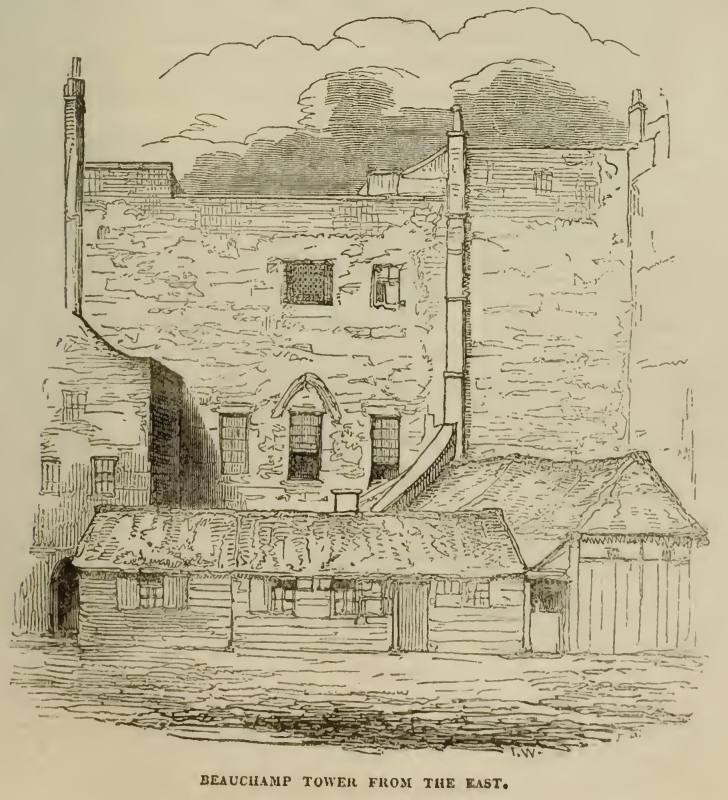

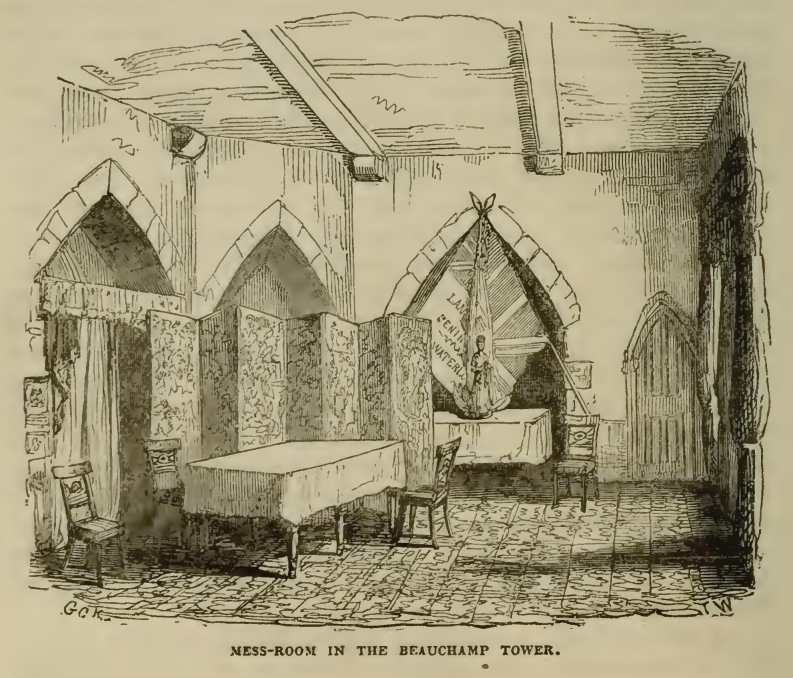
Ascending the spiral stone stairs of the tower, they passed beneath the arched doorway, and entered the principal chamber—now used—as has more than once been observed—as the mess-room of the garrison. Here they found Gardiner awaiting their arrival, he was seated on a high backed arm chair between Bonner and Feckenham, who occupied stools on either side of him, while behind him stood the friar who had attended the Duke of Northumberland on the scaffold. Across one of the deep and arched embrazures of the room looking towards the south, a thick curtain was drawn, and before it, at a small table covered with a crimson cloth, on which writing materials were placed, sat a secretary prepared to take down the heads of the disputation. On Jane’s appearance, Gardiner and the other ecclesiastics arose and gravely saluted her.
“You are welcome, daughter,” said the bishop. “You have come hither an unbeliever in our doctrines. I trust you will depart confirmed in the faith of Rome.”
“I am come to vanquish, not to yield, my lord,” replied Jane, firmly. “And as I shall give you no quarter, so I expect none.”
“Be it so,” rejoined the bishop. “To you, my son,” he continued, addressing Lord Guilford, “I can hold very different language. I can give you such welcome as the prodigal son received, and rejoice in your reconciliation with your heavenly father. And I sincerely trust that this noble lady, your consort, will not be a means of turning aside that mercy which her most gracious Majesty is desirous of extending towards you.”
“My lord,” said Jane, stepping between them, and steadfastly regarding the bishop, “if I am wrong and my husband is right, the Queen will do well not to punish the innocent with the guilty. And you, dear Dudley,” she continued, taking his hand, and gazing at him with streaming eyes, “grant me one favour—the last I shall ever ask of you.”
“Daughter!” observed Gardiner, severely, “I cannot permit this interference. I must interpose my authority to prevent your attempting to shake your husband’s determination.”
“All I ask, my lord, is this,” rejoined Jane, meekly; “that he will abide the issue of the disputation before he renounces his faith for ever. It is a request, which I am sure neither he, nor you will refuse.”
“It is granted, daughter,” replied Gardiner; “the rather that I feel so certain of convincing you that I doubt not you will then as strongly urge his reconciliation as you now oppose it.”
“I would that not my husband alone, but that all Christendom could be auditors of our conference, my lord,” replied Jane. “In this cause I am as strong, as in the late on which I was engaged I was weak. With this shield,” she continued, raising the Bible which she carried beneath her arm, “I cannot sustain injury.” Advancing towards the table at which the secretary was seated, she laid the sacred volume upon it. She then divested of her surcoat, and addressed a few words, in an under tone, to her husband, while the ecclesiastics conferred together. While this was passing, Lord Guilford’s eye accidentally fell upon his father’s inscription on the wall, and he called Jane’s attention to it. She sighed as she looked, and remarked, “Do not let your name be stained like his.”
Perceiving Simon Renard gazing at them with malignant satisfaction, she then turned to Gardiner and said, “My lord, the presence of this person troubles me. I pray you, if he be not needful to our conference, that you will desire him to withdraw.”
The bishop acquiesced, and having signified his wishes to the ambassador, he feigned to depart. But halting beneath the arched entrance, he remained an unseen witness of the proceedings.
A slight pause ensued, during which Jane knelt beside the chair, and fervently besought heaven to grant her strength for the encounter. She then arose, and fixing her eye upon Gardiner, said in a firm tone, “I am ready, my lord, I pray you question me, and spare me not.”
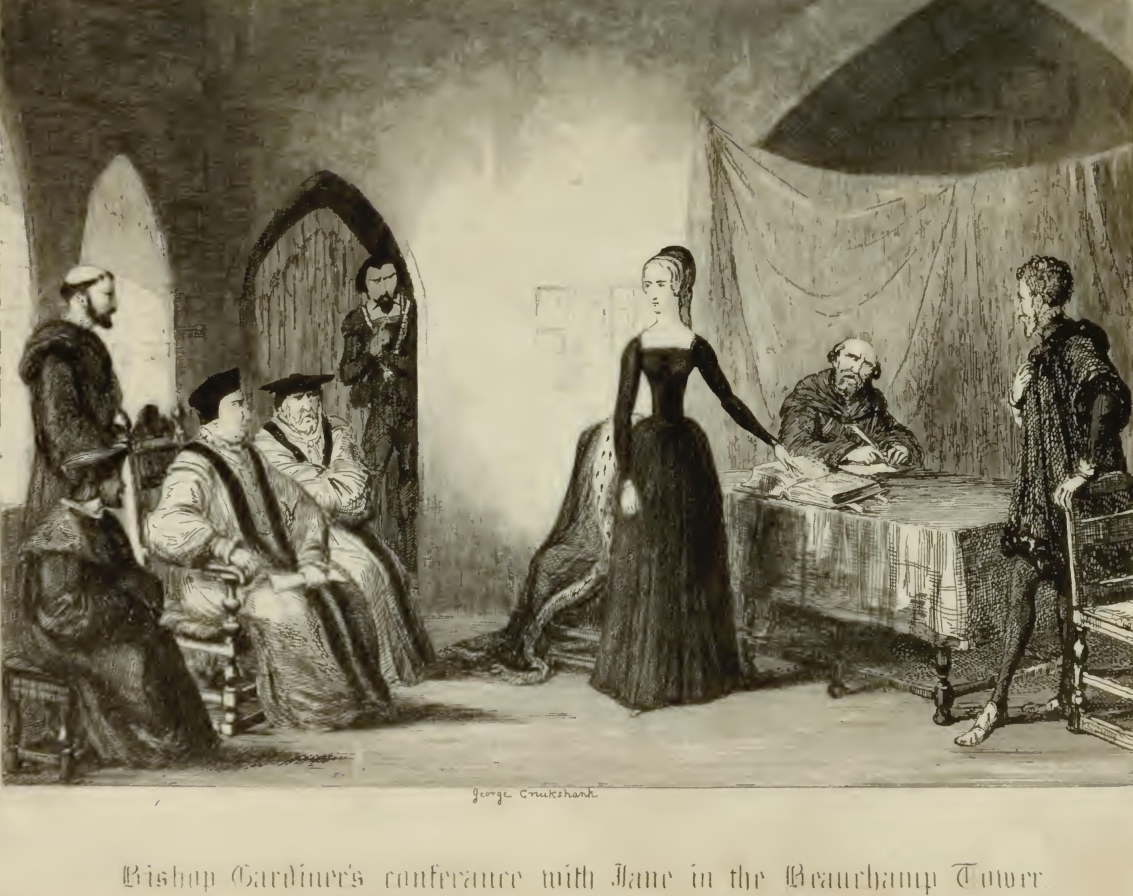
No further intimation was necessary to the bishop, who immediately proceeded to interrogate her on the articles of her faith; and being a man of profound learning, well versed in all the subtleties of scholastic dispute, he sought in every way to confound and perplex her. In this he was likewise assisted by Bonner and Feckenham, both of whom were admirable theologians, and who proposed the most difficult questions to her. The conference lasted several hours, during which Jane sustained her part with admirable constancy—never losing a single point—but retorting upon her opponents questions, which they were unable to answer—displaying such a fund of erudition—such powers of argument—such close and clear reasoning—and such profound knowledge of the tenets of her own faith and of theirs, that they were completely baffled and astounded. To a long and eloquent address of Gardiner’s she replied at equal length, and with even more eloquence and fervour, concluding with these emphatic words—“My lord, I have lived in the Protestant faith, and in that faith I will die. In these sad times, when the power of your church is in the ascendant, it is perhaps needful there should be martyrs in ours to prove our sincerity. Amongst these I shall glory to be numbered—happy in the thought that my firmness will be the means in after ages, of benefiting the Protestant church. On this rock,” she continued, pointing to the Bible, which lay open before her—“my religion is built, and it will endure, when yours, which is erected on sandy foundations, shall be utterly swept away. In this sacred volume, I find every tenet of my creed, and I desire no other mediator between my Maker and myself.”
As she said this, her manner was so fervid, and her look so full of inspiration, that all her listeners were awe-stricken, and gazed at her in involuntary admiration. The secretary suspended his task to drink in her words; and even Simon Renard, who ensconced beneath the door-way, seemed no inapt representation of the spirit of evil, appeared confounded.
After a brief pause, Gardiner arose, saying, “the conference is ended, daughter. You are at liberty to depart. If I listen longer,” he added, in an under tone to his companions, “I shall be convinced against my will.”
“Then you acknowledge your defeat, my lord,” said Jane, proudly.
“I acknowledge that it is in vain to make any impression on you,” answered the bishop.
“Jane,” cried her husband, advancing towards her, and throwing himself on his knees before her, “you have conquered, and I implore your forgiveness. I will never change a religion of which you are so bright an ornament.”
“This is indeed a victory,” replied Jane, raising him and clasping him to her bosom. “And now, my lord,” she added to Gardiner, “conduct us to prison or the scaffold as soon as you please. Death has no further terrors.”
After a parting embrace, and an assurance from her husband, that he would now remain constant in his faith, Jane was removed by her guard to the Brick Tower, while Lord Guilford was immured in one of the cells adjoining the room in which the conference had taken place.