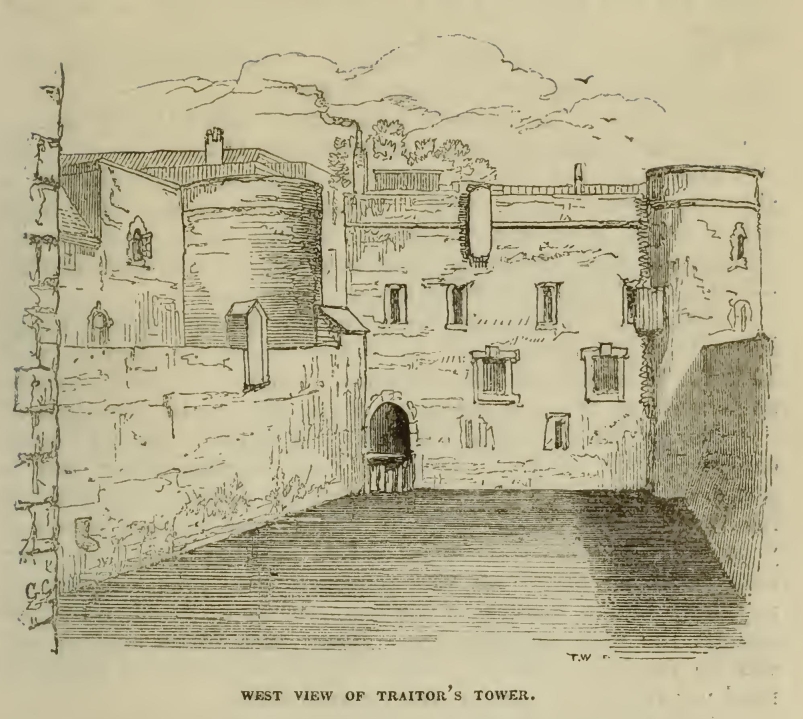
Horror-stricken by the discovery he had made of the body of the ill-fated Alexia, and not doubting from its appearance that she must have perished from starvation, Cholmondeley remained for some time in a state almost of stupefaction in the narrow chamber where it lay. Rousing himself, at length, he began to reflect that no further aid could be rendered her,—that she was now, at last, out of the roach of her merciless tormentor,—and that his attention ought, therefore, to be turned towards one who yet lived to suffer from his cruelty.
Before departing, he examined the corpse more narrowly to ascertain whether it bore any marks of violence, and while doing so, a gleam of light called his attention to a small antique clasp fastening her tattered hood at the throat. Thinking it not impossible this might hereafter furnish some clue to the discovery of her real name and condition, he removed it. On holding it to the light, he thought he perceived an inscription upon it, but the characters were nearly effaced, and reserving the solution of the mystery for a more favourable opportunity, he carefully secured the clasp, and quitted the cell. He then returned to the passages he had recently traversed, explored every avenue afresh, reopened every cell-door, and after expending several hours in fruitless search, was compelled to abandon all hopes of finding Cicely.
Day had long dawned when he emerged from the dungeon; and as he was slowly wending his way towards the Stone Kitchen, he descried Lawrence Nightfall advancing towards him. From the furious gestures of the jailor, he at once knew that he was discovered, and drawing his sword, he stood upon his defence. But a conflict was not what Nightgall desired. He shouted to the sentinels on the ramparts, and informing them that his keys had been stolen, demanded their assistance to secure the robber. Some half-dozen soldiers immediately descended, and Cholmondeley finding resistance in vain, thought fit to surrender. The keys being found upon him, were delivered to Nightgall, while he himself was conveyed to the guard-room near the By-ward Tower.
After he had been detained there for some hours in close captivity,—not even being allowed to communicate with his friends in the Stone-kitchen,—Nightgall returned with an order from the council for his imprisonment in the Nun’s Bower, whither he was forthwith removed. On the way to his place of confinement, he encountered Xit, and the friendly dwarf would fain have spoken with him, but he was kept at a distance by the halberts of the guard. He contrived, however, to inform him by sundry nods, winks, and expressive gestures, that he would keep a sharp watch upon the proceedings of Nightgall.
Having seen Cholmondeley safely bestowed, the jailor repaired to the entrance of the subterranean dungeons, and lighting a torch, opened the door of a small recess, from which he took a mattock and spade. Armed with these implements, he proceeded to the vault, beneath the Devilin Tower, where he commenced digging a grave. After labouring hard for a couple of hours, he attained a sufficient depth for his purpose, and taking the torch, ascended to the small chamber. Lifting the skeleton frame in his arms, he returned to the vault. In placing the torch on the ground it upset, and rolling into the grave was extinguished, leaving him in profound darkness. His first impulse was to throw down the body, but having, in his agitation, placed the hands, which were clasped together, over his neck, he found it impossible to free himself from it. His terror was so great that he uttered a loud cry, and would have fled, but his feet were rooted to the spot. He sank at last on his knees, and the corpse dropped upon him, its face coming into contact with his own. Grown desperate, at length, he disengaged himself from the horrible embrace, and threw the body into the grave. Relieved by this step from much of his fear, he felt about for the spade, and having found it, began to shovel in the mould.

While thus employed, he underwent a fresh alarm. In trampling down the mould, a hollow groan issued from the grave, trembling in every limb, he desisted from his task. His hair stood erect, and a thick damp gathered on his brow. Shaking off his terrors, he renewed his exertions, and in a short time his task was completed.
He then groped his way out of the vault, and having become by long usage familiarized with its labyrinths, soon reached the entrance, where he struck a light, and having found a lantern, set fire to the candle within it. This done, he returned to the vault, where, to his great horror, he perceived that the face of the corpse was uncovered. Averting his gaze from it, he heaped the earth over it, and then flattened the mass with repeated blows of the spade. All trace of his victim being thus removed, and the vault restored to its original appearance, he took back the implements he had used, and struck into a passage leading in another direction.
Pursuing it for some time, he came to a strong door; unlocked it; and, ascending a flight of stone steps, reached another arched passage, which he swiftly traversed. After threading other passages with equal celerity, he came to a wider avenue, contrived under the eastern ramparts, and tracked it till it brought him to a flight of steps leading to a large octangular chamber, surrounded by eight deep recesses, and forming the basement story of the Salt Tower, at that time, and for upwards of a century afterwards, used as one of the prison lodgings of the fortress. In a chamber in the upper story of this fortification, now occupied as a drawing-room, is a curious sphere, carved a few years later than the date of this chronicle, by Hugh Draper, an astrologer, who was committed to the Tower on suspicion of sorcery.
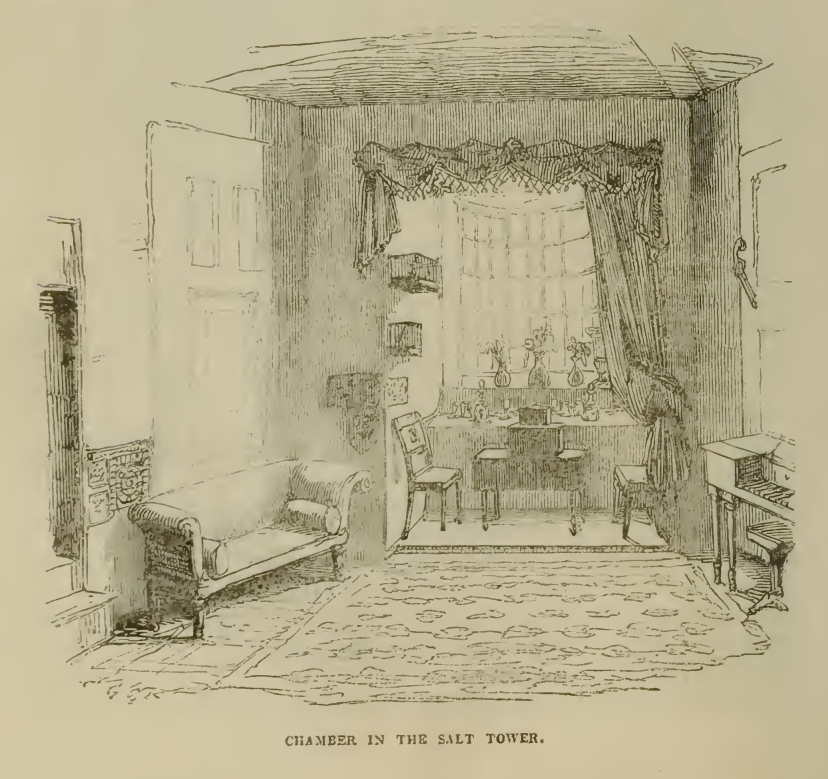
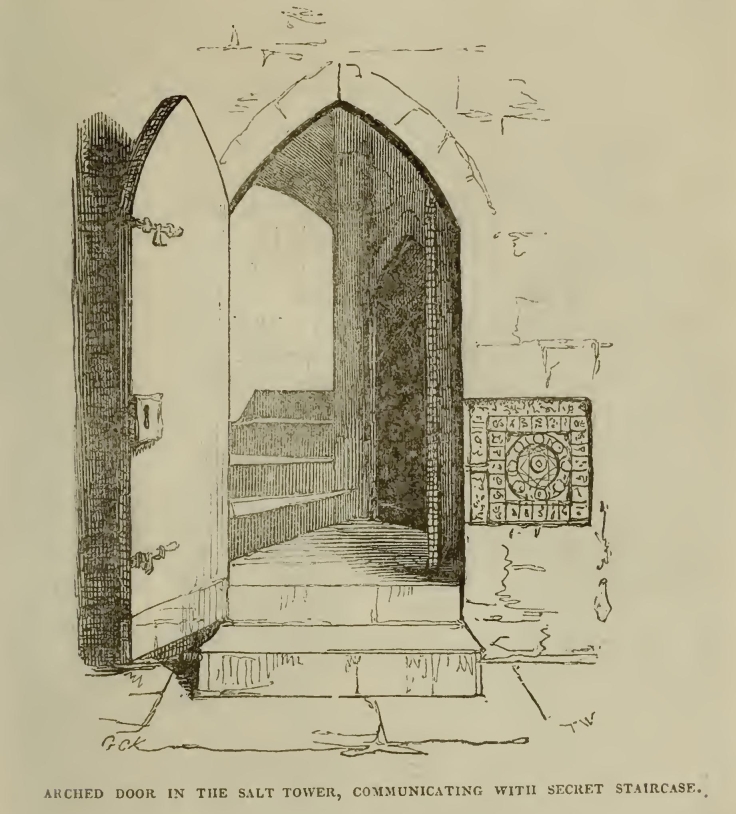
Quitting this chamber, Nightgall ascended a winding stone staircase which brought him to an arched door, leading to the room just described. Taking a key from the bunch at his girdle, he unlocked it, and entered the room. A female was seated in one corner with her face buried in her hands. Raising her head at his approach, she disclosed the features of Cicely. Her eyes were red with weeping—and her figure attenuated by long suffering. Conceiving from the savage expression of the jailor s countenance that he meditated some further act of cruelty, she uttered a loud shriek, and tried to avoid him.
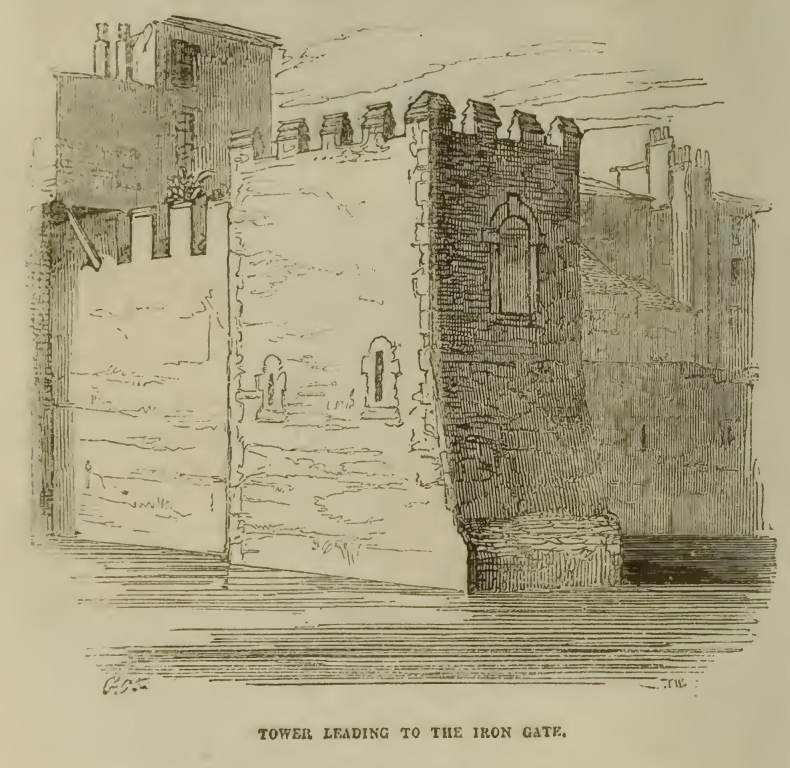
“Peace!” cried Nightgall, “I will do you no harm. Your retreat has been discovered. You must go with me to the tower leading to the Iron Gate.”
“I will never go thither of my accord,” replied Cicely. “Release me, villain. I will die sooner than become your bride.”
“We shall see that,” growled the jailer. “Another month’s captivity will make you alter your tone. You shall never be set free, unless you consent to be mine.”
“Then I shall die a prisoner like your other victims,” cried Cicely.
“Who told you I had other victims?” cried Nightgall, moodily.
“No matter who told me. I have heard Cuthbert Cholmondeley, whom I love as much as I hate you, speak of one—Alexia, I think she was named.”
“No more of this,” cried Nightgall, fiercely, “come along, or—”
“Never!” shrieked Cicely—“I will not go. You will murder me,”—And she filled the chamber with her screams.
“Confusion!” cried Nightgall, “we shall be heard. Come along, I say.”
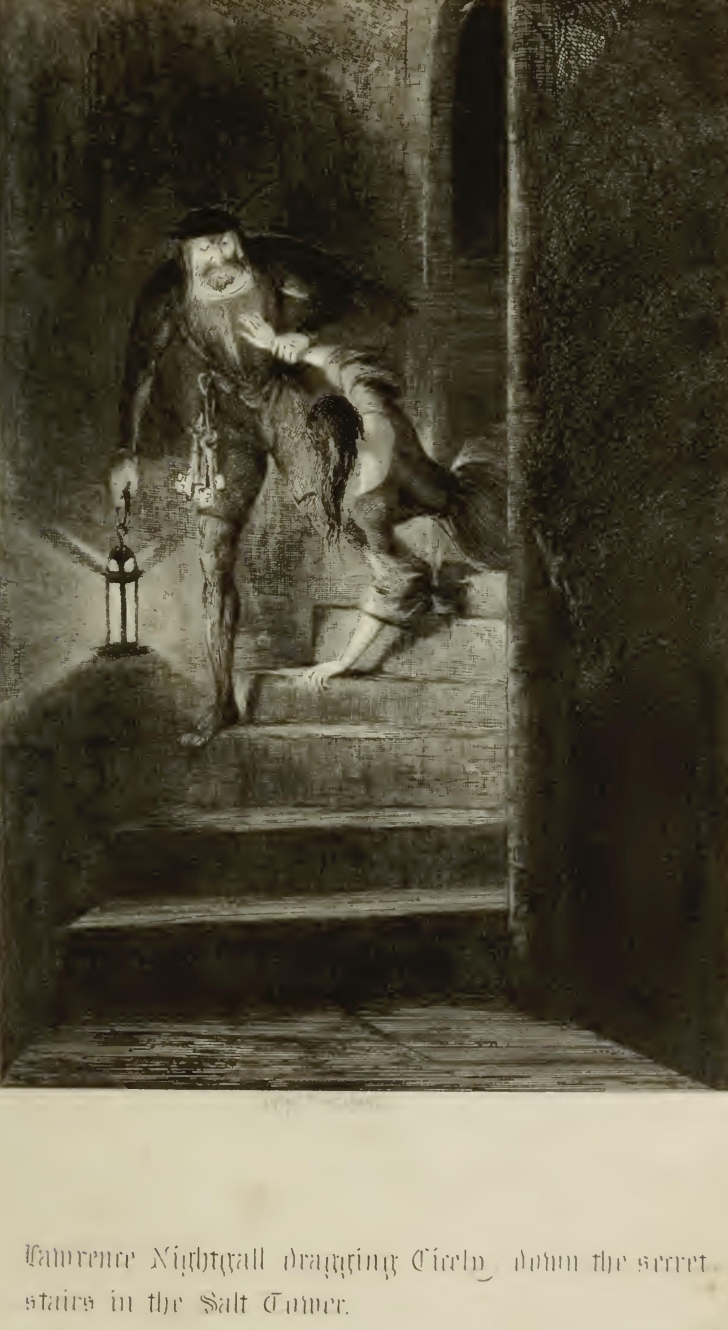
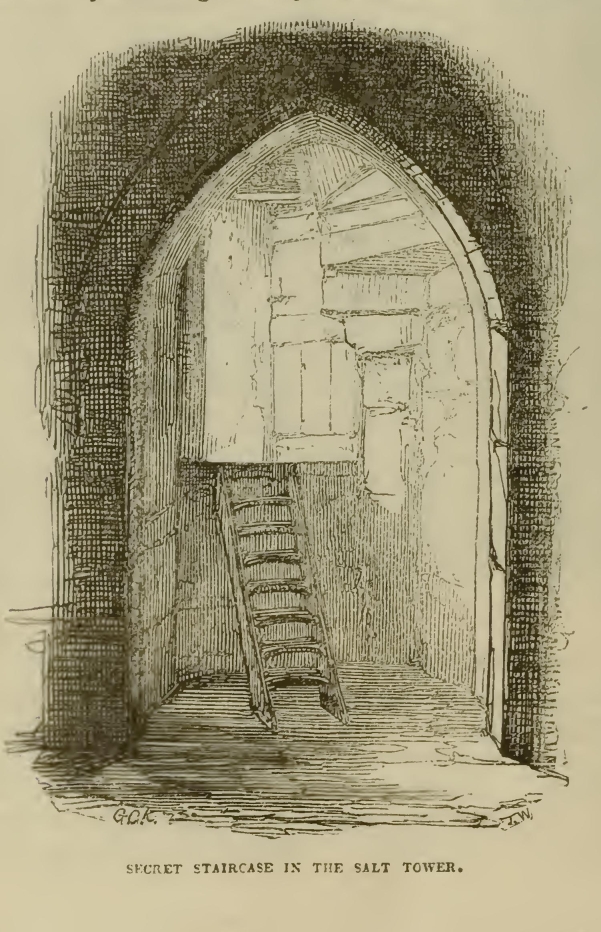
In struggling to free herself from him, Cicely fell upon the ground, regardless of this, Nightgall dragged her by main, force through the doorway, and so down the secret staircase. She continued her screams, until her head striking against the stones, she was stunned by the blow, and became insensible. He then raised her in his arms, and descending another short flight of steps, traversed a narrow passage, and came to a dark chamber beneath the Tower leading to the Iron Gate.