Persuading himself that his capture was matter of jest, Xit kept up his braggadocio air and gait, until he found himself within a few paces of the Constable Tower,—a fortification situated on the east of the White Tower, and resembling in its style of architecture, though somewhat smaller in size, the corresponding structure on the west, the Beauchamp Tower. As Nightgall pointed to this building, and told him with a malicious grin that it was destined to be his lodging, the dwarf’s countenance fell. All his heroism forsook him; and casting a half-angry, half-fearful look at his guards, who were laughing loudly at his terrors, he darted suddenly backwards, and made towards a door in the north-east turret of the White Tower.
Nightgall and the guards, not contemplating any such attempt, were taken completely by surprise, but immediately started after him. Darting between the legs of the sentinel stationed at the entrance of the turret, who laughingly presented his partizan at him, Xit hurried up the circular staircase leading to the roof. His pursuers were quickly after him, shouting to him to stop, and threatening to punish him severely when they caught him. But the louder they shouted, the swifter the dwarf fled; and, being endowed with extraordinary agility, arrived, in a few seconds, at the doorway leading to the roof. Here half-a-dozen soldiers, summoned by the cries, were assembled to stop the fugitive. On seeing Xit, with whose person they were well acquainted—never supposing he could be the runaway,—they inquired what was the matter.
“The prisoner! the prisoner!” shouted Xit, instantly perceiving their mistake, and pushing through them, “Where is he? What have you done with him?”
“No one has passed us,” replied the soldiers. “Who is it?”
“Lawrence Nightgall,” replied Xit, keeping as clear of them as he could. “He has been arrested by an order from the privy-council, and has escaped.”
At this moment, Nightgall made his appearance, and was instantly seized by the soldiers. An explanation quickly ensued, but, in the meantime, Xit had flown across the roof, and reaching the opposite turret at the south-east angle, sprang upon the platform, and clambering up the side of the building at the hazard of his neck, contrived to squeeze himself through a loophole.
“We have him safe enough,” cried one of the soldiers, as he witnessed Xit’s manoeuvre. “Here is the key of the door opening into that turret, and he cannot get below.”
So saying, he unlocked the door and admitted the whole party into a small square chamber, in one corner of which was the arched entrance to a flight of stone steps. Up these they mounted, and as they gained the room above, they perceived the agile mannikin creeping through the embrazure.
“Have a care!” roared Nightgall, who beheld this proceeding with astonishment; “You will fall into the court below and be dashed to pieces.”
Xit replied by a loud laugh, and disappeared. When Nightgall gained the outlet, he could see nothing of him, and after calling to him for some time and receiving no answer, the party adjourned to the leads, where they found he had gained the cupola of the turret, and having clambered up the vane, had seated himself in the crown by which it was surmounted. In this elevated, and as he fancied, secure position, he derided his pursuers, and snapping off a piece of the iron-work, threw it at Nightgall, and with so good an aim that it struck him in the face.
A council of war was now held, and it was resolved to summon the fugitive to surrender; when, if he refused to comply, means must be taken to dislodge him. Meanwhile, the object of this consultation had been discovered from below. His screams and antics had attracted the attention of a large crowd, among whom were his friends the giants. Alarmed at his arrest, they had followed to see what became of him, and were passing the foot of the turret at the very moment when he had reached its summit. Xit immediately recognized them, and hailed them at the top of his voice. At first, they were unable to make out whence the noise proceeded; but at length, Gog chancing to look up, perceived the dwarf, and pointed him out to his companions.
Xit endeavoured to explain his situation, and to induce the giants to rescue him; but they could not hear what he said, and only laughed at his gestures and vociferations. Nightgall now called to him in a peremptory tone to come down. Xit refused, and pointing to the crown in which he was seated, screamed, “I have won it, and am determined not to resign it. I am now in the loftiest position in the Tower. Let him bring me down who can.”
“I will be no longer trifled with,” roared Nightgall. “Lend me your arquebuss, Winwike. If there is no other way of dislodging that mischievous imp, I will shoot him as I would a jackdaw.”
Seeing he was in earnest, Xit thought fit to capitulate. A rope was thrown him which he fastened to the vane, and after bowing to the assemblage, waving his cap to the giants, and performing a few other antics, he slided down to the leads in safety. He was then seized by Nightgall, and though he promised, to march as before between his guards, and make no further attempt to escape, he was carried, much to his discomfiture,—for even in his worst scrapes he had an eye to effect,—to the Constable Tower, and locked up in the lower chamber.
“So, it has come to this,” he cried, as the door was barred outside by Nightgall. “I am now a state prisoner in the Tower. Well, I only share the fate of all court favourites and great men—of the Dudleys, the Rochfords, the Howards, the Nevills, the Courtenays, and many others whose names do not occur to me. I ought rather to rejoice than be cast down that I am thus distinguished. But what will be the result of it? Perhaps, I shall be condemned to the block. If I am, what matter? I always understood from Mauger that decapitation was an easy death—and then what a crowd there will be to witness my execution—Xit’s execution—the execution of the famous dwarf of the Tower! The Duke of Northumberland’s will be nothing to it. With what an air I shall ascend the steps—how I shall bow to the assemblage—how I shall raise up Mauger when he bends his lame leg to ask my forgiveness—how I shall pray with the priest—address the assemblage—take off my ruff and doublet, and adjust my head on the block! One blow and all is over. One blow—sometimes, it takes two or three—but Mauger understands his business, and my neck will be easily divided. That’s one advantage, among others, of being a dwarf. But to return to my execution. It will be a glorious death, and one worthy of me. I have half a mind to con over what I shall say to the assembled multitude. Let me see. Hold! it occurs to me that I shall not be seen for the railing. I must beg Mauger to allow me to stand on the block. I make no doubt he will indulge me—if not, I will not forgive him. I have witnessed several executions, but I never yet beheld what I should call a really good death. I must try to realize my own notions. But I am getting on a little too fast. I am neither examined, nor sentenced yet. Examined! that reminds me of the rack. I hope they won’t torture me. To be beheaded is one thing—to be tortured another. I could bear anything in public, where there are so many people to look at me, and applaud me—but in private it is quite another affair. The very sight of the rack would throw me into fits. And then suppose I should be sentenced to be burnt like Edward Underhill—no, I won’t suppose that for a moment. It makes me quite hot to think of it. Fool that I was, to be seduced by the hope of rank and dignity held out to me by the French ambassador, to embark in plots which place me in such jeopardy as this! However, I will reveal nothing. I will be true to my employer.”
Communing thus with himself, Xit paced to and fro within his prison, which was a tolerably spacious apartment, semi-circular in form, and having deep recesses in the walls, which were of great thickness.
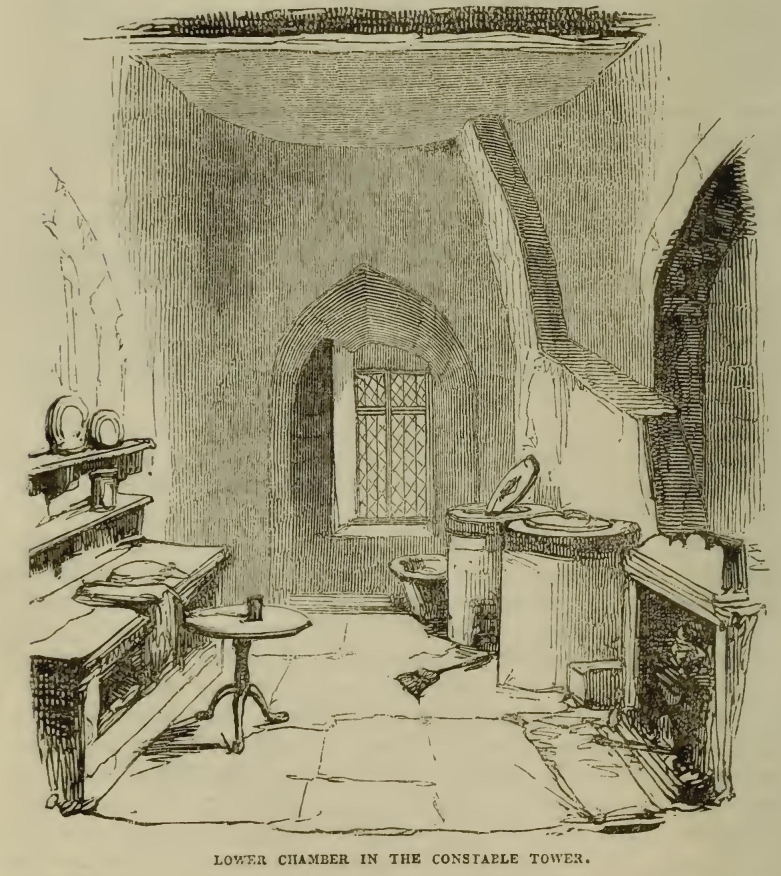

As he glanced around, an Idea occurred to him. “Every prisoner of consequence confined within the Tower carves his name on the walls,” he said. “I must carve mine, to serve as a memorial of my imprisonment.”
The only implement left him was his dagger, and using it instead of a chisel, he carved, in a few hours, the following inscription in characters nearly as large as himself:—
X I T.
1553.
By the time he had finished his work, he was reminded by a clamorous monitor within him, that he had had no supper, and he recalled with agonizing distinctness the many glorious meals he had consumed with his friends the giants. He had not even the common prisoners fare, a loaf and a cup of water, to cheer him.
“Surely they cannot intend to starve me,” he thought. “I will knock at the door and try whether any one is without.” But though he thumped with all his might against it, no answer was returned. Indignant at this treatment, he began to rail against the giants, as if they had been the cause of his misfortunes.
“Why do they not come to deliver me?” he cried, in a peevish voice. “The least they could do would be to bring me some provisions. But, I warrant me, they have forgotten their poor famishing dwarf, while they are satisfying their own inordinate appetites. What would I give for a slice of Hairun’s wild boar now! The bare idea of it makes my mouth water. But the recollection of a feast is a poor stay for a hungry stomach. Cruel Og! barbarous Gog! inhuman Magog! where are ye now? Insensible that ye are to the situation of your friend, who would have been the first to look after you had ye been similarly circumstanced! Where are ye, I say—supping with Peter Trusbut, or Ribald, or at our lodging in the By-ward Tower? Wherever ye are, I make no doubt you have plenty to eat, whereas I, your best friend, who would have been your patron, if I had been raised to the dignity promised by De Noailles—am all but starving. It cannot be—hilloah! hilloah! help!” And he kicked against the door as if his puny efforts would burst it open. “The queen cannot be aware of my situation. She shall hear of it—but how?”
Perplexing himself how to accomplish this, he flung himself on a straw mattress in one corner, which, together with a bench and a small table constituted the sole furniture of the room, and in a short time fell asleep. He was disturbed by the loud jarring of a door, and, starting to his feet, perceived that two men had entered the room, one of whom bore a lantern, which he hold towards him. In this person Xit at once recognised Nightgall; and in the other, as he drew nearer, Wolfytt the sworn tormentor. The grim looks of the latter so terrified Xit, that he fell back on the mattress in an ecstacy of apprehension. His fright seemed to afford great amusement to the cause of it, for he burst into a coarse loud laugh that made the roof ring again. His merriment rather restored the dwarf, who ventured to inquire, in a piteous accent, whether they had brought him any supper.
“Ay, ay!” rejoined Wolfytt, with a grin. “Follow us, and you shall have a meal that shall serve you for some days to come.”
“Readily,” replied Xit. “I am excessively hungry, and began to think I was quite forgotten.”
“We have been employed in making all ready for you,” rejoined Wolfytt. “We were taken a little by surprise. It is not often we have such a prisoner as you.”
“I should think not,” returned Xit, whose vanity was tickled by the remark. “I was determined to let posterity know that one dwarf had been confined within the Tower. Bring your lantern this way, Master Nightgall, and you will perceive I have already carved my name on the wall.”
“So I see,” growled Nightgall, holding the light to the inscription. “Bring him along, Wolfytt.”
“He will not need, sir,” returned Xit, with dignity. “I am ready to attend you.”
“Good!” exclaimed Wolfytt. “Supper awaits us, he! he!” They then passed through the door, Xit strutting between the pair. Descending a short flight of stone steps, they came to another strong door, which Nightgall opened. It admitted them to a dark narrow passage, which, so far as it could be discerned, was of considerable extent. After pursuing a direct course for some time, they came to an opening on the left, into which they struck. This latter passage was so narrow that they were obliged to walk singly. The roof was crusted with nitrous drops, and the floor was slippery with moisture.
“We are going into the worst part of the Tower,” observed Xit, who began to feel his terrors revive. “I have been here once before. I recollect it leads to the Torture Chamber, the Little-Ease, and the Pit. I hope you are not taking me to one of those horrible places?”
“Poh! poh!” rejoined Wolfytt, gruffly. “You are going to Master Nightgall’s bower.”
“His bower!” exclaimed Xit, surprised by the term—“what! where he keeps Cicely?”
At the mention of this name, Nightgall, who had hitherto maintained a profound silence, uttered an exclamation of anger, and regarded the dwarf with a withering look.
“I can keep a secret if need be,” continued Xit, in a deprecatory tone, alarmed at his own indiscretion. “Neither Cuthbert Cholmondeley, nor Dame Potentia, nor any one else, shall hear of her from me, if you desire it, good Master Nightgall.”
“Peace!” thundered the jailor.
“You will get an extra turn of the rack for your folly, you crack-brained jackanapes,” laughed Wolfytt.
Luckily the remark did not reach Xit’s ears. He was too much frightened by Nightgall’s savage look to attend to anything else.
They had now reached a third door, which Nightgall unlocked and fastened as soon as the others had passed through it. The passage they entered was even darker and damper than the one they had quitted. It contained a number of cells, some of which, as was evident from the groans that issued from them, were tenanted.
“Is Alexia here?” inquired Xit, whose blood froze in his veins as he listened to the dreadful sounds.
“Alexia!” vociferated Nightgall, in a terrible voice. “What do you know of her?”
“Oh, nothing, nothing,” replied Xit. “But I have heard Cuthbert Cholmondeley speak of her.”
“She is dead,” replied Nightgall, in a sombre voice; “and I will bury you in the same grave with her, if her name ever passes your lips again.”
“It shall not, worthy sir,” returned Xit,—“it shall not. Curse on my unlucky tongue, which is for ever betraying me into danger!”
They had now arrived at an arched doorway in the wall, which being opened by Nightgall, discovered a flight of steps leading to some chamber beneath. Nightgall descended, but Xit refused to follow him.
“I know where you are taking me,” he cried. “This is the way to the torture-chamber.”
Wolfytt burst into a loud laugh, and pushed him forward.
“I won’t go,” screamed Xit, struggling with all his force against the tormentor. “You have no authority to treat me thus. Help! kind Og! good Gog! dear Magog!—help! or I shall be lamed for life. I shall never more be able to amuse you with my gambols, or the tricks that so much divert you. Help! help! I say.”
“Your cries are in vain,” cried Wolfytt, kicking him down the steps; “no one can save you now.”
Precipitated violently downwards, Xit came in contact with Nightgall, whom he upset, and they both rolled into the chamber beneath, where the latter arose, and would have resented the affront upon his comrade, or, at all events, upon the dwarf, if he had not been in the presence of one of whom he stood in the greatest awe. This was Simon Renard, who was writing at a table. Disturbed by the noise, the ambassador glanced round, and on perceiving the cause immediately resumed his occupation. Near him stood the thin erect figure of Sorrocold,—his attenuated limbs appearing yet more meagre from the tight-fitting black hose in which they were enveloped, The chirurgcon wore a short cloak of sad-coloured cloth, and a doublet of the same material. His head was covered by a flat black cap, and a pointed beard terminated his hatchet-shaped, cadaverous face. His hands rested on a long staff, and his dull heavy eyes were fixed upon the ground.
At a short distance from Sorrocold, stood Mauger, bare-headed, and stripped to his leathern doublet, his arms folded upon his bosom, and his gaze bent upon Renard, whose commands he awaited. Nightgall’s accident called a smile to his grim countenance, but it instantly faded away, and gave place to his habitual sinister expression.
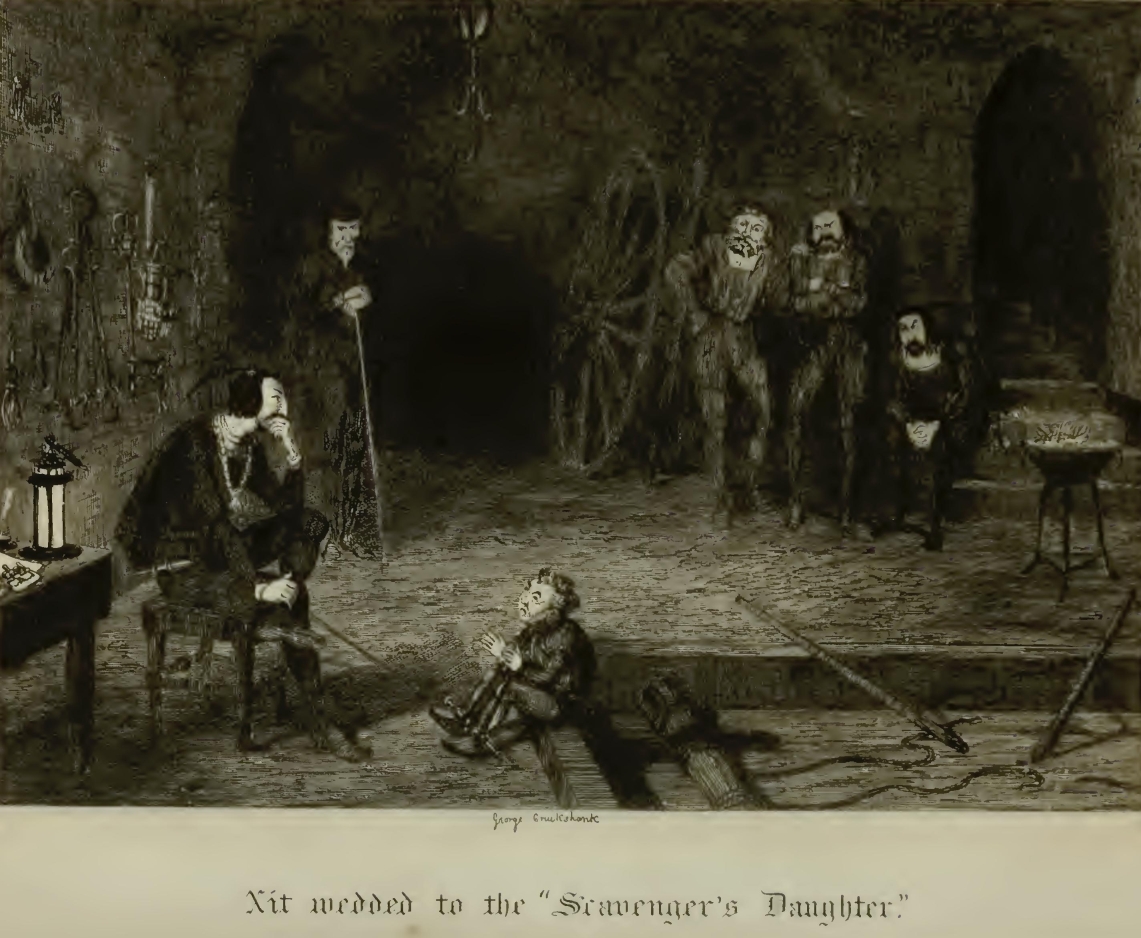
Such were the formidable personages in whoso presence Xit found himself. Nor was the chamber less calculated to strike terror into his breast than its inmates. It was not the torture-room visited by Cholmondeley, when he explored the subterranean passages of the fortress, but another and larger chamber contiguous to the former, yet separated from it by a wall of such thickness that no sound could penetrate through it. It was square-shaped, with a deep round-arched recess on the right of the entrance, at the further end of which was a small cell, surmounted with a pointed arch. On the side where Renard sat, the wall was decorated with thumb-screws, gauntlets, bracelets, collars, pincers, saws, chains and other nameless implements of torture. To the ceiling was affixed a stout pulley with a rope, terminated by an iron hook, and two leathern shoulder-straps. Opposite the door-way stood a brasier, filled with blazing coals, in which a huge pair of pincers were thrust; and beyond it was the wooden frame of the rack, already described, with its ropes and levers in readiness. Reared against the side of the deep dark recess, previously mentioned, was a ponderous wheel, as broad in the felly as that of a waggon, and twice the circumference. This antiquated instrument of torture was placed there to strike terror into the breasts of those who beheld it—but it was rarely used. Next to it was a heavy bar of iron employed to break the limbs of the sufferers tied to its spokes.
Perceiving in whose presence he stood, and what preparations were made for him, Xit gave himself up for lost, and would have screamed aloud, had not his utterance failed him. His knees smote one another; his hair, if possible, grew more erect than ever; a thick damp burst upon his brow; and his tongue, ordinarily so restless, clove to the roof of his mouth.
“Bring forward the prisoner,” cried Renard, with a stern voice, but without turning his head.
Upon this, Nightgall seized Xit by the hand, and dragged him towards the table. A quarter of an hour elapsed, during which Renard continued writing as if no one were present; and Xit, who at first was half dead with fright, began to recover his spirits.
“Your excellency sent for me.” he ventured, at length.
“Ha!” ejaculated Renard, pausing and looking at him, “I had forgotten thee.”
“A proof that my case is not very dangerous,” thought Xit. “I must let this proud Spaniard see I am not so unimportant as he seems to imagine. Your excellency I presume, desires to interrogate me on some point,” he continued aloud. “I pray you proceed without further delay.”
“Is it your excellency’s pleasure that we place him on the rack?” interposed Nightgall.
“Or shall we begin with the thumb-screws,” observed Mauger, pointing to a pair upon the table; “I dare say they will extort all he knows. It would be a pity to stretch him out.”
“I would not be an inch taller for the world,” rejoined Xit, raising himself on his tiptoes.
“I have a suit of irons that will exactly fit him,” observed Wolfytt, going to the wall, and taking down an engine that looked like an exaggerated pair of sugar-tongs. “These were made as a model, and have never been used before, except on a monkey belonging to Hairun the bearward. We will wed you to the ‘Scavenger’s Daughter,’ my little man.”
Xit knew too well the meaning of the term to take any part in the merriment that followed this sally.
“The embraces of the spouse you offer me are generally fatal,” he observed. “I would rather decline the union, if his excellency will permit me.1’ *
“What is your pleasure?” asked Nightgall, appealing to Renard.
“Place him in the irons,” returned the latter. “If these fail, we can have recourse to sharper means.”
Xit would have flung himself at the ambassador’s feet, to ask for mercy, but he was prevented by Wolfytt, who slipping a gag into his mouth, carried him into the dark recess, and, by the help of Mauger, forced him into the engine. Diminished to half his size, and bent into the form of a hoop, the dwarf was then set on the ground, and the gag taken out of his mouth.
“How do you like your bride?” demanded Wolfytt, with a brutal laugh.
“So little,” answered Xit, “that I care not how soon I am divorced from her. After all,” he added, “uncomfortable as I am, I would not change places with Magog.”
This remark was received with half-suppressed laughter by the group around him, and Wolfytt was so softened that he whispered in his ear, that if he was obliged to put him on the rack, he would use him as tenderly as he could. “Let me advise you as a friend,” added the tormentor, “to conceal nothing.”
“Rely upon it,” replied Xit, in the same tone. “I’ll tell all I know—and more.”
“That’s the safest plan,” rejoined Wolfytt, drily.
By this time, Renard having finished his despatch, and delivered it to Nightgall, he ordered Xit to be brought before him. Lifting him by the nape of his neck, as he would have carried a lap-dog, Wolfytt placed him on the edge of the rack, opposite the ambassador’s seat. He then walked back to Manger, who was leaning against the wall near the door, and laid his hand on his shoulder, while Nightgall seated himself on the steps. All three looked on with curiosity, anticipating much diversion. Sorrocold, who had never altered his posture, only testified his consciousness of what was going forward by raising his lacklustre eyes from the ground, and fixing them on the dwarf.
Wheeling round on the stool, and throwing one leg indolently over the other, Renard regarded the mannikin with apparent sternness, but secret entertainment. The expression of Xit’s countenance, as he underwent this scrutiny, was so ludicrous, that it brought a smile to every face except that of the chirurgeon.
After gazing at the dwarf for a few minutes in silence, Renard thus commenced—“You conveyed messages to the Earl of Devonshire when he was confined in the Bell Tower?”
“Several,” replied Xit.
“And from whom?” demanded Renard.
“Your excellency desires me speak the truth, I conclude?” rejoined Xit.
“If you attempt to prevaricate, I will have you questioned by that engine,” returned Renard, pointing to the rack. “I again ask you by whom you were employed to convey these messages?”
“Your excellency and your attendants will keep the secret if I tell you?” replied Xit. “I was sworn not to reveal my employer’s name.”
“No further trifling, knave,” cried Renard, “or I shall deliver you to the tormentors. Who was it?”
“The Queen,” replied Xit.
“Impossible!” exclaimed Renard, in surprise.
“Nothing is impossible to a woman in love,” replied Xit; “and her highness, though a queen, is still a woman.”
“Beware how you trifle with me, sirrah,” rejoined Renard. “It was M. De Noailles who employed you.”
“He employed me on the part of her majesty, I assure your excellency,” returned Xit.
“He deceived you if he told you so,” replied Renard. “But now, repeat to me the sum of your conversations with the earl.”
“Our conversations all related to his escape,” replied Xit.
“Hum!” exclaimed Renard. “Now mark me, and answer me truly as you value a whole skin. Was nothing said of the princess Elizabeth, and of a plot to place her on the throne, and wed her to Courtenay?”
“Nothing that I remember,” answered Xit.
“Think again!” cried Renard.
“I do recollect that upon one occasion his lordship alluded to the princess,” answered Xit, after a moment’s pretended reflection.
“Well, what did he say?” demanded Renard.
“That he was sorry he had ever made love to her,” replied Xit.
“And well he might be,” observed Renard. “But was that all?”
“Every syllable,” replied Xit.
“I must assist your memory, then,” said Renard. “What ho! tormentors.”
“Hold!” cried the dwarf; “I will hide nothing from you.”
“Proceed, then,” rejoined Renard, “or I give the order.”
“Well, then,” returned Xit, “since I must needs confess the whole truth, the reason why the Earl of Devonshire was sorry he had made love to the princess was this. Her majesty sent him a letter through me, promising to forgive him, and restore him to her affections.”
“You have been either strangely imposed upon, or you are seeking to impose upon me, knave,” cried Renard. “But I suspect the latter.”
“I carried the billet myself, and saw it opened,” returned Xit, “and the earl was so transported with its contents, that he promised to knight me on the day of his espousals.”
“A safe promise, if he ever made it,” rejoined Renard; “but the whole story is a fabrication. If her majesty desired to release the earl, why did she not issue her orders to that effect to Sir Henry Bedingfeld?”
“Because—but before I proceed, I must beg your excellency to desire your attendants to withdraw. You will perceive my motives, and approve them, when I offer you my explanation.”
Renard waved his hand, and the others withdrew, Wolfytt observing to Mauger, “I should like to hear what further lies the little varlet will invent. He hath a ready wit.”
“Now, speak out—we are alone,” commanded Renard.
“The reason why her majesty did not choose to liberate the Earl of Devonshire was the fear of offending your excellency,” replied Xit.
“How?” exclaimed Renard, bending his brows.
“In a moment of pique she had affianced herself to Prince Philip of Spain,” continued Xit. “But in her calmer moments she repented her precipitancy, and feeling a return of affection for the earl, she employed M. Do Noailles to make up the matter with him. But the whole affair was to be kept a profound secret from you.”
“Can this be true?” cried Renard. “But no—no—it is absurd. You are abusing my patience.”
“If your excellency will condescend to make further inquiries you will find I have spoken the truth,” rejoined the dwarf.
“But I pray you not to implicate me with the queen. Her majesty, like many of her sex, has changed her mind, that is all. And she may change it again for aught I know.”
“It is a strange and improbable story,” muttered Renard; “yet I am puzzled what to think of it.”
“It was no paltry hope of gain that induced me to act in the matter,” pursued Xit; “but, as I have before intimated, a promise of being knighted.”
“If I find, on inquiry, you have spoken the truth,” rejoined Renard, “and you will serve me faithfully on any secret service on which I may employ you, I will answer for it you shall attain the dignity you aspire to.”
“I will do whatever your excellency desires,” returned Xit, eagerly. “I shall be knighted by somebody, after all.”
“But if you have deceived me,” continued Renard, sternly, “every bone in your body shall be broken upon that wheel. Your examination is at an end.” With this, he clapped his hands together, and at the signal the attendants returned.
“Am I to remain in these irons longer?” inquired Xit.
“No,” replied Renard. “Release him, and take him hence. I shall interrogate him at the same hour to-morrow night.”
“I pray your excellency to desire these officials to treat me with the respect due to a person of my anticipated dignity,” cried Xit, as he was unceremoniously seized and thrown on his back by Wolfytt; “and above all, command them to furnish me with provisions. I have tasted nothing to-night.”
Renard signified a wish that the latter request should be complied with, and the dwarf’s irons being by this time removed, he was led back, by the road he came, to his chamber in the Constable Towrer, where some provisions and a flask of wine were placed before him, and he was left alone.