On the 2nd of January, 1554, a solemn embassy from the emperor Charles the Fifth, consisting of four of his most distinguished nobles, the Count D’Egmont, the Count Lalaing, the Seigneur De Courrieres, and the Sieur De Nigry, chancellor of the order of the Toison D’Or, arrived in London to sign the marriage-treaty between Philip and Mary which had been previously agreed upon by the courts of England and Spain.
Gardiner, who as long as he found it possible to do so, had strenuously opposed the match, and had recommended Mary to unite herself to Courtenay, or at least to some English nobleman, finding her resolutely bent upon it, consented to negociate the terms of marriage with Renard, and took especial care that they were favourable to his royal mistress.
They were as follows:—The queen was to have for her jointure thirty thousand ducats a year, with all the Low Countries of Flanders,—her issue was to be heir as well to the kingdom of Spain as to the Low Countries,—her government was to continue in all things as before,—and no stranger was to be member of the council, nor have custody of any forts of castles, nor bear any rule or office in the queen’s household, or elsewhere in all England.
To these terms Renard, on behalf of his sovereign, readily assented, and the subject was brought before the Parliament where it met with violent opposition from all parties. In spite of this, Mary asserted her privilege to wed whom she pleased, and after a long and stormy discussion the measure, chiefly through the management of Arundel, Paget and Rochester, was carried.
During the agitation of the question, Mary deemed it prudent to feign indisposition to avoid receiving an address intended to be presented to her from the Commons imploring her to marry one of her own countrymen. But when at length she could no longer decline giving them an audience, she dismissed them with these words:—
“I hold my crown from God, and I beseech him to enlighten me as to the conduct I ought to pursue in a matter so important as my marriage. I have not yet determined to wed, but since you say in your address that it is for the welfare of the state that I should choose a husband, I will think of it—nothing doubting I shall make a choice as advantageous as any you may propose to me, having as strong an interest in the matter as yourselves.”
While this was going forward, De Noailles and his party had not been idle. Many schemes were devised, but some were abandoned from the irresolution and vacillation of Courtenay; others were discovered and thwarted by Renard. Still, the chief conspirators, though suspected, escaped detection, or rather their designs could not be brought home to them, and they continued to form their plans as the danger grew more imminent with greater zeal than ever.
At one time, it was determined to murder Arundel, Paget, Rochester, and the chief supporters of the Spanish match, to seize the person of the queen and compel her to marry Courtenay, or depose her and place Elizabeth on the throne. This plan not suiting the views of Lord Guilford Dudley and Suffolk, was opposed by them; and owing to the conflicting interests of the different parties that unity of purpose indispensable to success could not be obtained.
Elizabeth, as has before been intimated, had dissembled her religious opinions, and though she formed some excuse for not being present at the performance of mass, she requested to have an instructor in the tenets of the Catholic faith, and even went so far as to write to the emperor to send a cross, a chalice, and other ornaments for the celebration of the religious rites of Rome, to decorate her chapel.
As to Courtenay, he appeared to have become sensible of the perilous position in which he stood, and was only prevented from withdrawing from the struggle by his unabated passion for Elizabeth. Lord Guilford Dudley still cherished his ambitious views, and Jane still mourned in secret.
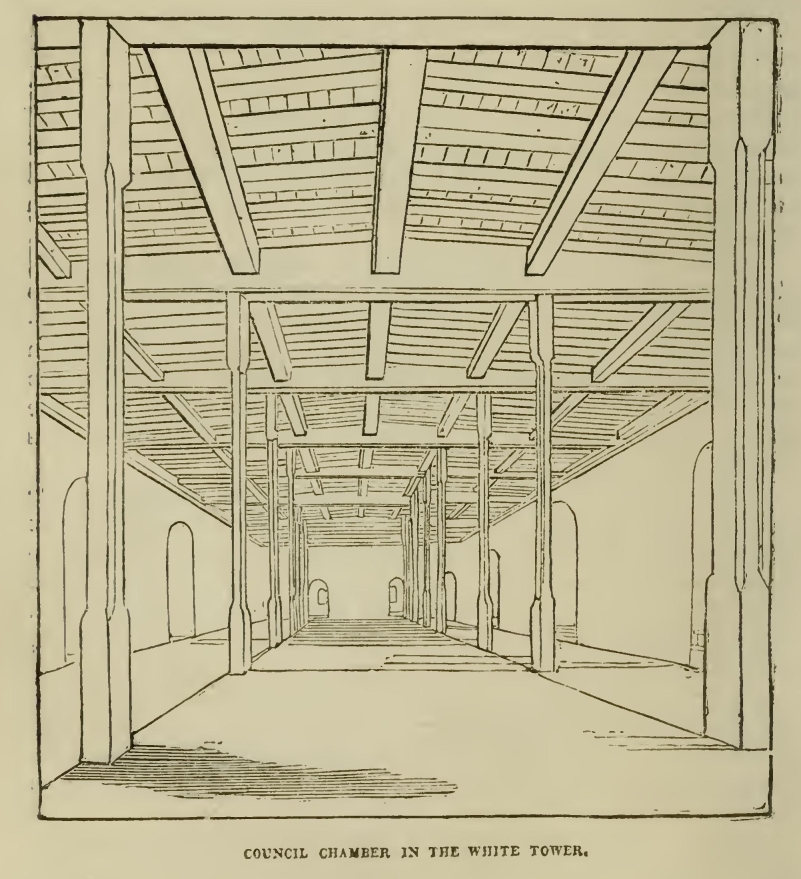
Matters were in this state at the commencement of the new year, when as above related, the ambassadors arrived from the court of Spain. Shortly after their arrival, they had an audience of the queen in the council-chamber of the White Tower; and when they had declared in due form that the Prince of Spain demanded her in marriage, she replied with great dignity, but some little prudery:—

“It does not become one of my sex to speak of her marriage, nor to treat of it herself. I have therefore charged my council to confer with you on the matter, and, by the strictest conditions, to assure all rights and advantages to my kingdom, which I shall ever regard as my first husband.”
As she pronounced the last words she glanced at the ring placed on her finger by Gardiner on the day of her coronation.
On the following day, the four ambassadors held a conference with Gardiner, Arundel, and Paget. The terms were entirely settled; and on the 12th of January, the treaty was signed, and delivered on both sides.