At the appointed time, Saint John’s chapel was thronged with armed men; and as the royal train passed along the upper gallery, and glanced down upon them, Mary was inexpressibly struck by the scene. Banners waved from the arched openings of the gallery, and the aisles and nave gleamed with polished steel. For fear of a sudden surprise, the soldiers were ordered to carry their weapons, and this circumstance added materially to the effect of the picture. Around the columns of the southern aisle were grouped the arquebussiers with their guns upon their shoulders; around those of the north stood the pike-men, in their steel caps and corslets; while the whole body of the nave was filled with archers, with their bows at their backs. Immediately in front of the altar stood the Duke of Norfolk, the Earls of Arundel and Pembroke, the lords Paget and Rochester; Sir Henry Bedingfeld; Sir Henry Jerningham, master of the horse; Sir Edward Bray, master of the ordnance, all in full armour. On the queen’s appearance all these personages bent the knee before her; and Bedingfeld, in virtue of his office, advancing a step before the others, drew his sword, and vowed he would never yield up the fortress but with life. He then turned to the troops, and repeated his determination to them. And the walls of the sacred structure rang with the shouts of the soldiers.
“You have yet loyal followers enow who will shed their last drop of blood in your defence,” he added to Mary.
“I nothing doubt it, dear Sir Henry,” she replied, in a voice of deep emotion. “I will share your danger, and, I trust, your triumph.”
Solemn mass was then performed by Gardiner, who was attended by Bonner, Tunstal, Feckenham, and other prelates and priests in their full robes. On its conclusion, the queen gave her hand to Sir Henry Bedingfeld, and followed by the whole assemblage, proceeded to the council-chamber, and took her seat beneath the state canopy.
As soon as the whole party was assembled, silence was commanded, and Mary spoke as follows: “I need not acquaint you that a number of Kentish rebels have seditiously and traitorously gathered together against us and you. Their pretence, as they at first asserted, was to resist a marriage between us and the prince of Spain. To this pretended grievance, and to the rest of their evil-contrived complaints, you have been made privy. Since then, we have caused certain of our privy council to confer with the rebels, and to demand the cause of their continuance in their seditious enterprise; and by their own avowal it appears that our marriage is the least part of their quarrel. For they now, swerving from their first statement, have betrayed the inward treason of their hearts, arrogantly demanding the possession of our person, the keeping of our Tower of London, and not only the placing and displacing of our council, but also the head of one who is an ambassador at our court, and protected by his office from injury.”
Here a murmur of indignation arose among the assemblage.
“Now, loving subjects,” continued Mary, “what I am you right well know. I am your queen, to whom, at my coronation, when I was wedded to the realm, and to the laws of the realm, (the spousal ring whereof I hold on my finger, never as yet left off, nor hereafter to be so), you promised your allegiance and obedience. And that I am the right and true inheritor of the crown of England, I not only take all Christendom to witness, but also your own acts of parliament confirming my title. My father, as you all know, possessed the regal estate by right of inheritance; and by the same right it descended to me. To him you always showed yourselves faithful subjects, and obeyed and served him as your liege lord and king. And, therefore, I doubt not you will show yourselves equally loyal to me, his daughter.”
“God save your highness!” cried the whole assemblage. “Long live Queen Mary!”
“If you are what I believe you,” pursued Mary, energetically; “you will not suffer any rebel to usurp the governance of our person, nor to occupy our estate, especially so presumptuous a traitor as this Wyat, who having abused our subjects to be adherents to his traitorous quarrel, intends, under some plea, to subdue the laws to his will, and to give scope to the rascal and forlorn persons composing his army to make general havoc and spoil of our good city of London.
“Down with Wyat!” cried several voices. “Down with the rebels!”
“Never having been a mother,” continued Mary, “I cannot tell how naturally a parent loves her children: but certainly a queen may as naturally and as tenderly love her subjects as a mother her child. Assure yourselves, therefore, that I, your sovereign lady, do as tenderly love and favour you; and thus loving you, I cannot but think that you as heartily and faithfully love me again. And so, joined together in a knot of love and of concord, I doubt not we shall be able to give these rebels a short and speedy overthrow.”
Here she was again interrupted by the most enthusiastic expressions of loyalty and devotion.
“On the word of a queen I promise you,” concluded Mary, “if it shall not appear to the nobility and commons in parliament assembled, that my intended marriage is for the benefit of the whole realm, I will not only abstain from it, but from any other alliance. Pluck up your hearts, then, and like true men stand fast with your lawful queen against these rebels, both my enemies and yours, and fear them not, for I fear them nothing at all.”
Thundering plaudits followed Mary’s oration, which, it was evident, had produced the desired effect upon the assemblage; and if any one entered the council-chamber wavering in his loyalty, he returned confirmed in his attachment to the throne. Mary’s intrepid demeanour was sufficient to inspire courage in the most faint-hearted; and her spirit imparted an expression of beauty to her countenance which awakened the warmest admiration among all the beholders.
“You have proved yourself a worthy daughter of your august sire, madam,” observed Bedingfeld.
“I will prove myself so before I have done, Sir Henry,” rejoined Mary, smiling. “I trust myself wholly to you.”
“Your majesty may depend upon me,” replied the old knight. “And now, with your permission, I will withdraw my forces, and visit the ramparts. After your address no one will forsake his post.”
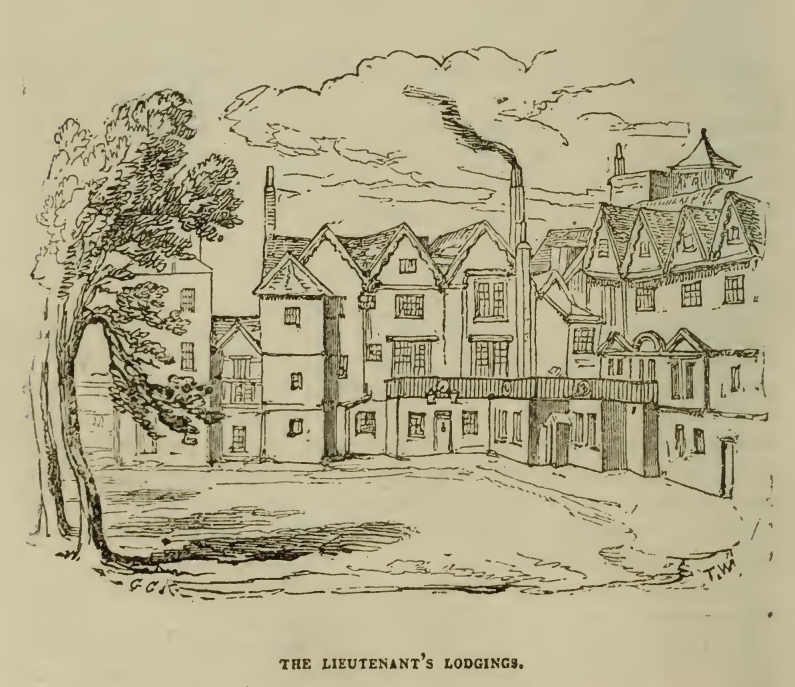
So saying, he departed with the troops, and, after making his rounds, returned to his lodgings.

Mary then appointed Lord William Howard, in conjunction with the Lord Mayor, Sir Thomas White, to the government of the city, and the Earl of Pembroke to the command of the army. These arrangements made, she continued for some time in conference with Gardiner and Renard. Just as she was about to retire, Sir Henry Bedingfeld came to apprise her that Wyat’s army had reached Southwark, and had taken up a position at the foot of London Bridge. After mature deliberation, it was resolved that the rebel-leader should be invited to an interview with the queen; and Bedingfeld was intrusted with the mission.
Proceeding to Traitor’s Gate, the old knight embarked in a wherry with four soldiers and a herald, and was rowed towards the hostile party. As he drew near the Surrey side of the water, Wyat’s sentinels presented their calivers at him; but as soon as they perceived he was attended by a herald, they allowed him to approach. On learning his errand, Wyat, contrary to the advice of the Duke of Suffolk and Lord Guilford Dudley, determined to accompany him.
“You will fall into some snare,” observed Dudley, “and lose the day when you have all but gained it.”
“Have no fears,” replied Wyat. “We shall conquer without striking a blow. Mary would not have made this proposal to me had she not felt certain of defeat.”
“But dare you trust her?” demanded Suffolk.
“Sir Henry Bedingfeld has pledged his word for my safe return, and I know him too well to doubt it. Farewell, my lords. We shall meet again in an hour.”
“I much doubt if we shall meet again at all,” observed Dudley to the duke, as Wyat stepped into Bedingfeld’s wherry, which was rowed swiftly across the river, and presently disappeared beneath the gloomy arch of Traitor’s Gate.
Ushered into the council-chamber, Wyat found Mary seated on a chair of state placed at the head of a row of chairs near a partition dividing the vast apartment, and covered with arras representing various naval engagements. The wooden pillars supporting the roof were decorated with panoplies; and through an opening on the right of the queen, Wyat perceived a band of armed men, with their leader at their head, cased in steel, and holding a drawn sword in his hand. Noticing these formidable preparations with some uneasiness, he glanced inquiringly at Bedingfeld.
“Fear nothing,” observed the old knight. “My head shall answer for yours.”
Thus re-assured, Wyat advanced more confidently towards the queen, and when within a few paces of her, paused and drew himself up to his full height. Bedingfeld took up a station on the right of the royal chair, and supported himself on his huge two-handed sword. On the left stood Gardiner and Renard.
“I have sent for you, traitor and rebel that you are,” commenced Mary, “to know why you have thus incited my subjects to take up arms against me?”
“I am neither traitor nor rebel, madam,” replied Wyat, “as I have already declared to one of your council, and I but represent the mass of your subjects, who being averse to your union with the prince of Spain, since you refuse to listen to their prayers, are determined to make themselves heard.”
“Ha! God’s death! sir,” cried Mary, furiously, “do you, or do any of my subjects think they can dispose of me in marriage as they think proper? But this is an idle pretext. Your real object is the subversion of my government, and my dethronement. You desire to place the princess Elizabeth on the throne—and in default of her, the Lady Jane Grey.”
“I desire to uphold your majesty’s authority,” replied Wyat, “provided you will comply with my demands.”
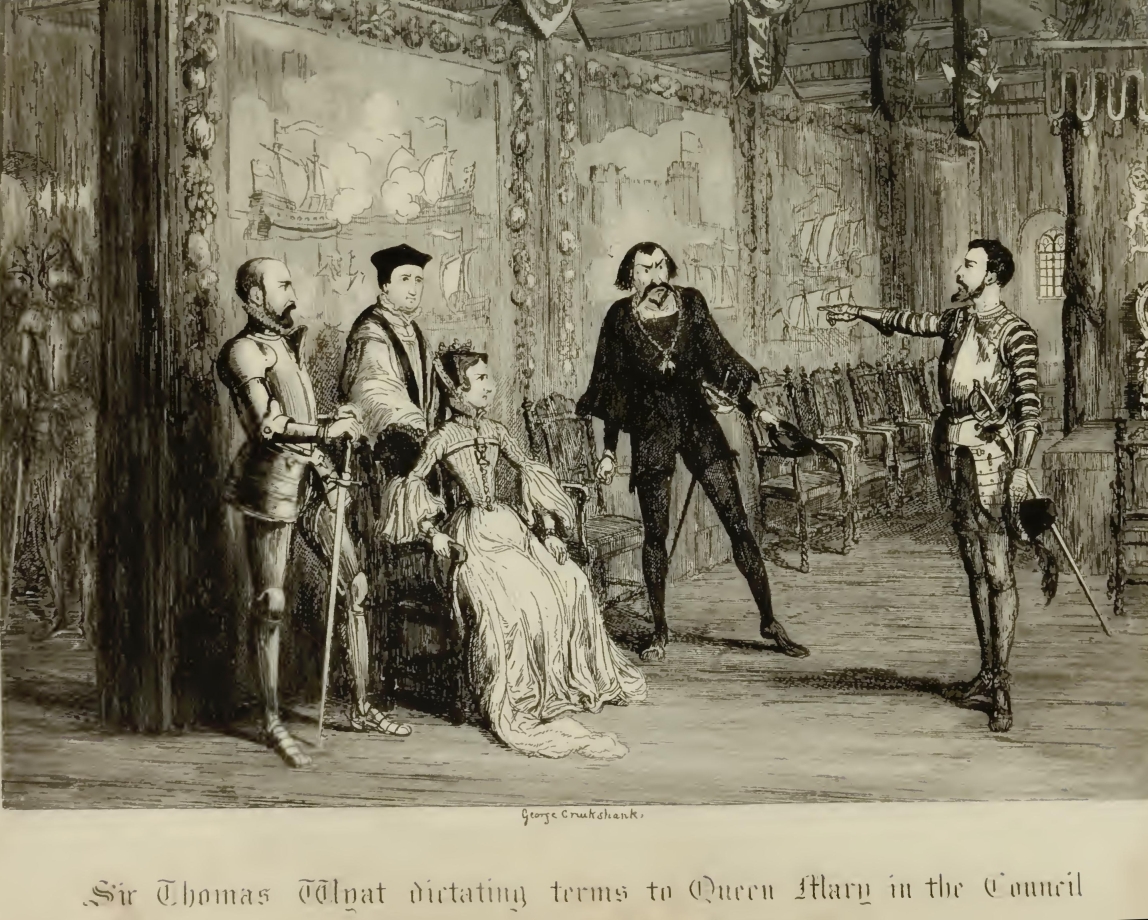
“Demands!” cried Mary, stamping her foot, while her eyes flashed fire. “It is the first time such a term has been used to me, and it shall be the last. In God’s name, what are your demands? Speak, man.”
“These, madam,” replied Wyat, firmly. “I demand the custody of the Tower,—the care of your royal person,—the dismissal of your council,—and the head of your false counsellor, Simon Renard.”
“Will nothing less content you?” inquired Mary, sarcastically.
“Nothing,” returned Wyat.
“I pray your majesty to allow me to punish the insolence of this daring traitor,” cried Renard, in extremity of fury.
“Peace, sir,” rejoined Mary, majestically. “Now hear me in turn, thou traitor Wyat. No man ever dictated terms to my father, and, by his memory! none shall do so to me. At once, and peremptorily, I reject your conditions; and had not Sir Henry Bedingfeld pledged his word for your safety, my guards should have led you from hence to the scaffold. Quit my presence, and as I would rather be merciful than severe, and spare the lives of my subjects than destroy them, if you disperse your host, and submit yourself to my mercy, I will grant you a free pardon. Otherwise, nothing shall save you.”
“When we next meet your majesty may alter your tone,” rejoined Wyat; “I take my leave of your highness.”
So saying, he bowed and retired with Sir Henry Bedingfeld.
“Your majesty will not let him escape?” cried Renard.
“In sooth but I shall sir,” replied Mary; “my word must be kept even with a traitor.”
“You are over-scrupulous, madam,” rejoined Renard; “there is no faith to be kept with such a villain. Beseech you, let me follow him. His head, displayed to his companions, will disperse them more speedily than your whole army.”
“I have already said it must not be,” replied Mary.
“Nay then,” rejoined Renard, “I will take the responsibility of the act upon myself.”
“Disobeyed!” exclaimed Mary, authoritatively. “I command you not to leave the presence.”
“Your majesty will repent this mistaken clemency,” cried Renard, chafing with fury.
“I shall never repent adhering to my word,” returned Mary. “And see here comes our lieutenant. How now, Sir Henry? Is the traitor gone?”
“He is, your highness,” replied Bedingfeld; “and it required all my authority to prevent the infuriated guard from falling upon him, and cutting him in pieces.”
“I am glad you were with him,” replied Mary; “I would not for the best jewel in my crown that any harm had happened to him. Give me your hand, Sir Henry. I will myself visit the ramparts, and cheer the soldiers with my presence.”
“Your majesty will expose yourself,” returned Bedingfeld.
“To whom?” replied Mary,—“only to my subjects. They will not dare to assail their queen. The daughter of your old master, Henry the Eighth, should have no fear.”