Towards the close of the day following that on which the rebels were defeated, a boat, rowed by a single waterman, shot London Bridge, and swiftly approached the Tower wharf. It contained two persons, one of whom, apparently a female, was so closely muffled in a cloak that her features could not be discerned; while her companion, a youthful soldier, equipped in his full accoutrements, whose noble features were clouded with sorrow, made no attempt at concealment. As they drew near the stairs, evidently intending to disembark, the sentinels presented their arquebusses at them, and ordered them to keep off; but the young man immediately arose, and said that having been concerned in the late insurrection, they were come to submit themselves to the queen’s mercy. This declaration excited some surprise among the soldiers, who were inclined to discredit it, and would not have suffered them to land, if an officer of the guard, attracted by what was passing, had not interfered, and granted the request. By his command, they were taken across the draw-bridge opposite the stairs, and placed within the guard-room near the By-ward Tower. Here the officer who had accompanied them demanded their names and condition, in order to report them to the lieutenant.
“I am called Cuthbert Cholmondeley,” replied the young man, “somewhile esquire to Lord Guilford Dudley.”
“You bore that rebel lord’s standard in the attack on the Brass Mount—did you not?” demanded the officer, sternly.
“I did,” replied Cholmondeley.
“Then you have delivered yourself to certain death, young man,” rejoined the officer. “What madness has brought you hither? The queen will show you no mercy, and blood enough will-flow upon the scaffold without yours being added to the stream.”
“I desire only to die with my master,” replied Cholmondeley.
“Where is Lord Guilford Dudley?” demanded the muffled’ female, in a tone of the deepest emotion.
“Confined in one of the secret dungeons—but I may not answer you further, madam,” replied the officer.
“Are his wounds dangerous?” she continued, in a tone of the deepest anxiety.
“They are not mortal, madam,” he answered. “He will live long enough to expiate his offences on the scaffold.”
“Ah!” she exclaimed with difficulty, repressing a scream.
“No more of this—if you are a man,” cried Cholmondeley, fiercely. “You know not whom you address.” *
“I partly guess.” replied the officer, with a compassionate look. “I respect your sorrows, noble lady—but oh! why—why are you here? I would willingly serve you—nay, save you—but it is out of my power.”
“My presence here must show you, sir, that I have no wish to avoid the punishment I have incurred,” she replied. “I am come to submit myself to the queen. But if you would serve me—serve me without danger to yourself, or departure from your duty—you will convey this letter without delay to her highness’s own hand.”
“It may be matter of difficulty,” rejoined the officer, “for her majesty is at this moment engaged in a secret conference in the Hall Tower, with the chancellor and the Spanish ambassador. Nay, though I would not further wound your feelings, madam, she is about to sign the death-warrants of the rebels.”
“The more reason, then,” she replied, in accents of supplicating eagerness, “that it should be delivered instantly. Will you take it?”
The officer replied in the affirmative.
“Heaven’s blessing upon you!” she fervently ejaculated. Committing the captives to the guard, and desiring that every attention, consistent with their situation, should be shown them, the officer departed. Half an hour elapsed before his return, and during the interval but few words were exchanged between Cholmondeley and his companion. When the officer reappeared, she rushed towards him, and inquired what answer he brought.
“Your request is granted, madam,” he replied. “I am commanded to bring you to the queen’s presence; and may your suit to her highness prove as successful as your letter! You are to be delivered to the chief jailor, sir,” he added to Chol-mondeley, “and placed in close custody.”
As he spoke, Nightgall entered the guard-room. At the sight of his hated rival, an angry flush rose to the esquire’s countenance—nor was his wrath diminished by the other’s exulting looks.
“You will not have much further power over me,” he observed, in answer to the jailor’s taunts. “Cicely, like Alexia, is out of the reach of your malice. And I shall speedily join them.”
“You are mistaken,” retorted Nightgall, bitterly. “Cicely yet lives; and I will wed her on the day of your execution. Bring him away,” he added, to his assistants. “I shall take him, in the first place, to the torture-chamber, and thence to the subterranean dungeons. I have an order to rack him.”
“Farewell, madam,” said the esquire, turning from him, and prostrating himself before his companion, who appeared in the deepest anguish; “we shall meet no more on earth.”
“I have destroyed you,” she cried. “But for your devotion to me, you might be now in safety.”
“Think not of me, madam—I have nothing to live for,” replied the esquire, pressing her hand to his lips. “Heaven support you in this your last, and greatest, and—as I can bear witness—most unmerited trial. Farewell, for ever!”
“Ay, for ever!” repeated the lady. And she followed the officer; while Cholmondeley was conveyed by Nightgall and his assistants to the secret entrance of the subterranean dungeons near the Devilin Tower.
Accompanied by his charge, who was guarded by two halberdiers, the officer proceeded along the southern ward, in the direction of the Hall Tower—a vast circular structure, standing on the east of Bloody Tower.
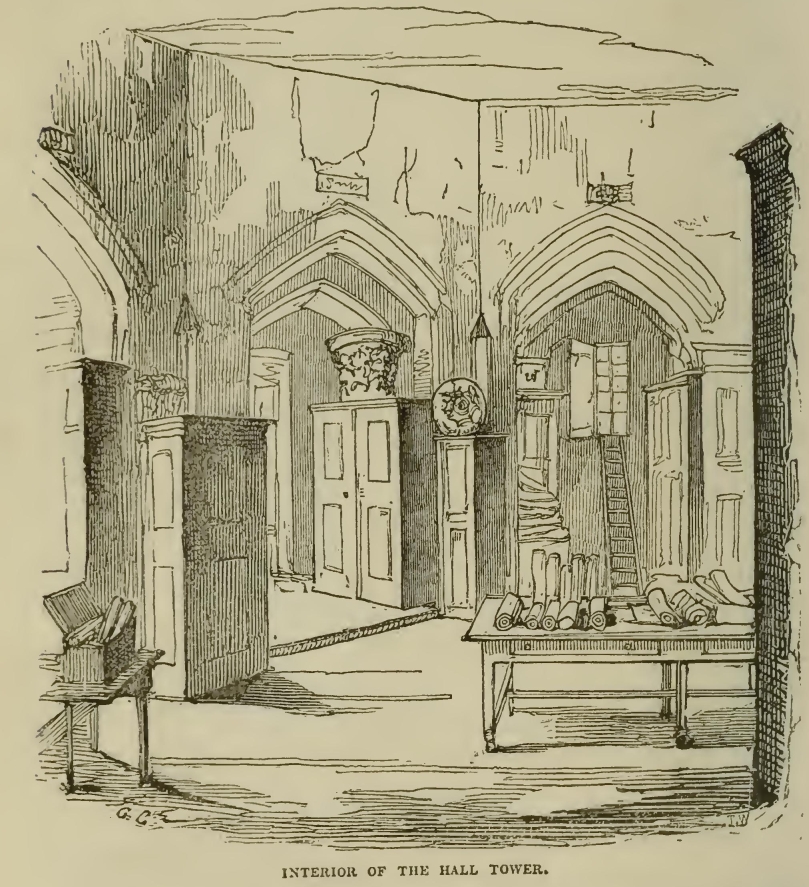

This fabric, (sometimes called the Wakefield Tower from the prisoners confined within it, after the battle of that name in 1460, and more recently the Record Tower, from the use to which it has been put,) is one of the oldest in the fortress, and though not coeval with the White Tower, dates back as far as the reign of William Rufus, by whom it was erected. It contains two large octagonal chambers,—that on the upper story being extremely lofty, with eight deep and high embrazures, surmounted by pointed arches, and separated by thin columns, springing from the groined arches formerly supporting the ceiling, which though unfortunately destroyed, corresponded, no doubt, with the massive and majestic character of the apartment. In this room tradition asserts that
—the aspiring blood of Lancaster
Sank in the ground:—
—it being the supposed scene of the murder of Henry the Sixth by the ruthless Gloster. And whatever doubts may be entertained as to the truth of that dark legend, it cannot be denied that the chamber itself seems stamped with the gloomy character of the occurrence. In recent times, it has been devoted to a more peaceful purpose, and is now fitted up with presses containing the most ancient records of the kingdom. The room on the basement floor is of smaller dimensions, and much less lofty. The recesses, however, are equally deep, though not so high, and are headed by semicircular arches. At high tides it is flooded, and a contrivance for the escape of the water has been made in the floor.
Passing through an arched doorway on the east of this structure, where the entrance to the Record Office now stands, the officer conducted his prisoner up a spiral stone staircase, and left her in a small antechamber, while he announced her arrival. The unhappy lady still kept herself closely muffled. But though her features and figure were hidden, it was evident she trembled violently. In another moment, the officer reappeared, and motioning her to follow him, led the way along a narrow passage, at the end of which hangings were drawn aside by two ushers, and she found herself in the presence of the queen.
Mary was seated at a table, near which stood Gardiner and Renard, and at the new-comer’s appearance she instantly arose.
The interview about to be related took place in the large octangular chamber previously described. It was sumptuously furnished: the walls were hung with arras from the looms of Flanders, and the deep recesses occupied with couches, or sideboards loaded with costly cups and vessels.
Hastily advancing towards the queen, the lady prostrated herself at her feet, and, throwing aside her disguise, revealed the features of Jane. She extended her hands supplicatingly towards Mary, and fixed her streaming eyes upon her, but was for some moments unable to speak.
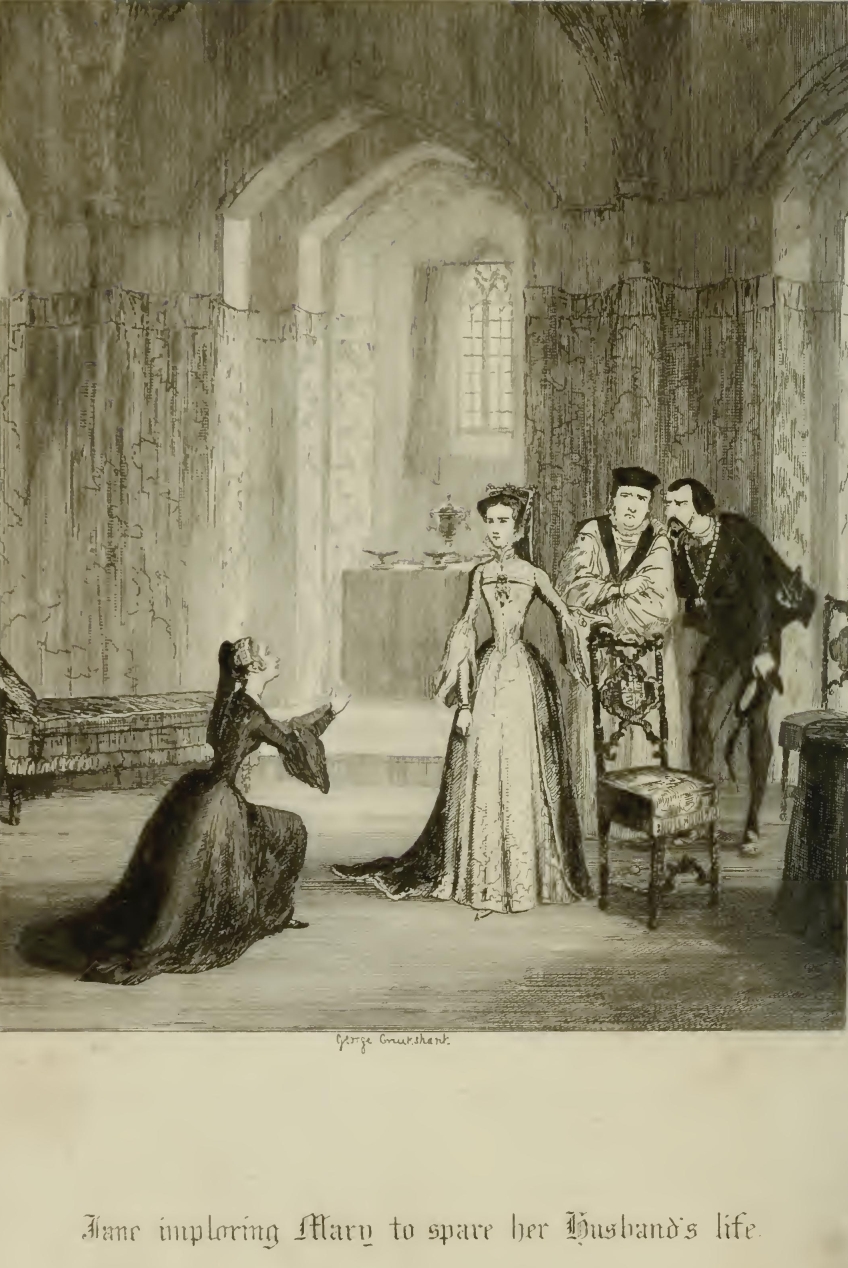
“I am come to submit myself to your highness’s mercy,” she said, as soon as she could find utterance.
“Mercy!” exclaimed Mary, scornfully. “You shall receive justice, but no mercy.”
“I neither deserve, nor desire it,” replied Jane. “I have deeply, but not wilfully—Heaven is my witness!—offended your majesty, and I will willingly pay the penalty of my fault.”
“What would you with me?” demanded Mary. “I have acceded to this interview in consideration of your voluntary submission. But be brief. I have important business before me, and my heart is steeled to tears and supplications.”
“Say not so, gracious madam,” rejoined Jane. “A woman’s heart can never be closed to the pleadings of the unfortunate of her own sex, still less the heart of one so compassionate as your highness. I do not sue for myself.”
“For whom, then?” demanded the queen.
“For my husband,” replied Jane.
“I am about to sign his death-warrant,1’ replied Mary, in a freezing tone.
“I will not attempt to exculpate him, madam,” returned Jane, restraining her emotion by a powerful effort, “for his offence cannot be extenuated. Nay, I deplore his rashness as much as your highness can condemn it. But I am well assured that vindictiveness is no part of your royal nature—that you disdain to crush a fallen foe—and that, when the purposes of justice are answered, no sentiments but those of clemency will sway your bosom. I myself, contrary to my own wishes, have been the pretext for the late insurrection, and it is right I should suffer, because while my life remains, your highness may not feel secure. But my husband has no claims, pretended or otherwise, to the throne, and when I am removed, all fear of him will be at an end. Let what I have done speak my sincerity. I could have escaped to France, if I had chosen. But I did not choose to accept safety on such terms. Well knowing with whom I had to deal—knowing also that my life is of more importance than my husband’s, I have come to offer myself for him. If your highness has any pity for me, extend it to him, and heap his faults on my head.”
“Jane,” said Mary, much moved—“you love your husband devotedly.”
“I need not say I love him better than my life, madam,” replied Jane, “for my present conduct will prove that I do so. But I love him so well, that even his treason to your highness, to whom he already owes his life, cannot shake it. Oh, madam! as you hope to be happy in your union with the Prince of Spain—as you trust to be blessed with a progeny which shall continue on the throne of this kingdom—spare my husband—spare him for my sake.”
“For your sake, Jane, I would spare him,” replied Mary, in a tone of great emotion, “but I cannot.”
“Cannot, madam!” cried Jane—“you are an absolute queen, and who shall say you nay? Not your council—not your nobles—not your people—not your own heart. Your majesty can and will pardon him. Nay, I read your gracious purpose in your looks. You will pardon him, and your clemency shall do more to strengthen your authority than the utmost severity could do.”
“By Saint Paul!” whispered Renard to Gardiner, who had listened with great interest to the conference, and now saw with apprehension the effect produced on Mary, “she will gain her point, if we do not interfere.”
“Leave it to me,” replied Gardiner. “Your majesty will do well to accede to the Lady Jane’s request,” he remarked aloud to the queen, “provided she will comply with your former proposition, and embrace the faith of Rome.”
“Ay,” replied Mary, her features suddenly lighting up, “on these terms I will spare him. But your reconciliation with our holy church,” she added to Jane, “must be public.”
“Your highness will not impose these fatal conditions upon me,” cried Jane, distractedly.
“On no other will I accede,” replied Mary, peremptorily. “Nay, I have gone too far already. But my strong sympathy for you as a wife, and my zeal for my religion, are my inducements. Embrace our faith, and I pardon your husband.”
“I cannot,” replied Jane, in accents of despair; “I will die for him, but I cannot destroy my soul alive.”
“Then you shall perish together,” replied Mary, fiercely. “What ho! guards. Let the Lady Grey be conveyed to the Brick Tower, and kept a close prisoner during our pleasure.” And, waving her hand, Jane was removed by the attendants, while Mary seated herself at the table, and took up some of the papers with which it was strewn, to conceal her agitation.
“You struck the right key, my lord,—bigotry,” observed Renard, in an under tone to Gardiner.