Both men continued to stand during the interview that followed—the one in his white robes by the end of the sofa, resting two tapering fingers upon it, the other in his General's uniform by the side of the desk, except when in the heat of his anger he strode with heavy step and the jingling of spurs across the space between.
"Now, sir, now," said the General. "I have urgent work to do, and not much time to give you. What is it?"
"I come," said Ishmael, who was outwardly very calm, though his large black eyes were full of fire and light, "I come to speak to you about the order to close El Azhar."
"Then you come to the wrong place," said the General sharply. "You should go to the Agency—the British Agency."
"I have seen the English lord already. He refuses to withdraw his order. Therefore I am here to ask you—forgive me—I am here to ask you not to obey it."
The General tried to laugh. "Wonderful!" he said. "Your Eastern ideas of discipline are wonderful! Please understand, sir, I am here as the instrument of authority—that and that only."
"An instrument has its responsibility," said Ishmael. "If there were no instruments to do evil deeds would evil deeds be done? It is not your fault, sir, that the order has been issued, but it will be your fault if it is carried into effect."
"Really!" said the General, again trying to laugh. "Permit me to tell you, sir, that in this case there will be no fault in question, neither of mine nor anybody else's. El Azhar is a hotbed of sedition, and it is high time the Government cleared it out."
"El Azhar," said Ishmael, "is the heart of the Moslem faith. Take their religion away from them and the Moslems have nothing left. You are a Christian, and when your great Master was on earth He fed the souls of the people first."
"Yes, and He whipped the rascals out of the temple, and that's what the Government is going to do now—to drive out the pretentious impostors who are putting a lying spirit into the mouth of the people and making it impossible to govern them."
The Egyptian showed no anger. "I am here only to plead for the people, sir. Do not harden your heart against them. Do not send armed men among an unarmed populace. It will be slaughter."
"Tell them to submit to the Government and there will be no harm done to any one. It's their duty, isn't it? Whatever the Government may be, isn't it their duty to submit to it?"
"Yes," said Ishmael. "We who are Moslems are taught by the Prophet (blessed be his name!) that even if a negro slave is appointed to rule over us we ought to obey him."
"Deuce take it, sir, what do you mean by that?" said the General.
"But Government is a trust from God," said the Egyptian, "and at the Day of Resurrection the Most High will ask you what you have done to His children."
"Damn it, sir, have you come here to preach me a sermon?"
"I have come to plead with you for justice—the justice you look for from your Saviour. 'Be merciful to the weak,' He taught, and it is for the weak I appeal to you. He was meek and lowly—will you forget His precepts? 'Love one another'—will you make strife between man and man? He is dead—shall it be said that His spirit has died out among those who call Him their Redeemer?"
The General brought his fist heavily down on the desk as if to command silence.
"Listen here, sir," he said. "If you imagine for one moment that this tall talk will have any effect upon me, let me advise you to drop it. Being a plain soldier who has received a plain command, I shall take whatever military steps are necessary to see it faithfully carried out, and if the precious leaders of the people, playing on their credulity and fanaticism, should instigate rebellion, I shall have the honour—understand me plainly—I shall have the honour to lodge them in safe quarters, whosoever they are and whatsoever their pretensions may be."
The Egyptian's eyes showed at that moment that he was a man capable of wild frenzy, but he controlled himself and answered—
"I am not here to defend myself, sir. You can take me now if you choose to do so. But if I cannot plead with you for the people let me plead with you for yourself—your family."
The General, who had turned away from Ishmael, swung round on him.
"My family?"
"He that troubleth his own house, saith the Koran, shall inherit the wind. Will you, my brother, allow your daughter to be separated from the brave man who loves her? A woman is tender and sweet; all she wants is love; and love is a sacred thing, sir. Your daughter is your flesh and blood—will you make her unhappy? I see a day when you are dead—will it comfort you in the grave that two who should be together are apart?"
"They're apart already, so that's over and done with," said the General. "But listen to me again, sir. My girl needs none of your pity. She has done her duty as a soldier's daughter, and cut off the traitor whom you, and men like you, appear to have corrupted. Look here—and here," he cried, pointing to the broken sword and the medals which were still lying where he had flung them on the floor. "The man has gone—gone in disgrace and shame. That's what you've done for him, if it's any satisfaction to you to know it. As for my daughter," he said, raising his voice in his gathering wrath and striding up to Ishmael with heavy steps and the jingling of his spurs, "As for my daughter, Helena, I will ask you to be so good as to keep her name out of it—do you hear? Keep her name out of it, or else——"
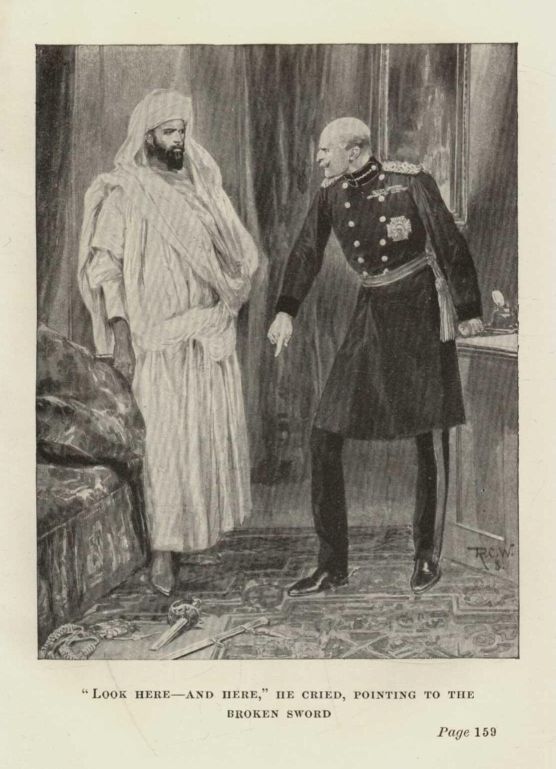 "Look here—and here," he cried, pointing to the broken sword
At that moment the men heard the door open and a woman's light footsteps behind them. It was Helena coming into the room.
"Did you call me, father?" she asked.
"No; go back immediately."
She looked doubtfully at the two men, who were now face to face as if in the act of personal quarrel, hesitated, seemed about to speak, and then, went out slowly.
There was silence for a moment after she was gone, and then Ishmael said—
"Do I understand you to say, sir, that Colonel Lord has gone in disgrace?"
"Yes, for consorting with the enemies of his country and refusing to obey the order of his General."
"Lost his place and rank as a soldier?"
"Soon will, and then he will be alone and have you to thank for it."
The Egyptian drew himself up to his full height and answered, "You are wrong, sir. He who has no one has God, and if that brave man has suffered rather than do an evil act, will God forget him? No!"
"God will do as He thinks best without considering either you or me, sir," said the General. "But I have something to do and I will ask you to leave me.... Or wait one moment! Lest you should carry away the impression that because Colonel Lord has refused to obey his General's order the order will not be obeyed—wait and see."
He touched the bell and called for his Aide-de-camp.
"Tell Colonel Macdonald to come to me immediately," said the General, and when the Aide-de-camp had gone he turned to his desk for papers.
The Egyptian, who had never moved from his place by the sofa, now took one step forward and said in a low, quivering voice—
"General, I have appealed to you on behalf of my people and on your own behalf, but there is one thing more."
"What is it?"
"Your country."
The General made an impatient gesture, and the Egyptian said, "Hear me, I beg, I pray! Real as life, real as death, real as wells of water in a desert place, is their religion to the Muslemeen, and if you lay so much as your finger upon it your Government will die."
He raised his hand and with one trembling finger pointed upwards. "Do you think your swords will govern them? What can your swords do to their souls? By the Most High God I swear to you that I have only to speak the word and the rule of England in Egypt will end."
At that moment Colonel Macdonald, a large man in khaki, a Highlander, with a ruddy face and a glass in his left eye, opened the door and stood by it, while the General, whose own face was scarlet with anger, said—
"So! So that's how you talked to Colonel Lord, I presume—how you darkened the poor devil's understanding! Now see—see what effect your threats have upon me. Step forward, Colonel Macdonald."
The Colonel saluted and stepped up to the General, who repeated to him word for word the order he had given to Gordon, and then said—
"You will arrest all who resist you, and if any resist with violence you will compel obedience—you understand?"
"Perfectly," said the Colonel, and saluting again he left the room.
"Now, sir, you can go," said the General to Ishmael, whereupon the Egyptian, whose face had taken on an extreme pallor, replied—
"Very well! I have warned you and you will not hear me. But I tell you that at this moment Israfil has the trumpet to his mouth and is only waiting for God's order to blow it! I tell you, too, that I see you—you—on the Day of Judgment, and there are black marks on your face."
"Silence, sir!" said the General, bringing his clenched fist heavily down on the desk. Then he struck the bell, and in a choking voice called first for his servant and afterwards for his Aide-de-camp. "Robson! See this man out of the Citadel! This damnable, presumptuous braggart! Robson! Where are you?" But the servant did not appear and the Aide-de-camp did not answer.
"No matter," said the Egyptian. "I will go of myself. I will try to forget the hard words you have said of me. I will not retort them upon you. You are a Christian, and it was a Christian who said 'Resist not evil.' That is a commandment as binding upon us as upon you. God's will be done."
With that Ishmael went out as he had entered, slowly, solemnly, with head bent and eyes on the ground.