As the hours of the day passed on, Helena became painfully aware that her courage was ebbing away.
Unconsciously Ishmael was adding to her torture. Soon after the midday meal he called on her to write to his dictation a letter which Gordon was to take into Cairo...
"One more letter, O Rani, only one, before our friend and brother leaves us."
It was to the Ulema, telling them of the change in his plans and begging them to be good to Gordon.
"Trust him and love him. Receive him as you would receive me, and believe that all he does and says is according to my wish and word."
Helena had to write this letter. It was like writing Gordon's death-warrant.
Later in the day, seeing her idle, nibbling the top of the reed pen which she held in her trembling fingers, Ishmael called for the kufiah.
"Where is the kufiah, O Rani—the kufiah that was to disguise the messenger of God from his enemies?"
And when Helena, in an effort to escape from that further torture, protested that in Gordon's case a new kufiah was not essential, because he wore the costume of a Bedouin already, Ishmael replied—
"But the kufiah he wears now is white, and every official in Khartoum has seen it. Therefore another is necessary, and let it be of another colour."
At that, with fiendish alacrity, the Arab woman ran off for a strip of red silken wool, and Helena had to shape and stitch it.
It was like stitching Gordon's shroud.
The day seemed to fly on the wings of an eagle, the sun began to sink, the shadows to lengthen on the desert sand, and the time to approach for the great ceremony of the leave-taking in the mosque. Helena was for staying at home, but Ishmael would not hear of it.
"Nay, my Rani," he said. "In the courtyard after prayers we must say farewell to Omar, and you must clothe him in the new kufiah that is to hide him from his foes. Did you not promise to do as much for me? And shall it be said that you grudge the same honour to my friend and brother?"
Half-an-hour afterwards, Ishmael having gone off hand in hand with Gordon, and old Mahmud and Zenoba and Ayesha and the two black servants having followed him, Helena put on a veil for the first time since coming to Khartoum, and made her way to the mosque.
The streets of the town, as she passed through them, seemed to be charged with an atmosphere of excitement that was little short of frenzy; but the courtyard, when she had crossed the threshold, was like the scene of some wild phantasmagoria.
A crowd of men and women, squatting about the walls of the open space, were strumming on native drums, playing on native pipes, and uttering the weird, monotonous ululation that is the expression of the Soudanese soul in its hours of joy.
A moment later Helena was in the gallery, the people had made way for her, and she was sitting as before by the Arab woman and the child. Overhead was a brazen, blood-red Southern sky; below were a thousand men on crimson carpets, some in silks, some in rags, all moving and moaning like tumultuous waves in a cavern of the sea.
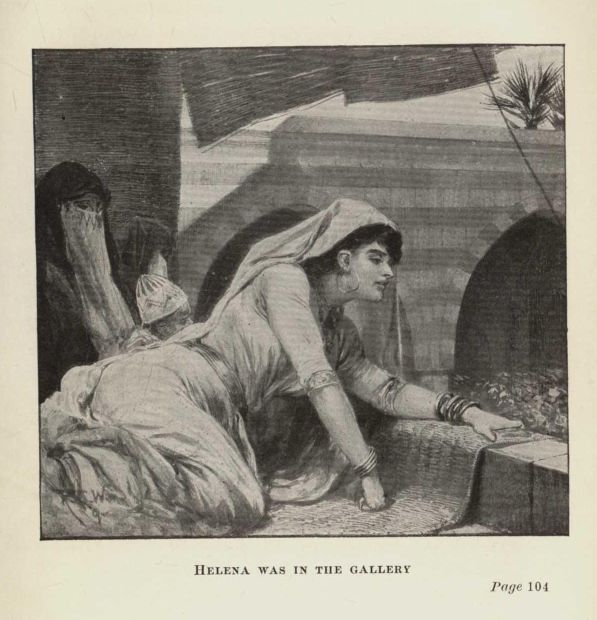 Helena was in the gallery
The Reader, in the middle of the mosque, was chanting the Koran, the muezzin in the minaret was calling to prayers, the men on the floor were uttering their many-throated responses, and the very walls of the mosque itself seemed to be vibrating with religious fervour.
A moment after Helena had taken her seat Ishmael entered, followed by Gordon, and the people gathered round them to kiss their hands and garments. Helena felt her head reel, she wanted to cry out, and it was with difficulty she controlled herself.
Then the Reader stood up in his desk and recited an invocation, and the people repeated it after him.
"God is Most Great!"
"God is Most Great!"
"There is no god but God! ...
"Mohammed is His Prophet! ...
"Listen to the preacher! ...
"Amen!"
"Amen!"
After that Ishmael rose from his knees before the Kibleh, took the wooden sword at the foot of the pulpit, ascended to the topmost step, and, after a preliminary prayer, began to preach.
Never had Helena seen him so eager and excited, and every passage of his sermon seemed to increase both his own ecstasy and the emotion of his hearers.
Helena hardly heard his words, so far away were her thoughts and so steadfastly were her eyes fixed on the other figure in front of the Kibleh, but a general sense of their import was beating on her brain as on a drum.
All religions began in poverty and ended in corruption.
It had been so with Islam, which began with the breaking of idols and went on to the worship of wealth, the quest of power, the lust of conquest—Caliphs seeking to establish their claim not by election and the choice of God but by theft and murder.
It had been so with Christianity, which began in meekness and humility and went on to pride and persecution—Holy Fathers exchanging their cells for palaces and their poverty for pomp, forgetting the principle of their great Master, whose only place in their midst was in pictured windows, on vaporous clouds, blessing with outstretched arms a Church which favoured everything he fought against and a world which practised everything he condemned.
"What is the result, O my brothers? War, wealth, luxury, sensuality, slavery, robbery, injustice, and oppression!
"Listen to the word of the Holy Koran: 'And Pharaoh made proclamation among his people, saying, Is not this Kingdom of Egypt mine and the rivers thereof?'
"But not in Egypt only, nor alone under the Government of the King who lives across the seas, but all the world over, wheresoever human empires are founded, wheresoever men claim the earth and the fruits of the earth and the treasures that lie in the bowels of the earth—impoverishing the children of men to obtain them, or destroying their souls that they may deck and delight their bodies—there the Pharaohs of this world are saying, 'Is not this Kingdom of Egypt mine and the rivers thereof?'
"But the earth and the fruits of the earth and the treasures of the earth are God's, my brothers, and He is coming to reclaim them, and to right the wrongs of the oppressed, to raise up the downtrodden, and to comfort the broken-hearted."
The mosque seemed to rock with the shouts which followed these words, and as soon as the cries of the people had subsided, the voice of Ishmael, now louder and more tremulous than before, rang through its vaults again.
"Deep in the heart of man, my brothers, is the expectation of a day when the Almighty will send His Messenger to purify and pacify the world and to banish intolerance and wrong. The Jews look for the Messiah, the Christians for the divine man of Judæa, and we that are Moslems for the Mahdi and the Christ.
"In all climes and ages, amid all sorrows and sufferings, sunk in the depths of ignorance, sold into slavery, the poorest of the poor, the most miserable among the most miserable of the world, humanity has yet cherished that great expectation. Real as life, real as death, real as wells of water in a desert land to man on his earthly pilgrimage is the hope of a Deliverer from oppression and injustice—and who shall say it is vain and false? It is true, my brothers, true as the sky rolling overhead. Our Deliverer is coming! He is coming soon! He is coming now!"
Ishmael's tremulous voice had by this time broken into hysterical sobs, and the responses of his hearers had risen to delirious cries.
More of the same kind followed which Helena did not hear, but suddenly she was awakened to full consciousness of what was going on about her by hearing Ishmael speak of Gordon and the people answering him with rapturous shouts.
"He is not of our race, yet no doubt enters into our hearts of his fidelity."
"El Hamdullillah!"
"He is not of our faith, yet he will be true to God and His people."
"Allah! Allah!"
"For us he has left his home, his country, and his kindred."
"Allah! Allah! Allah!"
"For us he is going into the place of danger."
"Allah! Allah! Allah!"
"What says the Lord in the Holy Koran?—'They therefore who had left their country and suffered for My sake I will surely bring them into gardens watered by rivers—a reward of God.'"
"Allah! Allah! Allah!"
"The Lord bless the white man to whom the black man is a brother! Bless him in the morning splendour! Bless him in the still of night! Bless him with children—the eye of the heart of man! Bless him with the love of woman—the joy and the crown of life!"
"Allah! Allah! Allah!"
"And may the Lord of majesty and might who has hitherto covered his head in battle protect and preserve him now!"
At this last word the whole company of men on the floor below—men in silks and men in rags—rose to their feet, as if they had been one being animated by one heart, and raising their arms to heaven, cried—
"Allah! Allah! Allah! Allah!"
Helena felt as if some one had taken her by the throat. To see these poor, emotional Eastern children, with their brown and black faces, streaming with tears and full of love for Gordon, shouting down God's blessing upon him, was stifling her.
It was like singing his dirge before he was dead.
During the next few minutes Helena was vaguely aware that Ishmael had come down from the pulpit; that the Reader was reciting prayers again; that the men on the crimson carpets were bowing, kneeling, prostrating themselves and putting their foreheads to the floor; and finally that the whole congregation was rising and surging out of the mosque.
When she came to herself once more, somebody by her side—it was Zenoba—was touching her shoulder and saying—
"The Master is in the Courtyard and he is calling for you—come!"
The scene outside was even more tumultuous. Instead of the steady solemnity of the service within the mosque there were the tum-tumming of the drums, the screeling of the pipes, and the lu-luing of the women.
The great enclosure was densely crowded, but a space had been cleared in the centre of the courtyard, where the Ulema of Khartoum, in their grey farageeyahs, were ranged in a wide half-circle. In the mouth of this half-circle Gordon was standing in his Bedouin dress with Ishmael by his side.
Silence was called, and then Ishmael gave Gordon his last instructions and spoke his last words of farewell.
"Tell our brothers, the Ulema of Cairo," he said, "that we are following close behind you, and when the time comes to enter the city we shall be lying somewhere outside their walls. Let them therefore put a light on their topmost height—on the minaret of the mosque of Mohammed Ali—after the call to prayers at midnight—and we shall take that as a sign that the Light of the World is with you, that the Expected One has appeared, and that we may enter in peace, injuring no man, being injured by none, without malice towards any, and with charity to all."
Then seeing Helena as she came out of the mosque, veiled and with her head down, he called on her to come forward.
"Now do as you have always designed and intended," he said. "Cover our friend and forerunner with the kufiah you have made for him, that until his work is done and the time has come to reveal himself, he may, like the angel of the Lord, be invisible to his foes."
What happened after that Helena never quite knew—only that a way had been made for her through the throng of wild-eyed people and that she was standing by Gordon's side.
Down to that instant she had intended to bear herself bravely for Gordon's sake if not for her own, but now a hundred cruel memories came in a flood to sap away her strength—memories of the beautiful moments of their love, of the little passages of their life together that had been so tender and so sweet. In vain she tried to recover the spirit with which he had inspired her in the morning, to think how much better it was that he should die gloriously than live in disgrace, to feel the justice, the necessity, the inevitableness of what he was going to do.
It was impossible. She could think of nothing but that she was seeing Gordon for the last time, that he was leaving her behind him, among these Allah-intoxicated Arabs, that he was going away, not into battle—with its chance of victory and its hope of life—but to death, certain death, perhaps shameful death, and that, say what he would about Fate and Destiny or the will of God, she herself was sending him to his doom.
She felt that the tears were running down her cheeks under her thin white veil, and that Gordon must see them, but she could not keep them back; and though she had promised not to break down, she knew that at that last moment, in the face of the death that was about to separate them, the dauntless heroine of the morning was nothing better than a poor, weak, heart-broken woman.
Meantime the drums and the pipes and the lu-luing had begun again, and she was conscious that under the semi-savage din Gordon was speaking to her and comforting her.
"Keep up! Be brave! Nobody knows what may happen. I'll write. You shall hear from me again."
He had taken off the white kufiah which he had hitherto worn, and she could see his face. It was calm—the calmest face in all that vast assembly.
The sight of his face strengthened her, and suddenly a new element entered into the half-barbaric scene—an element that was half human and half divine. These poor, half-civilised people thought Gordon was going to risk his life for them; but he was going to die—deliberately to die for them—to save them from themselves, from the consequences of their fanaticism, the panic of their rulers, and the fruits of the age-long hatred that had separated the black man from the white.
Helena felt her bosom heave, her nerves twitch, her fingers dig trenches in her palms, and her thoughts fly up to scenes of sacrifice which men talk of with bated breath.
"If he can do it, why can't I?" she asked herself, and taking the red kufiah, which the Arab woman was thrusting into her hands, with a great effort she put it on Gordon—over his head and under his chin and across his shoulders and about his waist.
It was like clothing him for the grave.
Every eye had been on her, and when her work was done, Ishmael, who was now weeping audibly, demanded silence and called on the Ulema to recite the first Surah—
"Praise be to God, the Lord of all creatures——"
When the weird chanting had come to an end the hoarse voices of the people broke afresh into loud shouts of "Allah! Allah! El Hamdullillah!"
In the midst of the wild maëlstrom of religious frenzy which followed—the tum-tumming of the drums, the screeling of the pipes, and the ululation of the women—Helena felt her hand grasped, and heard Gordon speaking to her again.
"Don't faint! Don't be afraid! Don't break down at the last moment."
"I'm not afraid," she answered, but whether with her voice or only with her lips she never knew.
Still the drums, the pipes, the zaghareet, and the delirious cries of "Allah!" And to show Gordon that she felt no fear, that she was not going to faint or to break down, Helena also, in the fierce tension of the moment, cried—
"Allah! El Hamdullillah!"
"That's right! That's brave! God bless you!" whispered the voice by her side. And again a moment later—
"God bless and protect you!"
After that she heard no more. She saw the broad gate of the Courtyard thrown open—she saw a long streak of blood-red sand outside—she saw Gordon turn away from her—she saw Ishmael embrace and kiss him—she saw the surging mass of hot and streaming black and brown faces close about him—and then a loud wind seemed to roar in her ears, the earth seemed to give way under her feet, the brazen sky seemed to reel about her head, and again she felt as if she were falling, falling, falling into a bottomless abyss.
When she recovered consciousness the half-barbaric scene was over, and she was being carried into the silence of her own room in the arms of Ishmael, who with many words of tender endearment was laying her gently on her bed.