“Where is Louis Mortimer?” asked Hamilton, the next Saturday afternoon, about a quarter of an hour after dinner. “Does any one know where Louis Mortimer is?”
“Here I am, Hamilton, prèt à vous servir, as Monsieur Gregoire would say!” cried Louis, starting from behind the school-room door.
“Are you engaged this afternoon?”
“Never, when you want me!” exclaimed Louis.
Hamilton looked gratified, but checked the expression as soon as he was aware of it.
“That is not right, Louis; I never wish, and never ought, to be an excuse for breaking an engagement.”
“But suppose I make your possible requirements a condition of my engagements,” said Louis, archly; “you have no objection to that, have you?”
“Only I cannot imagine such a case.”
“Such is the case, however, this afternoon. I had the vanity to hope you would let me walk with you, and so only engaged myself conditionally.”
“To whom were you engaged in default of my sufferance?”
“I was going to stay with Casson,” replied Louis, hesitatingly. “He has a cold and headache, and he asked me if I would stay with him in the class-room, where he is obliged to stay while we are out.”
“Casson!” said Hamilton, contemptuously; “you were not talking to him just now?”
“No; I was only listening to Ferrers. He was telling me about a wager Frank had just laid with Salisbury.”
“How is it you prefer Casson to your friend Clifton?”
“Oh, Hamilton, I don't much like Casson; but he asked me, poor fellow. Charlie's engaged to West—our days are Sunday, Monday, and Thursday.”
“Which of you is first now?”
“Charles is, to-day,” said Louis; “he is so very clever, Hamilton.”
“I know he is; but you are older, and not a dunce, if you were not idle, Louis. Louis, I shall repudiate you, if you don't get past him.”
“That would be a terrible fate,” said Louis, slipping his hand into Hamilton's. “I cannot tell you how I should miss your kind face and help. You have been such a very kind friend to me: but I have not been so very idle, Hamilton.”
“Yes, you have,” returned Hamilton; “I am vexed with you, Louis. If I did not watch over you as I do, you would be as bad as you were last half. Don't tell me you can't keep before Clifton if you choose.”
Louis looked gravely in Hamilton's face, and put his other hand on that he held. Hamilton drew his own quickly away.
“Lady Louisa,” he said, “these affectionate demonstrations may do well enough for us alone, but keep them for private service, and don't let us play Damon and Pythia in this touching manner, to so large an audience. It partakes slightly of the absurd.”
Louis colored, and seemed a little hurt; but he replied, “I am afraid I am very girlish sometimes.”
“Incontrovertibly,” said Hamilton, kindly laying his hand heavily on Louis' shoulder. “But we have no desire that any one should laugh at you but our royal self.”
“Are we going to the downs?” asked Louis.
Before Hamilton could answer, Frank Digby, one of the large audience alluded to, came up. “Of course,” he replied; “Hamilton is one of our party.”
“One of your party?” asked Hamilton.
“Your majesty's oblivious of the fact,” said Frank, “that among the many offices, honorary and distinctive, held by your most gracious self, the presidency of the ‘Ashfield Cricket Club’ is not altogether one of the most insignificant.”
“We will thank our faithful amanuensis to become our deputy this afternoon,” said Hamilton; “having a great desire to refresh ourself with a quiet discourse on the beauties of Nature.”
“No cricket this afternoon, Hamilton!” cried Louis; “I shall be so much disappointed if you go!”
“No cricket!” exclaimed Frank: “we will enter into a conspiracy, and dethrone Edward, if he refuses to come instanter.”
“Dethrone me by all means, this afternoon,” said Hamilton; “my deposition will save me a great deal of trouble. I am only afraid that my freedom from state affairs would be of short duration; my subjects appear to be able to do so little without me.”
“Hear him!” exclaimed Jones, laughing; “hear king Log!”
“No favoritism!” cried Smith; “I bar all partiality. We'll treat you in the Gaveston fashion, Louis, if you don't persuade your master to accede to our reasonable demands.”
“That would be treason against my own comforts,” said Louis, laughing, and struggling unsuccessfully to rise from the ground, where he had been playfully thrown by Salisbury. “To the rescue! your majesty; I cry help!”
“To the rescue!” shouted Reginald, pouncing suddenly upon Salisbury, and diverting his attention from Louis who would have recovered his feet, but for the intervention of one or two of the party.
“Your majesty perceives,” said Frank, “that a rebellion is already broken out. A word from you may compose all.”
“I have engaged to walk with Louis Mortimer, and I declare I will not stir anywhere without him,” said Hamilton.
“We cannot do without you, Hamilton,” said Trevannion, who had just joined the council. “You are engaged for all the meetings.”
“Which meetings have no right to be convened without the concurrence of the president;—eh, Mr. Secretary?” rejoined Hamilton.
“Of course you can please yourself,” said Trevannion, proudly.
“Let Louis get up, Jones,” said Hamilton.
“Does your majesty concede, or not?” said Jones, who was sitting upon Louis.
“I will answer when you let him get up.”
Jones suffered Louis to rise, breathless and hot with his laughing exertions to free himself from durance vile.
“I will come, on condition that Louis comes too.”
“Certainly,” said Salisbury.
“And join our game, mind,” said Hamilton.
“Oh!” exclaimed Smith; “that's decidedly another affair. You can't play, Sir Piers, can you?”
“He can learn,” said Hamilton, who was perfectly aware of his ignorance.
“I've not the smallest objection,” said Jones, “as I'm on the opposition side.”
“Nor I,” cried Salisbury; “though I should be a loser, as is probable.”
“Really, Hamilton,” exclaimed Trevannion, sulkily, “it's impossible! He'll only be in the way. I never saw such a fuss about a boy; it's quite absurd. If you want him, let him look on.”
“I don't like cricket,” said Louis.
“Humbug!” exclaimed Salisbury.
“I shall be in the way, as Trevannion says,” continued Louis; “I am sure I shall never learn.”
“ ‘Patientia et perseverantia omnia vincunt,’ ” remarked Frank; “which may be freely translated in three ways:
‘If a weary task you find it,
Persevere, and never mind it;’
or,
‘Never say die;’
or, thirdly,
‘If at first you don't succeed,—try, try again,’ ”
“Louisa, I am ashamed for you,” said Hamilton; “and insist on the exhibition of a more becoming spirit.”
“That's right, Hamilton,” cried Reginald; “make him learn.”
Louis pleaded as much as he dared, in dread of a few thumps, friendly in intent, but vigorous in execution, from Salisbury, and a second shaking from Hamilton, but all in vain, and they sallied forth. Trevannion fastened on Hamilton, and grumbled ineffectual remonstrances till they reached a convenient spot for their game. Here, under the active supervision of Hamilton, Salisbury, and Reginald, Louis was duly initiated; and after a couple of hours' play they returned home, Louis being in some doubt as to whether his fingers were not all broken by the concussion of a cricket-ball, but otherwise more favorably disposed towards the game than heretofore. He was, likewise, not a little gratified by the evident interest most of the players took in his progress. Hamilton had entirely devoted himself to his instruction, encouraged him when he made an effort, and laughed at his cowardliness, and Salisbury had been scarcely less kind.
As they entered the playground, Salisbury held up a silver pencil-case to Frank:
“Remember, Frank,” said he, warningly.
“Do you think I've forgotten?” said Frank; “my memory's not quite so treacherous, Mr. Salisbury.”
“What's that, Salisbury?” said Jones.
“Only my wager.”
“Wager!” repeated Hamilton. “What absurdity is Frank about to perpetrate now?”
“He is going to make Casson swallow some medicine of his own concoction. My pencil-case against his purse, contents and all, he isn't able to do it. Casson's too sharp.”
“I am surprised,” said Hamilton, “that Frank is not above playing tricks on that low boy. I thought you had had enough of it, Frank.”
Frank laughed;—“No, he has foiled me regularly twice lately, and I am determined to pay him off for shamming this afternoon.”
“I think it is real,” said Louis.
“Then he has all the more need of medicine,” said Frank; “and if he supposes it, my physic will do him as much good as any one else's.”
“You'll certainly get yourself into some serious scrape some day with these practical jokes, Frank,” said Hamilton. “It is a most ungentlemanly propensity.”
“Hear, hear,” said Reginald.
“What's that? Who goes there?” said Frank, directing the attention of the company to the figure of a tall woman neatly dressed in black silk, with an old-fashioned bonnet of the coal-scuttle species, who was crossing from the house to the playground at the moment; the lady in question being no other than the housekeeper, clothes-mender, &c., to Dr. Wilkinson introduced by Mr. Frank Digby as Gruffy, more properly rejoicing in the name of Mrs. Guppy.
“It's Gruffy, isn't it? Where is she going, I wonder.”
Without waiting for an answer, Frank flew round the house, and disappeared in the forbidden regions of the kitchen.
“What is he after?” said Meredith. “I suspect we shall have some fun to-night.”
“I do wish Frank wouldn't be so fond of such nonsense,” said Hamilton, angrily. “Come, Louis, and take a turn till the tea-bell rings.”
They had taken two or three turns up and down in front of the school-room, when the bell rang, and Frank Digby came back full of glee.
“I've done it, Salisbury,” he cried, as he threw his hat in the air. “I've done it. I shall kill two birds with one stone. I'm sure to win; it's all settled; only I must be allowed to put the school-room clock forward half an hour.”
“That wasn't in the bargain,” said Salisbury.
“It wasn't out of it, at any rate,” said Frank.
“It's all fair,” said several voices; “he may do it which way he pleases.”
“Remember, tace,” said Frank. “Tace is the candle that lights Casson to bed to-night.”
“I promise nothing, Frank,” said Hamilton.
“Nevertheless you'll keep it,” said Frank, laughing.
When tea was over, Frank disappeared rather mysteriously.
Salisbury had just begun to make use of one of the pile of books he had brought to the table in the class-room, when a notification was brought to him from the school-room, that Mrs. Guppy wanted to speak to him.
“Bother take her!” he exclaimed. “Why can't she come and speak to me? Interrupting a fellow at his work! Don't take my place; I shall be back presently.”
Some time, however, elapsed, and no Salisbury. Now and then a few wonderments were expressed as to how Frank's wager would be won, and as to what Mrs. Guppy could want with Salisbury.
“Where is Frank, I wonder?” said one. “Just see, Peters, if Casson's gone yet.”
Peters departed, and returned with the news that Casson had gone to bed a little while before.
“The farce has begun, I suspect,” said Meredith. “It's more than half an hour since Salisbury went,—and depend upon it, wherever he is, there is Frank.”
At this moment Salisbury rushed into the room, and throwing himself in a sitting posture on the floor, with his back against the wall as if completely exhausted, laughed on without uttering a word, till his mirth became so infectious, that nearly all the room joined him.
“Well, Salisbury!” “Well, Salisbury!” “What is it?” “Tell us.” “Have done laughing, do, you wretch, you merry-andrew.” “Do be sensible.”
“Sensible!” groaned Salisbury, laying his head against a form; “oh, hold me, somebody—I'm quite knocked up with laughing. It's enough to make a fellow insensible for the rest of his life.”
“Well, what is it, madcap?” said Reginald, jumping up from his seat, and approaching him in a threatening attitude.
“Frank Digby!” said Salisbury, going off into another paroxysm of laughter.
“Shake him into a little sense, Mortimer,” said Jones.
“Come, Salisbury, what is it?” said several more, coming up to him.
Salisbury sat upright and wiped his eyes.
“It was the clearest case of stabbing a man with his own sword I ever saw. I don't know whether I shall ever get it out for laughing, but I'll try.”
Louis looked up at Hamilton, rather anxious to get nearer to Salisbury, but Hamilton wrote on as if determined neither to let Louis move, nor to pay any attention himself, and Louis dared not ask.
“Well, you know, Mrs. Guppy sent for me. I went off in a beautiful humor, as you may imagine, and found her ladyship in a great dressing-gown, false front, and spectacles, surrounded by little boys in various stages of Saturday night's going to bed, tucking up Casson very comfortably.
“ ‘Oh, Mr. Salisbury,’ said she, ‘I'll speak with you presently,—will you be so good as to wait there a minute?’
“Well, I thought she looked very odd, but she spoke just the same as ever; and being very cross, I said, ‘I am in a hurry; perhaps when you've done you'll call on me in the study,’ Whereupon her ladyship comes straight out of the room, and says on the landing, in Frank Digby's voice, ‘Know me by this token, I am mixing a black draught by the light of a Latin candle.’ ”
Salisbury burst out into a fresh fit of laughter, in which he was joined by all present except Hamilton, who steadily pursued his work with an unmoved countenance.
“Well, you may imagine,” said Salisbury, when he had recovered himself, “I wasn't in a hurry then. I came back and waited behind the door very patiently. You never saw any thing so exact—every motion and tone. He had pulled the curls over his eyes, and tied up his face with a great handkerchief over the cap, as Gruffy has been doing lately when she had the face-ache, and he went about among the little chaps in such a motherly, bustling way, it was quite affecting. Sally, who helped him, hadn't the least idea it wasn't Gruffy. However, the best of it is to come,” said Salisbury, pausing a moment to recover the mirth which the recollection produced:—“He was stirring up a concoction of cold tea, ink and water, slate-pencil dust, sugar, mustard, and salt, when I thought” (Salisbury's voice trembled violently) “that I heard a step I ought to know, and I had hardly time to get completely behind the door when it was widely opened, and in walked the doctor!”
A burst of uproarious mirth drowned the voice of the speaker. There was a broad smile on Hamilton's face, though he did not raise his head. As soon as Salisbury could speak, he continued:
“ ‘Oh!’ said I to myself, ‘it's all up with you, Mr. Frank,’ and I felt a little desirous of concealing my small proportions as much as might be. What Frank might feel I can't say, but he seemed to be very busy, and, as he turned round to the doctor, put up his handkerchief to his face.
“ ‘Does your face ache, Mrs. Guppy?’ says the doctor; and—imagine the impudence of the boy—he answered, it was a little troublesome. ‘How is Clarke this evening?—I hear he has been asleep this afternoon.’ I imagine Frank has as much idea of the identity of Clarke as I have—I don't even know who he is, much less that he was ill—but he answered just as Gruffy would do, with her handkerchief up to her mouth, ‘Rather better, sir, I think—he was asleep when I saw him last, and I didn't disturb him.’ ‘Hem,’ said the doctor, ‘and who's this?’ ”
The audience was here so convulsed with laughter that Salisbury could not proceed; Louis could not help joining the laugh, though rather checked by the immovable gravity of Hamilton's countenance.
“Really, Hamilton,” he said, “I wonder how Frank could tell such stories.”
“He doesn't think them so,” said Hamilton, abruptly.
“Well, Salisbury!” “Well, Salisbury!” exclaimed several impatient voices. “The impudence of the fellow.” “How will he ever get out of it?” “Get on, Salisbury.” “The idea of joking with the doctor.” “Go on, Salisbury.” “What a capital fellow he'd make for one of those escaping heroes in romances—he'd never stay to have his head cut off.”
“Well, and the doctor says, ‘Who's this, Mrs. Guppy? Casson? How—what's the matter with you? How long have you been here?’ ‘Just come to bed, sir,’ says Casson; and then the doctor makes a few inquiries about his terrible headache, et cetera; and Mrs. Guppy had a twinge of the toothache, and could only let the doctor know by little and little how she had thought it better to put him to bed.
“ ‘And that is medicine for him?’
“The doctor looked very suspiciously at the cup, I fancy, for his tone was rather short and sulky. Frank seemed a little daunted, but he soon got up his spirits again, and, stirring up the mess, was just going to give it to Casson, when, lo! another strange footfall was heard; doctor turned round (I was in a state of fright, I assure you, lest he should discover me) and in marched the real Simon Pure! It was a picture—oh! if I had been an artist:—there stood Gruffy, in her best black silk, looking more puzzled than angry; Frank—I couldn't see what he looked like, but I'll suppose it, as he says—and doctor turning from one to the other with a face as red as a turkey-cock, and looking so magnificent!”
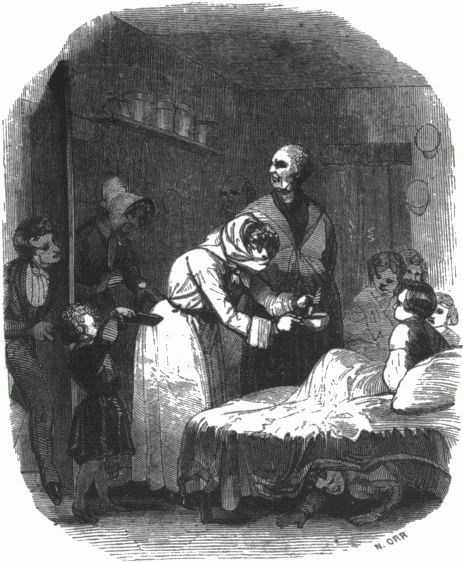
The counterfeit Mrs. Guppy.
“Poor Frank!” exclaimed several laughing voices.
“Well, at last Fudge found words, and in such a tone, exclaimed, ‘Mrs. Guppy! who is this, then?’ Then she stormed out; ‘Ay, sir, who is it, indeed? perhaps you will inquire.’ I didn't see what followed, for my range of vision was rather circumscribed—but I imagine that doctor pulled off part of Frank's disguise, for the next words I heard were, ‘Digby, this is intolerable!’ uttered in the doctor's most magnificent anger—‘What is the meaning of this?’ Frank said something about a wager and a little fun, meaning no harm, et cetera; and Fudge gave him such a lecture, finishing off by declaring, that ‘if he persisted in perpetrating such senseless follies he should find some other place to do so in than his house.’ All the little boys were laughing, but doctor stopped them all with a thundering ‘Silence!’ and then he asked what Frank had in that cup. ‘Cold tea, sir,’ said Digby, quite meekly. ‘And what's this at the bottom?’ ‘Sugar, sir,’ I saw the doctor's face—it was not one to be trifled with, but there seemed a sort of grim smile there, too, when he gave the cup to Frank and insisted upon his drinking it all up; and Digby did it, too—he dared not refuse.”
Another peal of laughter rang through the room, in which Hamilton joined heartily.
“Then,” continued Salisbury, “doctor said he hoped he would feel a little better for his dose—and, becoming as grave as before, he desired he would return Mrs. Guppy's things, and beg her pardon for his impertinence.”
“He didn't do so, surely?” said Jones.
“He did, though,” replied Salisbury; “and I wouldn't have been him if he'd been obstinate; but he added—I wondered how even he dared—I've saved you a little trouble, ma'am, there are six of them in bed.”
“Oh! oh! disgraceful!” exclaimed Hamilton.
“What did Fudge say?” asked Smith.
“ ‘This to my face, sir!’ and then, what he was going to do I don't know, but Frank was quite frightened, and begged pardon so very humbly that at last Fudge let him off with five hundred lines of Virgil to be done before Wednesday evening, and then sent him to bed—and there he is, for he was too much alarmed to play any more tricks.”
“I'd have given something to have seen it,” cried one, when the laugh was a little over.
“I think,” said Jones, “all things considered, that the doctor was tolerably lenient.”
“Oh! Digby's a little bit of a favorite, I fancy,” said Meredith.
“Not a bit,” said Reginald. “What do you say, Hamilton?”
“Nothing,” said Hamilton, shortly.
“One would think you never liked a joke, Hamilton,” said Peters.
“Nor do I, when it is so low as to be practical,” said Hamilton. “I feel no sympathy whatever with him.”
The event furnished idle conversation enough for that evening, and it was long before it was forgotten; and, in spite of Frank's reiterated boast that he did not care, and his apparent participation in the mirth occasioned by his failure, it required the utmost exercise of his habitual good-humor to bear equally the untiring teasing of his school-fellows, and the still more trying coldness and sarcasm of his master, whose manner very perceptibly altered towards him for some time after. Casson took care that no one in the lower school should be ignorant of Frank's defeat, and stimulated the little boys to tease him—but this impertinence, being an insult to the dignity of the seniors, was revenged by them as a body, and the juvenile tormentors were too much awe-struck and alarmed to venture on a repetition of their offence.