During Louis' frequent walks with Hamilton, it must not be supposed that his home and home-doings were left out of the conversation; before very long, Hamilton had made an intimate mental acquaintance with all his little friend's family, their habits of life, and every other interesting particular Louis could remember. Hamilton was an excellent listener, and never laughed at Louis' fondness for home, and many were the extracts from home-letters with which he was favored; nay, sometimes whole letters were inflicted on him.
Among the many delightful topics of home history, Louis dwelt on few with more pleasure and enthusiasm than the social musical evenings, and said so much on them, that Hamilton's curiosity was at length aroused, after hearing Louis sing two or three times, to wonder what a madrigal could be like. Louis tried to satisfy this craving by singing the treble part, and descanting eloquently on the manner in which the other parts ought to come in; but all in vain he repeated, “There now, Hamilton, you see this is the contralto part; and when this bit of the soprano is sung, it comes in so beautifully, and the bass is crossing it, and playing hide and seek with the tenor.”
Hamilton was obtuse, but at length, by fagging very hard with one or two boys in the school-room, and getting one of the ushers, who generally performed a second in all the musical efforts in the school, to make some kind of bass, Louis presented his choir one evening in the playground, and made them sing, to the great rapture of the audience.
After this exhibition, the whole school seemed to have a fever for madrigals; nothing was heard about the playground but scraps of that which Louis had taken pains to drill into his party; and one or two came to Louis and Reginald to learn to take a second part. In play-hours, nothing seemed thought of but part-singing, and suddenly the propriety of giving a grand public concert was started; and after a serious debate, a singing-class was established, Louis being declared president, or master of the choir.
We will not say how fussy Louis was on the occasion; but he went about very busily trying the voices of his school-fellows for a day or two after his appointment, and picking out the best tones for his pupils. Casson owned a very fine singing voice, though it was one of the most rude in speaking, and having been partially initiated in the mystery before, by Louis was declared a treasure. Frank Digby was another valuable acquisition; for, joined to an extremely soft, full contralto voice, he possessed, in common with his many accomplishments, a refined ear and almost intuitive power of chiming in melodiously with any thing. Salisbury was a very respectable bass, as things went; and Reginald, who was certainly incapacitated for singing treble, declared his intention of assisting him, being quite confident that his voice would be a desirable adjunct. The members of the class having at last been decided on, a subscription was raised, and Hamilton was commissioned to purchase what was necessary, the first convenient opportunity; and accordingly, the next half-holiday, he obtained leave for Louis to accompany him, and set off on his commission. He had scarcely left the school-room when Trevannion met him, and volunteered to accompany him.
“I shall be very glad of your company,” said Hamilton; “I am going to choose the music. You may stare when I talk of choosing music—it is well I have so powerful an auxiliary, or I am afraid I should not give much satisfaction to our committee of taste.”
“What powerful auxiliary are you depending on?” said Trevannion; “I shall be a poor one.”
“You—oh, yes!” exclaimed Hamilton; “a very poor one, I suspect. I was speaking of Louis Mortimer; he is going with me.”
“Indeed,” said Trevannion, coldly; “you will not want me, then!”
“Why not?” asked Hamilton. “We shall, I assure you, be very glad of your company.”
“So will Hutton and Salisbury,” said Trevannion; “and I can endure my own company when I am not wanted;”as he spoke, he walked away.
Hamilton turned, and looked after his retreating figure, as, drawn up to its full height, it quickly disappeared in the crowd of boys, who were chaffering with the old cake-man. His puzzled countenance soon resumed its accustomed gravity, and with a slight curl of the lip, he laid his hand on Louis' arm, and drew him on.
“Trevannion is offended,” said Louis.
“He's welcome,” was the rejoinder.
“But it is on my account, Hamilton,” said Louis, anxiously; “I cannot bear that you should quarrel with him for me.”
“I have not quarrelled,” said Hamilton, coldly. “If he chooses to be offended, I can't help it.”
“But he is an older friend than I am in two senses—let me go after him and tell him I am not going. I can go with you another afternoon.”
Louis drew his arm away as he spoke, and was starting off, when Hamilton seized him quite roughly, and exclaimed in an angry tone, “You shall do no such thing, Louis! Does he suppose I am to have no one else but himself for my friend—friend, indeed!” he repeated. “It's all indolence, Louis.”
Louis looked up half alarmed, startled at his vehemence.
“Perhaps,” said Hamilton, relaxing his hold, and laughing as he spoke, “perhaps if I had not been so lazy, I should have found a more suitable friend before; as it is, I do not yet find Trevannion indispensable—by no means,” he added, scornfully.
“Dear Hamilton,” said Louis, “I shall be quite unhappy if I think I am the cause of your thinking ill of Trevannion. You used to be such great friends.”
“None the worse, perhaps, because we are aware of a common absence of perfection in each other,” replied Hamilton, whose countenance had gradually regained its calmness. “It is foolish to be angry, Louis, but I was; and now let there be an end of it—I don't mean to forsake you for all the Trevannions in Christendom.”
They had by this time reached the playground gates, and were here overtaken by Frank Digby, who had before engaged to be one of the party.
“Better late than never,” said Louis, in reply to his breathless excuses. “I had my doubts whether your pressing engagements with Maister Dunn would allow you to accompany us.”
“Why, I got rid of him pretty soon,” said Frank; “only just as I had wedged myself out of the phalanx, who should appear but Thally.”
“Who?” said Louis.
“Tharah,” repeated Frank.
“Sally Simmons, the boot-cleaner, Louis,” said Hamilton; “you are up to nothing yet.”
“She's a queer stick,” said Frank.
“What a strange description of a woman!” remarked Louis. “It is as clear as a person being a brick.”
“And so it is,” replied Frank; “only it's just the reverse.”
“Up comes Thally with my Sunday boots as bright as her fair hands could make them, and wanted me to look at a hole she had scraped in them, nor, though I promised to give her my opinion of her handiwork when I came back, was I allowed to depart till she had permission to take them to her ‘fayther.’ ”
Nothing worthy of record passed during the walk to Bristol till the trio reached College Green. Here Louis began to look out for music-shops, while Frank entertained his companions with a running commentary on the shops, carriages, and people. It was a clear, bright day, and Clifton seemed to have poured itself out in the Green.
“Look there, Hamilton, there's a whiskered don! What a pair of moustaches! Hamilton, where is your eye-glass? Here's Trevannion's shadow—was there ever such a Paris! Good gracious! as the ladies say, what a frightful bonnet! Isn't that a love of a silk, Louis? Now, Hamilton, did you ever see such a guy?”
Hamilton was annoyed at these remarks, made by no means in a low tone, and, in his eagerness to change the conversation and get further from Frank, he unfortunately ran against a lady who was getting out of a carriage just drawn up in front of a large linen-draper's shop, much to the indignation of a young gentleman who attended her.
Hamilton begged pardon, with a crimson face; and, as the lady kindly assured him she was not hurt, Louis recognized in her his quondam friend, Mrs. Paget, and darted forward to claim her acquaintance.
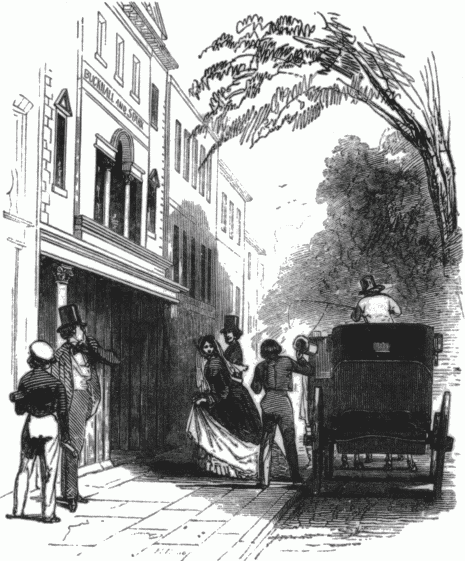
The meeting with Mrs. Paget.
“What, Louis! my little Master Louis!” exclaimed the lady; “I did not expect to see you. Where have you come from?”
“I am at school, ma'am, at Dr. Wilkinson's, and I had leave to come out with Hamilton this afternoon. This is Hamilton, ma'am—Hamilton, this is Mrs. Paget.”
“Our rencontre, Mr. Hamilton,” said the lady, “has been most fortunate; for without this contretemps I should have been quite ignorant of Master Louis' being so near—you must come and see me, dear. Mr. Hamilton, I must take him home with me this afternoon.”
“It is impossible, ma'am,” said Hamilton, bluntly; “I am answerable for him, and he must go back with me.”
“Can you be so inexorable?” said Mrs. Paget. “Will you come, too, and Mr. Francis Digby—I beg your pardon, Mr. Frank, I did not see you.”
“I beg yours, ma'am,” replied the affable Frank, with a most engaging bow; “for I was so taken up with the tempting display on the green this afternoon, that I only became aware this moment of my approximation to yourself.”
“The shops are very gay, certainly; but I should have thought that you young gentlemen would not have cared much for the display. Now, a tailor's shop would have been much more in your taste.”
“Indeed, ma'am, we came out with the express purpose of buying a silk for the Lady Louisa.”
“I wonder any lady should commission you to buy any thing for her.”
“Oh!” replied Frank, “I am renowned for my taste; and Hamilton is equally well qualified. Can you recommend us a good milliner, ma'am?”
“I am going to look at some bonnets,” said the lady. “But, Mr. Frank, I half suspect you are quizzing. What Lady Louisa are you speaking of?”
Frank had drawn up his face into a very grave and confidential twist, when Mrs. Paget's equerry, the young gentleman before mentioned, offered his arm, and, giving Frank a withering look, warned the lady of the time.
“You are right. It is getting late,” she said. “Good-bye, dear boy. Where are you now? Dr. Williams?”
“Dr. Wilkinson's, Ashfield House,” said Louis.
“Henry, will you remember the address?” said the lady.
The young gentleman grunted some kind of acquiescence; and, after due adieus, Mrs. Paget walked into the shop.
“Frank, I'm ashamed of you,” said Hamilton.
“I am sure,” replied Frank, “I've been doing all the work; I'm a walking exhibition of entertainment for man and beast.”
Hamilton would not laugh, and, finding all remonstrances unavailing, he quickened his pace and walked on in silence till they reached the music-seller's, where, after some deliberation, they obtained the requisite music, and, after a few more errands, began to retrace their steps.
The walk home was very merry. Louis, having unfastened the bundle, tried over some of the songs, and taught Frank readily the contralto of two. Then he wanted to try Hamilton, but this in the open air Hamilton stoutly resisted, though he promised to make an effort at some future time. After Frank and Louis had sung their duets several times over to their own satisfaction while sitting under a hedge, all the party grew silent: there was something so beautiful in the stillness and brightness, that none felt inclined to disturb it. At last, Louis suddenly began Eve's hymn:
“How cheerful along the gay mead
The daisy and cowslip appear!
The flocks, as they carelessly feed,
Rejoice in the spring of the year;
The myrtles that shade the gay bowers,
The herbage that springs from the sod,
Trees, plants, cooling fruits, and sweet flowers,
All rise to the praise of my God.
“Shall man, the great master of all,
The only insensible prove?
Forbid it, fair gratitude's call!
Forbid it, devotion and love!
Thee, Lord, who such wonders canst raise,
And still canst destroy with a nod,
My lips shall incessantly praise,
My soul shall be wrapped in my God.”
—Dr. Arne.
Frank joined in the latter part of the first verse, but was silent in the second.
“Why did you not go on, Frank?” asked Hamilton.
“It was too sweet,” said Frank. “Louis, I envy you your thoughts.”
“Do you?” said Louis, looking up quickly in his cousin's face, with a bright expression of pleasure.
“When you began that song,” continued Frank, “I was thinking of those lines,
‘These are Thy glorious works, Parent of good,
Almighty, Thine this universal frame,
Thus wondrous fair; Thyself how wondrous then!’ ”
“ ‘Thyself how wondrous then!’ ” repeated Hamilton, reverentially.
“I don't know how it is, Louis,” said Frank; “in cathedrals, and in beautiful scenery, when a grave fit comes over me, I sometimes think I should like to be religious.”
Louis squeezed his hand, but did not speak.
“Take care, Frank,” said Hamilton with some emotion. “Be very, very careful not to mistake sentiment for religion. I am sure it is so easy to imagine the emotion excited by beauty of sight or sound, religious, that we cannot, be too careful in examining the reason of such feelings.”
“But how, Hamilton?” said Frank. “You would not check such impressions?”
“No; it is better that our thoughts should be carried by beauty to the source of all beauty; but to a poetical, susceptible imagination this is often the case where there is not the least vital religion, Frank. The deist will gaze on the splendid landscape, and bow in reverence to the God of nature, but a Christian's thoughts should fly to his God at all times; the light and beauty of the scenes of nature should be within himself. When a person's whole religion consists in these transient emotions, he ought to mistrust it, Digby.”
“But, dear Hamilton,” said Louis, after a few minutes' silence, “we ought to be thankful when God gives us the power of enjoying the beautiful things He has made. Would it not be ungrateful to check every happy feeling of gratitude and joy for the power to see, and hear, and enjoy, with gladness and thankfulness, the loveliness and blessings around?”
“The height of ingratitude, dear Louis,” said Hamilton, emphatically. “But I am sure you understand me.”
“To be sure,” said Louis. “Many good gifts our Almighty Father has given us, and one perfect gift, and the good gifts should lead us to think more of the perfect one. I often have thought, Hamilton, of that little girl's nice remark that I read to you last Sunday, about the good and perfect gifts.”
Hamilton did not reply, and for a minute or two longer they sat in silence, when the report of a gun at a little distance roused them, and almost at the same instant, a little bird Louis had been watching as it flew into a large tree in front of them, fell wounded from branch to branch, until it rested on the lowest, where a flutter among the leaves told of its helpless sufferings.
“I must get it, Hamilton!” cried Louis, starting up. “It is wounded.”
“The branch is too high,” said Hamilton. “I dare say the poor thing is dying; we cannot do it any good.”
“Indeed I must try!” exclaimed Louis, scrambling partly up the immense trunk of the tree, and slipping down much more quickly. “I wish there were something to catch hold of, or to rest one's foot against.”
“You'll never get up,” said Hamilton, laughing; “if you must get it, mount my shoulders.”
As he spoke he came under the tree, and Louis, availing himself of the proffered assistance, succeeded in reaching and bringing down the wounded bird, which he did with many expressions of gratitude to Hamilton.
“I am sure you ought to be obliged,” said Frank. “Royalty lending itself out as a ladder is an unheard-of anomaly. Pray, what are you going to do with cock-sparrow now you have got him?”
Louis only replied by laying some grass and leaves in the bottom of his cap, and putting the bird on this extempore bed. He then seized Hamilton's arm and urged him forward. Hamilton responded to Louis' anxiety with some queries on the expediency of assisting wounded birds if pleasant walks were to be thereby curtailed, and Frank, after suggesting, to Louis' horror, the propriety of making a pie of his favorite, walked on, singing,
“A little cock-sparrow sat upon a tree,”
which, with variations, lasted till they reached the playground gates, where Louis ran off to find Clifton, that he might enter into proper arrangements for due attendance on his sparrow's wants.