“In the multitude of words there wanteth not sin; but he that refraineth his lips is wise.”—Prov. x. 19.
“Let another man praise thee, and not thine own mouth; a stranger, and not thine own lips.”—Prov. xxvii. 2.
We are now considering Louis Mortimer under prosperity; a state in which it is much more difficult to be watchful, than in that of adversity. When he first came to school, his struggle was to be consistent in maintaining his principles against ridicule and fear of his fellow-creatures' judgment. In that he nearly failed; and then came the hard trial we have related, the furnace from whose fires he came so bright: and another trial awaited him, but different still.
By the beauty of conduct Divine grace alone had enabled him to observe, he now won the regard of the majority of his school-fellows; and no one meddled with him or his opinions. He was loved by many; liked by most, and unmolested by the rest. We are told, “When a man's ways please the Lord, even his enemies are at peace with him;”and this was Louis' case. If a few remarks were now and then made on the singularity and stiffness of his notions, the countenance of the seniors, and the general estimation in which he was held, prevented any annoyance or interference. His feet were now on smooth ground, and the sky was bright above his head; and he began to forget that a storm had ever been.
One day between school-hours, when Louis and his brother were diligently drilling the chorus, they were summoned to the drawing-room, where they found the doctor standing talking with a lady, in the large bay-window. Her face was turned towards the prospect beyond, and she did not see them enter; and near her, leaning on the top of a high-backed chair, stood a tall gentlemanly youth, whom Louis immediately recognized as Mrs. Paget's esquire. The lady was speaking as they entered, and her gentle lady-like tones fell very pleasantly on Louis' ears, and made him sure he should like her, if even the words she had chosen had been otherwise.
“I have been quite curious to see him; my sister has said so much, poor little fellow!”
Dr. Wilkinson at this moment became aware of the presence of his pupils, and, turning round, introduced them to the lady, and the lady in turn to them, as Mrs. Norman.
“I am personally a stranger to you, Master Mortimer,” said Mrs. Norman; “but I have often heard of you. You know Mrs. Paget?”
“Oh, yes!” replied Louis.
“She is my sister, and, not being able to come herself to-day, she commissioned me to bring an invitation for you and your brother to spend the rest of this day with her, if Dr. Wilkinson will kindly allow it.”
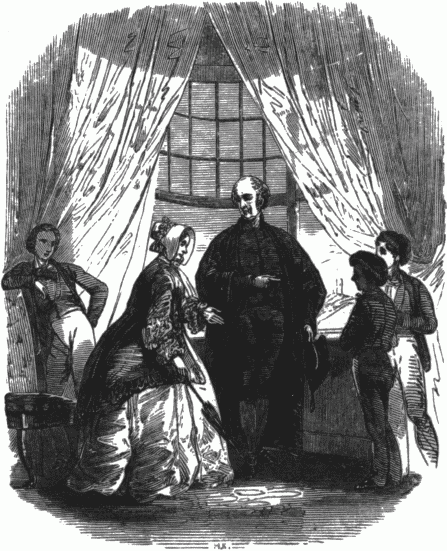
The invitation.
Louis looked at Dr. Wilkinson; and Reginald answered for himself—
“I am much obliged, ma'am; and, if you please, thank Mrs. Paget for me, but as it is not a half-holiday, I shall not be able to come this afternoon. I shall be very glad to come when school is over, if Dr. Wilkinson will allow me.”
Dr. Wilkinson smiled. “Mrs. Norman will, I am sure, excuse a school-boy's anxiety to retain a hard-earned place in his class,” he said. “I have given my permission, you may do as you please.”
“Mrs. Paget will be so much disappointed,” said Mrs. Norman; “are you anxious about your class, too, Master Louis?”
Louis blushed, hesitated, and then looked from Reginald to the doctor, but Dr. Wilkinson gave no assistance. Louis demurred a little; for he had a place to lose that he had gained only the day before, and that, probably, he might not be able to gain from Clifton for the rest of the half-year. But at length, on another persuasive remark from Mrs. Norman, he accepted the invitation in rather a confused manner; and, it being decided that Reginald was to join them at dinner, he went away to make some alteration in his dress. When he returned, Mrs. Norman carried him off in her carriage, which was waiting at the door, having first introduced him to her companion, as her son, Henry Norman.
During the ride to Clifton, Louis became very communicative. He liked Mrs. Norman very much, she was so very sweet, and now and then made little remarks that reminded Louis of home; and then he was sure she liked him; even if he had not guessed that the few words he first heard from her lips referred to him, her very kind full eyes and affectionate manner spoke of unusual interest, and Louis felt very anxious to rise in her estimation. Things that are not sinful in themselves, become sins from the accompanying motives; the desire of favor in the eyes of so excellent a person was not wrong, had it been mixed with a wish to adorn the doctrine of Christ, and thankfulness for the love and favor given; but now Louis talked of things which, though he really believed them, and of feelings which, though he had once really experienced them, were not now the breathings of a heart that overflowed with all its fulness of gratitude. He had quickness enough to see what was most precious in his new friend's sight, and tried to ingratiate himself with her, by dwelling on these subjects, and showing how much he had felt on them. Had felt, for he had “left his first love.”
Let it not be supposed that Louis meant to deceive—he deceived himself as much as any one; but he was in that sad state when a Christian has backslidden so far as to live on the remembrance of old joys, instead of the actual possession of new.
The carriage stopped, at length, at a house in York Crescent, where the trio alighted. Mrs. Norman led Louis up stairs into the drawing-room, while her son, who had scarcely spoken a word during the drive, stayed a minute or two at the house-door, and then ran down the nearest flight of steps leading to the carriage-road, jumped into the carriage, which was just driving off, and paid a visit to the stables.
The room into which Louis entered was very large, and littered so with all descriptions of chairs, stools, and non-descript elegancies, that it required some little ingenuity to reach the further end without upsetting the one, or being overthrown by the others. Near one of the three windows, reclining on a sofa, was Mrs. Paget, who welcomed Louis with her usual warmth.
“You see,” said she, “I am a prisoner. I sprained my ankle the very day I saw you; and I am positively forbidden to walk. But where is Master Reginald?”
Louis informed Mrs. Paget of his brother's intentions, and, after expressing her regrets at his non-appearance, the lady continued:
“Now, sit near me, and let us have a little talk; I want to hear how you are going on, and how many prizes you are likely to get. But, perhaps, my dear, you would like to go on the downs, or into the town, or to——Where's Henry, I wonder: where is Mr. Norman?” she asked of a servant who came to remove a little tray that stood beside her.
“Just gone round to the stables, ma'am.”
“Dear, how unfortunate! You can't think what a beautiful little horse he has; I tell him it is quite a lady's horse. He will show it to you. I can't think how he could go away this afternoon. You'll be very dull, my dear—but my sister will take you out.”
Louis assured her he should enjoy sitting with her.
“That is very kind of you; very few of your age would care about staying with a lame, fidgety, old woman.”
Louis protested against the two last epithets, and as Mrs. Norman had left the room he began talking of the pleasant ride he had had with her, and how much he loved her.
Mrs. Paget warmly admitted every thing, only adding that in some things she was a little too particular.
“But, dear me! you must be very hungry,” she exclaimed, interrupting herself. “How could I forget? Just ring the bell, dear boy—there's lunch down stairs. Oh, never mind, here is Charlotte.”
As she spoke, Mrs. Norman re-entered, and took Louis down to lunch.
When he returned to the drawing-room, Mrs. Paget had her sofa moved so as to face the window, and a little table was placed in front of her. A low armchair was near her for Louis, and another quite in the window Mrs. Norman took possession of, when she had provided herself with some work.
“Oh, what a beautiful view!” exclaimed Louis, as he looked for the first time out of the window. “How very, very beautiful! I think this is the pleasantest situation in Clifton.”
“It is very beautiful,” said Mrs. Norman. “But you have a magnificent prospect at Dr. Wilkinson's.”
“Dr. Wilkinson's is a very nice place, I believe, is it not?” said Mrs. Paget. “It is a pity such a pretty place should be a school.”
“Nay,” said Mrs. Norman, smiling; “why should you grudge the poor boys their pleasure?”
“I don't think they appreciate it,” said Mrs. Paget; “and, poor fellows, they are always so miserable that they might as well be miserable somewhere else.”
“We are not at all miserable after the first week,” said Louis.
“I thought you were not to go to school again, my dear,” said Mrs. Paget.
“So I thought, myself, but papa wished me to go, and he is the best judge.”
“Well, dear it's a very nice thing that you are wise enough to see it,—and you are happy?”
“I should be very ungrateful not to be so ma'am; Dr. Wilkinson and all the boys are so kind to me this half. It is so different from the first quarter spent at school.”
“They are kind, are they? Well, I dare say; they couldn't help it, I'm sure,” replied Mrs. Paget. “I suppose you will have the medal again this half year. I am sure you ought to have it to make up.”
“Oh, but I shouldn't have it to make up for last half, ma'am,” said Louis, smiling.
“But you will get it, I dare say,” said the lady.
“I don't know,” said Louis; “perhaps—I think I have a very good chance yet, but we never can tell exactly what Dr. Wilkinson thinks about us. There are only one or two I am afraid of.”
“I should think you needn't be afraid of any,” said Mrs. Paget. “I told you, Charlotte, about that story we heard at Heronhurst last summer—dear boy—you know he bore—”
“Yes,” interrupted Mrs. Norman. “You have a large number of school-fellows, Master Louis,” she added.
“Yes, ma'am, there are seventy-six of us this half, so many that we hardly know the names of the lower school.”
“Is that M. Ferrar or Ferrers there still?” asked Mrs. Paget.
“Yes, ma'am, and he is so much improved, you cannot think.”
Louis looked very earnestly at her as she spoke, and she put her hand on his forehead, stroking his hair off, while she replied,
“He is very happy in having so kind a friend, I am sure; he ought to have been expelled.”
“Oh no, ma'am—I think kindness was much the best way,” said Louis; and remembering how incautiously he had spoken of him before, he said all that he could in his praise.
The conversation then turned upon the school in general, and it was astonishing to watch how much Louis said indirectly in his own praise, and how nearly every thing seemed to turn in the direction of dear self, in the history of his lessons, progress, and rivals—and even when it branched off to his friends, among whom in the first rank stood Hamilton.
“You would so like Hamilton, he is so kind to me. I told you about him before,” said Louis, eagerly.
“Is that the young gentleman who had charge of you the other day?” asked Mrs. Paget.
Louis answered in the affirmative.
“I did not much like him, only one doesn't judge people fairly at first, often.”
“Oh, Hamilton's such a good creature!” exclaimed Louis, in his energy letting fall one end of a skein of silk he was holding. He gathered it up, apologized, and resumed his defence of his friend.
“He is, perhaps, a little blunt, but he is so sincere, and so steady and kind, Dr. Wilkinson is very, very fond of him, I know; he makes me sit by him every night, and I learn my lessons with him. I am sure if it were not for him I should be terribly behind Clifton.”
“I saw them coming out of Redland Chapel yesterday morning,” said Mrs. Paget. “At least I saw Mr. Hamilton, but I did not see you.”
Louis informed her of the division of the school on Sunday, and she continued,
“I noticed a very aristocratic young gentleman with Mr. Hamilton—quite a contrast, so very handsome and elegant; who was he?”
“Was he tall?” asked Louis; “and dressed in black, with a light waistcoat?”
“I don't know what waistcoat he had,” said Mrs. Paget, laughing. “His dress was in perfect gentlemanly taste. He was, I should think, tall for his age, and had dark hair and eyes.”
“I have no doubt it was Trevannion; he is the handsomest fellow in the school, except Salisbury.”
“That he is not,” said Mrs. Paget, significantly.
Louis blushed, and felt rather foolish, certainly not wholly insensible to the injudicious hint.
“Only Fred Salisbury is so different: he is not elegant, and yet he is not awkward; he is rough and ready, and says all kinds of vulgar things. He is very much liked among us, but I don't think Trevannion is, though he gets his own way a great deal: he thinks nobody is equal to himself, I know, but I am sure he is not a favorite.”
“Why not?” said Mrs. Paget.
“He is so very selfish, and so contemptuous, and so dreadfully offended if Hamilton does not treat him with the deference he wants. I think we know more of each other than any one else does, and no one would think, in company, when Trevannion is smiling and talking so cleverly, that he is so unamiable.”
“He does not look like an ill-tempered person,” said the lady.
“I don't think he is what is generally called an ill-tempered person; for he never puts himself into passions, nor does he seem to mind many things that make others very angry. But he is sometimes dreadfully disdainful and haughty when any one offends him, and especially when Hamilton seems to like anybody as well as himself. Only last Saturday he was so much affronted because Hamilton had asked leave for me to go into Bristol with him. When he found I was coming, he wouldn't go with us. I think he is very jealous of me, though I begged Hamilton to let me stay at home, and I was just going after him to call him back, only Hamilton wouldn't let me. I did not like to see such old friends quarrel. I am sure I would very gladly have stayed at home to keep peace.”
“I am quite sure of that,” said Mrs. Paget. “But how came your perfect Mr. Hamilton to choose such a friend?”
“I have often wondered,” said Louis; “and last Saturday, when that happened that I told you of just now, and Hamilton (he is so kind) said he wouldn't give me up for anybody, he said he thought he made Trevannion his friend because he was too lazy to find another for himself.”
“Too lazy to find another?” repeated Mrs. Paget.
“Hamilton does not like taking trouble, generally,” said Louis; “it is his greatest fault, I think. He takes things as they come. I have often wished he would concern himself a little more about the wrong things that go on among us. You know it would be of no use my speaking about them, though I try sometimes; it is so much easier to do right when the great boys support you.”
“So it is, dear,” said Mrs. Paget, kindly.
Mrs. Norman had scarcely spoken during the whole conversation, though she had once or twice laid down her work and looked very gravely at Louis; but he had not noticed it; for he was so elated with himself, and the relations of his own importance at school, and the idea of his superiority above his school-fellows, that there was no room for any thing else in his head, and he went on with the firm conviction that both the ladies were, like every one else, extremely delighted and interested in him and his sentiments. There had been another auditor in the room almost ever since the beginning of the long chat, and that was Henry Norman, who, when he had seen his horse and lunched, entered the room unperceived by Louis or Mrs. Paget, and passed noiselessly along to the furthest window, where he sat, with a book, hid by the curtains from a careless glance. A few words caught his ear as he was finding out his place; and, whether the matter of the first page required deep consideration and digestion or not, we cannot pretend to determine, not knowing the nature of the chosen volume, but it is certain that that leaf was not turned over that afternoon, and the eyes that professed to convey its meaning to the mind of the reader not unfrequently wandered on the hills in the distant prospect, or, on being recalled, on the nearer objects of Mrs. Paget's sofa—the skein of silk and the pair of hands, which were the only portions visible to him of the loquacious little visitor. That he was listening with interest of an equivocal nature might be gathered from the frequent, impatient knitting of the brow, biting of the lips, and sudden laying down of the book altogether; but there he sat till Louis, having flown off from Hamilton to the general school failings, had finished relating the history of Frank Digby's memorable Saturday night's exploit, and concluded by an emphatic delivery of his upright sentiments on the heinousness of practical jokes. He paused a minute to take breath, after a Philippic that elicited a small dose of flattery from Mrs. Paget, and, with a face flushed with satisfaction and excitement, stooped to pick up a fallen pair of scissors, when Mrs. Norman, laying down her work looked again at him and uttered a sound indicative of an intention of speaking. This time Louis was fully aware of an expression in her countenance far from satisfactory, but she had not time to express her sentiments, for at this moment Reginald was announced, and a general move took place. Henry Norman came forward and welcomed him, and then took him and Louis out on the Crescent till dinner-time. Here they were joined by some of Norman's acquaintances, whom he introduced to his visitors. Louis thought uncomfortably, for a few minutes, of Mrs. Norman's look of disapprobation; but he persuaded himself that there was nothing meant by it, and soon became very lively. There was something he did not like about Norman, who, though perfectly well-bred and attentive, showed a degree of indifference and disregard to any thing he said or did, that did not altogether suit Louis' present state of mind. If Louis addressed him, he listened very politely, but with a slight, sarcastic smile, and either returned a very short and cool reply, or, if the remark did not require one, an inclination of the head, and turned immediately to one of his other companions. Reginald did not much fancy him; but, upon the whole, they managed to pass the time very pleasantly till they were summoned to dinner.
Several persons came in in the evening, and Louis was called upon by Mrs. Paget to sing, “Where the bee sucks.” This led to other songs, and Louis attracted the notice of a musical gentleman, who was much pleased with him, and who gave him a general invitation to his house. Louis was in the midst of his thanks when Reginald summoned him to go home, and, in spite of Mrs. Paget's remonstrances and offers of her carriage, carried his point.
“Well, Louis, how did you get on?” said Reginald, as they were walking home; “I think you must have been dreadfully bored with holding skeins and talking fine for Mrs. Paget's edification for two hours at least, to say nothing of all the stuffing you have had this evening.”
“Oh! I have been very happy,” said Louis. “Do you know Mr. Fraser has invited me to his musical parties?”
“I wish you joy, I am sure. What a nice woman Mrs. Norman seems!”
“Yes,” said Louis, doubtfully.
“Yes—that sounds very much like no,” said Reginald.
“I did not mean it.” Louis recalled her manner lately towards him, and mentally went over the conversation of the day.
“Well, what's the matter?” asked Reginald.
“I am afraid I have been very foolish; I talk so foolishly sometimes, Reginald—I said so many foolish things this afternoon. I don't think Mrs. Norman likes me.”
“Rubbish! stuff and nonsense! Just like you, Louis, always imagining somebody's displeased with you—I won't hear a word more; I have no patience with you.”
“Then you don't think she seemed vexed with me?”
“Not I; and if she were, what's the odds? What difference need she make in your happiness? What a wretched creature you'll make of yourself, Louis, if you think so much of the opinion of every one—a person, too, you may never see again.”
Louis was relieved, and talked on other matters with his brother till they reached home. He was a little annoyed to hear that Hamilton had expressed considerable vexation at his going with Mrs. Norman before afternoon school, and this, combined with the excitement and vanity under which he labored, disturbed considerably the tranquillity of his slumbers, and prevented his earnestly seeking that aid he so much needed.